Copy of APES: Point, No Point FRQ (Released 2023 #1 Set 1) First Attempt (2/7/2025)
star
star
star
star
star
Last updated 8 months ago
18 questions
Attestation
1
The difference between a students' qualification or lack of qualification on the AP exam does not come down to answering FRQs correctly during practice. It comes down to honestly attempting FRQS and then learning from them.
1
I need to earn around 80% of the points on the FRQs to qualify on the exam.
1
I am allowed to talk during the free-response writing portion of this activity.
1
I am graded for accuracy for the free-response writing portion of this activity.
FRQ
Researchers interested in sustainability developed three new varieties of genetically modified green beans designed to produce higher yields in arid regions. Four plots (A-D) were set up on a floodplain of a river to grow beans. Plots A, B, and C were each planted with seeds of different types of genetically modified strains of green beans. Plot D was planted with seeds of unmodified green beans. Each plot was given equal amounts of fertilizer, which contains phosphorus and nitrogen, and water and was irrigated using spray irrigation for one hour per day. Throughout the growing season, researchers measured the amount of green beans harvested within each plot. The plots with genetically modified beans had higher crop yields than the plot with unmodified beans.
(a) Identify the control group in this experiment.
(b) Identify the scientific question for the investigation.
(c) Researchers repeated the experiment by modifying the length of time for the spray irrigation to 20 minutes per day. Explain how the results of the experiment could be altered with this modification.
Researchers also monitored the amount of sediment and fertilizer washing into the river from each plot in the original study. The soil temperature was also measured in each plot at the same depth and at the same time each day approximately 0.05 meters below the surface of the soil.
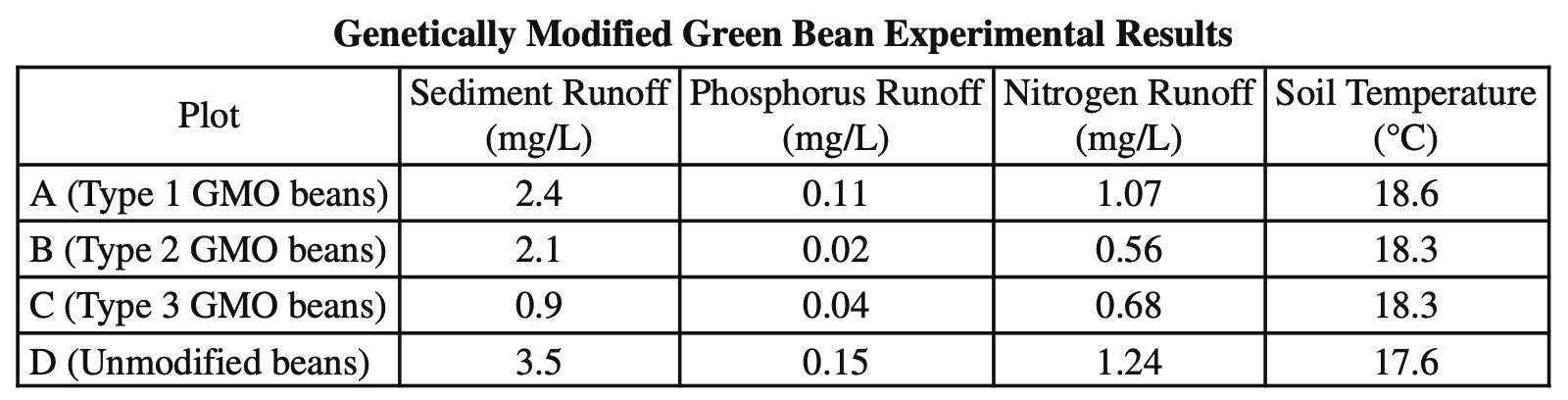
(d) Based on the data in the table, identify the plot with the lowest soil temperature.
(e) Describe how sediment runoff and fertilizer runoff compare between the unmodified green beans and the genetically modified green beans.
(f) The Type 2 GMO beans in Plot B were developed to grow more quickly than the unmodified beans in Plot D. Researchers have hypothesized that the Type 2 beans would use fertilizer more completely than the other varieties. Based on the data in the table and the experimental design, explain whether the researchers' hypothesis was supported or refuted.
Once the experiment was concluded, the researchers burned the plots to remove the crops that had been planted. After a few years, the researchers returned to the plots and observed a variety of plants, insects, and bird species living there.
(g) Describe the ecological process that occurred on the plots after the crops were burned.
A survey indicated that one of the plots had twice the plant diversity that the other plots had. Over the next five years, the river occasionally flooded the plots, killing off many of the species that inhabited the plots.
(h) After each flooding event, the plot with twice the plant diversity returned to its prior level of biodiversity more quickly than the other plots did. Explain why a community with more plant diversity will recover more quickly from the flooding.
(i) After the last flooding event, a beetle not previously known in the area appeared in one of the plots with less plant diversity. Over a period of a few months, the new beetle population increased, whereas the existing beetle species in the plot had declining populations. Explain why the new beetle species could be better able to successfully populate this plot than the existing beetle species could.
(j) Describe one realistic method to prevent the new beetle from spreading beyond the experimental plot.
1
Complete your responses here.
1
I think I earned the point for
1
I am ready to move on to independent point/no point.
Point, No Point Exercise
Researchers interested in sustainability developed three new varieties of genetically modified green beans designed to produce higher yields in arid regions. Four plots (A-D) were set up on a floodplain of a river to grow beans. Plots A, B, and C were each planted with seeds of different types of genetically modified strains of green beans. Plot D was planted with seeds of unmodified green beans. Each plot was given equal amounts of fertilizer, which contains phosphorus and nitrogen, and water and was irrigated using spray irrigation for one hour per day. Throughout the growing season, researchers measured the amount of green beans harvested within each plot. The plots with genetically modified beans had higher crop yields than the plot with unmodified beans.
(a) Identify the control group in this experiment.
(b) Identify the scientific question for the investigation.
(c) Researchers repeated the experiment by modifying the length of time for the spray irrigation to 20 minutes per day. Explain how the results of the experiment could be altered with this modification.
Researchers also monitored the amount of sediment and fertilizer washing into the river from each plot in the original study. The soil temperature was also measured in each plot at the same depth and at the same time each day approximately 0.05 meters below the surface of the soil.
(d) Based on the data in the table, identify the plot with the lowest soil temperature.
(e) Describe how sediment runoff and fertilizer runoff compare between the unmodified green beans and the genetically modified green beans.
(f) The Type 2 GMO beans in Plot B were developed to grow more quickly than the unmodified beans in Plot D. Researchers have hypothesized that the Type 2 beans would use fertilizer more completely than the other varieties. Based on the data in the table and the experimental design, explain whether the researchers' hypothesis was supported or refuted.
Once the experiment was concluded, the researchers burned the plots to remove the crops that had been planted. After a few years, the researchers returned to the plots and observed a variety of plants, insects, and bird species living there.
(g) Describe the ecological process that occurred on the plots after the crops were burned.
A survey indicated that one of the plots had twice the plant diversity that the other plots had. Over the next five years, the river occasionally flooded the plots, killing off many of the species that inhabited the plots.
(h) After each flooding event, the plot with twice the plant diversity returned to its prior level of biodiversity more quickly than the other plots did. Explain why a community with more plant diversity will recover more quickly from the flooding.
(i) After the last flooding event, a beetle not previously known in the area appeared in one of the plots with less plant diversity. Over a period of a few months, the new beetle population increased, whereas the existing beetle species in the plot had declining populations. Explain why the new beetle species could be better able to successfully populate this plot than the existing beetle species could.
(j) Describe one realistic method to prevent the new beetle from spreading beyond the experimental plot.
1
For notes on your answers/reflections as you go, if you would like to do so:
4
(a). Identify the control group in this experiment.
4
(b) Identify the scientific question for the investigation.
View the hint only after you have done your identifications.
(b) Identify the scientific question for the investigation.
View the hint only after you have done your identifications.
4
(c) Researchers repeated the experiment modifying the length of time for the spray irrigation to 20 minutes per day. Explain how the results of the experiment could be altered with this modification.
4
(d) Based on the data in the table, identify the plot with the lowest soil temperature.
4
(e) Describe how sediment runoff and fertilizer runoff compare between the unmodified green beans and the genetically modified green beans.
4
(f) The Type 2 GMO beans in Plot B were developed to grow more quickly than the unmodified beans in Plot D. Researchers have hypothesized that the Type 2 beans would use fertilizer more completely than the other varieties. Based on the data in the table and the experimental design, explain whether the researchers’ hypothesis was supported or refuted.
6
(g) Describe the ecological process that occurred on the plots after the crops were burned.
4
(h) After each flooding event, the plot with twice the plant diversity returned to its prior level of biodiversity more quickly than the other plots did. Explain why a community with more plant diversity will recover more quickly from the flooding.
4
(i) After the last flooding event, a beetle not previously known in the area appeared in one of the plots with less plant diversity. Over a period of a few months, the new beetle population increased, whereas the existing beetle species in the plot had declining populations. Explain why the new beetle species could be better able to successfully populate this plot than the existing beetle species could.
4
(j) Describe one realistic method to prevent the new beetle from spreading beyond the experimental plot.