Log in
Sign up for FREE
arrow_back
Library

Melanin Test GB S'25 (2/7/2025)

star
star
star
star
star
Last updated about 1 month ago
24 questions
1
1
1
4
2
2
5
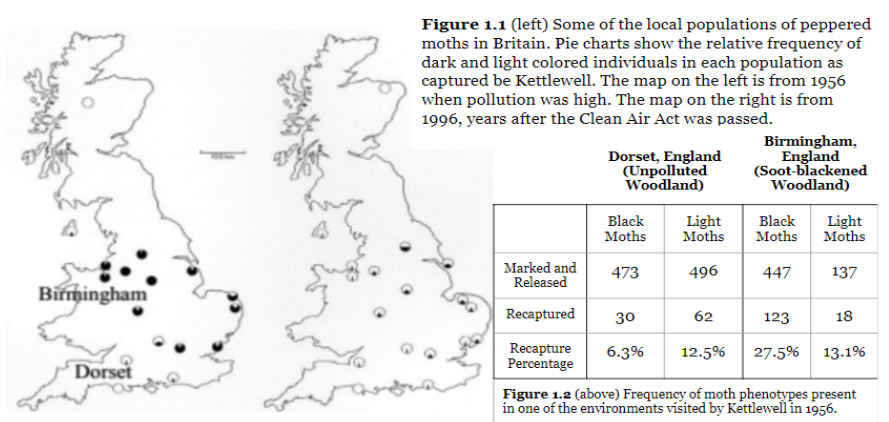
Bernard Kettlewell, a British field biologist, was convinced that wing coloration is an important adaptation in peppered moths (Biston bestularia). These moths rest on trees with their wings spread open in order to camouflage. This is thought to provide some protection against predatory birds. Kettlewell suspected light-colored wings provided camouflage when moths rested on lichens that grow on the surface of tree trunks in British forests. The camouflage is so effective that the moths are invisible to humans standing only a few feet away.
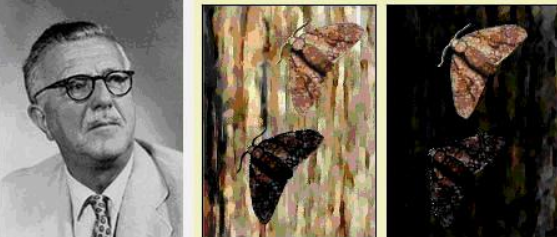
As a result of the Industrial Revolution, many areas of Britain became heavily polluted, causing the lichens to die off and the trees to darken with soot from burning coal. Here, the adaptive value of wing coloration was reversed. Against a dark background, darker moths (the dominant trait) are camouflaged and light-colored moths are more conspicuous (visible).

1
1
Question 3
3.

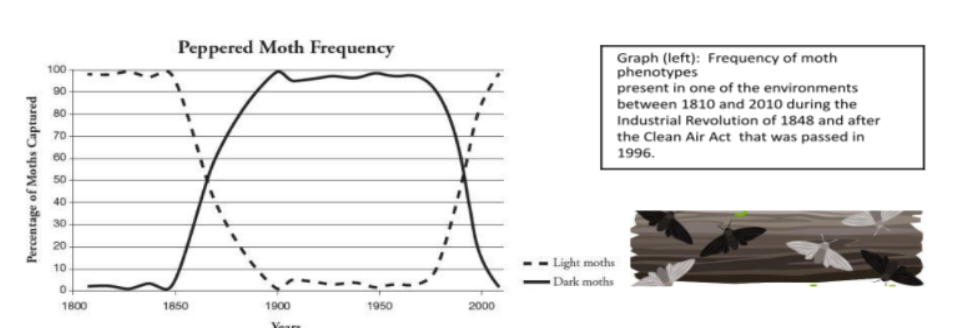
What event caused the change in phenotype frequencies of the moths in the 1850s?

Question 4
4.

Dark color (D) is dominant to light color (d) in moths. If a purebred dark moth and a purebred light moth reproduced, what would be the resulting phenotype frequencies of their offspring? (You may find it helpful to draw the punnett square on scratch paper.)

Question 5
5.

Dark color (D) is dominant to light color (d) in moths. If two heterozygous moths reproduced, what would be the resulting genotype frequencies of their offspring?

The peppered moths show complete dominance for their color. Describe how the phenotype of the peppered moth would change if their color was determined under an incomplete and codominant pattern of inheritance.
1
1
1
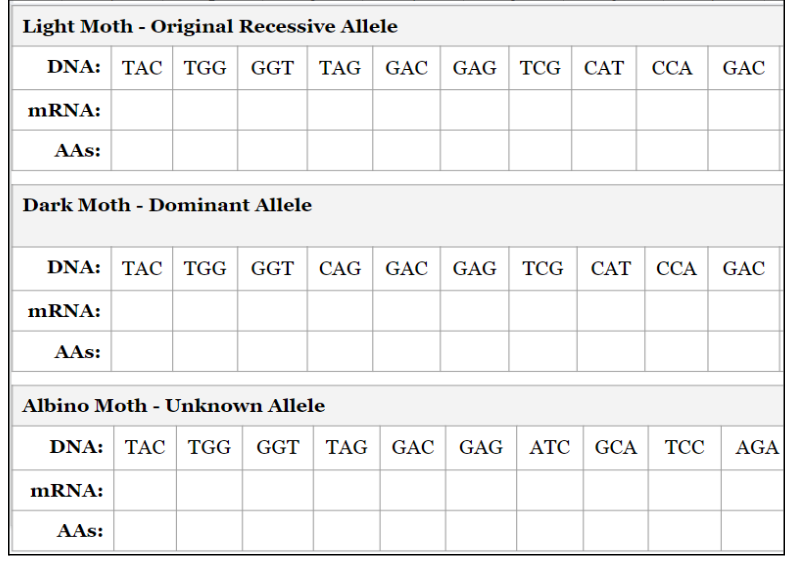
The DNA sequences below represent alleles found in the peppered moth population. We have been aware that there are dark and light phenotypes, and the newer dark phenotype is dominant. However, an albino peppered moth has just been discovered! The gene was sequenced below for study.

Complete the sequences below by transcribing the DNA and translating the mRNA into amino acids. A DNA -> mRNA and amino acid code chart will be provided to you.


0
Question 9
9.

On your gene sheet, transcribe and translate the moth DNA sequences

1
1
1
1
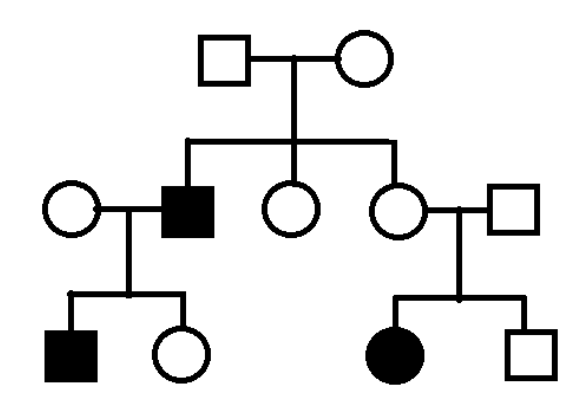
Two scientists, Dr. Ramirez and Dr. Singleton, have been researching the pattern of inheritance of albinism in the peppered moth population. Through their work they have produced the pedigree you see below. Use the pedigree to answer questions 14-20.

1
1
1
1
1
1
3
Question 21
21.

What is the function of melanin? Explain the selective pressure, and explain how it provides a fitness advantage in certain areas of the world, and a fitness disadvantage in other areas.

Question 22
22.

Explain how mutation is a random process, but natural selection is not random.

Question 23
23.

Are substitution or deletion mutations more likely to have harmful effects? Explain your reasoning.

Question 24
24.
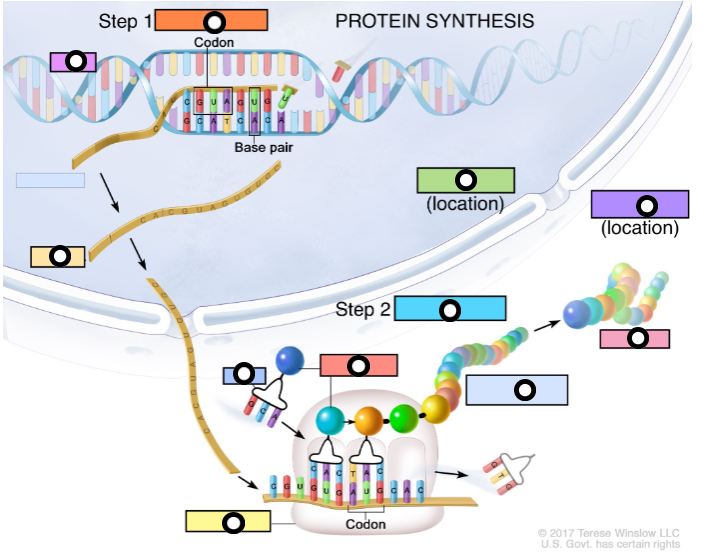
Drag and Drop the boxes to their appropriate locations.
Other Answer Choices:
Amino acid
Transcription
Cytoplasm
Ribosome
Translation
Protein
mRNA
Nucleus
tRNA
DNA
Question 1
1.

How do the phenotypes of the moths compare between Birmingham and Dorset in 1956?
Question 2
2.

What caused the different phenotypes of light moths and dark moths?

Question 6
6.

Under incomplete/codominance, which genotype is affected?

Question 7
7.

What is the incomplete dominance phenotype?

Question 8
8.

What is the codominance phenotype?

Question 10
10.

What type of mutation caused the dark allele?

Question 11
11.

What was the effect of this mutation?

Question 12
12.

What type of mutation caused the albino allele?

Question 13
13.

What was the effect of this mutation?

Question 14
14.

Dr. Ramirez claims that the albinism gene is X-linked, and not autosomal.

State whether you agree or disagree with Dr. Ramirez' claim.

Question 15
15.

What does it mean for a trait to be X-linked?

Question 16
16.

Provide evidence to support your agreement/disagreement with Dr. Ramirez' claim.

Question 17
17.

Dr. Singleton claims that the albinism trait is recessive and not dominant.

State whether you agree/disagree with Dr. Singleton's claim.

Question 18
18.

What does it mean for a trait to be recessive?

Question 19
19.

Provide evidence to support your agreement/disagreement with Dr. Singleton’s claim.

Question 20
20.

Select all of the individuals from the pedigree that must be carriers for albinism.