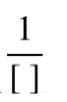
Take your best guess!
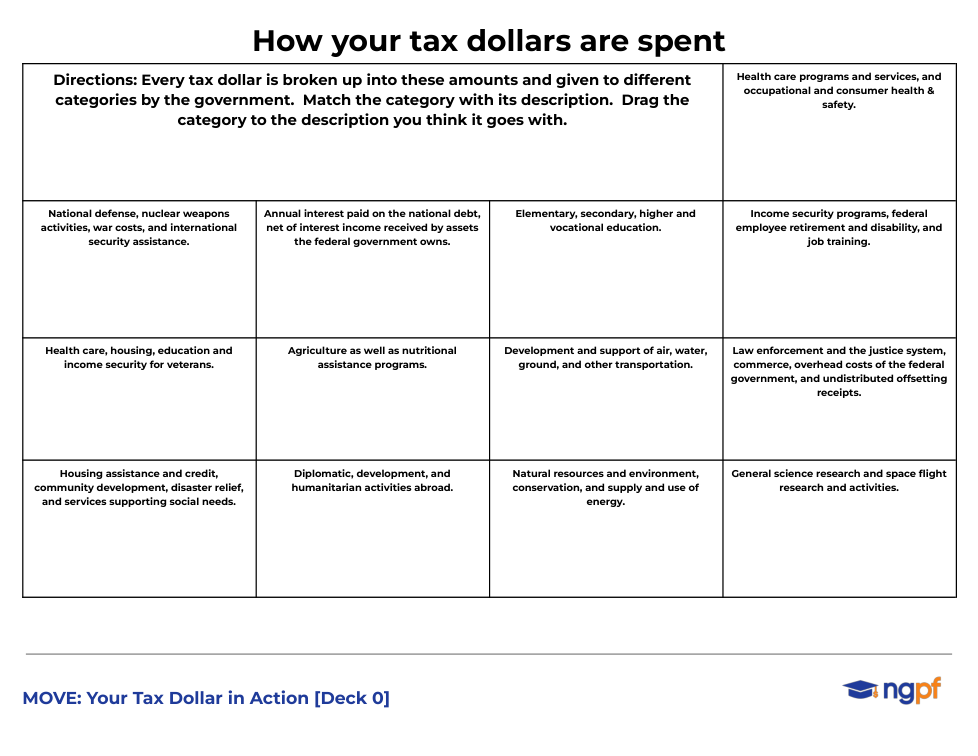
Mmuae Afoforo a Wobɛpaw:
Veterans Benefits
International Affairs
Housing & Community
Science
Food & Agriculture
Transportation
Government
Energy & Environment
Interest on Debt
Education
Unemployment & Labor
Health
Military
Unit 1 Covers the basics of Algebra and some arithmetic connected to taxes. We will look at how they are paid and used.
Chapter 1 Objectives:
Define rational numbers
Express rational numbers as a fraction, decimal, and percent, and convert between the three
Multiply rational numbers to solve word problems
Understand how the federal government spends income tax dollars
Explain the similarities and difference between payroll taxes and self-employment taxes
Explain how sales tax is calculated, and how it differs between states and local areas
Calculate percentages
Read a pay stub
Complete a W-4
Identify common payroll deductions
Unit 1 Covers the basics of Algebra and some arithmetic connected to taxes. We will look at how they are paid and used.
Chapter 1 Objectives:
Define rational numbers
Express rational numbers as a fraction, decimal, and percent, and convert between the three
Multiply rational numbers to solve word problems
Understand how the federal government spends income tax dollars
Explain the similarities and difference between payroll taxes and self-employment taxes
Explain how sales tax is calculated, and how it differs between states and local areas
Calculate percentages
Read a pay stub
Complete a W-4
Identify common payroll deductions
Take your best guess!
Now that you know what the categories are, which ones do you think get the most money? Take a guess, match each category with the amount it gets from every tax dollar.
| Draggable item | arrow_right_alt | Corresponding Item |
|---|---|---|
Interest on National Debt | arrow_right_alt | 29.2 cents |
Health | arrow_right_alt | 19.4 cents |
Running the Government | arrow_right_alt | 14.2 cents |
Transportation | arrow_right_alt | 9.1 cents |
Social Security | arrow_right_alt | 5.7 cents |
National Defense | arrow_right_alt | 3.8 cents |
Education and Social Services | arrow_right_alt | 3.1 cents |
Criminal Justice System and Operations | arrow_right_alt | 1.6 cents |
Unemployment & Labor | arrow_right_alt | 1.1 cents |
Commerce and Banking | arrow_right_alt | 1.0 cents |
Veterans Benefits | arrow_right_alt | 0.8 cents |
Environment and Energy | arrow_right_alt | 0.3 cents |
In general, why does the US government collect taxes?
How do you think the federal government decides how to allocate its funds? Who makes the decisions?
What, if anything, surprises you about how the federal government spends taxpayer dollars?
Which, if any, of these programs have you heard about recently or frequently in the news? In what context are people talking about them?
Opinion: If you were in charge of allocating tax dollars, are there spending categories you would prioritize more or less than they currently are? Why?
The data in the activity we did is from the most recent tax year. Would you imagine the ranking from highest to lowest changes much between years? Why or why not?
Opinion: Do you think the average American household would be better or worse off if they got to keep all their income rather than paying some in taxes? Why?
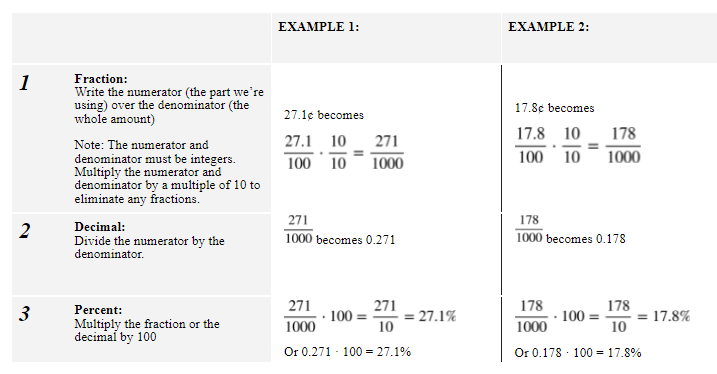
7 out of 20 students in the class had income tax withheld from (taken out of) their paychecks
Write as a fraction:
Write as a decimal (round to three decimal places):
Write as a percent:
8 states in the US have no state income tax
Write as a fraction:
Write as a decimal (round to three decimal places):
Write as a percent:
$3 of Christine’s $41 receipt was sales tax
Write as a fraction:
Write as a decimal (round to three decimal places):
Write as a percent:
$52.70 was deducted from Larnell’s $850 paycheck for Social Security taxes
Write as a fraction:
Write as a decimal (round to three decimal places):
Write as a percent:
The fraction, decimal, and percent versions of a number represent the exact same quantity. How would you decide which way to express a given quantity?
In 2022, 40% of taxpayers owed no federal income taxes or received tax credits back from the government.
Is 40% a rational number? , because it be written as a fraction.
In 2022, 40% of taxpayers owed no federal income taxes or received tax credits back from the government.
What is an equivalent fraction that also represents 40%?
Also during 2022, 16.5% of households paid no federal income taxes AND no payroll taxes. Payroll taxes are specific taxes that contribute toward paying into the funds for Social Security and Medicare.
What is one way you could write the percent as a fraction instead?
Which number is larger –
IXL Practice
Go to Classlink (under your Peabody bookmarks or click the link) and click the green IXL button
On IXL, search the shortcut codes listed below for each activity or just come back here and click the links below. You can also find these on your "From Your Teacher" but make sure you're doing the right ones!
Work on each activity until you get a Smart Score of 80 or better
IGNORE THE SNAPSHOT POPUP IF IT COMES UP!
A.3 Convert between decimals and fractions
Shortcut code: WSD
What was your score?
The Tax Policy Center estimates that 40% of middle-income households will pay no federal income tax for tax year 2022.
Write this percent as a fraction.
18 out of 26 students in the class have never filed taxes before.
Represent this value as a percent rounded to the nearest tenth. (Accurate rounding matters!!!)
In 2022 the top 1% of taxpayers (in many cases, people with the highest incomes) paid nearly 26% of the total federal income taxes collected.
Write each percent as a fraction:
1% =
1896 of the 6492 households in your zipcode filed their taxes by February 15. By March 15, another 2429 had done so. What percent of households, rounded to the nearest tenth, have NOT filed by March 15?
You’re given the rational number 46/224. You can choose to add 10 to the numerator OR add 10 to the denominator. Which option will give you a larger final number?
$3.34 out of Annette’s $73 bill at the grocery store was sales tax. Write this as a rational number (fraction), remembering that numerator and denominator must be integers.
What’s one integer that could be used as the denominator of this fraction
to make its value less than 23%?
(There are many possible answers!!)
Click here to complete the 5 point quiz. You need to complete any combination of problems that adds up to 5 points. Harder questions = more points.
If you are trying to complete this after the original due date, you need to contact Mrs B to unlock it!
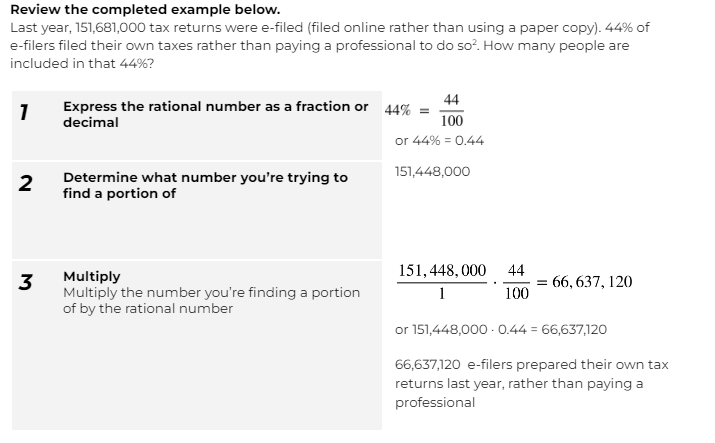
Practice together: Sales tax is another way governments collect tax money. MA state sales tax is 6.25%. If you were purchasing an item for $50.00, what would the tax be? Round to two decimal places so it looks like money!
Practice together: Last year, Keisha paid $765 in taxes while working a part-time job and going to school. Now that she’s working full-time, she was shocked to find that her taxes jumped 612%! How much does Keisha pay in taxes now?
Practice together: How could find the total price in one step for #29?
Click here to complete the Apply It Questions - this is CRITICAL THINKING, we haven't done problems exactly like this, you are APPLYING your knowledge
If you are trying to complete this after the original due date, you need to contact Mrs B to unlock it!