STIG AS Level Ethics and Code of Conduct
star
star
star
star
star
Last updated about 1 year ago
0 Asɛmmisa
Societies are a collection of individuals, each having their own ideas and beliefs about the type of behaviour that is acceptable, or not acceptable. These ideas and beliefs can vary widely, and what one person beliSocieties are a collection of individuals, each having their own ideas and beliefs about the type of behaviour that is acceptable, or not acceptable. These ideas and beliefs can vary widely, and what one person believes is good and right, another may see as bad and wrong.
To make sure that societies function successfully, they develop principles that define what is morally good and right behaviour for individuals and the society itself. These principles are known as ethics. Computer ethics are a set of principles that define what is morally good and right behaviour when using computers. These ethics cover: computers’ contribution to the health, safety and welfare of the public privacy intellectual property rights (copyright) censorship. Computers have an increasingly central role in society, industry, commerce, education, health and medicine, warfare and government. With so many people using, and being affected by computers, it is extremely important to have ethics that relate to the design, behaviour and use of computer systems.eves is good and right, another may see as bad and wrong.
To make sure that societies function successfully, they develop principles that define what is morally good and right behaviour for individuals and the society itself. These principles are known as ethics.
Computer ethics are a set of principles that define what is morally good and right behaviour when using computers.
These ethics cover:
-computers’ contribution to the health, safety and welfare of the public
privacy
-intellectual property rights (copyright)
-censorship.
Computers have an increasingly central role in society, industry, commerce, education, health and medicine, warfare and government. With so many people using, and being affected by computers, it is extremely important to have ethics that relate to the design, behaviour and use of computer systems
A code of conduct is a set of rules or practices defining how a group or organisation should behave – organisations such as businesses, schools, and hospitals have codes of conduct. Many codes contain rules that seek to protect the organisation from the behaviour of individuals, as well as protecting the individuals within the organisation. For example, a school’s code of conduct may include rules about behaviour, dress codes, bullying and respect for others and their property.
Codes of conduct are also applied to computers and their use. They seek to make sure that computers are used safely and lawfully, and to protect the interests of organisations and individuals. Computer professionals in particular have a need to follow codes of conduct. The computer systems they design, build, implement and use may have a great impact on, for example, the success of an organisation, the protection and privacy of its employees, and the protection, privacy and safety of the public. When designing and building systems, software developers (engineers) have opportunities to cause harm to their clients and to the public, such as:
-failing to make sure their software is fit for purpose (for example, consider the implications of a safety system that has faulty software)
-including malicious software designed to spread malware
-including unauthorised and undeclared ways into the system (backdoor) so that they can later gain access without their client’s knowledge.
In order to prevent these types of behaviour and their consequences, computer codes of conduct are becoming increasingly important.
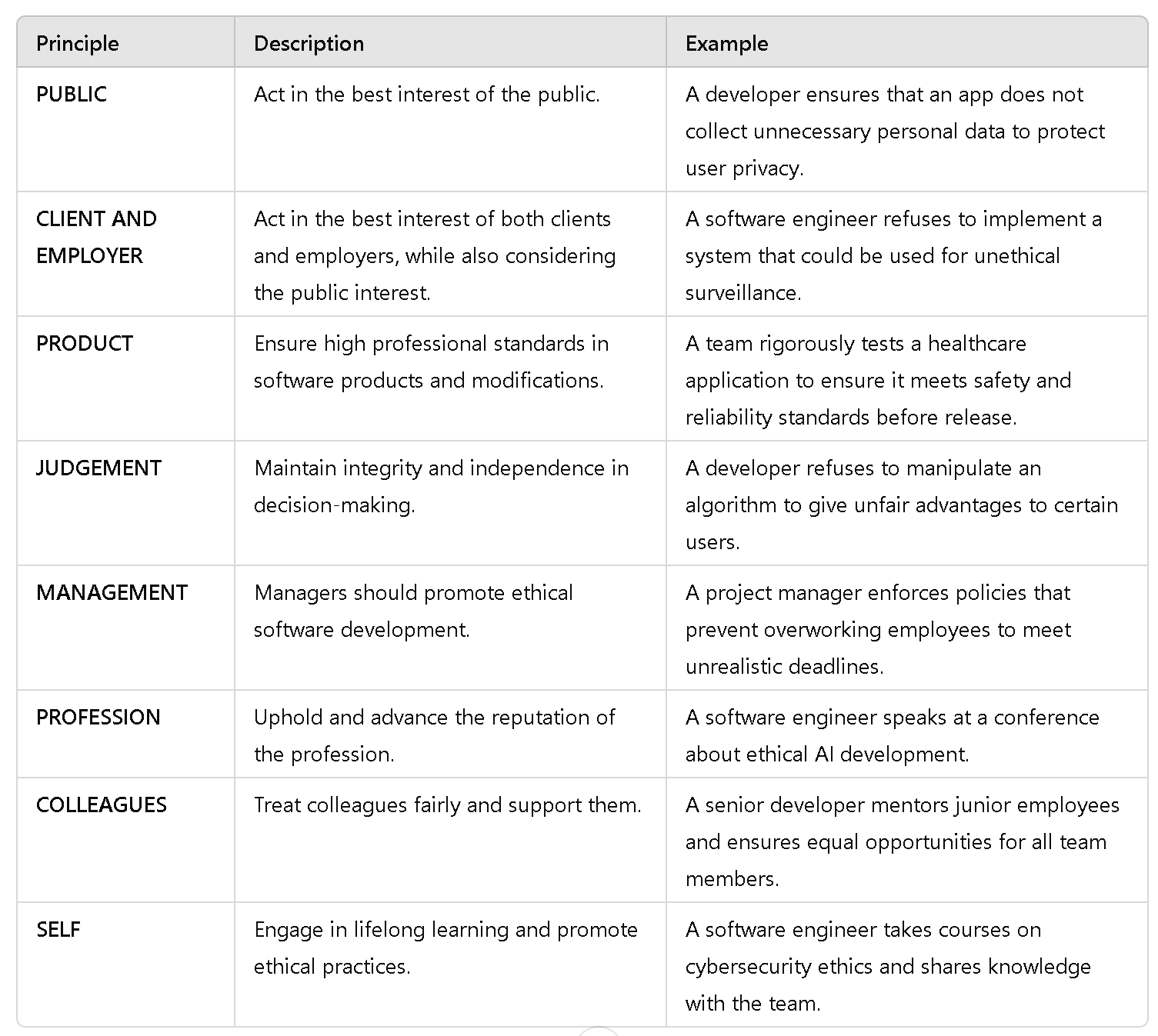
Organisations exist that aim to provide standards for professionals. Two organisations that represent computing professionals are the Association for Computing Machinery (ACM), and the Institute of Electrical and Electronics Engineers (IEEE) Computer Society. Between them, these organisations developed the ACM/IEEE Software Engineering Code of Ethics. These ethics aim to provide rules, standards and protection for software developers and their clients.