Log in
Sign up for FREE
arrow_back
Library

✅25M- Evidence of Evolution Quiz

star
star
star
star
star
Last updated about 1 year ago
16 questions
1
1
1
1
Required
1
1
1
1
1
1
1
1
Required
1
1
1
Question 13
13.

Question 14
14.

Question 15
15.

  1. Read the statement that follows:
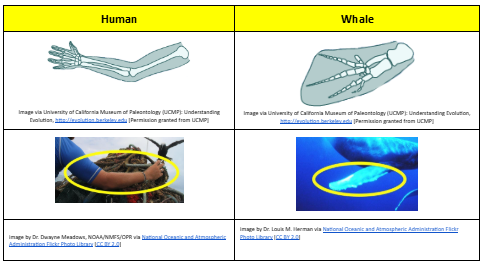
“When you look at a human’s arm and a whale’s limb, I think you are looking at two completely different structures. They do not look the same, and they do not even do the same thing! There is no way a walking creature and a swimming creature are related.”
Required
5
Question 1
1.

Question 2
2.

Question 3
3.

Question 4
4.

Question 5
5.

Question 6
6.

Question 7
7.

Question 8
8.

Question 9
9.

Question 10
10.

Question 11
11.

Question 12
12.

Evolution most often takes a very long time.
True
False
Which of the animals above share an ancester with fingers? (Select 4)
Whale
Frog
Horse
Lion
Bat
Bird
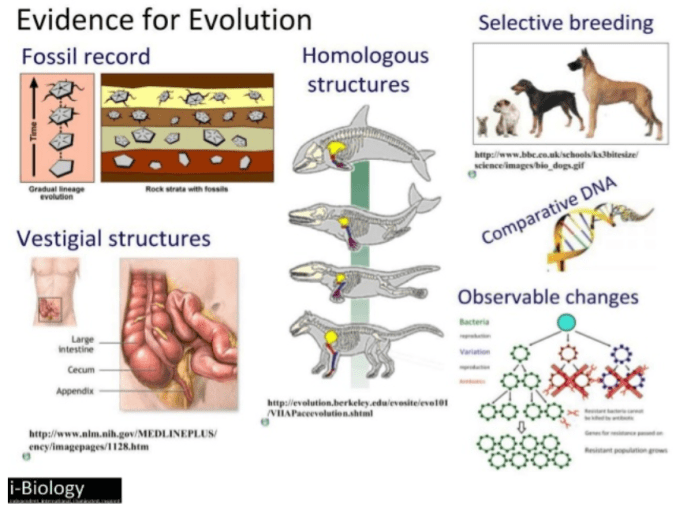
According to homologous structures, the similarities of mammal limbs provide evidence that...
The organisms shown lived in the same natural envionrment
The organisms have the same genetic diseases
The organisms may have developed from a common ancestor
All vertebrate species have identical forelimbs
Question 16
16.

Write an improved statement that includes your reasoning.

(Word Bank: Homologous Structures, Common Ancestor, Structure, Function)

Which of the following is an example of a homologous structure?
a) The wings of a butterfly and a bat
b) The front limbs of a frog, bird, and human
c) The eye of a human and the eye of a squid
d) The fins of a shark and the wings of a bird
Why do fossils found in deeper rock layers tend to be older than those found in upper layers?
a) Older fossils are pushed to the bottom over time
b) The deeper layers form first, covering older organisms
c) Younger fossils sink into lower layers
d) Fossils randomly distribute throughout rock layers
Which of these is NOT a line of evidence for evolution?
DNA / Biochemistry
Comparative Anatomy
Embryology
All of these are lines of evidence
Scientists compare organisms' DNA to support the theory that all species share a common ____
Separation
Population
Ancestor
Environment
What does the fossil record provide evidence for?
a) The Earth is only a few thousand years old
b) Species have remained unchanged throughout history
c) Life on Earth is old and has changed over time
d) Evolution is just a hypothesis
How do transitional fossils provide evidence for evolution?
a) They show that species appear suddenly without change
b) They display a mix of traits between ancestral and modern day species
c) They disprove the idea that species share common ancestors
d) They are identical to modern species, proving no change has occurred
A scientist discovers a fossil of an ancient horse-like species that had three toes. How might this fossil support the theory of evolution?
a) It shows that modern horses always had hooves
b) It provides evidence that horses evolved from ancestors with multiple toes
c) It suggests that evolution only happens in certain species
d) It proves that all species eventually evolve into horses
When all of the organisms of a species have died it is called...
Evolution
Adaptation
Extinction
Natural Selection
How do fossils provide evidence that evolution has happened on Earth?
Fossils show how the sizes of certain animals has changed drastically over millions of years
Fossils show how life forms present today are different than those from the past
Fossils show that some species have gone extinct
Different sedimentary rock layers provide evidence for how the environment has changed over time
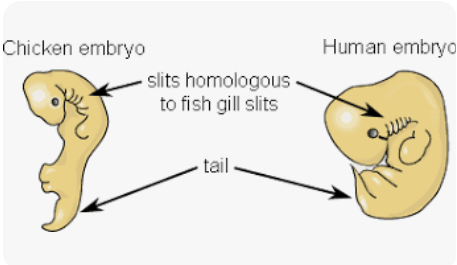
The presence of gill slits in both chicken and human embryos suggests that:
a) Chickens and humans can breathe underwater
b) Chickens and humans evolved from a common ancestor
c) Chickens and humans will eventually develop gills
d) There is no connection between their embryonic development
If two species have similar DNA sequences, it would indicate that they
share a common ancestor.
are not closely related.
will have similar fitness.
have no evolutionary relationship.
The study of embryos of various organisms to show a common ancestor because of similarities in development is known as what?
Natural Selection
Speciation
Embryology
Evolution