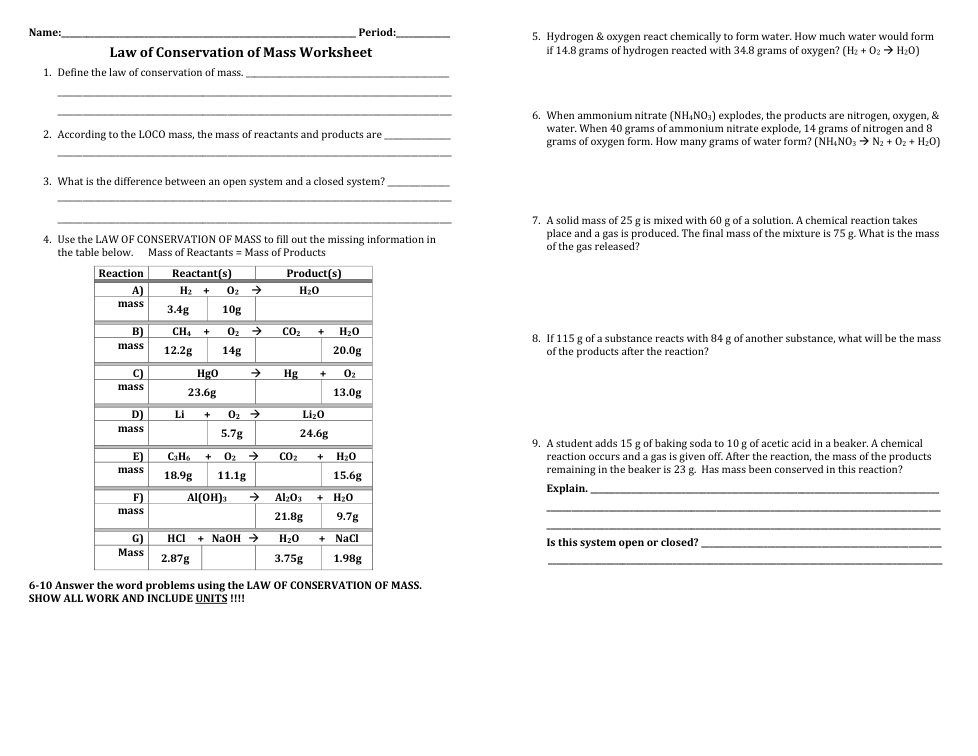
According to the Law of Conservation of Mass, the mass of reactants and products are__________
Other Answer Choices:
equal
unknown
chemically bonded
unbalanced
missing
neutrally charged
Question 3
3.
Draggable item
arrow_right_alt
Corresponding Item
arrow_right_alt
arrow_right_alt
Question 4
4.
What is the missing value on the table?
REMEMBER TO ADD THE UNIT
Question 5
5.
What is the missing value on the table?
REMEMBER TO ADD THE UNIT
Question 6
6.
What is the missing value on the table?
REMEMBER TO ADD THE UNIT
Question 7
7.
What is the missing value on the table?
REMEMBER TO ADD THE UNIT
Question 8
8.
What is the missing value on the table?
REMEMBER TO ADD THE UNIT
Question 9
9.
What is the missing value on the table?
REMEMBER TO ADD THE UNIT
Question 10
10.
What is the missing value on the table?
REMEMBER TO ADD THE UNIT
Question 11
11.
Hydrogen & oxygen react chemically to form water.
How much water (H₂O) would form if
14.8g of hydrogen (H₂) reacted with 34.8g of oxygen (O₂)?
(H₂ + O₂ → H₂O)
REMEMBER TO ADD THE UNIT
Question 12
12.
When ammonium nitrate (NH₄NO₃) explodes, the products are nitrogen, oxygen, & water.
When 40g of ammonium nitrate explode, 14g of nitrogen and 8g of oxygen form. How many grams of water form?
(NH₄NO₃ → N₂ + O₂ + H₂O)
REMEMBER TO ADD THE UNIT
Question 13
13.
A solid mass of 25g is mixed with 60g of a solution. A chemical reaction takes place and a gas is produced. The final mass of the mixture is 75 g.
What is the mass of the gas released?
REMEMBER TO ADD THE UNIT
Question 14
14.
If 115g of a substance reacts with 84g of another substance.
What will be the mass of the products after the reaction?
REMEMBER TO ADD THE UNIT
I PINKIE PROMISE
I WILL CLICK "TURN IN"
ON GOOGLE CLASSROOM
AFTER I SUBMIT
Yes-I pinkie promise!
No- I want it say "missing" and I want my grades to take longer to be updated and I want Ms. Bolton to make mistakes in my grading that negatively impact me and only me.
Define the law of conservation of mass:
Matter ___________ be ____________ or______________
What is the difference between an open system and a closed system?
closed system
systems that can result in a lower mass of the reactants in the products
open system
systems that always result in an equal mass of the reactants in the products