Log in
Sign up for FREE
arrow_back
Library

Re-Take Copy of CP Quiz-Chemistry Ionic Bonding & Formula Units (2/5/2025) (2/11/2025)

star
star
star
star
star
Last updated 11 months ago
12 questions
Required
2
Required
2
Required
2
Required
2
Required
6
Required
2
Required
1
Required
1
Required
2
Required
2
Required
2
Required
2
Question 1
1.

Question 2
2.

Question 3
3.

Question 4
4.

Question 5
5.
Using the periodic table as a model, students are asked to complete a graphic organizer that could be used to predict the charges of stable ions formed from atoms in a group on the periodic table.
Atoms are __________ because they have the same number of protons and electrons. However, based on valence electrons, some atoms will easily gain or lose electrons to other atoms in order to achieve noble gas electronic structure. __________are atoms that have gained or lost electrons.  Atoms that have __________ electrons have a positive charge and are called __________.  Atoms that have __________ electrons have a negative charge and are called __________.
.
Question 6
6.

Question 7
7.

Question 8
8.

Question 9
9.

Question 10
10.

Question 11
11.

Question 12
12.

A user is constructing an ionic bond between magnesium and oxygen and has reached the stage below. What should the user do next? [Take time to study the picture before you answer]
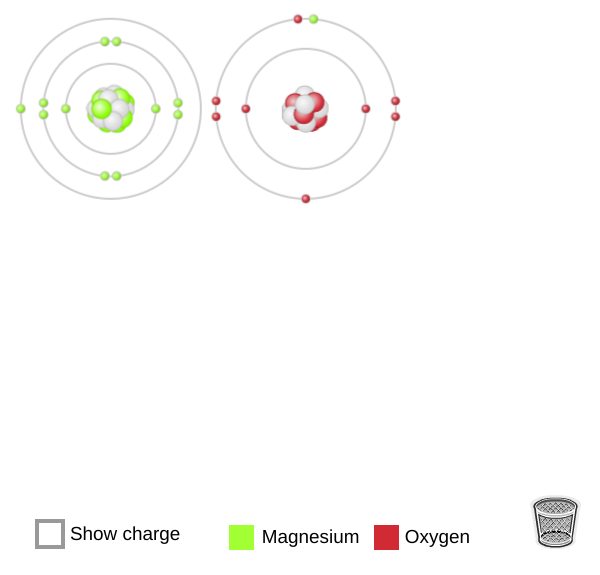
Transfer an electron from the oxygen atom to the magnesium atom.
Add another magnesium atom.
Add another oxygen atom.
Transfer an electron from the magnesium atom to the oxygen atom.
Lithium nitride has the chemical formula Li3N. Potassium is in the same chemical family as lithium. What is the formula of potassium nitride?
KN3
K3N
KN
K2N3
The diagram above represents the formation of lithium oxide from its elements. Which of the following statements provides the best explanation of the chemical reaction?
Two atoms of lithium each donate one electron to oxygen, forming two positively charged lithium ions and one negatively charged oxygen ion that are attracted to one another, forming a covalent bond.
Two atoms of lithium and one atom of oxygen share electrons, forming an ionic bond.
Two atoms of lithium and one atom of oxygen share electrons, forming a covalent bond.
Two atoms of lithium each donate one electron to oxygen, forming two positively charged lithium ions and one negatively charged oxygen ion that are attracted to one another, forming an ionic bond.
Which element is most likely to chemically combine with strontium (Sr) in a 1:1 ratio?
Oxygen
Calcium
Chlorine
Nitrogen
A portion of the periodic table is shown below. Which column of elements would be most likely to chemically combine with calcium in a 1:1 ratio?
Oxygen, Sulfur, Selenium group
Nitrogen, Phosphorus, Arsenic group
Fluorine, Chlorine, Bromine group
None of these groups would combine with calcium in a 1:1 ratio
Which of the following would be the best formula for lead (IV) nitride?
Pb4N2
Pb3N4
PbN
Pb2N3
Which type of element will always become a negative ion
Nonmetals
Metalloids
Noble Gases
Metals
What is the formula for sodium chloride?
Na2Cl
NaCl3
NaClO
NaCl
NaCl2
Which is the correct name for BeF2?
Beryllium difluoride
Diberyllium dioxide
Beryllium fluorine
Beryllium fluoride
What is the formula for calcium fluoride?
CaF
CaF3
CaF2
Ca2F
What is the name of K2S?
Potassium sulfide
Potassium sulfite
K sulfur
Dipotassium sulfur