WAY TO INCORPORATE A QUOTE #1:
BLOCK QUOTATION
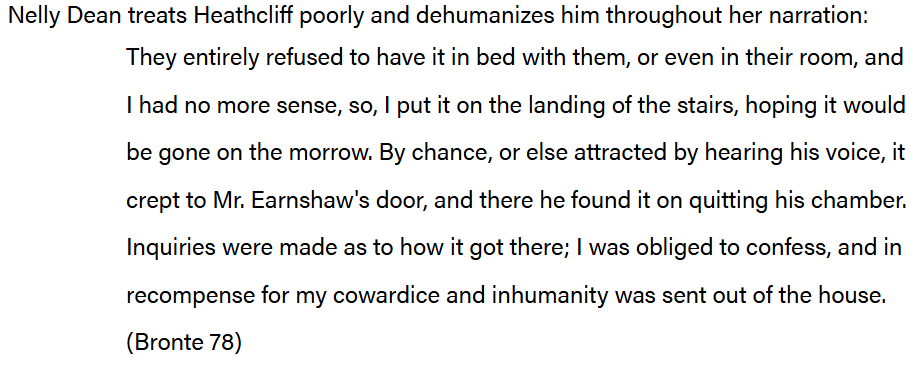
For a quotation that is more than four lines long when you type it out in your paper, place the quotation in a free-standing block of text and omit quotation marks. Introduce the long quotation with a colon, and then start the quotation on a new line, with the entire quote indented with a hanging indent. Your parenthetical citation should come after the closing punctuation mark.
Example:
Nelly Dean treats Heathcliff poorly and dehumanizes him throughout her narration:
They entirely refused to have it in bed with them, or even in their room, and I had no more sense, so, I put it on the landing of the stairs, hoping it would be gone on the morrow. By chance, or else attracted by hearing his voice, it crept to Mr. Earnshaw's door, and there he found it on quitting his chamber. Inquiries were made as to how it got there; I was obliged to confess, and in recompense for my cowardice and inhumanity was sent out of the house. (Bronte 78)
Imagine the entire block quote is indented like this... sorry, Formative doesn't currently have indenting capabilities.
Practice this type of quote introduction using the longest of your chosen quotes from 1984.
WAY TO INCORPORATE A QUOTE #1:
BLOCK QUOTATION
For a quotation that is more than four lines long when you type it out in your paper, place the quotation in a free-standing block of text and omit quotation marks. Introduce the long quotation with a colon, and then start the quotation on a new line, with the entire quote indented with a hanging indent. Your parenthetical citation should come after the closing punctuation mark.
Example:
Nelly Dean treats Heathcliff poorly and dehumanizes him throughout her narration:
They entirely refused to have it in bed with them, or even in their room, and I had no more sense, so, I put it on the landing of the stairs, hoping it would be gone on the morrow. By chance, or else attracted by hearing his voice, it crept to Mr. Earnshaw's door, and there he found it on quitting his chamber. Inquiries were made as to how it got there; I was obliged to confess, and in recompense for my cowardice and inhumanity was sent out of the house. (Bronte 78)
Imagine the entire block quote is indented like this... sorry, Formative doesn't currently have indenting capabilities.
Practice this type of quote introduction using the longest of your chosen quotes from 1984.