describe the motion of the blue line in the following spacetime diagram from the perspective of the red guy
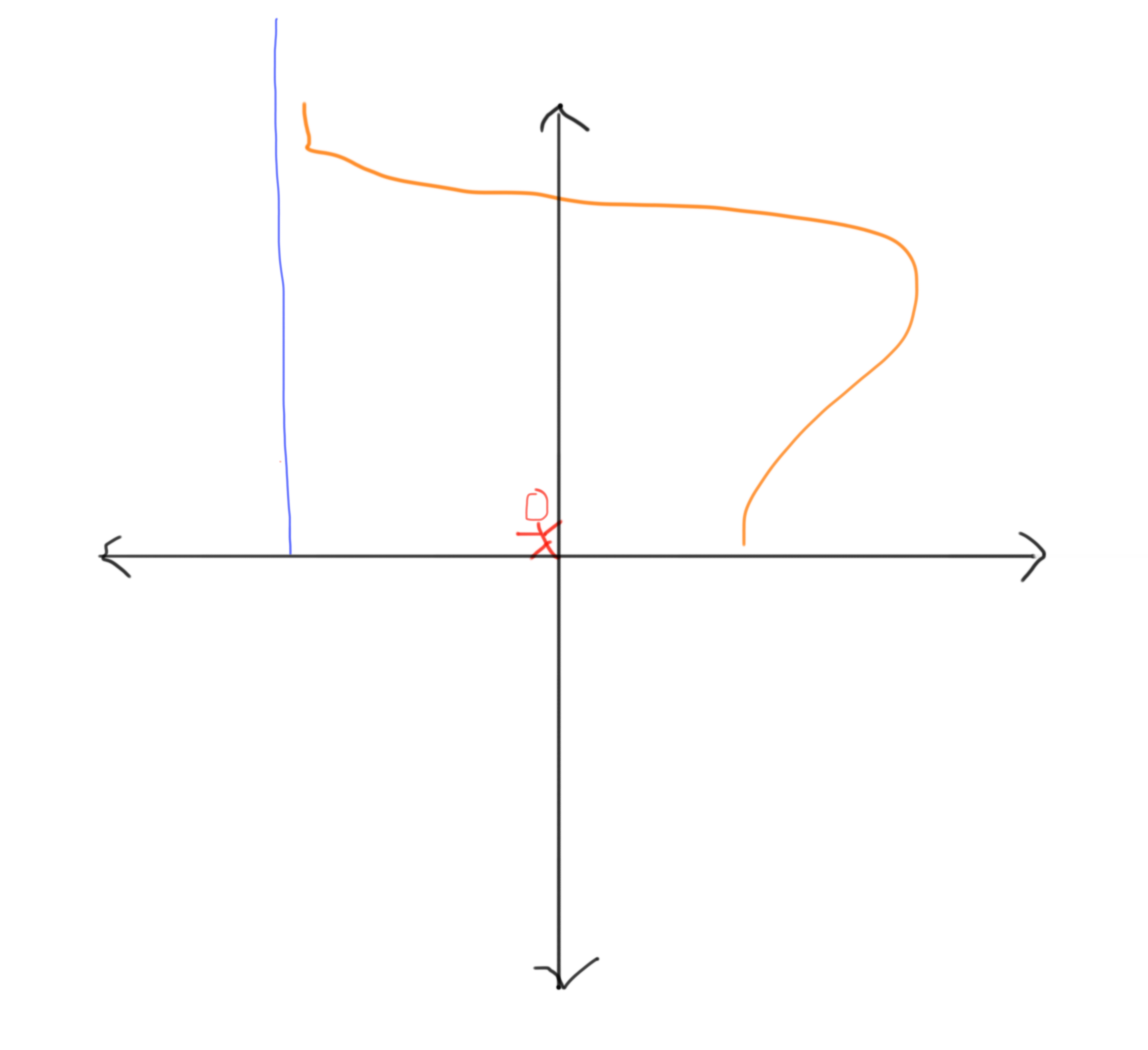
describe the motion of the blue line in the following spacetime diagram from the perspective of the red guy
Quick recap of inertial frames of reference. Rewatch this if you don't remember.
relative motion is
Its special relativity time! Watch this video - take notes on spacetime diagrams. do you have any questions?
the coordinate position of an object is
the distance between two objects is
Explain your answers to the last two questions.
in a spacetime diagram, the horizontal axis is what? Some definitions - inertial frame of reference is the perspective of something moving at a constant velocity (even if that velocity is 0) an non-inertial frame of reference is the perspective of something accelerating.
The vertical axis is what? Some definitions - inertial frame of reference is the perspective of something moving at a constant velocity (even if that velocity is 0) an non-inertial frame of reference is the perspective of something accelerating.
describe the motion of the blue line in the following spacetime diagram from the perspective of the red guy
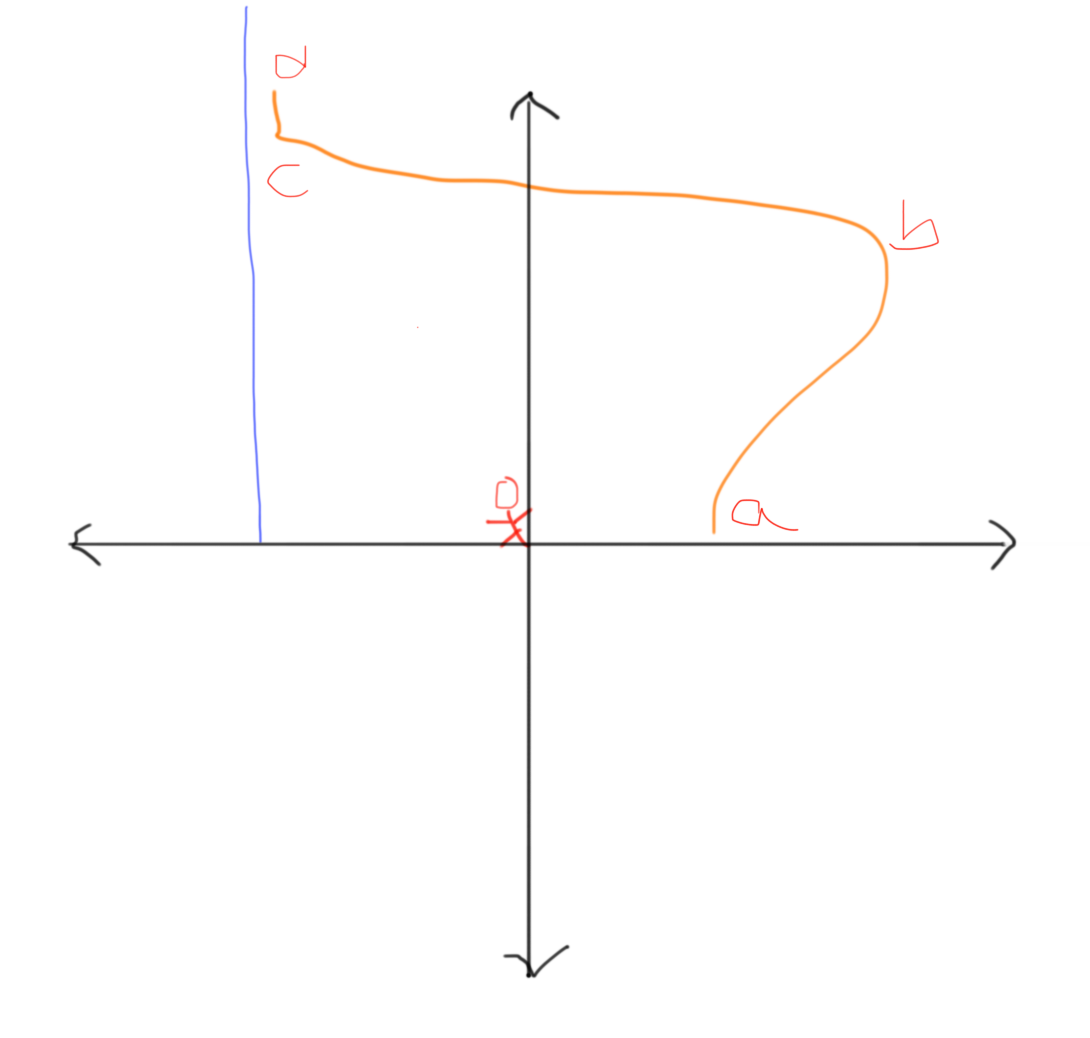
describe the motion of the orange line in the following spacetime diagram from the perspective of the red guy
at which part of the orange guys line is the orange guy going fastest? remember, speed is distance divided by time, and the x axis is distance, and the y axis is time.
Now watch the video on Lorentz transformation. Do you have any questions.
The spacetime line for light is shown as a
The purpose of performing a lorentz transformation is
The Lorentz Transformation is when you
One of the key aspects of a lorentz transformation is
Recall from last week's general relativity video that spacetime is a pseudo-Riemannian manifold which simply means in the local area everything looks flat, but it isn't flat everywhere. Newtonian physics is a approximation of the local flat spacetime. tell me as best you can what that means
You are walking in the park. you walk along a straight path for 20 m, you stop, you continue on the same path for another 20m. how far are you from your original position?
This path never bends and never turns. after 10,000 km you are somewhere past the arctic, and in another 10,000 you are somewhere in Asia. what is the shortest distance between you and where you started?
If you are going 10mph and the car next to you is going 12 mph, how fast does it seem to you the car next to you is going?
Does the math you just did for the last question work if I replace 10 mph and 12 mph with 0.8 x the speed of light and 0.9 x the speed of light?
How are the last two questions and the first two questions similar?
Draw a spacetime diagram for a batter that hits a homerun in baseball, where the inertial frame of reference is home plate?
Draw a spacetime diagram for the middle 80 meters of a 100 meter dash, where the three contestants are an olympic athlete, a middle school athlete and a toddler. Use the olympic athlete as the inertial frame of reference.
I asked for the middle 80 meters so you could assume that they olympic athlete maintained a constant speed during that time. Why does that matter?
How are you feeling?
what is a spacetime diagram?
how would you write a spacetime diagram for something where the frame of reference is not moving
how would you draw a spacetime diagram for when a frame of reference is moving
Why can't you just rotate the graph to move from one inertial frame to another
What is a lorenz transformation?
the similarity of walking around the globe compared to going the speed of light
I've got this
I'm fuzzy
So confused