6th Grade Math: Unit 1

Last updated 9 months ago
16 questions
Unit 1 – Item 1
A 6th grade class is analyzing the effects of screen time to promote an increased use of hands- on materials over increased time on the computer.

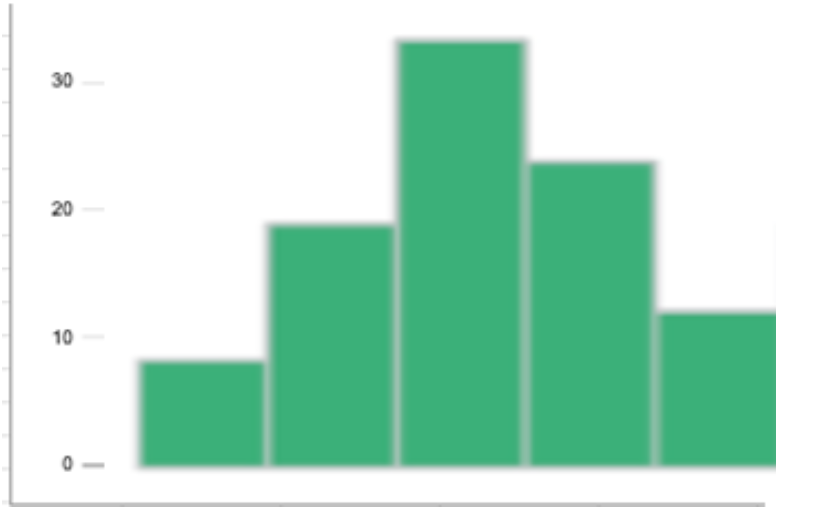
A schoolwide survey was conducted regarding the number of hours spent on screens (TV, computers, tablets, phones) each day. The data is displayed on the histogram below. NOTE: The first bin indicates the number of students who spent 0-2 hours on the screen.

1

PART A
Approximately, how many students spend 4 – 6 hours on the screen each day?

1

PART B
Based on the shape of the data, what conclusions can be drawn about the number of hours students spend on the screen?

Unit 1 – Item 2
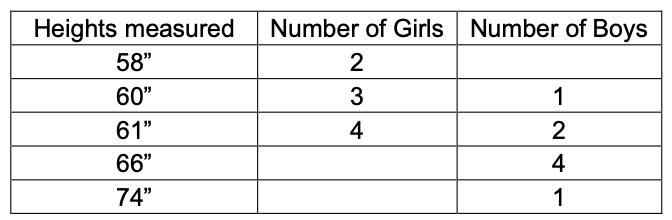
Carmen’s class wanted to find the average height of students in their class. They generated the following data:
1

PART A
  • What is the average height of girls in Carmen’s class? Explain how you determined your answer.
  • What is the average height of boys in Carmen’s class? Explain how you determined your answer.

1

PART B
What is the average height of students in Carmen’s class? Explain how you determined your answer.

1

PART C
Would the mean or median provide the most accurate average height of students in the class? How do you know?

1

Unit 1 – Item 3
A group of students in a summer camp participated in a hiking competition. Campers recorded the following times for their hike (in minutes):

46, 41, 39, 46, 72, 64, 61, 64, 49, 57, 68, 55, 60, 59, 59, 50, 63, 66

Which of the following statements are true? Select all that are true. Explain how you know.

Unit 1 – Item 4
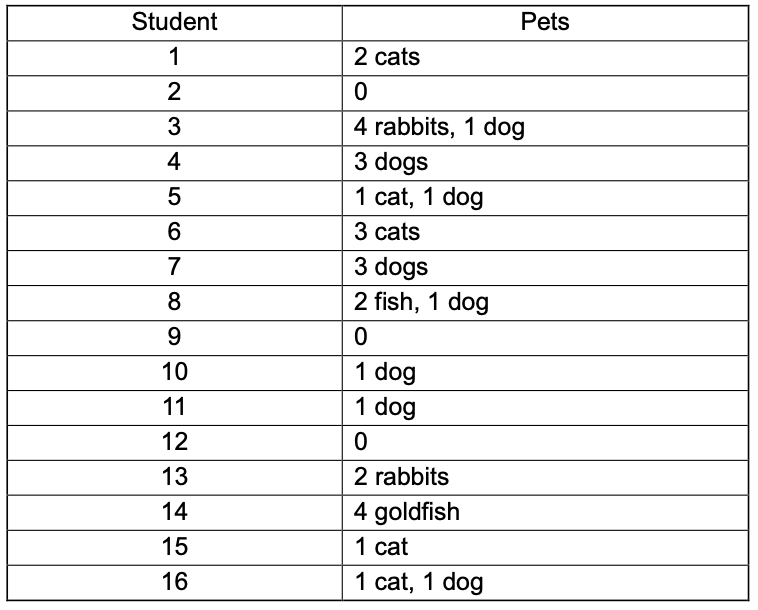
Karen and Richard want to find out how many pets students in their sixth-grade class typically have.
1

PART A
Write a question they could use on a survey to collect data. Is your question a statistical investigative question? Why or why not?

1

PART B
Below are the results of Karen’s and Richard’s survey.
Display the data using a bar graph. What conclusion might Karen and Richard make about the data?

Unit 1 – Item 5
Mrs. Burke’s class engaged in a scavenger hunt. Below is a data set of the length of times, in seconds, that it took the class to find the nine objects in the hunt.
1

PART A
Create a box plot using the data in the table.

1

PART B
Describe the spread of the overall data for the box plot and explain what this tells you about the data.

1

Unit 1 – Item 6
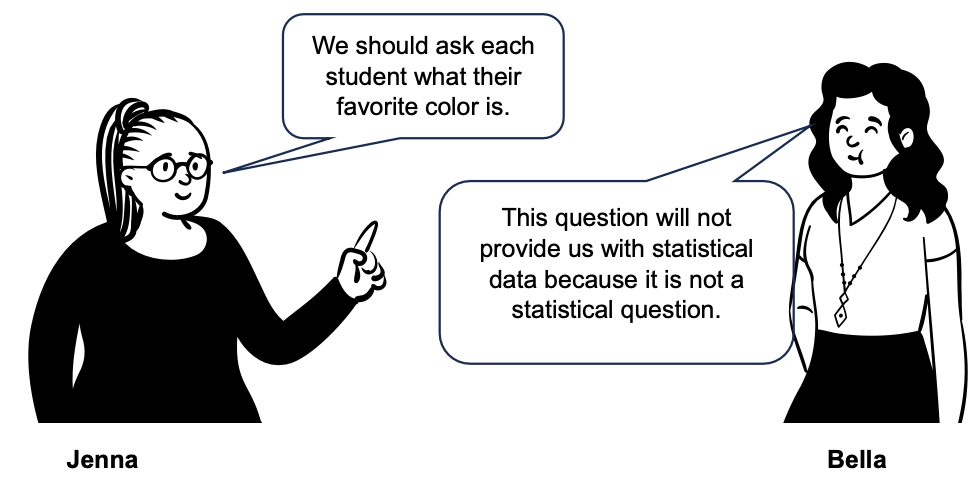
Bella and Jenna are working to develop a survey to collect data on students in their class.

Do you agree with Jenna or Bella? Why?

Unit 1 – Item 7
Below are the 10 birth weights, in ounces, of all the Labrador Retriever puppies born at Kingston Kennels in the last six months.

13, 14, 15, 15, 16, 16, 17, 18, 19, 20
1

PART A
Create a dot plot of the data above.

1

PART B
The kennel owner realized the birth of two puppies were not account for in the original data set.

How do the additional data points affect the data?

17, 10

Unit 1 – Item 8
Marcus looked up his grades before a quiz on Monday. His grades were:

89, 92, 70, 80, and 92

His average (or mean) grade was 84.6.
1

PART A
What will happen to his grade if he scores a 50 on the quiz? Select the best response from the answer choices below.

1

PART B
What will happen to his grade if the teacher drops the lowest score from the original 5 scores?

1

Unit 1 – Item 8

Statistical Investigative Task: "A Day in the Life of Our School"

Objective: To investigate and analyze the number and types of activities students engage in throughout a school day using photography and statistical analysis.

Materials Needed:
  • Cameras or smartphones with cameras
  • Notebooks and pens/pencils
  • Graph paper or access to graphing software
  • Computers or tablets for data entry and analysis

Task Instructions:
  1. Determine what types of activities happen during a typical school day (e.g., classes, recess, lunch, extracurricular activities).
  2. Decide on categories for activities. For example, categories could be "Classroom Learning," "Recess," "Lunch," "Library Time," and "Extracurricular Activities."
  3. In small groups, take photos of different activities happening around the school during a single school day. Aim to take photos of each category at different times of the day. For each photo, note down the activity, the time it was taken, and the number of students involved.
  4. Create a histogram for each category to show the number of students involved in activities throughout the day. Then, create a box plot for each category to show the spread of data, including the minimum, lower quartile, median, upper quartile, and maximum number of students involved.
  5. Analyze the histograms and box plots to understand patterns. For example, you might find that most students are in classrooms during certain hours and in the playground during others. Discuss any outliers or unusual data points.
  6. Each group will present their findings to the class, showing their histograms and box plots.