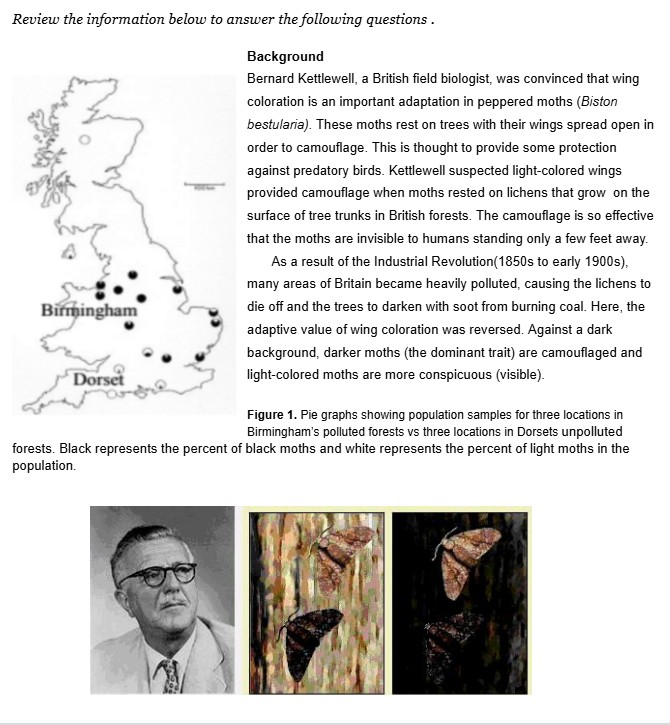
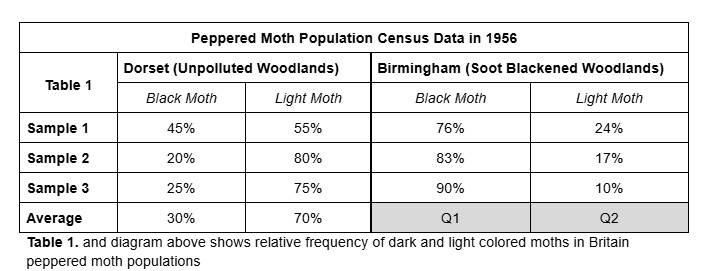
Birmingham Black Moth Average _______________
Birmingham White Moth Average _______________
How do the phenotypes of the moths compare between Birmingham and Dorset in 1956?
What caused some moths to be black?
What event caused the change in phenotype frequencies of the moths in the 1950s?
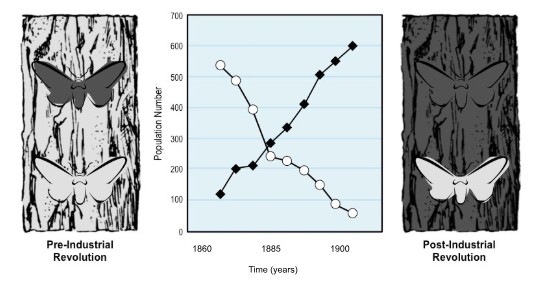
What is the selective pressure on the moth population causing the dark phenotype to become more common?
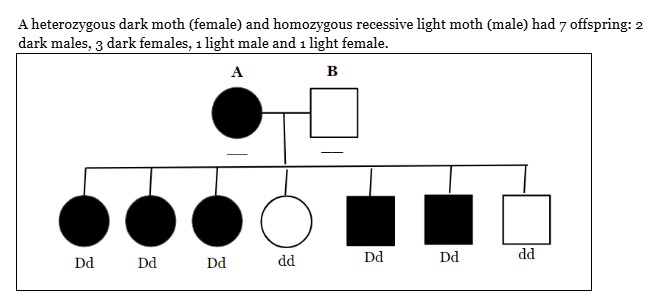
Using the pedigree above, what is the correct genotype of moth A.
Background:
Milk contains the important Vitamin D that helps our body to absorb calcium to create strong bones and a strong immune system. Milk also has the sugar lactose in it. Vitamin D can also be obtained by the skin’s exposure to the sun creating chemical reaction synthesizing Vitamin D. In most parts of the world adults are unable to drink milk because after weaning off breast milk their body switches off the gene that creates the enzyme(protein) to digest lactose. This leads to bloating, cramps, gas, diarrhea, or vomiting. In the past 5,000 to 10,000 years European adults that can drink milk due to their genes not switching off have had a strong selective advantage. Review the following data pieces before answering the Reasoning of the CER. The Claim and Evidence is done for you. Driving Question: Why are more European adults seen to have the lactose gene still active than those that live closer to the equator?
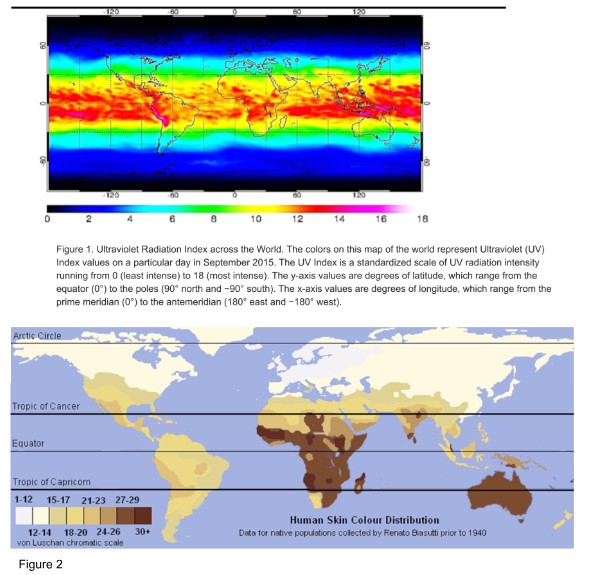
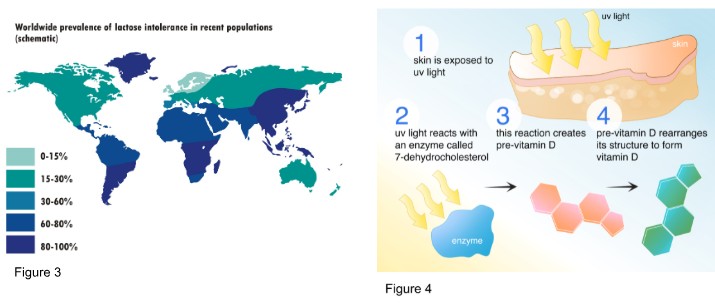
CLAIM: More European adults have the lactose gene switched on.
EVIDENCE
- Figure 1 shows less UV rays in Europe than by the equator.
- Figure 2 shows human skin color is lighter in Europe than by the equator.
- Figure 3 shows that people that can digest lactose is higher in Europe than by the equator.
- Figure 4 shows UV light is needed to hit the skin to synthesize(make) Vitamin D that the body needs.
- Vitamin D can be acquired through drinking milk or by UV rays causing a chemical reaction in skin.
Reasoning: (Connect the background info and maps. How does it all support the claim?)
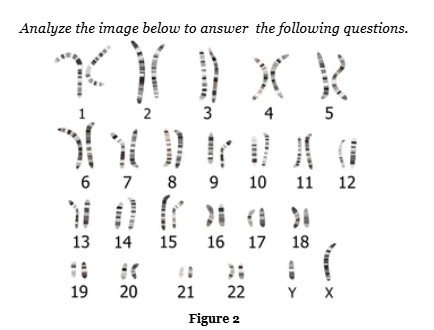
Is the individual represented in the photo a male or female?
Complete the sequences below by transcribing the DNA and translating the mRNA into amino acids on the Testing Supplement Sheet. A transcription diagram and translation amino acid code chart are provided to you the the Testing Supplement Sheet.
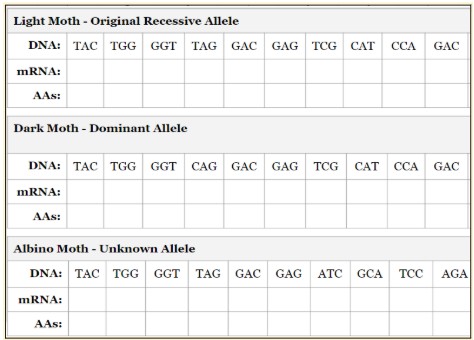
What type of mutation caused the dark allele?
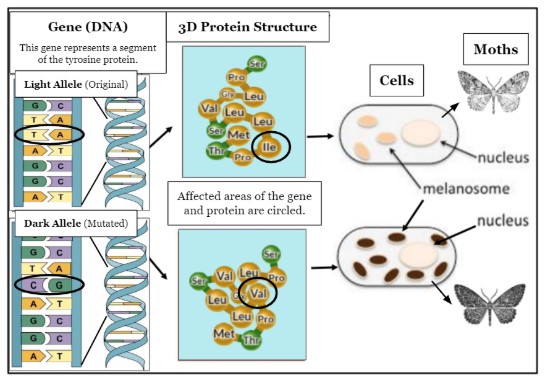
What effect has the dark allele mutation had on the structure of the protein?
Driving Question:
How did the Albinism trait appear in the moth population?
MAKE A CLAIM:
Driving Question:
How did the Albinism trait appear in the moth population?
PROVIDE EVIDENCE:
Provide two pieces of evidence to support the claim you have made. (Remember evidence is facts and figures. Do not explain until your reasoning section.)
Driving Question:
How did the Albinism trait appear in the moth population?
PROVIDE REASONING:
Explain how your evidence has led you to your claim. For full credit include the words: protein, structure, and function.
(Ex: Evidence 1 and evidence 2 supports my claim that _____ because...)
Dark color (D) is dominant to light color (d) in moths. If a purebred dark moth and a purebred light moth reproduced, what would be the resulting phenotype frequencies of their offspring? (Complete a Punnett Square)
Dark color (D) is dominant to light color (d) in moths. If two heterozygous moths reproduced, what would be the resulting genotype frequencies of their offspring? (Complete a Punnett Square)
Using the pedigree above, what is the correct genotype of moth B.
What does the Figure 2 represent?
How many pairs of chromosomes does this individual have?
Which genetic disorder does this individual have?
What type of mutation caused the albino allele?
How will this mutation affect the protein for the albino allele?
What seems to be the function of this protein?
In humans, melanin functions to protect our skin from U.V. radiation. What seems to be the function of melanin in the moths?