Ɛhia
1
Ɛhia
1
Ɛhia
1
Ɛhia
2
Ɛhia
7
Section Introduction: (Part 1)
Two of the most significant Greek city-states, Athens and Sparta, had contrasting forms of government. Their citizens also had very different ways of life. Athens was a walled city near the sea. Close by, ships came and went from a busy port supporting trade. Inside the city walls of Athens, talented master potters and sculptors labored in workshops. Wealthy Athenians and the people they enslaved strolled through the marketplace. Free men enjoyed citizenship. Most women remained at home to educate their sons and daughters, but others had jobs.
Match the types of Athenians with their location.
Workshops | Marketplace | Home | |
|---|---|---|---|
Enslaved People | |||
Sculptors | |||
Wealthy People | |||
Sons and Daughters | |||
Women | |||
Potters |
Section Introduction: (Part 2)
Sparta was located in a fertile farming area on an inland plain. No walls surrounded the city, and its buildings were simple compared with those of Athens. The same was true about the clothes the people wore. Spartan soldiers wore stern expressions behind their bronze helmets as they marched in columns through the streets. Military training was a major factor in each Spartan’s life. Men and women of Sparta were fiercely devoted to physical strength and power. Even a casual visitor in these cities would have noticed that Athens and Sparta were quite different from each other. Taking a closer look at the way people lived in these two city-states will help you examine each city’s government, economy, education, and treatment of women and people who were enslaved to discover exactly how they differed.
Section 1: Comparing Two City-States (Part 1)
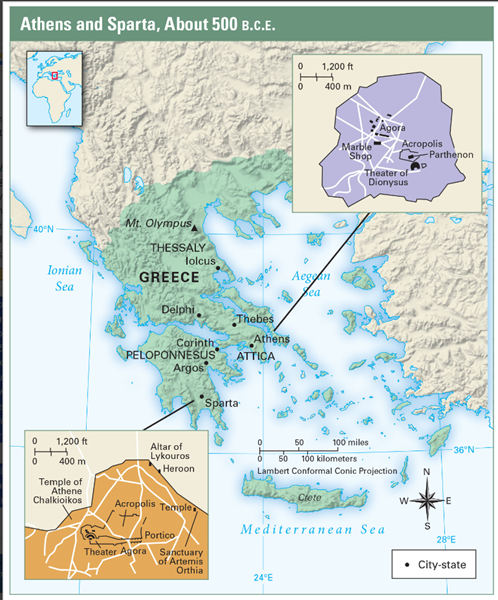
Despite a distance of only 100 miles separating these two Greek cities, Athens and Sparta were as different as they could be. But why did one contrast the other so greatly? Part of the answer is geography. Since Athens is only four miles from the Aegean Sea, its location encouraged Athenians to look outward toward the world beyond the city. Athenians enjoyed traveling and were eager to spread their own ideas and to learn from others. They encouraged artists from other parts of Greece to come and share their knowledge of art and architecture. Athens developed strong relationships with other city-states, and it flourished through trade. Additionally, a great fleet made it the leading naval power in Greece.
How far apart is Athens and Sparta?
Section 1: Comparing Two City-States (Part 2)
In contrast, Sparta was more isolated because it was located on a narrow plain on a peninsula in southern Greece known as the Peloponnesus. Mountains surrounded Sparta on three sides, and its harbor was about 25 miles away. Spartans were suspicious of outsiders and their ideas. They could already grow much of what they needed in the fertile soil around Sparta, but what they could not grow, Sparta’s powerful armies would often steal from their neighbors. While Athenians boasted of their art and culture, Spartans valued simplicity and strength. They taught their sons and daughters to fight and were proud to produce soldiers rather than artists and thinkers. For most of their histories, these two city-states were bitter rivals. As you continue reading, you will notice the major differences between Athens and Sparta reflected in almost every part of life.
Click on the synonym for hostile. Then click on the synonym for displayed.
For most of their
Move the items below to the proper city-state.
Culture
Artists
Thieves
Art
Soldiers
Strength
Simplicity
Thinkers
Athens
Sparta
What city-state is this section of text describing?
What five things were true of Athens from this section of text?
Click the word that is a synonym for important. Then click the word that is a synonym for different.
Two of the most
Athens was primarily known for its open land and agriculture rather than trade and craftsmanship.
In Athens, most women stayed at home to educate their children, but some did have jobs.
Sparta had a government similar to that of Athens in terms of citizenship and social structure.
What city-state is this section of text describing?
What four things are true of Sparta in this selection?
Although Athens and Sparta had some differences, they were very similar.
Click on the word that is a synonym for rich. Then click on the word that is a synonym for serious.
Sparta was
Which statement below best summarizes what was important to Spartans?
What five aspects of Athens and Sparta will we be taking a close look at?
Which five statements below describe the Athenians?
Click on the word that is a synonym for excited. Then click on the word that is a synonym for thrive.
Athenians enjoyed traveling and were
How far was Sparta from its harbor?
Which three statements best describe the Spartans?
What three statements below explain why Sparta was isolated?
Which sea is south of Crete?
Which city is farthest south?
In what directions would a Spartan go to attack Athens?
Look closely at the map, what two features do both cities have?
Put these Greek locations in order from North to South. (Most North First)
Crete
Iolcus
Thebes
Sparta
Delphi
Athens
Mt. Olympus