Choose the two atoms option
and make sure that all the boxes are click on. It should look like this
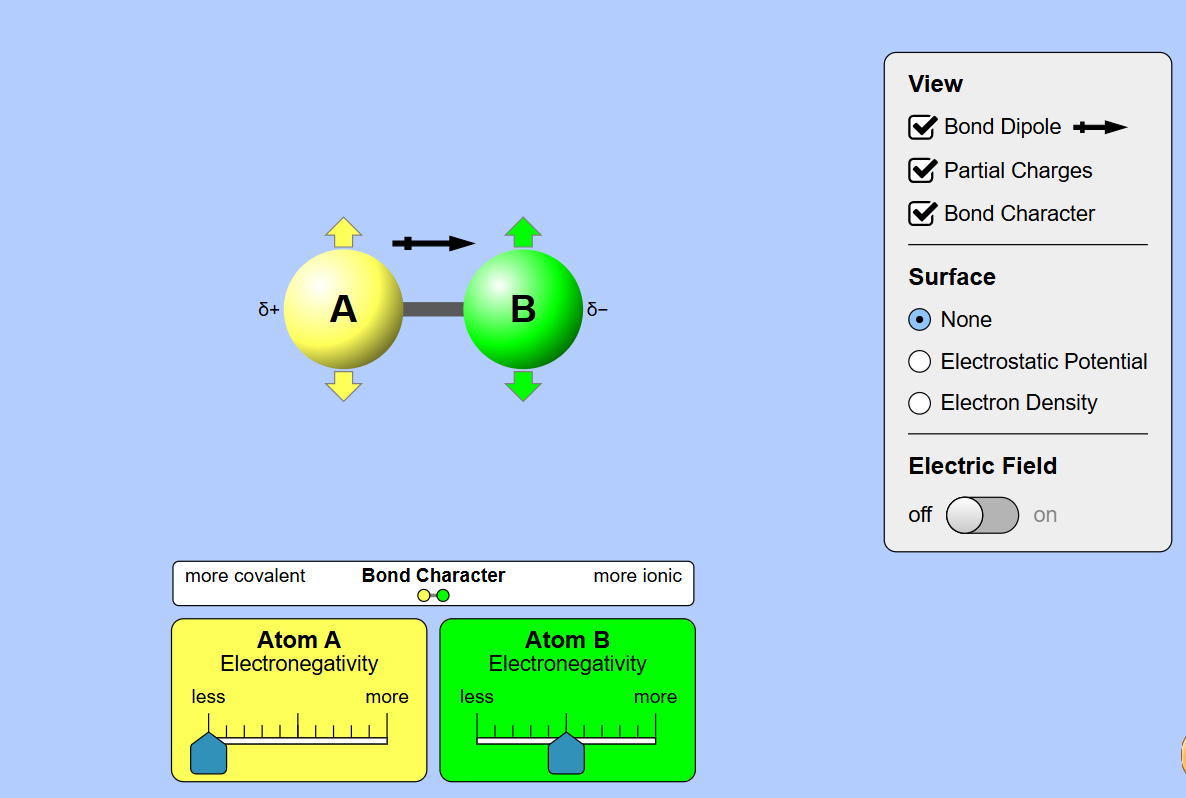
The difference in electronegativity between chlorine and hydrogen is
The bond between a chlorine atom and a hydrogen atom is . The chlorine atom is. The hydrogen atom is .
The difference in electronegativity between oxygen and hydrogen is
The bond between an oxygen and a hydrogen is . The oxygen atom is . The hydrogen atom is .
What is the electronegativity different between oxygen and sodium?
The bond between an oxygen atom and a sodium atom is . The oxygen atom is . The sodium atom is .
What is the electronegativity difference between carbon and hydrogen atoms?
The bond between a carbon atom and a hydrogen atom is . The carbon atom is . The hydrogen atom is .
Polar bonds in organic molecules tend to contain hydrogen. Which elements make polar bonds with hydrogen?
Which elements make polar bonds with carbon?
Choose the two atoms option
and make sure that all the boxes are click on. It should look like this
Examine how the initial screen and make the best match for each term or symbol
| Draggable item | arrow_right_alt | Corresponding Item |
|---|---|---|
separation of charge | arrow_right_alt | created by a separation of charge
|
polar bond | arrow_right_alt | slightly positively charged |
dipole | arrow_right_alt | slightly negatively charged |
δ⁻ | arrow_right_alt | bond in with a slightly positive end and a slightly negative atom |
δ⁺ | arrow_right_alt | positive in one area and negative in another |
Set the electronegativity to the approximate settings in the picture. Draw in the bond dipole and show the partial charges.
Set the electronegativity to the approximate settings in the picture. Draw in the bond dipole and show the partial charges.
Set the electronegativity to the approximate settings in the picture. Draw in the bond dipole and show the partial charges.
Set up the electronegativities for the atoms in the picture below. Draw the molecular dipole and the bond dipoles for the atoms.
Set up the electronegativities for the atoms in the picture below. Draw the molecular dipole and the bond dipoles for the atoms.
Set up the electronegativities for the atoms in the picture below. Draw the molecular dipole and the bond dipoles for the atoms.
Set up the electronegativities for the atoms in the picture below. Draw the molecular dipole and the bond dipoles for the atoms.
Experiment #1
Experiment #2
Experiment #3
Experiment #4
In your own words, explain how the molecular dipole is different from the bond dipoles.
Is it possible to have a molecule with three atoms in which the bonds have dipoles but the molecule does not. Be sure to explain your answer and use evidence from your experiments.
