Asemmisa {{asɛmmisaAhyɛnsode}}
5.
Read each question carefully, and give your best effort on every question.
Newton’s Third Law states that for every action force, there is an equal and opposite reaction force. Which of the following is the best example of this law?
Which of the following correctly describes the relationship between mass, force, and change in speed?
Two students push on opposite sides of a box. One pushes with 50 N to the right, and the other pushes with 30 N to the left. What is the total force on the box?
Which of the following statements about gravity is true?
Match each concept with its correct statement.
Unbalanced Forces:
Balanced Forces:
Gravity:
Friction:
Total Force:
A student pulls a 10 kg wagon with a force of 30 N. A second student pulls a 15 kg wagon with the same force of 30 N. Whose wagon will change its speed more quickly and why?
Newton's 3rd law states: "For every action force there is an equal and opposite reaction force."
A student sits on top of a skateboard and holds a weighted ball. When the student throws the ball forward, the student rolls backward.
Identify the action force (which object is pushing on what) and the corresponding reaction force.
Imagine you are an astronaut floating in space far from any planets. If you push a wrench away from you, what will happen to your motion and what will happen to the motion of the wrench? Write an explanation based on Newton’s Laws.
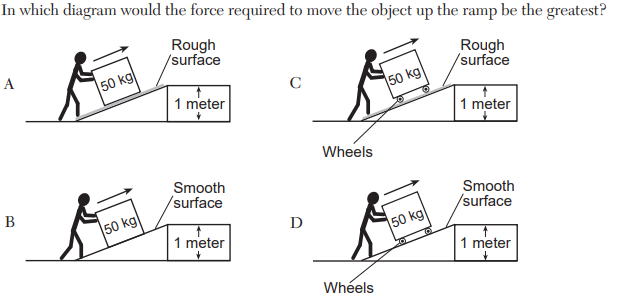
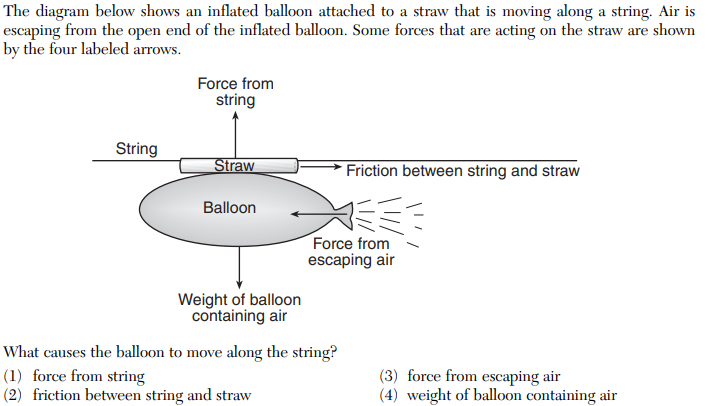
Based on your knowledge of friction force, answer the following question...
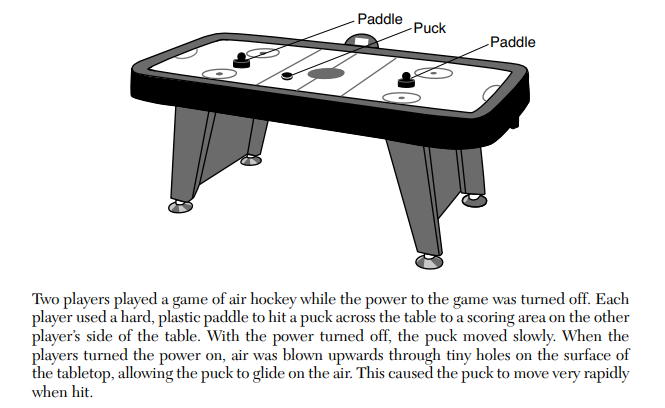
Describe one way, other than turning the table on, that the players could have changed the puck to make it glide more easily. Explain why it should work.
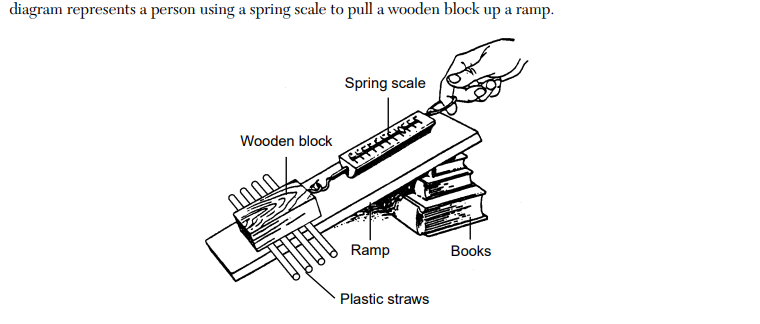
The plastic straws were placed under the wooden block to...
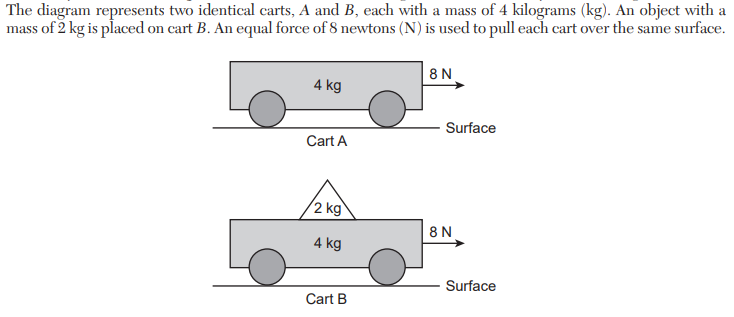
Which cart will change speed more quickly?
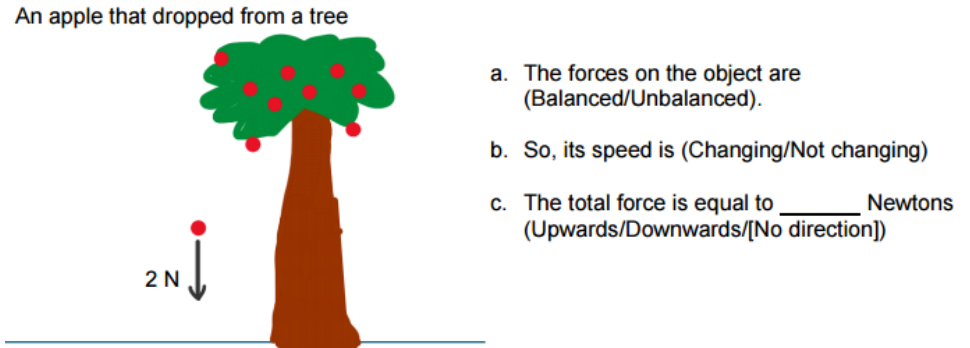
Answer the following questions based on the image.
Part a.
The forces on the object are...
Part b.
So, its speed is...
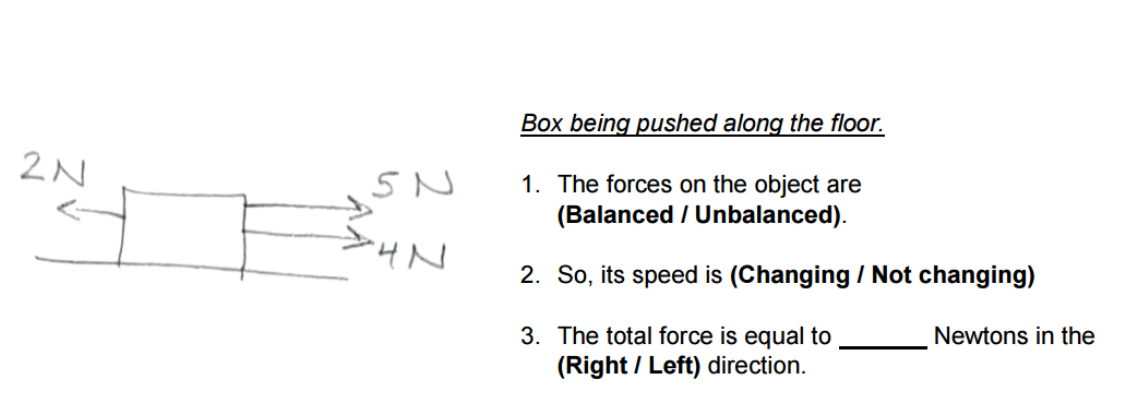
Answer the following questions based on the image.
Part a.
The forces on the object are...
Part b.
So, its speed is...
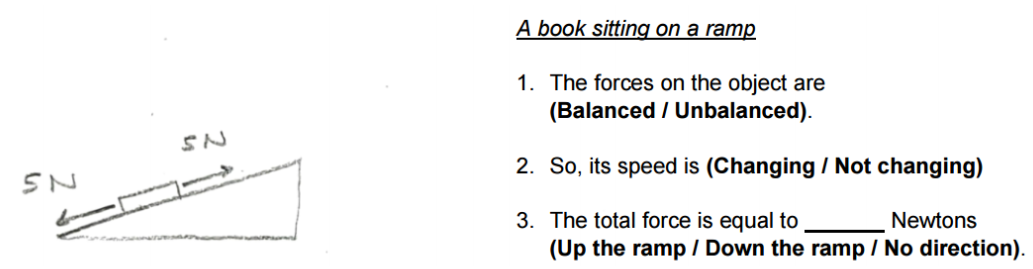
Answer the following questions based on the image.
Part a.
The forces on the object are...
Part b.
So, its speed is...
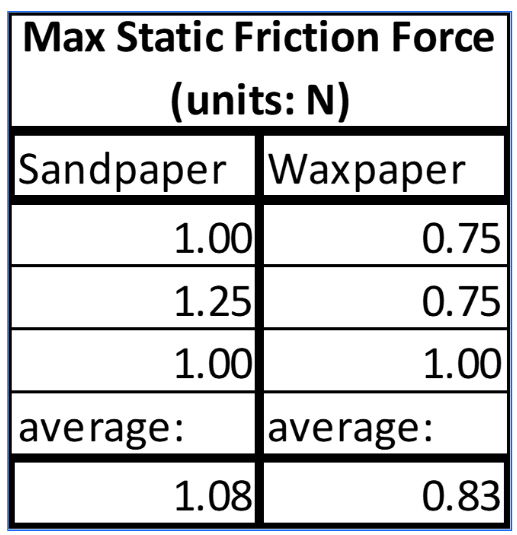
A wooden block is pulled on two different surfaces: sandpaper then wax paper. The maximum force of static friction between the block and each surface was recorded for three trials in the table shown.
Using the average values of force for sandpaper and wax paper, sketch a bar graph of Static Friction Force vs. Surface. Label the axes, shade in the bars, and write the numerical values for each bar with units.
Given the data and from your bar graph, what can be concluded about the static friction force of the different surfaces? Provide an explanation for this difference using your knowledge of why friction happens.
Part c.
The total force is equal to
Part c.
The total force is equal to
Part c.
The total force is equal to