Preskoči na glavni sadržaj
Prijava
Sign up for FREE
arrow_back
Biblioteka

U2 Ch1: Checking Accounts and Linear Equations

star
star
star
star
star
Posljednje ažuriranje over 1 year ago
61
Napomena autora:
Section 1: Paying for Things
0
0
0
0
0
0
Section 2: Checking Accounts
0
0
0
0
0
0
0
0
0
Section 3: Unbanked

Watch this short segment from a documentary, then answer the questions. (The whole thing is worth a watch when you have time!!)

0
0
0
0
0
0
Section 4: Bank Fees
0
0
0
0
0
0
0
0
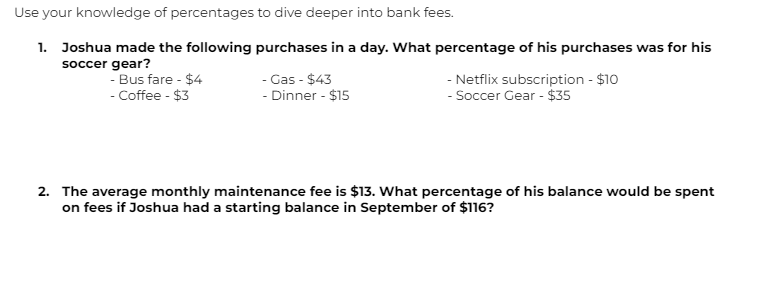
Section 5: Percentages and Bank Fees
Section 6: 5pt Quiz
Section 7: Linear Patterns
0
0
0
0
0
0

Notes on a couple of problems, including an example of using algebra to solve to the y-intercept

Section 8: Apply It Review
1
1
1
1
1
1
1
Section 9: Apply It
Objectives:

  • Explain the purpose and benefits of a checking account

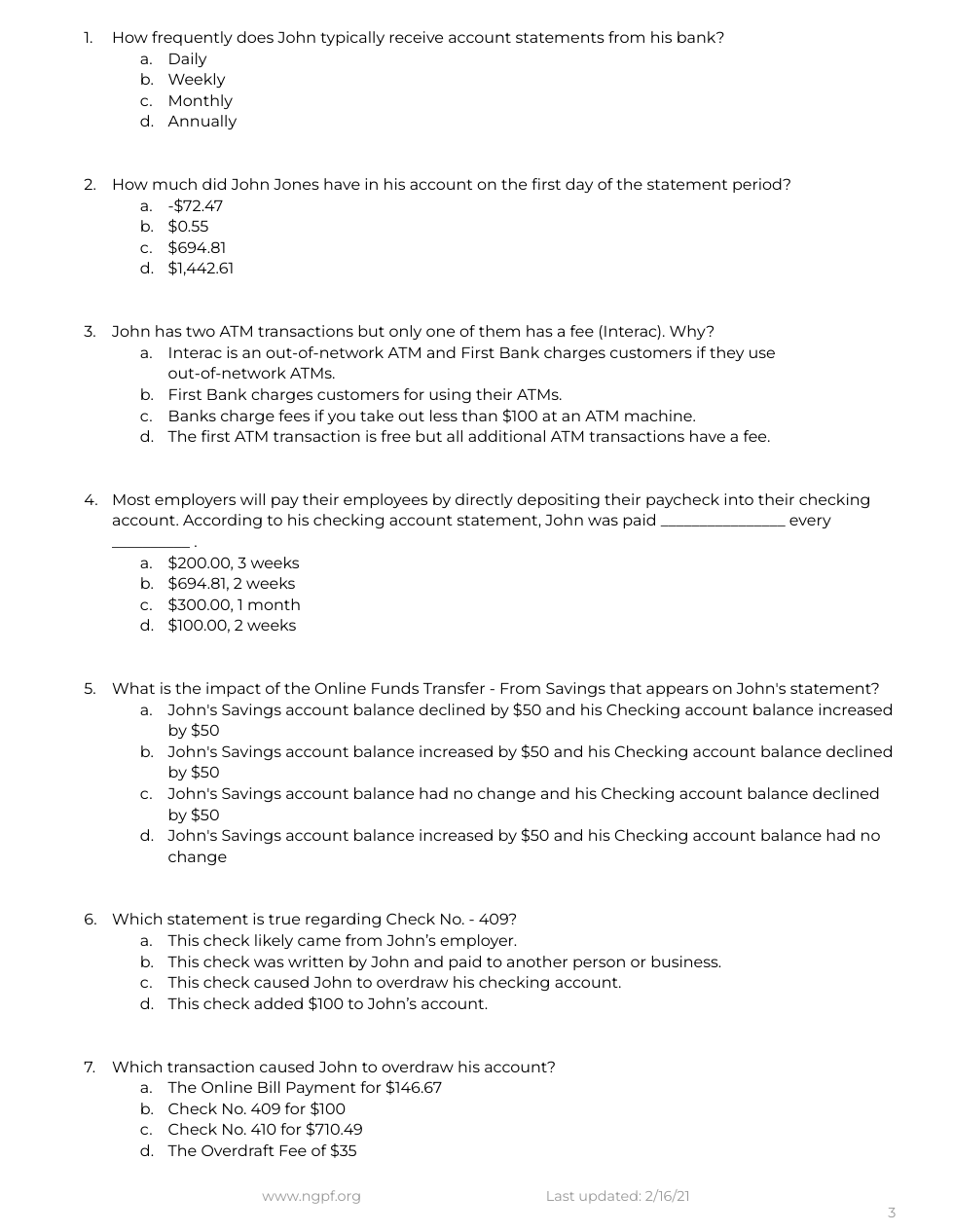
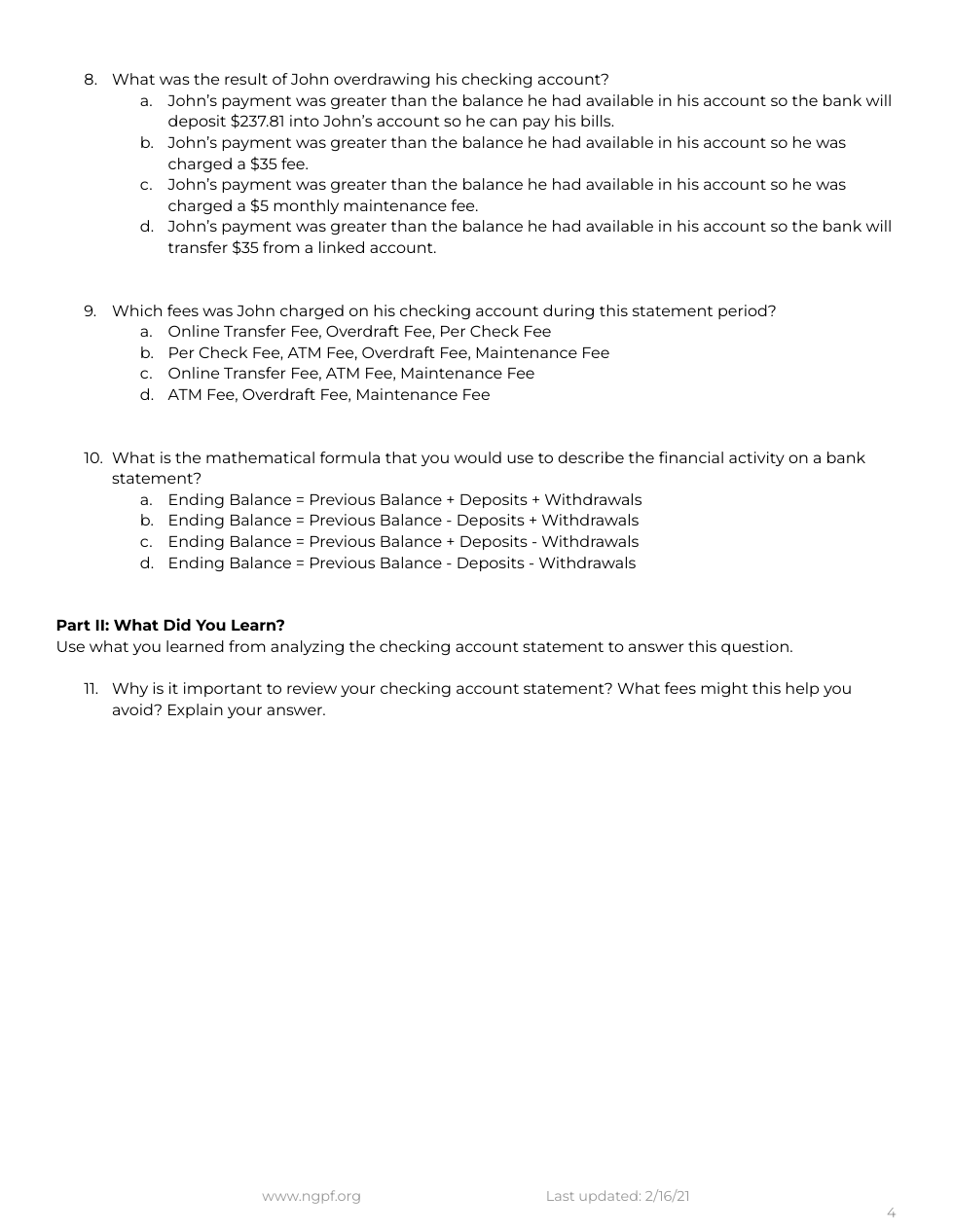
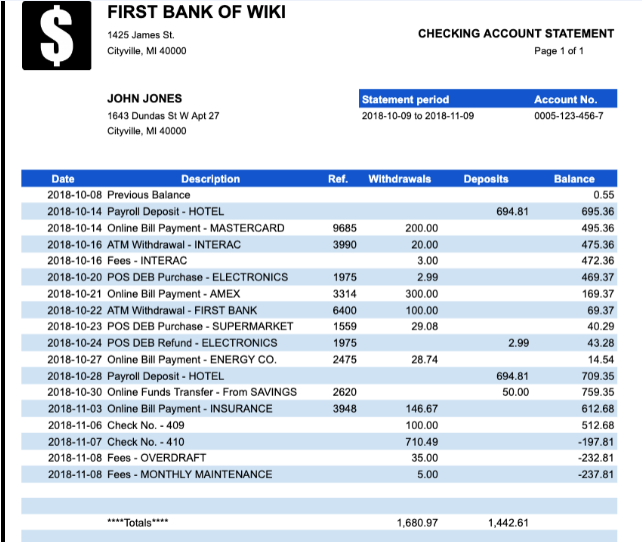
  • Read a bank statement

  • Analyze the consequences of not being in the banking system

  • Compare two different graph representations of account balance data

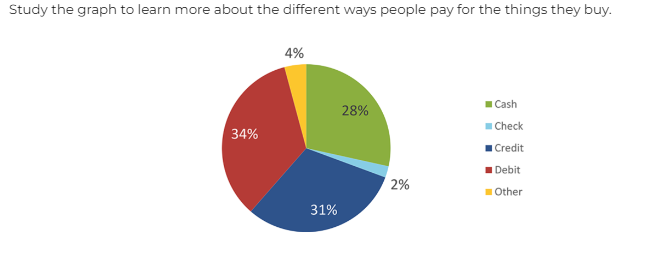
  • Analyze real-world data presented in a pie chart and bar graph.

Objectives:

  • Explain the purpose and benefits of a checking account

  • Read a bank statement

  • Analyze the consequences of not being in the banking system

  • Compare two different graph representations of account balance data

  • Analyze real-world data presented in a pie chart and bar graph.

Source

Pitanje 1
1.
Stavka koja se može prevućiarrow_right_altOdgovarajuća stavka

Debit

arrow_right_alt

Comes right out of your wallet, requires going to ATM/bank or getting paid/gifted money in cash

Check

arrow_right_alt

Connects to your checking account, takes money out instantly

Credit

arrow_right_alt

Connects to your checking account, depending on where you are making a purchase, money may come out instantly or in a few days

Cash

arrow_right_alt

Does not connect to your accounts, allows you to borrow money, borrowed money accrues interest which means you pay back more than you spent if you don't pay it back within a month (in most cases)

Pitanje 2
2.

Choose the THREE most common forms of payment, based on the graph

Pitanje 3
3.

What total percentage of purchases were paid for with either a credit card, debit card, or check?

Pitanje 4
4.

Make a prediction - how do you think popular payment methods might change over time?

Pitanje 5
5.

Critical thinking - what is the benefit of paying with cash/debit/check?

Pitanje 6
6.

Critical thinking - what is the benefit of paying with credit?

ARTICLE: The Complete Guide to Checking Accounts

Read the first few paragraphs of this article, up through the section titled “Free Checking Accounts -- and How to Qualify for One.”

Pitanje 7
7.

List some ways to get money OUT of your checking account.

Pitanje 8
8.

List some ways to get money INTO your checking account. Note: Two common methods not mentioned in the article are mobile banking apps and direct deposit. You’ll learn more about these methods in later lessons.

Pitanje 9
9.

Why do you think it is important to have a FREE checking account, if possible?

INFOGRAPHIC: Good Reasons to Open a Checking Account

Now that you know how a checking account works, review the infographic to learn more about the benefits of opening one.

Pitanje 10
10.

Which reason to open an account is the most important to you, personally? Why?

Pitanje 11
11.

Why might it be beneficial to get a text or email alert if your balance is low, there is a deposit or withdrawal, or a bill is due?

Pitanje 12
12.

Why do you think it’s important to choose a bank account that is FDIC-insured? Note: The Federal Deposit Insurance Corporation (FDIC) insures the money you deposit in certain bank accounts, so you will not lose your money if the bank fails.

Pitanje 13
13.

What is the purpose of a bank statement?

Pitanje 14
14.

Why is it helpful to check each transaction on your statement?

Pitanje 15
15.

You get official statements monthly, but you can also stay up to date on your transactions using the bank's app or website. How often do you think you would want to check your bank transactions and balance? Why?

0
0
0
0
0
0
0
0
Pitanje 23
23.
0
0
0
Pitanje 27
27.

Why do many people choose to use check-cashing services?

Pitanje 28
28.

What are some of the disadvantages of being unbanked?

Pitanje 29
29.

How might the shift towards digital banking, online shopping, and online bill payments impact people who are unbanked?

Why Are Many Americans Unbanked?

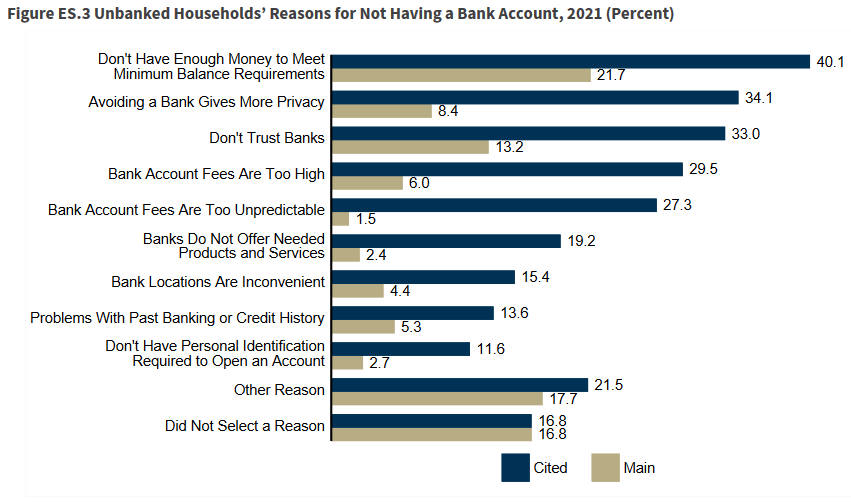
Being unbanked is expensive, yet millions of Americans do not have bank accounts and regularly rely on alternative financial services, like check cashers. Analyze this graph to learn more about the reasons why people are unbanked.

Pitanje 30
30.

Check off the THREE most common reasons people listed (cited) for not having a bank account? Hint: Look at the darker bar in each pair

Pitanje 31
31.

What percentage of people said their main reason was not having enough money to meet minimum balance requirements? (Hint: the lighter bars show Main Reasons)

Pitanje 32
32.

Opinion: Why do you think “bank fees are too unpredictable” is frequently cited as a reason not to have a bank account, but only 1.5% of respondents said it was the main reason?

7 Common Bank Fees Explained

Read this article about common checking account fees. Then, answer the questions.

Pitanje 33
33.

What fee or fees are the largest? Approximately how much are they?

Pitanje 34
34.

Why might small ATM fees turn out to be very expensive?

Pitanje 35
35.

What fees do you think you personally would be most likely to get hit with (incur)? Why?

VIDEO: Bank Overdraft Fees

One of the most common fees banks charge is the Overdraft fee. Watch this video to learn what this fee is and what you can do to avoid it. Then, answer the following questions.

Pitanje 36
36.

What is misleading about the term “overdraft protection”?

Pitanje 37
37.

True or False: Once you are signed up for overdraft protection, you cannot opt out.

Pitanje 38
38.

What else did Sharon do to avoid future overdraft fees?

ARTICLE: 7 Mobile Banking Alerts Everyone Should Activate

In the previous video, you saw that Sharon had set up some alerts so that she could avoid expensive banking fees. Skim this article to find out what kinds of alerts you can set up so you can avoid fees as well. Then, answer the following questions.

Pitanje 39
39.

In your own words, briefly describe the benefit of each type of alert below:

Low Balance

Direct Deposit

Unusual Activity

Pitanje 40
40.

Opinion: All three of the alerts are highly recommended, which one do you think is most important? Why?

0
Pitanje 41
41.

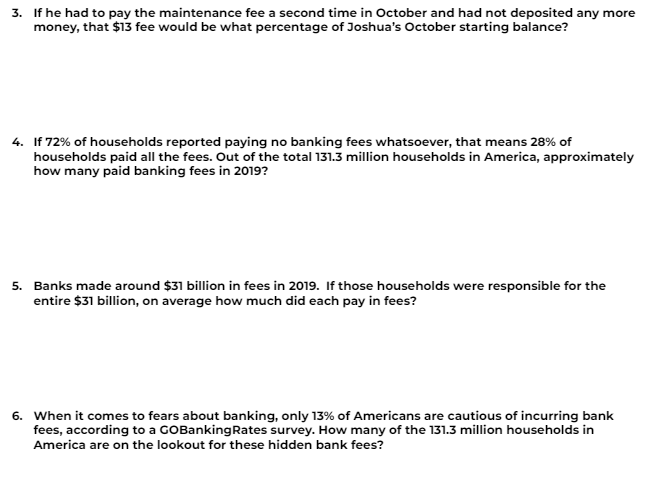
Round to the nearest hundredth (two decimal places)

0
Pitanje 42
42.

Round to the nearest hundredth (two decimal places)

0
Pitanje 43
43.

Round to the nearest hundredth (two decimal places)

0
Pitanje 44
44.
0
Pitanje 45
45.
0
Pitanje 46
46.

5 Point Quiz

This 5 Point Quiz will be about banking info and reading bank statements from sections 1-4 and percent questions like section 5

There will be three 1pt questions, two 2 pt questions, and two 3 pt questions. You need to complete a total of 5 points. You can do extra just in case you get something wrong.

Quiz Link (if you are doing this late, you need to ask Mrs. B to unlock it)

Pitanje 47
47.

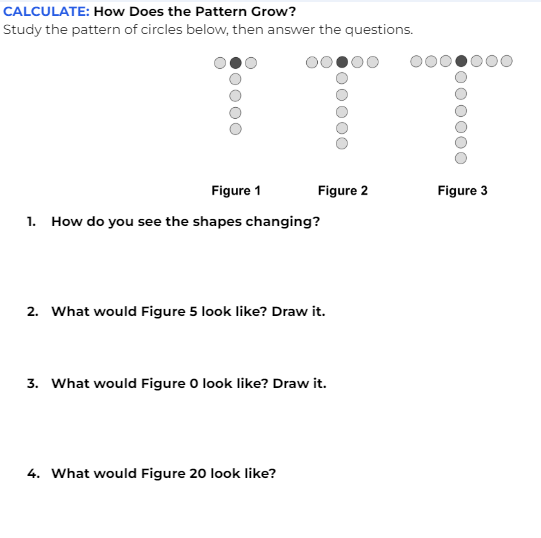
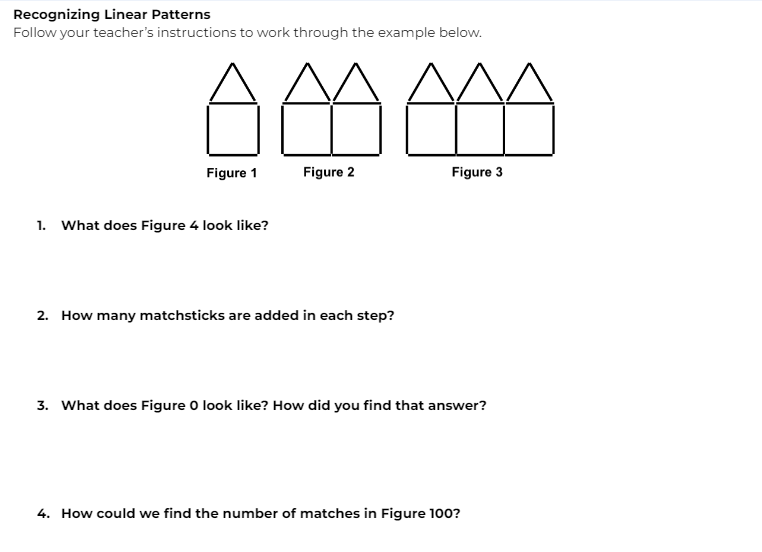
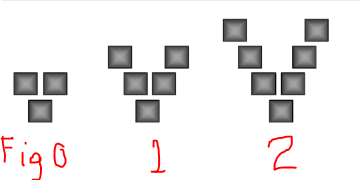
Click on the show your work box. Look at the pattern, then fill in the table, the graph, and answer the questions

Pitanje 48
48.

How many blocks would Figure 4 have in the pattern?

Pitanje 49
49.

When finding Figure 4, which representation (graph, table, or equation) is most useful for you? Why?

Pitanje 50
50.

Given y = 3x + 2

What is the slope (rate)?

What is the starting value (y-intercept)?

Pitanje 51
51.

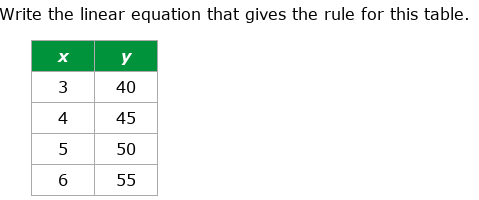
Write the equation by finding the starting point and rate of change (slope)

Slope (rate)

Starting value (y-intercept)

Equation

Pitanje 52
52.

Slope (rate)

Starting value (y-intercept)

Equation

0
Pitanje 53
53.

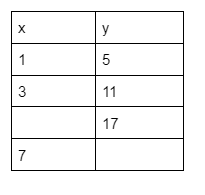
What value goes here?

0
Pitanje 54
54.

What value goes here?

Need more practice? Check out these skills on IXL:

X.10 Write a linear equation from a graph - Search Shortcut: 78T

CC.7 Write a linear function from a table - Search Shortcut UYY

W.6 Rate of change: tables - Search Shortcut 4Q5

CC.5 Rate of change of a linear function: graphs - Search Shortcut ZPF

O.9 Extend growing shape patterns - Search Shortcut NVV

Pitanje 55
55.

y=4x+2

Rate (slope)

Starting point (Initial Value, y-intercept)

Pitanje 56
56.

Rate (slope)

Starting point (Initial Value, y-intercept)

Pitanje 57
57.

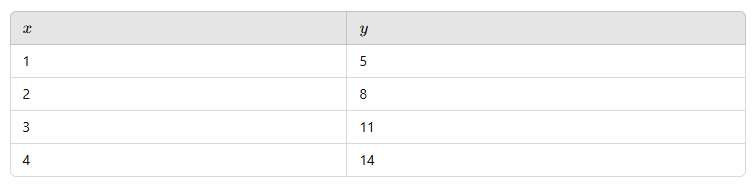
Write the equation for the table of values

Pitanje 58
58.

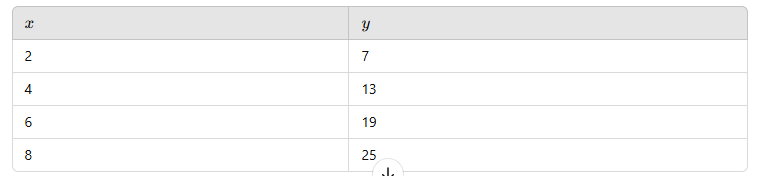
Write the equation for the table of values

Pitanje 59
59.

Emma is a freelance graphic designer. She charges a $50 setup fee plus $30 per hour of work.

Question: Write an equation that represents Emma’s total earnings, E, based on the number of hours worked,

Pitanje 60
60.

A cell phone company charges a monthly base fee of $25, plus $0.10 per text message sent.

Question: Write an equation to represent the total monthly cost, C for t text messages.

Pitanje 61
61.

David sells homemade cookies at a farmers' market. He spends $15 on ingredients and sells each cookie for $2.

Question: Write an equation for David’s profit, P after selling c cookies.

10 point graded assignment

Click here to access

If you are doing this late, you need to message Mrs B to unlock

Pitanje 16
16.
Pitanje 17
17.
Pitanje 18
18.
Pitanje 19
19.
Pitanje 20
20.
Pitanje 21
21.
Pitanje 22
22.
Pitanje 24
24.
Pitanje 25
25.
Pitanje 26
26.