OBJECTIVES & STANDARDS
Math Objectives
Explore and describe linear functions using pattern recognition
Identify the initial value and rate of change of a linear pattern
Write an equation for a linear function based on pattern
Common Core Math Standards
Link to all CCSS Math
Personal Finance Objectives
This lesson is focused on math. There are no applicable personal finance objectives
National Standards for Personal Financial Education
There are no relevant Jump$start standards.
DISTRIBUTION & PLANNING
Distribute to students
OBJECTIVES & STANDARDS
Math Objectives
Explore and describe linear functions using pattern recognition
Identify the initial value and rate of change of a linear pattern
Write an equation for a linear function based on pattern
Common Core Math Standards
Link to all CCSS Math
Personal Finance Objectives
This lesson is focused on math. There are no applicable personal finance objectives
National Standards for Personal Financial Education
There are no relevant Jump$start standards.
DISTRIBUTION & PLANNING
Distribute to students
CALCULATE: How Does the Pattern Grow?
Study the pattern of circles below, then answer the questions.
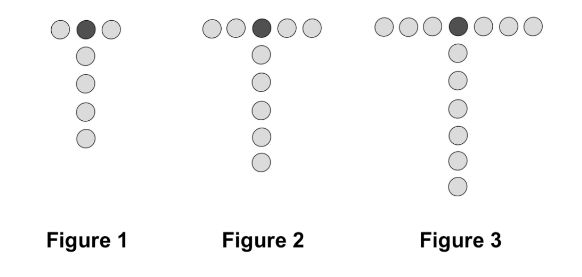
How do you see the shapes changing?
What would Figure 5 look like? Draw it.
What would Figure 0 look like? Draw it.
What would Figure 20 look like?
Recognizing Linear Patterns
Follow your teacher’s instructions to work through the example below.
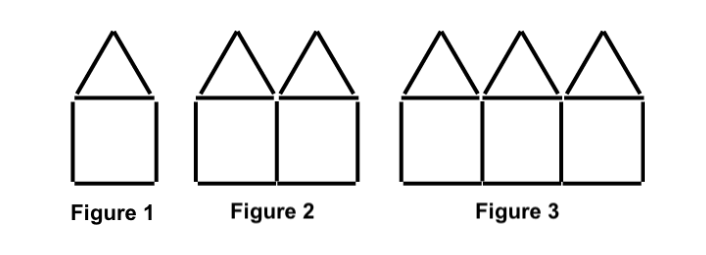
What does Figure 4 look like?
How many matchsticks are added in each step?
What does Figure 0 look like? How did you find that answer?
How could we find the number of matches in Figure 100?
ACTIVITY: CREATE: Linear Patterns Jigsaw
Now that you’re familiar with linear patterns, you’ll have some time to explore their different representations with your group. It’s okay if some parts seem new or confusing; it might take some work to figure out. Follow your teacher’s directions to complete the activity.
**If present, complete the chart on #9 in your book. If absent, complete your make-up work in the formative please and take notes in your book**
Complete here for make-up work, if present in class please fill out this table in your notebook.
After completing the activity with your pattern, answer the reflection questions below.
What connections did you find between the pattern, table, graph, and equation?
Your group found many different ways to represent that same function. Use those different representations to answer the questions below.
a. What would Figure 15 look like in your pattern?
b. When finding Figure 15, which representation is most useful for you? Why?
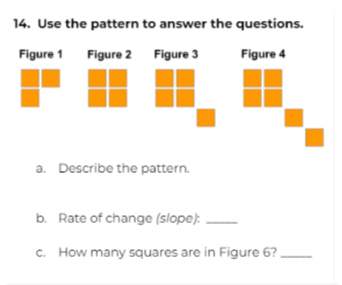
Use the Picture to answer the questions
a. Describe the Pattern:
b. Rate of Change (Slope):
c. How many squares are in Figure 6?
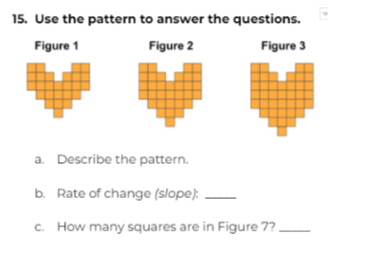
Use the pattern to answer the questions
a. Descirbe the pattern
b, Rate of change (slope):
c. How many squares are in figure 7?
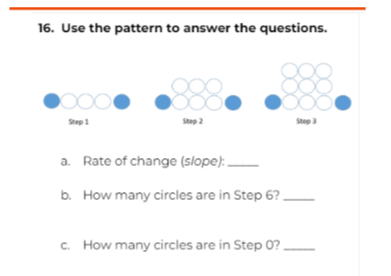
a. Rate of Change (slope):
b. How many circles are in step 6?
c. How many circles are in Step 0?
Complete the table to show the rate of change
x y
0
1 7
2 13
3 19
4
5
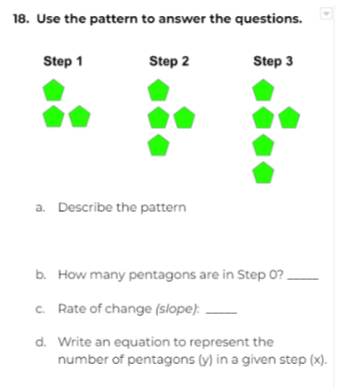
Use the pattern to answer the questions
a. Describe the pattern:
b. How many pentagons are in Step 0?
c. Rate of change (slope):
d. Write an equation to represent the number of pentagons (y) in a given step (x).
Hint: y-mx+b
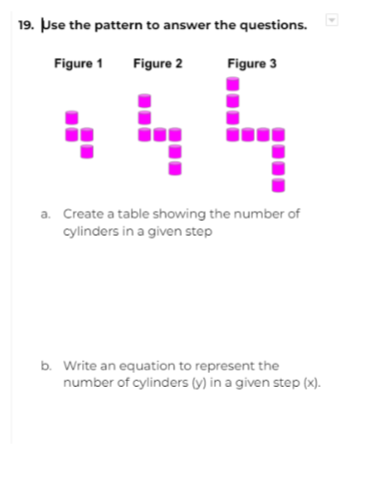
Use the pattern to answer the questions
a. Create a table showing the number of cylinders in a given step
x y
0
1
2
3
4
B. Write an equation to represent the number of cylinders (y) in a given step (x):
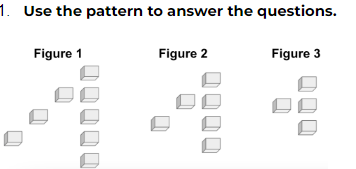
Use the pattern to answer questions about it.
a. How many cubes are in Figure 0?
b. Rate of Change (Slope)?
c. Write an equation to represent the number of squares (y) in a given step (x).
Sara starts a new job and deposits the same paycheck in her checking account each month. After 3 months, her checking account balance is $2,500. It increases to $3100 after four months and $3700 after five months. Assume she makes no withdrawals.
Create a table to represt her account balance: (no symbols like $, just the number)
x y
(Months) (Balance$)
0
1
2
3
4
5
How much did she have before starting direct deposit?$
Write an equation to model Sara's account balance, y, after x months.Hint: y=mx+b
Another term for “rate of change” is slope. Where did you see slope in this activity? Consider how you could find the rate of change from the pattern, table, graph, or equation.
Why was it helpful to find the zeroth term (initial value)?