TCAP Review Packet Unit 7: The Reformation (1 of 7)
star
star
star
star
star
Last updated over 1 year ago
10 Nsɛmmisa
Hyɛ no nsow a efi ɔkyerɛwfo no hɔ:
There are 10 units to the "TCAP Review Packet". This is unit 7 of 10. Do ALL units to get credit and be prepared for TCAP.
Every question can be answered using the information in each article. You should not need other resources.
Standard 7.44 Analyze Johannes Gutenberg’s printing press and William Tyndale’s translation of the Bible into the English language as vehicles for the spread of books, growth of literacy, and dissemination of knowledge.
Use the information in the text to answer the questions below. Be sure to complete all sections to receive full credit for the The Reformation Unit.
Spelling DOES count.
There are 10 units to the "TCAP Review Packet". This is unit 7 of 10. Do ALL units to get credit and be prepared for TCAP.
Every question can be answered using the information in each article. You should not need other resources.
Standard 7.44 Analyze Johannes Gutenberg’s printing press and William Tyndale’s translation of the Bible into the English language as vehicles for the spread of books, growth of literacy, and dissemination of knowledge.
Use the information in the text to answer the questions below. Be sure to complete all sections to receive full credit for the The Reformation Unit.
Spelling DOES count.
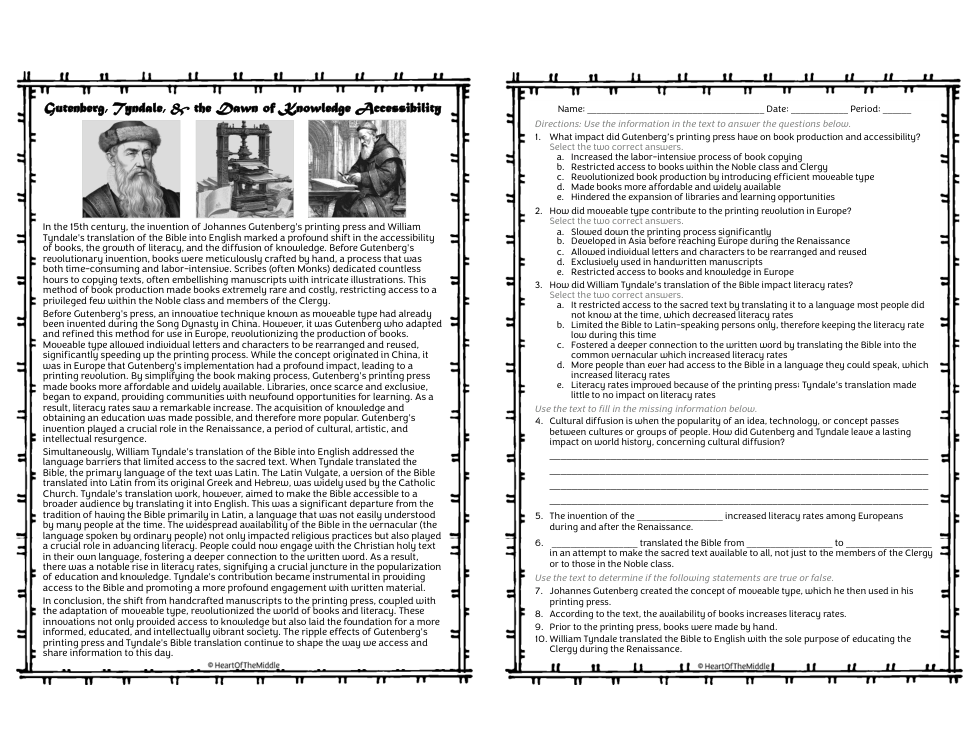
What impact did Gutenberg’s printing press have on book production and accessibility?
Select the two correct answers.
How did moveable type contribute to the printing revolution in Europe?
Select the two correct answers.
How did William Tyndale’s translation of the Bible impact literacy rates?
Select the two correct answers.
Cultural diffusion is when the popularity of an idea, technology, or concept passes between cultures or groups of people. How did Gutenberg and Tyndale leave a lasting impact on world history, concerning cultural diffusion?
The invention of the
after the Renaissance.
William Tyndale translated the Bible from Latin to English in an attempt to make the sacred text available to all, not just to the members of the Clergy or to those in the Noble class.
Johannes Gutenberg created the concept of moveable type, which he then used in his printing press.
According to the text, the availability of books increases literacy rates.
Prior to the printing press, books were made by hand.
William Tyndale translated the Bible to English with the sole purpose of educating the Clergy during the Renaissance.
