Ɛhia
2
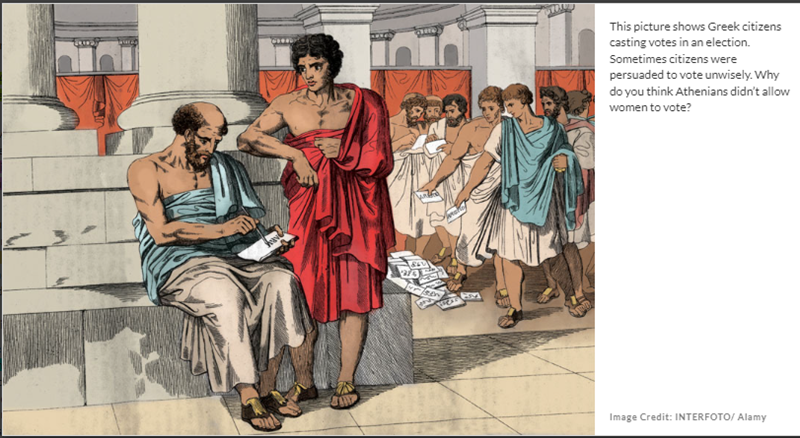
After studying this picture and caption, what were two problems with Athen's democracy?
After studying this picture and caption, what were two problems with Athen's democracy?
Ɛhia
1
After studying this picture and caption, what were two problems with Athen's democracy?
Sparta differed from Athens in almost every way, beginning with its government. While Athens was a democracy, Sparta was an oligarchy in which the ruling power was in the hands of a few people. Sparta's government—as well as Spartan society—was dedicated to military strength. Founded in the 800s B.C.E., Sparta was the leading military power in the Mediterranean area until about 370 B.C.E. Like Athens, Sparta had an Assembly. However, the important decisions were actually made by a much smaller group called the Council of Elders. The Council of Elders consisted of two kings and 28 other men. The two kings inherited their position and shared equal powers, but the other 28 members of the council were elected by members of the Assembly.
Which word below is a synonym for the word argued?
The
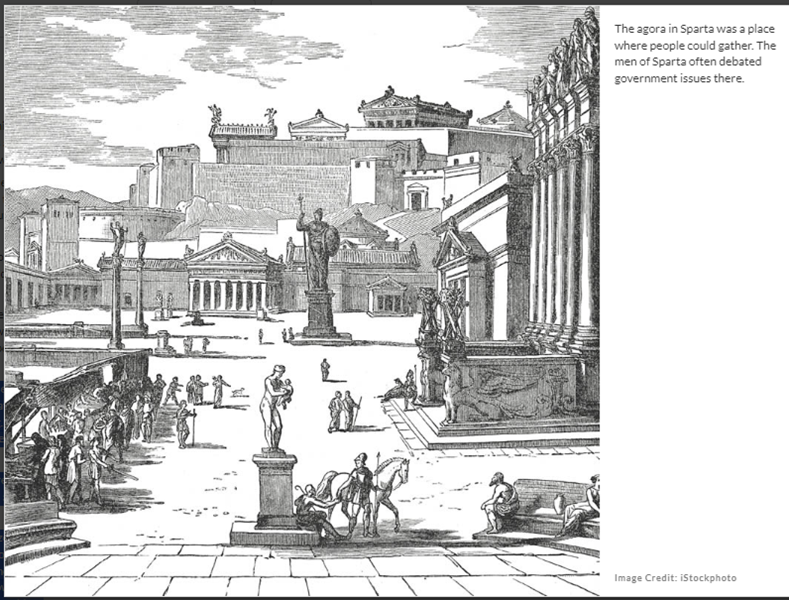
The agora in Sparta was a gathering place for citizens.
Every citizen could take part in the city's government. A group called the Council of 500 met every day. Each year, the names of all citizens who were 30 years of age or older were collected. Then, 500 citizens were selected to serve on the council. The council ran the daily business of government. It also suggested new laws.
Proposed laws needed approval from a much larger group. That was the Assembly of Athens. The Assembly met on a hill called the Pnyx every ten days. According to law, at least 6,000 citizens needed to be there for a meeting to happen. If fewer people attended a meeting, enslaved people armed with ropes dipped in red paint would be sent out to collect more citizens. Athenian men were said to be embarrassed to appear in red-stained clothes at these meetings.
The Assembly debated issues. They also voted on laws that the council proposed. Every citizen had the right to speak at Assembly meetings. Some speakers were more skilled than others. Some spoke longer than others. Sometimes, a water clock was used to time a speaker. It worked by placing a cup filled with water above another cup. The top cup had a small hole drilled into the bottom. A speaker was allowed to talk only during the time it took for all the water in the top cup to drain into the bottom cup.
After reading BOTH passages, which government group had the least power?
After reading both passages above, compare the governments of Athens and Sparta. Drag the items below to the correct category.
Had to be at least 30 years old
Met every 10 days
Met every day
Had to be at least 60 years old
Made up of thirty citizens
Could only vote yes or no
Met away from the center of the city because it was too large
At least 6000 citizens
Prepared laws for Sparta
Debated issues AND voted on laws
Made up of five hundred citizens
Used a water-cup timer
Had to be from a noble family
Athens' Assembly
Council of Elders
Athens Council
Sparta's Assembly
Athens became a democracy around 500 B.C.E. However, unlike modern democracies, Athens only permitted free men to be citizens. All Athenian-born men over the age of 18 were considered Athenian citizens. Women and people who were enslaved were not permitted citizenship. Every citizen could participate in the city's government. A group called the Council of 500 met every day. Each year, the names of all citizens 30 years of age or older were collected. Then, 500 citizens were selected to serve on the council, which ran the daily business of government and suggested new laws.
What type of government did Athens use around 500 B.C.E?
Which word below is a synonym for "allowed?"
Athens
Which three groups were not allowed to participate in Athen's government?
What three things were true of the Council of 500?
Only free men could be citizens in ancient Athens.
The Council of 500 was responsible for making the laws in Athens.
All Athenian-born men over 18 were considered citizens in Athens.
Women had the same rights as men in Athenian citizenship.
Proposed laws needed approval from a much larger group, the Assembly of Athens. The Assembly met on a hill called the Pnyx every ten days. According to law, at least 6,000 citizens needed to be present for a meeting to occur. If fewer people attended a meeting, enslaved people armed with ropes dipped in red paint would be sent out to collect more citizens. Athenian men were said to be embarrassed to appear in red-stained clothes at these meetings. The Assembly debated issues and voted on laws that the council proposed. Every citizen retained the right to speak at Assembly meetings. Some speakers were more skilled than others, and some spoke longer than others. Sometimes, a water clock was used to time a speaker. It worked by placing a cup filled with water above another cup. The top cup had a small hole drilled into the bottom. A speaker was permitted to talk only during the time it took for all the water in the top cup to drain into the bottom cup. Most Athenian men enjoyed participating in the city’s democratic government. They liked to gather and debate the issues and were proud of their freedom as Athenian citizens.
Which word below is a synonym for suggested?
How did the Athenian citizens feel about their democratic government?
What five statements below were true of the Assembly of Athens?
Once someone suggested a new law, who needed to approve it?
The Assembly of Athens met every ten days at a location called the Pnyx.
Only Athenian men were allowed to participate in the Assembly debates.
A maximum of 6,000 citizens were required for an Assembly meeting to take place.
A water clock was used to time speeches during Assembly meetings.
What are the people in this picture doing?
What type of government did Sparta use?
Which word below is a synonym for created?
Sparta's
Which statement below best summarizes how Sparta's government was similar to Athen's government?
What three statements below describe the Council of Elders?
Sparta had a democracy similar to Athens.
Sparta's government prioritized military strength over other values.
To be elected to the Council of Elders, men had to be at least 60 years old and from a noble family. Some scholars believe that members of the Assembly voted for candidates by shouting. Those men who received the loudest support were elected. Once elected, they served for life. The Council of Elders held the real power in Sparta. It prepared laws for the Assembly to vote on and had the power to stop any laws passed by the Assembly that council members opposed. The Assembly in Sparta was comprised of only male citizens. Because the Assembly was large, it met in a spacious outdoor area away from the center of the city. Unlike the Assembly in Athens, it did not debate issues. Members of the Assembly had limited powers and could only vote yes or no on laws suggested by the Council of Elders.
How old did a Spartan citizen have to be to be elected into the Council of Elders?
What other four statements are true of the Council of Elders in Sparta?
Click on the two selections below that explain why the Assembly in Sparta was not very strong?
The Assembly in Sparta was
Which three statements below were true about the Assembly in Sparta?
How did the Assembly members vote for candidates?
Who had real power in the Spartan government?
What could Sparta's Assembly do with laws proposed by the Council?
The Assembly in Sparta actively debated laws before voting on them.
The Council of Elders had the authority to block laws approved by the Assembly.
Only male citizens were allowed to be part of the Assembly in Sparta.
After studying the picture and caption, What did the men of Sparta do at their agora?