STAAR Grade 5 RLA

Last updated 9 months ago
41 questions
Read the selection and choose the best answer to eat question.

Fashion Forward

(1) Traditional fabrics come from natural sources. Cotton comes from plants, for example. Wool comes from animals. But by the twentieth century, scientists found ways to create plastic fibers. We use fabrics made from them, such as polyester, nylon, and spandex, every day. Plastic fibers are strong and stretchy. Their fabrics do not wrinkle easily and are less likely to tear. People love how durable these clothes are.

(2) But plastic-based clothing can be too strong. These fabrics take a very long time to biodegrade, or fall apart. That means that a lot of old T-shirts and sweatpants just sit in our landfills. To solve this problem, fashion designers have started using new materials to make clothing. These fabrics can be the best of both worlds. Like traditional fabrics, they can be biodegradable and break down in the earth when thrown away. Yet they can still be strong like plastic-based fabrics. More designers need to start using fabrics like these. The fibers they are made from are not only safe for the planet but also great for making interesting, beautiful clothing.

(3) Biodegradable fibers do not just break down in a landfill—they do it quickly. Fibers made from kelp, a kind of seaweed, can break down even faster than cotton can. Kelp fiber was created by a team of professors and students at the Fashion Institute of Technology. The team first extracts algae from the kelp. Then they turn the algae into a gel. Finally, they transform the gel into a fiber that can be spun into a yarn. You can knit that yarn into clothes. When one of the team members spoke about this process to the public, she was wearing a kelp-fiber tank top.

(4) Since these fibers are usually made from natural materials, they take less energy to produce. Kelp, for instance, grows with sunlight. It is one of the fastest-growing living things on Earth. Kelp grows up to two feet in a single day. Humans do not need a factory to create this resource, so it does not pollute the air. Nature does the work for us.

(5) In addition, biodegradable fibers can be turned into stylish clothing. This has the added benefit of opening up new frontiers for fashion designers. It is often hard for designers to come up with shapes and styles that have not been made already. But a new kind of fabric can bring something fresh to their work. One designer recently made a gold-colored dress from biodegradable Microsilk. The material is made from water, yeast, sugar, and spider DNA. It moves like silk but is actually stronger. It's a revolutionary idea.

(6) Though such fibers can make Earth-safe, stunning dresses, they are not perfect. Most are still not as durable as plastic-based materials. Durability and quality are why people like plastic fibers in the first place. A shopper might not buy a biodegradable shirt unless it is as affordable, easy to wear, and long-lasting as a nylon one. But with further research and collaboration with scientists, designers can improve the quality of such clothes. Then, we can all start to wear the fashion of the future.
1

Which sentence from the selection supports the argument that fabric choices can have lasting harmful effects?

1

Read this sentence from paragraph 5.

This has the added benefit of opening up new frontiers for fashion designers.

What is the most likely reason the author describes new biodegradable fibers this way?

1

In paragraph 4, the details about kelp fibers support the key idea that—

1

Based on the ideas presented throughout the selection, what can the reader conclude about fabrics?

1

Read these sentences from paragraph 5.

It is often hard for designers to come up with shapes and styles that have not been made already. But a new kind of fabric can bring something fresh to their work.

What is the best paraphrase of these sentences?

1

What is the most likely reason that the author included the information in paragraph 6?

2

Read the question carefully. Then enter your answer in the box provided.

What is the main claim the author makes in the selection? Support your answer with evidence from the selection.

Read the next two selections. Then choose the best answer to each question.

Passage 1:
A Country Connected

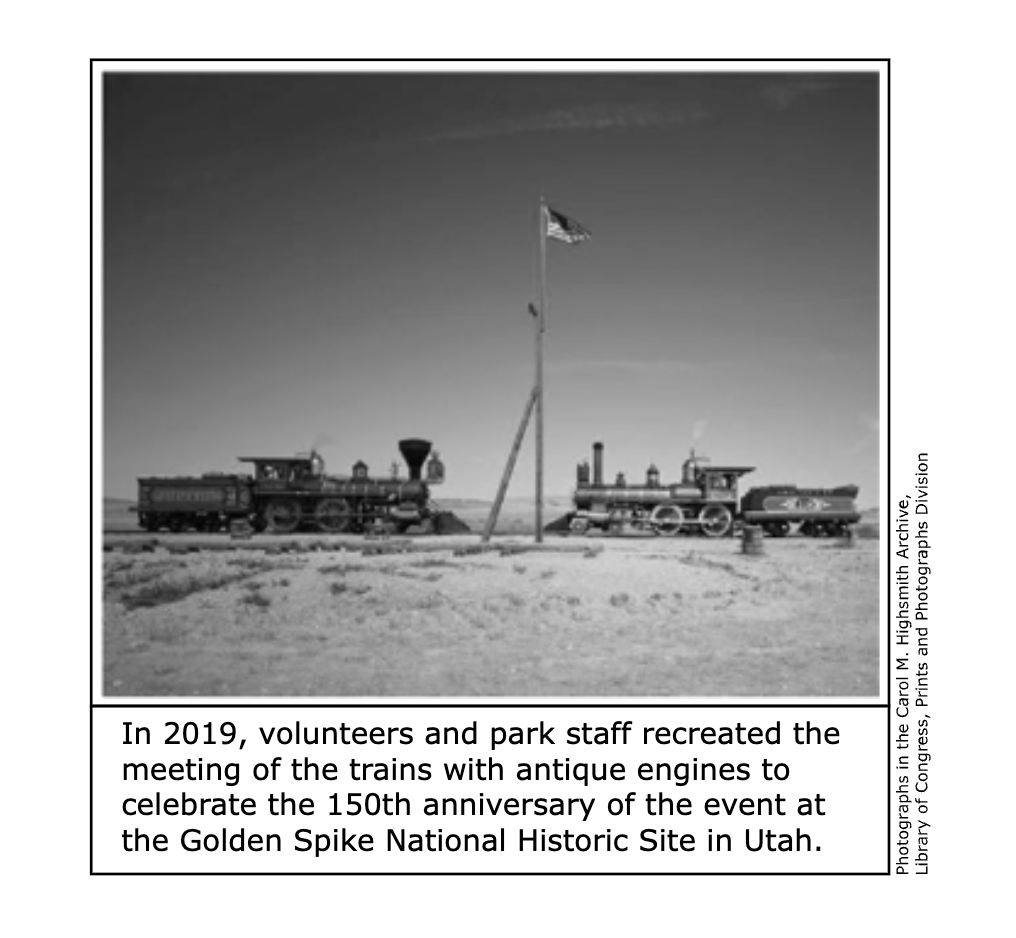
(1) At Promontory Summit, Utah, a crowd gathered to watch. A businessman named Leland Stanford tried to hammer a golden spike to fasten the last rail into the last wooden tie for the longest railroad line ever built. Stanford took a swing, but hit the tie instead! So Thomas Durant, the vice-president of one of the railroad companies, tried. He missed completely! Finally, a third person, a railroad worker, drove the golden spike into the tie.

(2) As soon as the railroad was completed, a message was sent all over the United States: D-O-N-E.

A Life-Changing Project

(3) For six years, people had been building a railroad that would connect the two coasts of the United States. It was called the First Transcontinental Railroad. It was probably as important as the invention of cell phones.

(4) The First Transcontinental Railroad completely changed how and where people lived in America. Traveling from one end of the United States to the other used to take six months. After the railroad was built, this journey took under a week.

(5) According to James Ronda, a historian, it made the western states more important. "What the transcontinental railroad did was bring the West into the world," Ronda said.

How It Was Done

(6) Two railroad companies were in charge of building the railroad. The Union Pacific company built a railroad starting at the Iowa-Nebraska border and reaching the West. The Central Pacific company built track in California and continued to the east. The two rail lines met in Utah.

(7) The companies hired thousands of people to do this work. Many of them were Irish and Chinese immigrants or war veterans. Many left their families behind as they traveled to the West to build the railroad. Their sacrifice was often underappreciated after the railroad was completed. For example, they were left out of the main photo taken at the celebration.

(8) The railroad workers also faced physical challenges. Difficult terrain, such as mountains, blocked the path. The workers had to tunnel through the mountains by blowing up the rock.

(9) Together, the workers of the two companies laid down 1,912 miles of railroad track.

Behind the Scenes

(10) On May 10th, 2019, people celebrated 150 years since the First
Transcontinental Railroad was finished. This time, they highlighted the contribution of the immigrant railroad workers.

(11) Michael Kwan, a judge in Utah, spoke about his great-great-grandfather who worked on the railroad. "He came here pretty much with nothing, and was able to work . .. and then have a family of his own here," Kwan said.

(12) It took enormous effort to finish the First Transcontinental Railroad. So maybe it's fitting that a railroad worker was the one who hammered in the last spike on the day the railroad was completed. He symbolized all the railroad workers who made this achievement happen.
1

In the article "A Country Connected," what is most likely the author's purpose for using a cause-and-effect structure in the section "A Life-Changing Project"?

1

What are the most likely reasons the author includes the photograph in the article "A Country Connected"?

Select TWO correct answers.

1

Based on the ideas presented throughout the article "A Country Connected," what can the reader conclude about the workers who built the railroad?

1

Read the dictionary entry.

depths \'depths\ noun
  1. a place far from the surface
  2. the middle of a time period
  3. the worst part
  4. a measurement from front to back
Which definition best matches the meaning of depths in line 19 of the poem "The World Is at My Fingertips"?

1

Which is the best summary of the poem "The World Is at My Fingertips"?

1

What is the most likely reason the poet includes the details in lines 21 through 28 of the poem "The World Is at My Fingertips"?

1

Which statement expresses an idea found in BOTH the article "A Country Connected" and the poem "The World Is at My Fingertips"?

1

How does the author of the article "A Country Connected" appreciate the accomplishments of others DIFFERENTLY than the poet of the poem "The World Is at My Fingertips"?

1

Which idea about change is developed in BOTH the article "A Country Connected" and the poem "The World Is at My Fingertips"?

1

How are the authors' purposes for including information about family in the article "A Country Connected" and the poem "The World Is at My Fingertips" DIFFERENT?

Read the selection and choose the best answer to each question.

The rabbit El-ahrairah is on a journey to find a solution to protect his home from a fox.

from Tales from Watership Down
by Richard Adams

(1) They say that after that El-ahrairah wandered far and wide, and everywhere he went he gave the animals and birds good advice and help. He met mice and water rats and even an otter, which did him no harm; yet he seemed no nearer to what he was seeking.

(2) At last, one day, he came to a great expanse of common land, and at last, tired out, lay down in a sunny place.

(3) As he lay dozing, he felt the presence of some creature close by and opened his eyes, to see a snake watching him. He was not afraid of a snake, of course, and he greeted it and waited to hear what it would say.

(4) "Cold!" said the snake at last. "How cold it is!"

(5) It was a warm, sunny day, and El-ahrairah himself felt almost too snug in his fur. Rather gingerly, he put out one paw and touched the snake on its green length. It was indeed cold to the touch. He pondered on this but could think of no explanation.

(6) They lay together on the grass for a long time, until at last El-ahrairah became aware of something which he had not noticed before.

(7) "Your blood is not like ours," he said to the snake. "You have no pulse, have
you?"

(8) "What is a pulse?"

(9) "Feel mine," said El-ahrairah.

(10) The snake pressed closer and could feel El-ahrairah's pulse beating.

(11) "That is the reason you are cold," said El-ahrairah. "Your blood is cold.
Snake, you need to bask in the sun as much as you can. When you can't, you will feel sleepy. But when you can, it will warm your blood and make you lively. That's the answer to your problem-sunshine.

(12) They lay in the sun for several hours more, until the snake began to feel active and ready to hunt for food.

(13) "You are a good friend, El-ahrairah," said the snake. "I have heard of the many creatures you have helped with your good advice. I will give you a gift. I will give you the hypnotic power of the snake that is in my eyes. But whatever you use it for, use it quickly, for it will not last. Now stare at me!"

(14) El-ahrairah looked steadily into the snake's eyes and felt his willpower dissolve and even his power to move. At length the snake removed its gaze.
"That's right." it said. So El-ahrairah got up and bade it farewell.

(15) Now he began his journey back to his home warren.1 It was a long way, and it was not until the following evening that he found himself approaching the place.

(16) Now, the story tells that across El-ahrairah's way there ran a brook and that the brook was crossed by a little bridge. And here, on the bridge, El-ahrairah paused to wait, for he knew in his heart what would happen.

(17) Presently, out of the woods above him, came the fox. El-ahrairah saw it coming, and his heart misgave him, yet he remained where he was on the bridge until the fox actually lay down beside him, licking its lips.

(18) "A rabbit!" said the fox. "Upon my life, a plump, fresh rabbit. What luck!"

(19) So then El-ahrairah said to the fox, "I can tell your fortune in the water."

(20) "Ah ha!" said the fox. "Tell my fortune in the water, eh? And what do you see in the water, my friend? Fat rabbits running on the grass, yes, yes?"

(21) "No," said El-ahrairah. "It is not fat rabbits that I see, but swift hounds on the scent and my enemy flying for his life."

(22) And with this he turned and looked the fox full in the eyes. The fox stared back at him, and he knew that it could not avert2 its gaze. It seemed to shrink and dwindle before him.

(23) "Go," whispered El-ahrairah to the fox. "Go, and never return!"

(24) El-ahrairah, exhausted by the terrible encounter, turned and made his way home to his warren, where all were overjoyed to see him. The fox and its mate disappeared from the neighborhood. They must have told their story, for no other foxes took their place, and the warren had peace; as we do now.

1A warren is a burrow habitat for rabbits.
2To avert one's gaze is to look away.

From "The Fox in the Water" by Richard Adams from TALES FROM WATERSHIP DOWN by Richard Adams, Paragon. © 1998.
1

What is the author's purpose for presenting the information in paragraphs 13 through 23 chronologically?

1

Which statement best describes El-ahrairah's relationship with the fox?

1

In paragraph 14, the word dissolve means—

1

Which characteristic of the story best identifies it as a fable?

1

When is the main problem in the story resolved?

1

Which sentence from the story shows that El-ahrairah is friendly?

They say that after that El-ahrairah wandered far and wide, and everywhere he went he gave the animals and birds good advice and help. He met mice and water rats and even an otter, which did him no harm; yet he seemed no nearer to what he was seeking.

At last, one day, he came to a great expanse of common land, and at last, tired out, lay down in a sunny place.

As he lay dozing, he felt the presence of some creature close by and opened his eyes, to see a snake watching him. He was not afraid of a snake, of course, and he greeted it and waited to hear what it would say.
1

Which point of view does the author use in the story?

5

ESSAY: Write your essay in the empty box below.

Read the selection from Tales from Watership Down. Based on the information in the selection, write a response to the following:

Explain how El-ahrairah's kindness helps him throughout the selection.

Write a well-organized informational composition that uses specific evidence from the selection to support your answer.

Remember to—
  • clearly state your central idea
  • organize your writing
  • develop your ideas in detail
  • use evidence from the selection in your response
  • use correct spelling, capitalization, punctuation, and grammar
Manage your time carefully so that you can—
  • review the selection
  • plan your response
  • write your response
  • revise and edit your response
Write your response in the box provided.

Read the selection and choose the best answer to each question.

Fumi has been reading about sunspots and wrote this paper to tell about what she has learned. Read Fumi's paper and look for revisions she needs to make. Then answer the questions that follow.
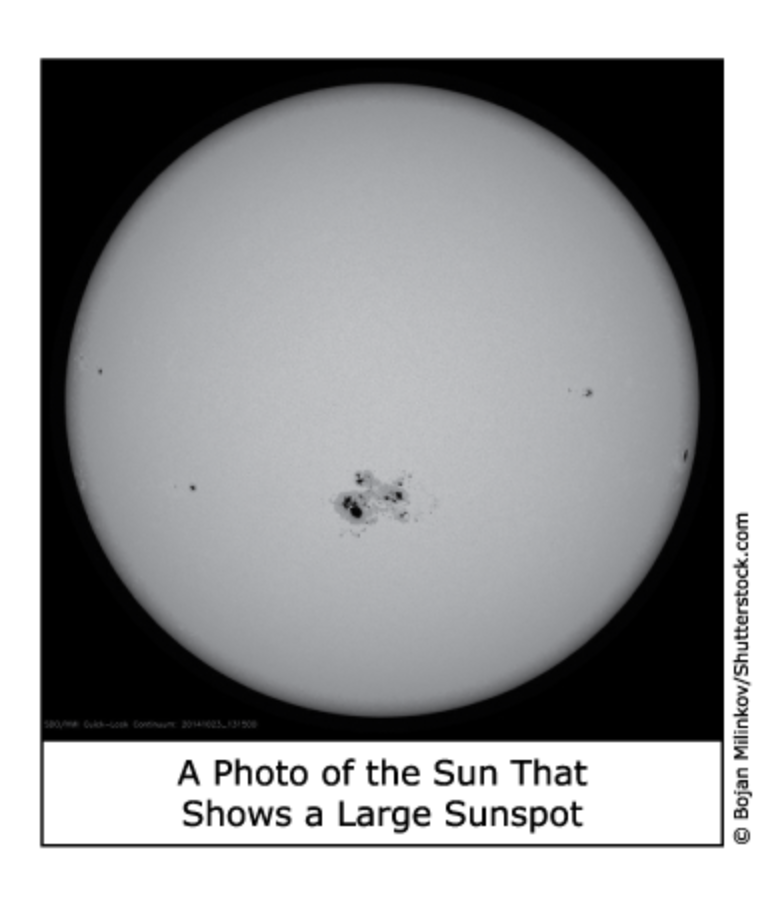

Sunspots

(1) Scientists have known for a long time that the sun is an important energy source for our planet. (2) For centuries they have studied it to learn more about its characteristics. (3) These studies have revealed dark spots on the sun's surface. (4) As early as the 1600s, astronomers used special telescopes and were able to see these spots, now known as sunspots. (5) They wondered if the spots might be clouds or planets passing in front of the sun. (6) Unfortunately, they had no good way to solve the mystery.

(7) Three hundred years later, those spots on the sun were still puzzling scientists on Earth. (8) By this time, however, they had observed that the spots came and went. (9) But they still didn't know why.

(10) As people learned more about the sun, they began to learn more about the funny sunspots. (11) Today scientists understand that the center of the sun is extremely hot. (12) It is so hot that a process called nuclear fusion is taking place all the time. (13) This process produces energy, light, and heat. (14) The surface of the sun is somewhat like a fiery volcano. (15) It is constantly exhibiting a great deal of movement and activity.

(16) In recent years scientists have learned more about sunspots. (17) They are certain areas on the sun's surface. (18) These areas are slightly cooler. (19) However, "slightly cooler" does not mean cool. (20) The spots are still around 6,500 degrees Fahrenheit. (21) That is more than 10 times hotter than an oven on its highest setting. (22) Also, sunspots are not dark. (23) They are simply less bright than the hotter areas that surround them.

(24) Another feature of sunspots is that they are all different sizes. (25) Scientists have observed spots that are as wide as 100,000 miles across. (26) One of the largest ever discovered was the size of the planet Jupiter.

(27) Perhaps most interesting of all, sunspots offer clues as to what is happening deep within the sun. (28) Magnetism is a force, just like gravity is. (29) Some areas within the sun have stronger magnetic activity than others. (30) Sunspots seem to form over the areas with the most magnetic activity. (31) The magnetism keeps some of the heat from escaping to the sun's surface. (32) This results in a cooler area, or sunspot.

(33) Sunspots are fascinating, and there is much more to learn about them. (34) In 2018 they launched an unmanned spacecraft to study the sun. (35) The Parker Solar Probe will travel closer to it than any spacecraft ever has. (36) Scientists hope to learn more about our sun and the magnetic activity that is creating all those sunspots.
1

The word funny is not the MOST effective word to use in sentence 10. Which word should replace funny in this sentence?

1

Which transition word or phrase should be added to the beginning of sentence 14?

1

Fumi wants to combine the ideas in sentences 17 and 18. In the box provided, write a complete sentence that combines these ideas in a clear and effective way.
1

The meaning of sentence 34 is unclear. Which word or phrase should replace they in this sentence?

Read the selection and choose the best answer to each question.

Benito wrote this paper about an adventure he had on a recent hike. Read Benito's paper and look for revisions he needs to make. Then answer the questions that follow.

An Unexpected Adventure
(1) The sun beamed from behind the puffy clouds. (2) We grabbed our walking sticks and scrambled out of the car. (3) Aunt Rosa, my sisters, and I were convinced that it was a perfect day for a hike.

(4) About an hour up the trail, everything started to change. (5) The birds that had been providing the background music for our hike seemed to go silent. (6) They were no longer singing at all. (7) A light wind began to blow. (8) There was an odd stuffiness in the air too. (9) Suddenly, the sky seemed to shift from bright and clear to dull and gray.

(10) I glanced up above and saw dark clouds rolling in. (11) The clouds looked almost like waves in the ocean, and they were moving fast. (12) Without much warning, the first raindrops began to fall onto the trail. (13) Splat! (14) I looked up, and a big one hit me in the face. (15) Soon, more and more raindrops began to splatter all around us.

(16) My little sister ran to grab her hand as the rain started to fall harder. (17) I wasn't particularly worried, but I was wondering how we were going to get back to the car. (18) Fortunately, I soon learned that our aunt was an experienced hiker. (19) She had been caught in sudden rainstorms before, and she knew exactly what to do.

(20) Aunt Rosa was really smart. (21) While lots of rain was falling, there did not seem to be any sign of thunder or lightning, which was a relief. (22) She said we needed a place to wait out the storm. (23) She began scanning the area for something she could use to make a little structure. (24) She chose a sturdy tree of decent size for one side of our temporary shelter.

(25) I helped pull together some fallen branches and stand them up against the trunk of the tree. (26) It created a little cave-like area where we could all huddle together. (27) We still felt a few raindrops, but for the most part, we were protected.

(28) From inside our little shelter, we watched the rain pour down. (29) Before long, the drops began to slow down. (30) As they did, more light started to filter through the clouds. (31) At last, only a sprinkling remained. (32) We squished through the mud and back down the trail.

(33) Finally we reached the car. (34) I was a bit wetter than when the day began, but I was also a bit wiser. (35) I had learned some new skills on this hike. (36) Soon I would be ready to run a marathon.
1

Benito has included a sentence in the second paragraph (sentences 4-9) that repeats information. Which sentence should be removed from this paragraph?

1

The meaning of sentence 16 is unclear. Which word or words should replace her in this sentence?

1

Benito needs a better transition between the fourth paragraph (sentences 16-19) and the fifth paragraph (sentences 20-24).

Which sentence can replace sentence 20 to help improve this transition?

1

Benito wants a better closing sentence for his paper. Which sentence should replace sentence 36?

Read the selection and choose the best answer to each question.

Amelia is writing a paper about a famous historical event. Read these paragraphs from the beginning of Amelia's paper and look for corrections she needs to make. Then answer the questions that follow.

A Famous Protest
(1) On December 16, 1773, a group of Boston colonists slipped quietly through the city's streets. (2) They were headed for the harbor, where three ships were sitting.
(3) The ships were loaded with tea from Great Britain. (4) The colonists boarded the ships and threw more than 300 chests of tea into the ocean. (5) The tea was worth $1,700,000 in todays' money. (6) After three hours of dumping tea into the water the colonists fled into the night.

(7) This event, which became known as the Boston Tea Party, did not just happen. (8) It was planned in advance by a group of Boston merchants called the Sons of Liberty. (9) They are very unhappy with the British government's approach to taxing the colonies.
1

What change, if any, needs to be made in sentence 2?

1

What change needs to be made in sentence 5?

1

What change, if any, needs to be made in sentence 6?

1
Amelia has made an error in sentence 9. Select the response that corrects this error.

They __________ very unhappy with the British government's approach to taxing the colonies.
Read the selection and choose the best answer to each question.

Matt wrote a story to tell about a boy who was going to be an extra in a movie. Read these paragraphs from the beginning of Matt's story and look for corrections he needs to make. Then answer the questions that follow.

Extra, Extra
(1) Pete and his dad had walked through this park many times before. (2) However, Zinnia Park looked different today because something special was happening. (3) A big studio was filming a seen for the movie Action Reaction II. (4) Pete's uncle worked on the studio as a stagehand. (5) He had gotten Pete a part as an extra in the movie.

(6) "I'm glad you're excited," Pete's dad reminded him, "but rember, extras are just in the background of the real action. (7) You might not even appear in the finished movie."

(8) "I know, Pete agreed, but deep down he was certain that his dad was wrong. (9) He was going to impress the director with his great acting and become a big star!
1

What change, if any, needs to be made in sentence 3?

1

What change needs to be made in sentence 4?

1

What change is needed in sentence 6?

1

What change needs to be made in sentence 8?