Read the selection and choose the best answer to each question.
The Great Aviation Communicator
by Suzanne Paulo
(1) Wilbur and Orville Wright were not the first to fly. They weren't even the first to try. However, their place in history is secure. They succeeded where others before them had failed. They added power and control to flight. But who came before them? Who inspired the bicycle builders from Ohio?
A Man of Vision
(2) Many people conducted flight experiments before the Wright brothers. Names like Gustave Whitehead, Augustus Herring, and Samuel Pierpont Langley also occupy the annals of aviation history. But it was a man named Octave Chanute that may have inspired the Wright brothers most.
(3) Alan B. Shepard, the first American in space, called Octave Chanute a remarkable man of vision. He was a noted engineer who encouraged scientists, mechanics, and dreamers to keep trying to master the secrets of the birds. Chanute was a genius who might well be called the Father of Aviation.
(4) Born in Paris on February 18, 1832, Octave Chanute (pronounced sha-noot) settled in New York with his family in 1839. A gifted civil engineer, Chanute distinguished himself as a brilliant designer of bridges and railroad systems. After retirement, he immersed himself in a new science that had captured his attention—aviation.
More Than a Hobby
(5) Chanute first studied the lifting properties of wind. Lifted roofs, tipped locomotives, and blown-over bridges fascinated him. He collected and studied materials on heavier-than-air flight.
(6) Chanute corresponded with researchers all over the world and soon became known as a one-man information exchange of the latest developments in aviation. Using his expanded knowledge of aeronautical history, Chanute wrote a series of articles on the development of flying machines that were later reprinted in book form—Progress in Flying Machines.
His Own Experiments
(7) By the late 1800s, most flight experiments were conducted using model airplanes. But gliding pioneer Otto Lilienthal thought that was misguided. He believed conquering the air was going to be achieved with full-scale, man-carrying gliders.
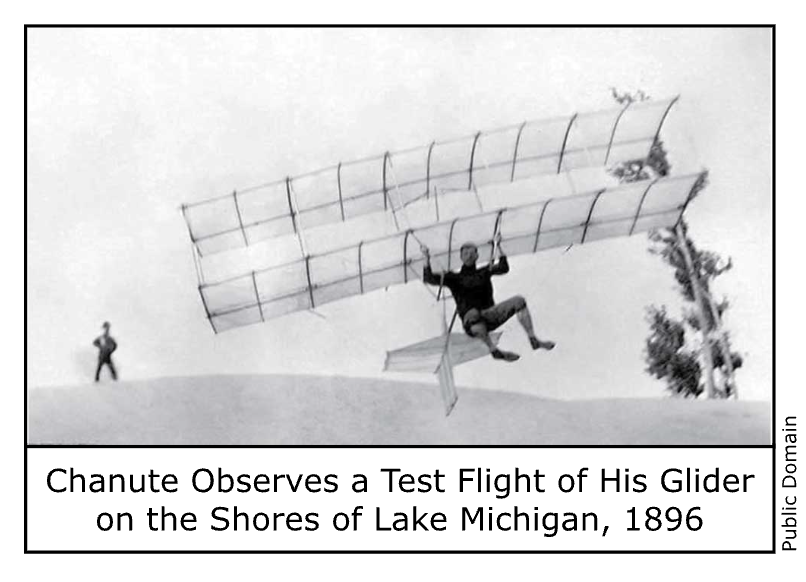
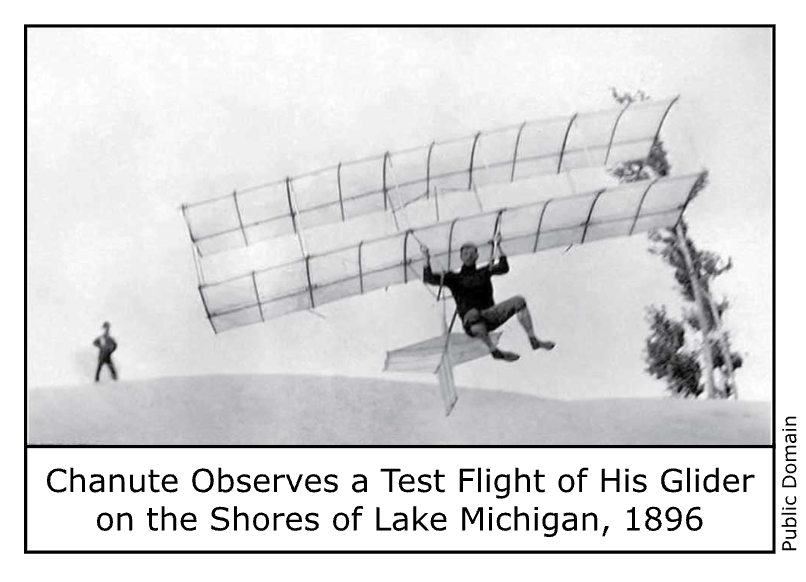
(8) Chanute agreed. Between 1896-1898, he worked on glider designs. With the help of assistants, he made hundreds of flight tests on the windswept sand dunes at the foot of Lake Michigan. He would say later, "I learned more in two weeks of practical experimentation than I did in years of research and study."
A Simple Request
(9) In the spring of 1899, Wilbur Wright wrote to the Smithsonian Institution asking for available information on flight experiments. One of the resources recommended to him was Progress in Flying Machines.
(10) Impressed with Chanute's work, Wilbur wrote to him on May 13, 1900. The letter began: "For some years I have been afflicted with the belief that flight is possible to man." It was the first of hundreds of letters the two men would exchange over the next 10 years. Chanute became an enthusiastic friend and supporter of the Wrights.
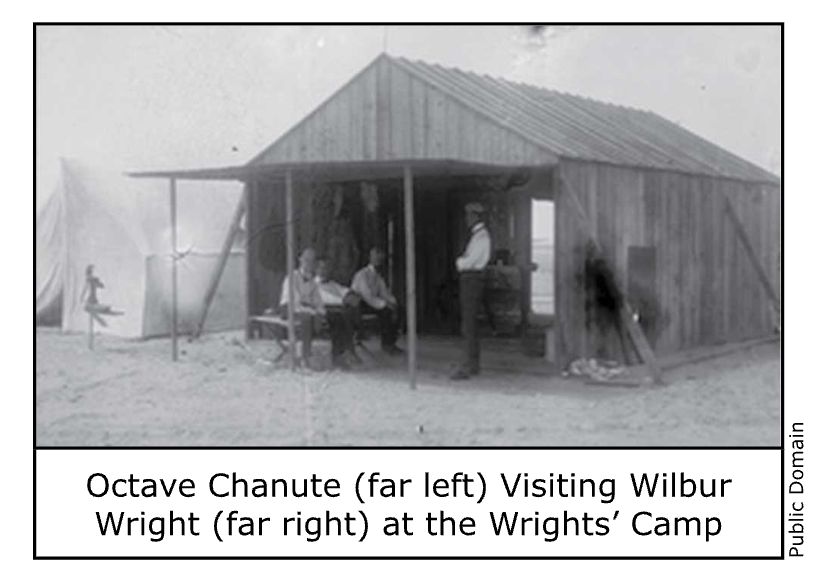
(11) Chanute did visit the Wrights occasionally. One such visit was in November 1903. He stayed at the Wrights' camp in Kitty Hawk, North Carolina. Afterward he wrote to a friend that the Wrights' flying machine was "the most promising attempt at flight that has yet been made." When informed of the Wrights' success a month later on December 17, Chanute immediately wired his congratulations.
A Lasting Legacy
(12) Octave Chanute's lasting legacy to aeronautics was his generosity. The "great aviation communicator" wrote hundreds of letters, essays, and articles. He gave speeches, kept a diary, and carefully recorded the results of his own experiments.
(13) Most experimenters during this time kept their findings to themselves. But Chanute felt the conquest of flight was a tremendous task that required teamwork. He recognized the importance of bringing people and information together.
(14) After Chanute's death, Wilbur wrote, "No one was too humble to receive a share of his time. In patience and goodness of heart, he has rarely been surpassed. Few men were more universally respected and loved."
(15) The Wright brothers made astounding progress in the four years it took them to be first in flight. Would their success have been so swift without Octave Chanute?
(16) Wilbur summed it up best, "If he had not lived, the entire history of progress in flying would have been other than it has been."
The Great Aviation Communicator, Suzanne Paulo, Boys' Quest, August 2001.
1 point
1
Question 1
1.
Which sentence shows that Chanute was more interested in developing a flying machine than in gaining fame for himself?
1 point
1
Question 2
2.
Read the information about the origin of the word immerse.
from Latin immersus, meaning "plunged in or submerged"
Based on this information, what is the meaning of immersed in paragraph 4?
1 point
1
Question 3
3.
What is the best paraphrase of paragraph 7?
1 point
1
Question 4
4.
In paragraphs 5 through 11, how is the information organized to help develop the thesis?
1 point
1
Question 5
5.
Based on information throughout the selection, what can the reader conclude about the field of aviation?
1 point
1
Question 6
6.
What can the reader infer about Chanute based on paragraph 11?
1 point
1
Question 7
7.
How does the information in paragraph 1 contribute to the controlling idea that successes in aviation were the result of a collaborative effort?
1 point
1
Question 8
8.
Look at this photograph from the selection.
What is the most likely reason this photograph is included in the selection?
Read the next two selections. Then choose the best answer to each question.
Passage 1:
Cameras in the Courtroom
(1) Even though cameras are everywhere these days, they are currently not allowed in many federal courtrooms. This includes the Supreme Court. Justice Elena Kagan has warned that if having cameras in the courtroom "came at the expense of the way the institution functioned, that would be a very bad bargain." Whether cameras should be in courtrooms is a long and ongoing debate.
(2) In 1946, at the dawn of the broadcast era, the Federal Rules of Criminal Procedure banned photographs or broadcast media coverage of criminal trials in federal court. Those who supported the ban argued that lawyers would play to the cameras by showing off. This behavior would disrupt the serious atmosphere of the courtroom. Ban supporters worried that defendants would get nervous and look untrustworthy. They feared that witnesses and jurors would be distracted. All these factors could deny the defendant a fair trial.
(3) The Judicial Conference of the United States makes policy for federal courts.
In 1972 it expanded the ban to apply to both criminal and civil cases. But, in 1990, the Judicial Conference agreed to a limited test of the idea. It allowed electronic media to record federal civil proceedings in eight courtrooms for three years. Supporters of the program argued that cameras would allow the public to see that justice was being served. In the end, the Judicial Conference decided that some participants may find cameras intimidating. It stood by the ban.
(4) However, a second pilot study ran from 2011 to 2015. As a result, five federal courts now allow video cameras in limited instances in civil cases. Supporters of cameras in federal courtrooms keep pushing to expand that number. Since 2005, members of Congress have introduced at least nine "Sunshine in the Courtroom" bills. The latest bipartisan measure was introduced in 2021. It would allow judges in all federal courts the discretion to permit electronic media coverage while safeguarding due process and privacy.
(5) It is unclear where the majority of federal judges stand on cameras in the courtroom. The Congressional Research Service notes in a 2019 report that as a group, federal judges have not been asked their opinion on the matter. But over the years, the focus on journalists with cameras has shifted. Advocates have suggested that the courts themselves take control of the electronic media and post video online. Many state courts, most of which allow cameras in the courtroom in some form, take this approach. Lower federal courts do as well. In addition, transcripts and audio often may be purchased through PACER. This is the online records system for federal courts. These developments have greatly expanded public access to federal court proceedings.
1 point
1
Question 9
9.
Read this sentence from paragraph 4 of the article "Cameras in the Courtroom."
It would allow judges in all federal courts the discretion to permit electronic media coverage while safeguarding due process and privacy.
Which word from the sentence best helps the reader determine the meaning of discretion as it is used in paragraph 4?
2 points
2
Question 10
10.
Read the question carefully. Then enter your answer in the box provided.
Based on the information in paragraphs 2 through 4 of the article "Cameras in the Courtroom," what is the most likely reason the Judicial Conference began to allow cameras in courtrooms after 2015? Support your answer with evidence from the article.
1 point
1
Question 11
11.
The author's use of language in paragraph 1 best contributes to the tone of the article "Cameras in the Courtroom" by—
1 point
1
Question 12
12.
What counterargument does the author recognize in the article "Challenging the Status Quo"?
1 point
1
Question 13
13.
What is the best summary of the article "Challenging the Status Quo"?
1 point
1
Question 14
14.
Read this sentence from the article "Challenging the Status Quo."
People find comfort in routine and familiarity. (paragraph 1)
Which of these is the most likely reason why the author uses a sweeping generalization?
1 point
1
Question 15
15.
What is the most likely reason the author wrote the article "Challenging the Status Quo"?
1 point
1
Question 16
16.
Read this sentence from paragraph 1 of the article "Cameras in the Courtroom.
Even though cameras are everywhere these days, they are currently not allowed in many federal courtrooms.
Now read this sentence from paragraph 4 of the article "Challenging the Status Quo."
However, this relatively minor example pales in comparison to the countless times the status quo was not preferable.
In these sentences, how do the authors DIFFER in their use of juxtaposition?
1 point
1
Question 17
17.
Based on information in BOTH the article "Cameras in the Courtroom" and the article "Challenging the Status Quo," the reader can infer that making changes to existing processes—
1 point
1
Question 18
18.
How does the authors' use of language in paragraph 2 of the article "Cameras in the Courtroom" and paragraph 1 of the article "Challenging the Status Quo" convey DIFFERENT tones?
1 point
1
Question 19
19.
Which detail from the article "Cameras in the Courtroom" best supports the key idea in paragraphs 1 and 2 of the article
"Challenging the Status Quo" that people are often reluctant to accept change?
Read the selection and choose the best answer to each question.
Carol Jenkins and her mother visit the home of Mr. Linden to explore his collection of books. Upon a return visit, Carol makes an unusual discovery.
from Mr. Linden's Library
by Walter Dean Myers
(1) It looked the same as the book she had handled before, but the ending of the story had changed.
(2) Taking a deep breath, she calmed down. There had to be a logical explanation. It was as if she had remembered a previous day but had mixed that day with another.
(3) "I'm glad to discover another reader," Mr. Linden said downstairs in the kitchen. He cradled a cup of tea in his hands. "We are a dying breed, I'm afraid."
(4) That night Carol's sleep was disturbed by troubled dreams. Carol dreamt of sitting in Mr. Linden's library, questioning him about his life and all the books in his library. Then she awoke and lay in the darkness of her room, thinking of the book on the window seat and how she must have allowed her imagination or some random thought to change the way she remembered the page.
(5) All things made sense. There were no mysteries in the real world. She thought of mentioning the book to her mother but decided against it. It was her mystery, and she rather enjoyed the curiousness of it all.
(6) The next time they were supposed to visit Mr. Linden, Carol's mother wasn't feeling well. She had one of the headaches that plagued her when the weather grew heavier, just before the late fall and temperatures plummeted the town into its annual winter doldrums. Now that her mother knew more about Mr. Linden, she was fine to let Carol go by herself.
(7) As she made her first trip alone to Mr. Linden's house, turning aside from the wind that rippled the bay, Carol thought about asking him directly about the book. Perhaps she would start by talking about the last book she had borrowed. But not at first, of course. First she had to get her hands on his book and check it out.
(8) She hoped he would allow her to go into the library alone, and he did. She held her breath and walked more softly, almost sneaking up on the books that awaited her.
(9) She glanced at the window seat. The book was still there, angled so that the sun cast a shadow diagonally across the title. She turned away from it, allowing her glance to capture it now and again as she read the titles of the shelved books.
(10) She found a book with small drawings of ships and islands, The Traveler's Guide to Madeira and the West Indies, and leafed casually through it, all the time listening for sounds from below. When she heard the clinking of the metal teakettle against the stove, she moved quickly to Mr. Linden's book.
(11) Esteban told himself that he had been swimming long enough. He had already gone much farther than anyone he knew, even farther than men with strong legs. No one swam all the way to the island. Now he was nearer than he had ever been, but it no longer seemed important to him. It was as if he were swimming not for himself but for the dolphin that went before him most of the time but sometimes behind him, nudging him forward.
(12) He began breathing hard, showing the dolphin how tired he was, how afraid he was to keep going when he wasn't at all sure of himself. He was not that strong and had already done more than he had ever done in his life. He stopped and treaded water for a while, with the dolphin only a few feet away. Esteban felt that he and the dolphin were on a mission together, that they were proving something. But what were they proving, and where would it lead?
(13) Again Carol checked the number on the page, even looking at the numbers of the pages before and after the one she was reading. She was right; the story had changed. It was changing from day to day! The boy in the story was swimming out farther each time, and the dolphin swam with him, as if it knew something special about the boy's mission. But how could the story be different each time she read it?
(14) She grabbed the book she would borrow, holding it with both hands, and carried it down to Mr. Linden.
(15) "Ah, George Miller's travel adventure from the age of sail." Mr. Linden examined the book over the rimless glasses he wore. "Excellent choice."
(16) "What are you reading?" Carol asked. "Something about dolphins, I think."
(17) The old black man looked quickly away. For a long moment the room was engulfed in silence. In the distance, barely audible, the gentle lapping of the low tide on the graveled shore came rhythmically.
(18) "It's not a very good book." His voice was lower than it had been. "You wouldn't be interested."
In paragraphs 7 through 13, which detail best supports the key idea that Carol is determined to explore the special qualities of the book?
1 point
1
Question 21
21.
How does Carol's motivation to discover the truth affect the rising action of the excerpt?
1 point
1
Question 22
22.
The author uses suspense to build the rising action of the excerpt primarily to—
1 point
1
Question 23
23.
How does the setting of the library influence Carol's belief that all things make sense?
2 points
2
Question 24
24.
This excerpt is an example of fictional mystery. Which details support this assertion?
Select the correct answer in each row.
Supports
Does Not Support
The characters are from different backgrounds.
The main character is presented with a puzzle.
The excerpt references the changing of seasons.
The setting includes some unusual features.
1 point
1
Question 25
25.
Read this sentence from paragraph 8.
She held her breath and walked more softly, almost sneaking up on the books that awaited her.
What is the effect of the figurative language in this sentence?
1 point
1
Question 26
26.
What is the most likely reason the author includes paragraphs 11 and 12 in the excerpt?
5 points
5
Question 27
27.
ESSAY: Write your essay in the empty box below.
Read the excerpt from "Mr. Linden's Library." Based on the information in the excerpt, write a response to the following:
Explain how Carol's curiosity influences events in the excerpt.
Write a well-organized informational composition that uses specific evidence from the excerpt to support your answer.
Remember to—
clearly state your thesis
organize your writing
develop your ideas in detail
use evidence from the selection in your response
use correct spelling, capitalization, punctuation, and grammar
Manage your time carefully so that you can—
review the selection
plan your response
write your response
revise and edit your response
Write your response in the box provided.
Read the selection and choose the best answer to each question.
Marisol wrote this paper about a popular style of art in the 1800s. Read Marisol's paper and look for revisions she needs to make. Then answer the questions that follow.
The Painters of Paradise
(1) The 315-mile Hudson River winds through the state of New York. (2) It passes through rolling meadows, craggy mountains, and forested hills. (3) During the mid-1800s, the wild beauty of this area helped inspire a new and distinctively American art style. (4) It emphasized the grandeur of nature and America with a promise as a land of boundless opportunity and freedom. (5) This artistic movement became known as the Hudson River School.
(6) The term "Hudson River School" refers to a group of like-minded artists, rather than to an actual physical school. (7) This movement began in 1825. (8) That year, 24-year-old artist Thomas Cole took a scenic boat ride up the Hudson River toward the Catskill Mountains. (9) After his trip, Cole created several paintings that reproduced the stunning scenery he had enjoyed. (10) These paintings caused him to become well known as an artist.
(11) Cole was talented, but his success stemmed from more than that. (12) His landscape paintings represented a departure from the work of other American artists. (13) In Cole's time it was common for American painters to study in Europe and to use European styles and subjects. (14) Cole had been born in England but moved with his family to the United States. (15) And while some European artists painted landscapes, this kind of art was seen as slightly inferior to other types. (16) Many people living at that time did not view the wilderness as something beautiful and majestic. (17) Rather, they saw it as something to be tamed and civilized.
(18) By contrast, Cole's pictures celebrated the wildness and emptiness of undeveloped land. (19) He and the artists he inspired sought to give the viewer a sense of awe and wonder. (20) At first, many of the paintings produced by the Hudson River School artists showed the beautiful Hudson River Valley. (21) This did change, however.
(22) Frederic Church was a student of Cole's. (23) He painted Niagara Falls and later headed to South America in search of stunning vistas. (24) Susie Barstow loved to climb mountains, one of several female artists in the Hudson River School. (25) Her work captured the beauty of the Appalachian and White Mountain ranges. (26) Albert Bierstadt became known for his large-scale paintings of the American West. (27) He painted Yosemite Valley, the Sierra Nevada Mountains, and other awe-inspiring sights.
(28) No matter which locations they chose to depict, the artists of the Hudson River School were united by a shared vision of America. (29) They felt a sense of optimism and excitement about the country's future. (30) They sought to convey this joy in their paintings, along with their deep appreciation for the magnificence of nature. (31) Their work presented viewers with a fresh, unspoiled paradise, one where hardworking men and women could make their dreams come true. (32) They were really quite amazing artists.
1 point
1
Question 28
28.
What is the BEST way to revise sentence 4?
1 point
1
Question 29
29.
Marisol has included a sentence that does not belong in the third paragraph (sentences 11-17). Which sentence should she remove from this paragraph?
1 point
1
Question 30
30.
Marisol wants to improve the transition between the fourth paragraph (sentences 18-21) and the fifth paragraph (sentences 22-27).
Which sentence can BEST replace sentence 21 to help accomplish this goal?
1 point
1
Question 31
31.
Sentence 24 needs to be revised. In the space provided, rewrite sentence 24 in a clear and effective way.
1 point
1
Question 32
32.
Which sentence should replace sentence 32 to bring this paper to a more effective conclusion?
Read the selection and choose the best answer to each question.
Adeline wrote this paper to tell about the first constitution of the United States. Read Adeline's paper and look for revisions she needs to make. Then answer the questions that follow.
Our Original Constitution
(1) "We the People of the United States, in Order to form a more perfect Union . . ." (2) So begins the U.S. Constitution. (3) This document was ratified between 1787 and 1790. (4) It is a unique document. (5) It defines a government that separates various powers and guarantees certain rights to its citizens. (6) Another document did this too. (7) Maybe you've heard of the Articles of Confederation.
(8) The original 13 states adopted the Articles of Confederation in 1781. (9) The young nation soon learned that the articles were greatly awry. (10) Within a little more than a decade, they were replaced by the Constitution we know today. (11) So how did all this happen?
(12) The colonies declared their independence from Great Britain in 1776 and quickly recognized the need to define their common bond. (13) Members of the Continental Congress of 1777 produced the Articles of Confederation. (14) Under these articles the United States would have a very weak national government. (15) As a result, each of the 13 states would be able to operate almost like an independent country.
(16) The articles gave each state one vote in Congress. (17) There was no president or federal court. (18) And to weaken the central government even more, Congress was denied the power to collect taxes. (19) It was granted the power to defend the new country against foreign nations, but with no way to pay for an army, this was not a very useful power.
(20) Another factor that hindered the young Congress was that before it could take any action, that action had to be approved by 9 of the 13 states. (21) A proposed change to the articles-an amendment-had to be agreed upon by all 13 states. (22) Since there were many rivalries between the states and disagreements too, the Articles of Confederation because of this rule were almost impossible to change. (23) In fact, it took four long years for all the states to even approve the document.
(24) Several Founding Fathers, including George Washington, recognized that the Articles of Confederation were insufficient. (25) In 1787 a group of delegates gathered again. (26) They came to Philadelphia for a Constitutional Convention.
(27) Although the Articles of Confederation proved inadequate, they were still important. (28) Their failure pushed America to think harder about the powers and responsibilities it wanted to give to its central government.
1 point
1
Question 33
33.
What is the MOST effective way to combine sentences 3 and 4?
1 point
1
Question 34
34.
Adeline needs a more effective controlling idea for this paper. Which sentences can BEST replace sentences 6 and 7 and help Adeline accomplish this goal?
1 point
1
Question 35
35.
Adeline wants to replace the word awry in sentence 9 with a more appropriate word. Which word should replace awry in this sentence?
1 point
1
Question 36
36.
What is the BEST way to revise sentence 22?
1 point
1
Question 37
37.
Which sentence could BEST follow sentence 26 to support the ideas in the sixth paragraph (sentences 24-26?
Read the selection and choose the best answer to each question.
Erin is writing a paper about a new idea her dad had for the family. Read these paragraphs from the body of Erin's paper and look for corrections she needs to make.
Then answer the questions that follow.
Core Values
(1) Dad came in with a legal pad and a few note cards. (2) Before we could even ask him what was going on, he bubbled over with exitement.
(3) "I can't wait to tell you about what we've been doing at work," Dad began. (4) "It all started when we identified our core values last Friday." (5) This new focus on values are making an enormous difference for my coworkers and me."
(6) After sharing a few more details, Dad handed each of us a sheet of paper titled
"100 Values." (7) As my eyes scanned the page, I noticed words like these honesty, positivity, courage, excellence, friendliness.
(8) "So," Dad said exuberantly, "it's time for us to work together to select our top three family values."
1 point
1
Question 38
38.
Select the response that corrects the spelling error in sentence 2.
Before we could even ask him what was going on, he bubbled over with __________.
1 point
1
Question 39
39.
What change is needed in sentence 4?
1 point
1
Question 40
40.
Select the correct response for sentence 5.
This new focus on values __________ an enormous difference for my coworkers and me."
1 point
1
Question 41
41.
What change is needed in sentence 7?
Read the selection and choose the best answer to each question.
Camilla is writing a paper about a recent injury. Read this paragraph from the body of Camilla's paper and look for corrections she needs to make. Then answer the questions that follow.
A Stubborn Toe
(1) As soon as my alarm clock dinged, I began my habitual stretching. (2) Groaning quietly, I slowly moved all my limbs, then I realized one big toe was not cooperating. (3) It felt as if it had fossilized overnight, and the more I attempted to move it, the more stubborn it seemed to be. (4) I stood up and nearly tumbled into the bookshelf, quickly steadying myself and hopping to the closet. (5) It was immediately evident that my right foot couldn't handle a pound of my weight. (6) Because I looked more closely, I knew exactly what had happened. (7) Yesterday's fall on the volleyball court was leaving my toe bruised and swollen. (8) Would Coach Everett let me sit out today and still play in the weekend tournament?