STAAR HS English I
star
star
star
star
star
Last updated 9 months ago
52 questions
Read the selection and choose the best answer to each question.
Credit Where Credit Is Due
(1) Doing the right thing often requires more effort than doing the wrong thing.
It is easier to stroll by someone who has dropped a bag of groceries on the sidewalk than to stop and help that person. This is also true with citing the work of others. Although it might be easier to ignore citations in the short term, using them has substantial benefits in the long run.
(2) First, citing sources is simply the right thing to do. This is because one is giving credit where credit is due. When we use others' words, images, or ideas found online or in print, we need to show that we are borrowing something from these creators. Otherwise, we are dishonestly taking the work of others and trying to pass it off as our own. After all, when someone asks our permission to use an item we own, we often give permission. On the other hand, if a person simply takes something of ours without asking, we understand how that act is profoundly different from sharing. It is a kind of theft.
(3) This idea is generally understood when it comes to writing. Each time we use something from another writer, we need to properly cite the ideas we take. By giving credit in this way, we are acknowledging our debt by the most efficient means possible. (We cannot feasibly ask permission from most of the writers whose ideas we cite. Another benefit of citing sources is that it helps writers avoid plagiarism. This is the act of presenting someone else's work as one's own.
(4) However, when it comes to ideas and creative forms, people are often less clear about the need to cite sources. Some experts claim that using an idea or part of an artwork without permission is not morally equivalent to stealing physical property. Disagreement over this matter is at the heart of debates over intellectual property, which is defined as ideas, words, or images that are the product of creative or thoughtful work.
(5) According to intellectual property expert Sheldon Richman, "Two or more people cannot use the same pair of socks at the same time and in the same respect, but they can use ideas with the same content. If I articulate an idea in front of other people, each now has his own copy. Yet I retain mine. However the others use their copies, it is hard to see how they have committed an injustice." One problem with this viewpoint is that it does not make a clear distinction between "an idea" and the "copies" of that idea that others are using. This is where citations come in. They make it clear where an idea originated from, and that a writer using or copying that idea is giving proper credit for it.
(6) Citations are also useful because they allow for the fact-checking of sources. For example, imagine if a student wrote a research paper that included statistics and failed to cite the sources of those statistics. In turn, no one could adequately check and verify the accuracy of the statistics. If a writer does not reveal the sources of statistics, one might wonder if the writer is trying to hide information or mislead readers in some way. On the other hand, using citations correctly can introduce teachers and other students to valuable sources of information. Therefore, citations can enhance learning opportunities for everyone in a class.
(7) At the same time, the use of citations has the potential to create reciprocal working relationships and uphold key social norms. Creators who give credit to others might also receive credit for their own public work. In a broader sense, citing sources upholds the key norms of honesty and respect—for others' property and for one's own. As historian Chris Gehrz states, "Citation is an act of courtesy and an expression of gratitude." Successful writers routinely refer to the words and ideas of authors they admire. By acknowledging these other writers, they are revealing how they have learned from artists who inspired them. Students do something similar when they cite sources: they show how they have benefited from the work of other writers and thinkers. This practice can help promote civility, respect, gratitude, and humility in the classroom and in our society.
(8) Today, the internet gives billions of people access to a vast array of information and artistic work. Unfortunately, though, the internet also makes it easier than ever for people to use ideas or artwork without giving credit or compensation. A society in which people commonly use artists' work without paying for it is bound to leave these creators vulnerable. As expert James V. Delong argues, "In the entertainment field, individual artists have always had a hard time making a buck, but the trend, as intellectual property rights become less reliable, is toward ever-greater industrial concentration." According to Delong, intellectual property rights are being eroded in part because individual artists find it virtually impossible to control the use—or theft—of their creations by potentially huge numbers of internet users.
(9) Citing sources and giving proper credit is more important now than ever before. Each of us has crucial choices to make in how we use information and art. Even if it is not easy, doing the right thing can benefit ourselves as well as others in our society and around the world.
1
Which detail from paragraphs 2 and 3 best supports the key idea that neglecting to cite sources is wrong?
1
How does the author's use of language in paragraph 7 contribute to the tone in the selection?
1
Which of these best states the author's claim about citing sources?
1
Enter your answer in the box.
In paragraph 7, the word _______ means "shared, felt, or done by both sides."
1
Who is the author most likely addressing in the selection?
1
What is the most likely reason the author includes the statement in paragraph 2 that taking something without asking is "a kind of theft"?
1
How does the author counter the claim made in the selection?
2
Read the question carefully. Then enter your answer in the box provided.
Based on the information in paragraph 8, what can the reader most likely infer about how individual artists feel about the internet's impact on their careers? Support your answer with evidence from the selection.
Read the question carefully. Then enter your answer in the box provided.
Based on the information in paragraph 8, what can the reader most likely infer about how individual artists feel about the internet's impact on their careers? Support your answer with evidence from the selection.
1
Read this quotation from paragraph 3.
This idea is generally understood when it comes to writing. Each time we use something from another writer, we need to properly cite the ideas we take. By giving credit in this way, we are acknowledging our debt by the most efficient means possible.
Which of these is the best paraphrase of this quotation?
Read this quotation from paragraph 3.
This idea is generally understood when it comes to writing. Each time we use something from another writer, we need to properly cite the ideas we take. By giving credit in this way, we are acknowledging our debt by the most efficient means possible.
Which of these is the best paraphrase of this quotation?
Read the next two selections and answer the questions that follow.
Passage 1:
This excerpt is from a fictional account of the lives of Frank and Maud Baum. The couple is attending the 1893 World's Columbian Exposition, where many new inventions debuted.
from Finding Dorothy
by Elizabeth Letts
(1) There was a line of people waiting to approach an upright wooden box shaped like a lectern. Frank explained that the device was called the Kinetoscope. The fellow at the front of the line was peering through what looked like binoculars into the interior of the box. Maud saw over and over again that as each person looked inside, they pulled away, gasped, laughed, or exclaimed, and then leaned toward the eyepiece again.
(2) "What is it?" Maud asked.
(3) "I'm not going to tell you. You have to see it for yourself."
(4) Frank and Maud had waited in line for almost two hours when at last it was
Maud's turn. She stood next to the box, bent over, and peeked inside. The operator pushed a button.
(5) Maud gasped. Inside the box, there were three tiny men-blacksmiths-hammering on an anvil. She drew her head away, and there she was, standing in front of the box, with Frank by her side. She put her head down again—it wasn't possible. It seemed that the men were moving inside the box. Black-and-white photographs that moved.
(6) Frank took his turn next, and begged for a second turn, and then a third, until the people standing in line behind them started to clamor for him to move along.
(7) Once outside, Frank couldn't stop talking about it. "That's the future, Maud.
Right there. The future."
(8) "It's fascinating," Maud said. "No doubt about that, and yet, I don't quite understand what it's for. Real moving people are all around us. Why do we need to see them moving in a picture?"
(9) "Because—oh, Maud. Do you really not see it? Everything it touches becomes immortal!"
(10) Maud shrugged. She liked the morning light shining through the elms at home in Fayetteville; she loved the way the clouds skidded across an endless Dakota sky. She didn't need a photograph or a moving picture to remember it. She did not understand what Frank saw in this machine.
(11) Maud wanted to linger and look at the displays, but Frank was dragging her along at a rapid clip, as if he had a specific mission. In the distance, the giant Chicago Wheel, studded with its thirty-six swinging cars, loomed up against the sky. When they had brought the boys to visit the fair, they had stood for hours, mesmerized, watching the wheel lift the lucky riders high into the air, then gracefully turn, each seat balancing so that the riders remained level even as the world turned. Frank had explained, to the boys' fascination, how the engineer, Ferris, had designed the wheel to rival the grand Eiffel Tower in Paris. At first everyone had been afraid to ride it. The spindly steel spokes didn't look as if they could support the massive lacquered cars, fitted with grilles, that could hold up to sixty people at a time. But Frank had read all about the wheel in the newspapers, and he explained that the structure was based on the most modern mechanical and electric techniques, including a double-sized Westinghouse air brake, just like those used on trains, as a safety feature. The idea of soaring through the air had intrigued the boys, but Maud had to put her foot down. They had paid fifty cents each to gain admission to the park, and another fifty cents each for five tickets to ride the Ferris wheel was out of the budget. They would have to watch from the ground.
(12) This time, Frank hustled her along without stopping for a second look at anything, until they reached the base of the giant wheel. The sun was hanging low over the lake now, the sky turning brilliant shades of purple and orange, and the fair's white buildings tinged with pink. Then suddenly, in an explosion like fireworks or a hundred shooting stars, the entire wheel burst into a confetti of electric light that danced and shimmered as the wheel spun through the air.
Excerpt(s) from FINDING DOROTHY: A NOVEL by Elizabeth Letts, copyright © 2019 by Elizabeth Letts. Used by permission of Ballantine Books, an imprint of Random House, a division of Penguin Random House LLC. All rights reserved.
1
How does the author establish that Maud is a character foil for Frank in the excerpt from Finding Dorothy?
1
In paragraph 11 of the excerpt from Finding Dorothy, what does the word spindly mean?
1
In paragraph 5 of the excerpt from Finding Dorothy, how does the author's use of the oxymoron "tiny men" contribute to the reader's understanding of the Kinetoscope?
2
How does the use of flashback in paragraph 11 contribute to the character development in the excerpt from Finding Dorothy?
Select TWO correct answers.
How does the use of flashback in paragraph 11 contribute to the character development in the excerpt from Finding Dorothy?
Select TWO correct answers.
1
How does the chronological organizational pattern of paragraphs 6 through 9 contribute to the development of the thesis of the excerpt from "Big Wheels Keep On Turnin' "?
1
What is the best summary of the excerpt from "Big Wheels Keep On Turnin' "?
1
Based on information in the excerpt from "Big Wheels Keep on Turnin'," which statement best captures a way that society views new technologies?
1
What is the most likely reason the author includes the quoted text in paragraphs 4 and 5 of the excerpt from "Big Wheels Keep On Turnin' "?
1
Which detail from paragraph 11 of the excerpt from Finding Dorothy and from paragraph 7 of the excerpt from "Big Wheels Keep On Turnin' " supports the key idea that people are fascinated by new inventions?
1
How does the author of Finding Dorothy use dialogue DIFFERENTLY than the author of "Big Wheels Keep On Turnin' " uses quotations?
1
Which statement expresses a theme found in BOTH the excerpt from Finding Dorothy and the excerpt from "Big Wheels Keep On Turnin' "?
1
How is the character Maud in the excerpt from Finding Dorothy DIFFERENT from the North Dakota farm boy mentioned in the excerpt from "Big Wheels Keep On Turnin' "?
Read the selection and choose the best answer to each question.
Mr. Roger Mifflin lives in a horse-drawn wagon, or van, that he has named Parnassus. He travels the countryside selling books, but he is ready to settle down now and hopes to sell the van and all its contents to Andrew McGill. He stops by the McGill property to speak to Andrew, but Helen, Andrew's sister, talks to Mr. Mifflin first.
from Parnassus on Wheels
by Christopher Morley
(1) I must admit that Mr. Roger Mifflin had fixed up his van mighty comfortably inside. The body of the wagon was built out on each side over the wheels, which gave it an unwieldy appearance but made extra room for the bookshelves. This left an inside space about five feet wide and nine long. On one side he had a little oil stove, a flap table, and a cozy-looking bunk above which was built a kind of chest of drawers—to hold clothes and such things, I suppose; on the other side more bookshelves, a small table, and a little wicker easy chair. Every possible inch of space seemed to be made useful in some way, for a shelf or a hook or a hanging cupboard or something. Above the stove was a neat little row of pots and dishes and cooking usefuls.1 The raised skylight made it just possible to stand upright in the center aisle of the van; and a little sliding window opened onto the driver's seat in front. Altogether it was a very neat affair. The windows in front and back were curtained and a pot of geraniums stood on a diminutive shelf. I was amused to see a sandy Irish terrier curled up on a bright Mexican blanket in the bunk.
(2) "Miss McGill," he said, "I couldn't sell Parnassus for less than four hundred.
I've put twice that much into her, one time and another. She's built clean and solid all through, and there's everything a man would need from blankets to bouillon cubes. The whole thing's yours for $400—including dog, cook stove, and everything—jib, boom, and spanker. There's a tent in a sling underneath, and an ice box (he pulled up a little trapdoor under the bunk) and a tank of coal oil and what all. She's as good as a yacht; but I'm tired of her. If you're so afraid of your brother taking a fancy to her, why don't you buy her yourself and go off on a lark? Make him stay home and mind the farm! . . . Tell you what I'll do. I'll start you on the road myself, come with you the first day and show you how it's worked. You could have the time of your life in this thing, and give yourself a fine vacation. It would give your brother a good surprise, too. Why not?"
(3) I don't know whether it was the neatness of his absurd little van, or the madness of the whole proposition, or just the desire to have an adventure of my own and play a trick on Andrew, but anyway, some extraordinary impulse seized me and I roared with laughter.
(4) "Right!" I said. "I'll do it."
(5) I, Helen McGill, in the thirty-ninth year of my age!
* * *
(6) "Well," I thought, "if I'm in for an adventure I may as well be spry about it. Andrew'll be home by half-past twelve and if I'm going to give him the slip I'd better get a start. I suppose he'll think I'm crazy! He'll follow me, I guess. Well, he just shan't catch me, that's all!" A kind of anger came over me to think that I'd been living on that farm for nearly fifteen years—yes, sir, ever since I was twenty-five—and hardly ever been away except for that trip to Boston once a year to go shopping with cousin Edie. I'm a homekeeping soul, I guess, and I love my kitchen and my preserve cupboard and my linen closet as well as grandmother ever did, but something in that blue October air and that crazy little red-bearded man just tickled me.
(7) "Look here, Mr. Parnassus," I said, "I guess I'm an old fool but I just believe
I'll do that. You hitch up your horse and van and I'll go pack some clothes and write you a check. It'll do Andrew all the good in the world to have me skip. I'll get a chance to read a few books, too. It'll be as good as going to college!" And I untied my apron and ran for the house. The little man stood leaning against a corner of the van as if he were stupefied. I dare say he was.
(8) I ran into the house through the front door, and it struck me as comical to see a copy of one of Andrew's magazines lying on the living-room table with "The Revolt of Womanhood" printed across it in red letters. "Here goes for the revolt of Helen McGill," I thought. I sat down at Andrew's desk, pushed aside a pad of notes he had been jotting down about "the magic of autumn," and scrawled a few lines:
(9) DEAR ANDREW,
Don't be thinking I'm crazy. I've gone off for an adventure. It just came over me that you've had all the adventures while I've been at home baking bread. Don't worry. I'm going off for a little while—a month, maybe—to see some of this happiness and hayseed of yours. It's what the magazines call the revolt of womanhood. Warm underwear in the cedar chest in the spare room when you need it. With love, HELEN.
1"Usefuls" is another word for utensils.
From PARNASSUS ON WHEELS by Christopher Morley—Public Domain
1
Which of the following most directly develops a theme of the excerpt?
1
Read this quotation from paragraph 9.
Warm underwear in the cedar chest in the spare room when you need it.
Which conclusion is best supported by this quotation?
Read this quotation from paragraph 9.
Warm underwear in the cedar chest in the spare room when you need it.
Which conclusion is best supported by this quotation?
1
How does the author use the farm setting to develop a theme of the excerpt?
1
Read this quotation from paragraph 8.
I sat down at Andrew's desk, pushed aside a pad of notes he had been jotting down about "the magic of autumn," and scrawled a few lines:
What are the most likely reasons the author includes these details?
Select TWO correct answers.
Read this quotation from paragraph 8.
I sat down at Andrew's desk, pushed aside a pad of notes he had been jotting down about "the magic of autumn," and scrawled a few lines:
What are the most likely reasons the author includes these details?
Select TWO correct answers.
1
Read this quotation from paragraph 2.
"She's built clean and solid all through, and there's everything a man would need from blankets to bouillon cubes. The whole thing's yours for $400—including dog, cook stove, and everything—jib, boom, and spanker."
What is the effect of the author's word choice in this quotation?
Read this quotation from paragraph 2.
"She's built clean and solid all through, and there's everything a man would need from blankets to bouillon cubes. The whole thing's yours for $400—including dog, cook stove, and everything—jib, boom, and spanker."
What is the effect of the author's word choice in this quotation?
1
What is the most likely reason the author uses a chronological structure in the excerpt?
1
Which statement expresses an idea about society that is developed in the excerpt?
1
At the end of the excerpt, what is the most likely reason the author includes the ironic detail of the magazine article titled "The Revolt of Womanhood"?
5
ESSAY: Write your essay in the empty box below.
Read the excerpt from Parnassus on Wheels. Based on the information in the excerpt, write a response to the following:
Identify and explain the significance of the revelation Miss McGill has from her dealings with Mr. Mifflin.
Write a well-organized essay that uses specific evidence from the excerpt to support your answer.
Remember to—- clearly state your thesis
- organize your writing
- develop your ideas in detail
- use evidence from the excerpt in your response
- use correct spelling, capitalization, punctuation, and grammar
Manage your time carefully so that you can—- review the excerpt
- plan your response
- write your response
- revise and edit your response
Write your response in the box provided.
ESSAY: Write your essay in the empty box below.
Read the excerpt from Parnassus on Wheels. Based on the information in the excerpt, write a response to the following:
Identify and explain the significance of the revelation Miss McGill has from her dealings with Mr. Mifflin.
Write a well-organized essay that uses specific evidence from the excerpt to support your answer.
Remember to—
- clearly state your thesis
- organize your writing
- develop your ideas in detail
- use evidence from the excerpt in your response
- use correct spelling, capitalization, punctuation, and grammar
Manage your time carefully so that you can—
- review the excerpt
- plan your response
- write your response
- revise and edit your response
Write your response in the box provided.
Read the selection and choose the best answer to each question.
Emma wrote this story about a girl and her new coworker. Read Emma's story and look for revisions she needs to make. Then answer the questions that follow.
Sawyer's New Coworker
(1) Sawyer smiled as she surveyed her surroundings. (2) She loved her new job and thought it was fun. (3) Wheeling a flat cart of canned goods through Aisle 6, she was enjoying the quiet environment and the complete solitude. (4) She was poised to place a can of tomato sauce on its designated shelf when a raucous voice from behind startled her. (5) This caused her to shriek and toss the can over her shoulder. (6) The can dented as it hit the floor, a tiny stream of tomato juice escaping from its side.
(7) The echo from an annoyingly loud laugh ricocheted through the aisle, and Sawyer quickly spun around, immediately recognizing a classmate of her older brother's. (8) "Hey, sorry if I scared you," he said with a grin. (9) "My name is Carlos, and my uncle's the manager of the store. (10) He figured I could use a job." (11) Leaning in toward Sawyer, he then whispered that he'd applied for the lifeguard position at the community pool but hadn't gotten it.
(12) Sawyer's eyes narrowed. (13) She knew enough about Carlos from observing his antics at school to know that she was unlikely to have any further moments of solitude or tranquility. (14) Carlos was the energetic, outgoing life of the party, while she, on the other hand, liked nothing better than retreating to quiet spaces to rest and recharge. (15) She sighed, reluctantly extending a hand and saying, "I'm Sawyer. (16) Nice to meet you."
(17) "Well," Carlos laughed, shaking her hand, "that's a bit of an underwhelming greeting, but I'll take it. (18) I guess I'd better get started shelving all those green beans!" (19) He grimaced, motioning dramatically to a pallet of canned vegetables, and Sawyer slowly retreated to her shelf and rolled her eyes. (20) It was going to be a long shift.
(21) After an exasperating hour of listening to Carlos animatedly talk, sing, and hum to himself, Sawyer was in need of a respite. (22) She retreated to the break room, reclining comfortably in a chair to check her text messages. (23) Her phone had a crack in the screen, but she could still use it. (24) Within minutes she was crying with laughter. (25) Her best friend, Tamika, had sent her a series of messages describing an awkward encounter she had had at a bookstore. (26) By the time Sawyer read the final text, she was laughing so hard that she could scarcely breathe. (27) Her break time over, she wiped the tears from her eyes and returned to the aisle to put the finishing touches on the paper towel display.
(28) Another hour passed, and Sawyer noticed something peculiar: complete silence. (29) Had Carlos left early? (30) She strode toward Aisle 7, where she had last spied her extroverted coworker. (31) There he was, quietly focused on his task, efficiently arranging the cans in their proper places. (32) Sensing Sawyer's presence, Carlos looked up from his work and inquired, "May I help you?"
(33) Sawyer, slightly embarrassed when she realized that she had been staring, responded by reminding Carlos that he was usually known for making a lot of noise.
(34) Carlos grinned mischievously and replied, "Like all that noise I heard coming from the break room a while ago?"
(35) "I'm not always quiet, you know," Sawyer said defensively.
(36) "And I'm not always loud!" Carlos replied indignantly.
(37) After an awkward moment of quiet silence, the two coworkers both began to laugh, and Sawyer realized she might have misjudged Carlos. (38) Unsure how to respond at this point, she simply said, "Well, my shift is over, so I guess I'll see you tomorrow."
(39) "See you then!" Carlos said. (40) He paused and then added, "And, Sawyer, please try to be a little quieter tomorrow."
(41) Sawyer smiled with the sudden realization that what she just might be making was a new friend as she left the store.
1
Which sentence can replace sentence 2 to help develop the introduction to this story?
1
What is the MOST effective way to combine sentences 4 and 5?
1
What is the BEST transition to add to the beginning of sentence 7?
1
Emma has included a sentence that does not belong in the fifth paragraph (sentences 21-27). Which sentence should she remove?
1
Sentence 37 contains some redundancy. In the space provided, rewrite sentence 37 in a clear and effective way.
1
What revision, if any, should be made in sentence 41?
Read the selection and choose the best answer to each question.
Maeve wrote this paper to tell about a problem some large cities are experiencing. Read Maeve's paper and look for revisions she needs to make. Then answer the questions that follow.
The Problem of Urban Heat Islands
(1) On a summer day, a big city can feel stiflingly hot. (2) It turns out this is not just a feeling; many big cities qualify as "urban heat islands, meaning they are measurably warmer than surrounding areas that are less developed. (3) Although urban heat islands are associated with some undesirable effects, several strategies can be used to make cities cooler.
(4) According to the Environmental Protection Agency, urban heat islands tend to be between one and seven degrees hotter than nearby rural landscapes. (5) There are a few reasons for this tendency. (6) Cities tend to consist of tightly packed buildings, parking lots, and roads. (7) They often lack trees, open land, and bodies of water. (8) Instead, they predominantly feature concrete and metal. (9) These materials are known to absorb a great deal of heat. (10) On top of all this, cities contain millions of people, who constantly generate heat by using machines and participate in other activities.
(11) The absence of undisturbed natural areas means that heat can remain trapped in the city. (12) Places that have plenty of trees and grass stay cooler because plants are able to store water in their stems and leaves. (13) In a process called transpiration, some of this water is released into the air as vapor. (14) This in turn cools the surroundings. (15) Researchers have found that plant-filled urban parks, such as Central Park in New York City, are cooler than the parts of the city that are covered with concrete.
(16) First, excessive heat can cause physical problems such as dehydration for people and some animals. (17) Plus, muggy heat is uncomfortable—a fact that leads many city dwellers to run their air conditioners around the clock. (18) Not only does this place enormous demands on the energy supply, it can also be very expensive.
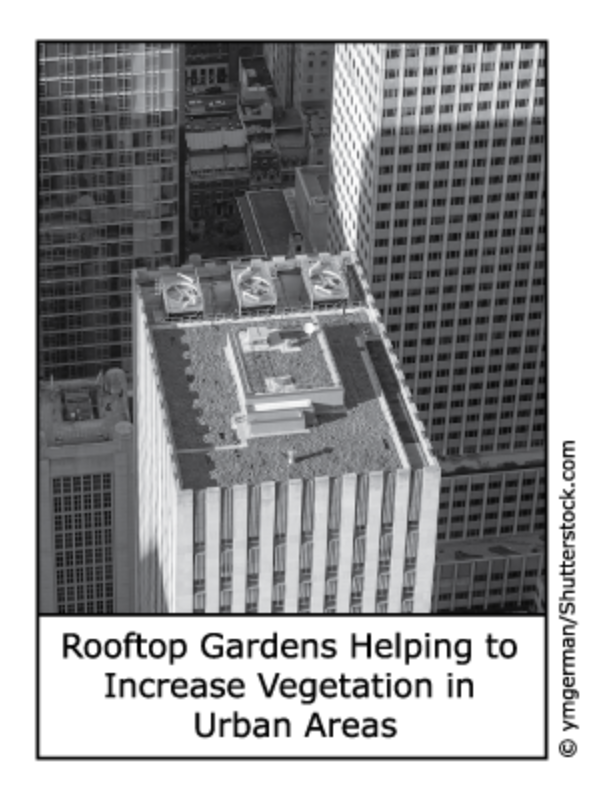
(19) So what is being done to reverse the negative effects of urban heat islands? (20) One promising approach is to make cities greener, literally, by planting trees. (21) Architects and city planners are becoming strategic, incorporating shade trees into their designs. (22) Of course, planting trees in places can be a challenge with little available soil. (23) Rooftop gardens, which provide beauty and shade, are a creative and popular way to increase vegetation in cities.
(24) A second way to tackle the problem of excessive city heat is to use lighter-colored building materials. (25) Old materials, especially those used for roofs and pavement, tend to be dark in color. (26) This makes them hold on to heat from the sun, instead of reflecting it the way lighter-colored materials do. (27) An alternative approach for cooling paved areas and for cooling buildings is to add a reflective coating. (28) This coating discourages heat absorption.
(29) Cities are economic and cultural hubs that contribute to a nation's vitality and diversity. (30) It is important that they remain livable and safe. (31) Many people are working to make this goal a reality.
1
What revision should be made in sentence 10?
1
Which sentence should come before sentence 16 to serve as a topic sentence for the fourth paragraph (sentences 16-18)?
1
What is the MOST effective way to revise sentence 22?
1
Maeve wants to use a more effective word than Old in sentence 25. Which word should replace Old in this sentence?
1
Maeve has included redundant information in sentence 27. What is the MOST effective way to revise this sentence?
1
Which sentence should replace sentence 31 to bring this paper to a more effective conclusion?
Read the selection and choose the best answer to each question.
Kason is writing a story about some kids who teach their grandmother to use something new. Read these paragraphs from the body of Kason's story and look for corrections he needs to make. Then answer the questions that follow.
Tutoring Grandma
(1) Grandma was a retired librarian who spent most of her time volunteering at the local community gardens. (2) When she needed to research a new plant, she checked out a book from the library. (3) For local and national information, she read the daily gazette, her local newspaper, and watched the news on television. (4) Grandma had expressed no interest in joining the computer age.
(5) Barrett interrupted his familys' laughter by saying, "I think Grandma would enjoy a computer if we taught her how to use it. (6) Let's do it!"
(7) When Grandma came to visit at Thanksgiving, the kids sat her down at the desktop computer. (8) As expected, she immediately rolled her eyes and chuckled, saying, "You're sweet, but you know I don't need this thing!" (9) Barrett and their siblings insisted, though, and Grandma was a good sport, as usual. (10) With some basic computer tutoring over the next few days, she was able to go onto the internet and type phrases into the search bar. (11) The kids showed her how to research plants and connect between other community gardeners in her city. (12) They also taught her how to set up an email account, browse news stories, and compose letters and documents.
1
What change needs to be made in sentence 3?
1
What change needs to be made in sentence 5?
1
What change needs to be made in sentence 9?
1
What change needs to be made in sentence 11?
1
What change, if any, needs to be made in sentence 12?
Read the selection and choose the best answer to each question.
Gianni read about an interesting art form and is writing a paper to share what he learned. Read the last few paragraphs of Gianni's paper and look for corrections he needs to make. Then answer the questions that follow.
Mayan Weaving, A Thread through the Generations
(1) Some weavers stitch traditional Mayan symbolism and color into their garments. (2) For example, the sun might signify agricultural life, while a butterfly could be used to represent freedom and liberty; similarly, a weaver might use blue to designate the sky and red to represent energy.
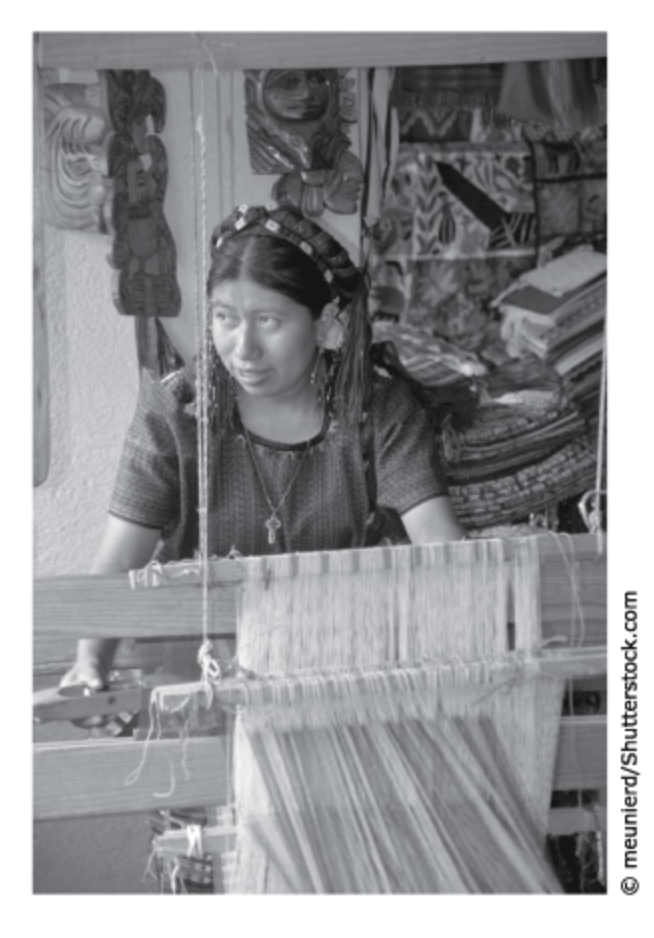
(3) In the highlands of Guatemala, weaving is a cherished and important part of everyday life. (4) The tradition is past down from generation to generation. (5) In fact, at just three weeks of age, a baby girl usually participates in a special ceremony that includes the gifting of miniature weaving tools. (6) Many mothers hope that their daughters will grow up to become skilled weavers and continue the ancient Mayan tradition.
(7) Like their ancestors, modern-day Mayan women wove intricate and beautiful designs (8) Their creations are rich with meaning, yet made for practical use. (9) The women make a profit of selling their wares to an admiring worldwide audience. (10) Some buyers are able to decipher the meaning behind the designs, others simply enjoy the vibrant colors in this unique, wearable art. (11) In any event, there is a rich tradition of Mayan weaving, it seems to be as loved today as it was in generations long ago.
1
What change, if any, needs to be made in sentence 4?
1
What change needs to be made in sentence 7?
1
Gianni has made an error in sentence 9. Select the response that corrects this error.
The women make a profit __________ selling their wares to an admiring worldwide audience.
1
What change needs to be made in sentence 10?
1
What is the correct way to write sentence 11?