STAAR HS English II
star
star
star
star
star
Last updated 9 months ago
52 questions
Read the selection and choose the best answer to each question.
That's Not What Happened
Characters
LINA: A girl in her late teens
JOELLE: Also a girl in her late teens, and Lina's best friend
FRIEND 1
FRIEND 2
1. [Lights come up on two bedrooms. In one, stage right, Lina sits on the end of her bed, playing guitar. Her strumming is intense. In the other bedroom, stage left, Joelle, holding her phone, hesitates and then dials a number. Lina's phone rings. She stops playing long enough to lean over, glance at the screen, and decline the call with one flick of her finger. She resumes playing, angrily, and Joelle drops her phone onto her bed in frustration. Lights go down on Lina's bedroom and her guitar playing fades out.]
2. JOELLE: [Addressing audience.] What did I do wrong? She won't answer my calls, she won't answer my texts. Last night we were hanging out with friends, having a great time, and then she just left all of a sudden, without even saying goodbye.
3. [Joelle crosses to center stage and joins Friend 1, Friend 2, and Lina, who sits cross-legged, playing guitar. Lights as from a campfire flicker on their faces. When Lina finishes the song, Friend 1, Friend 2, and Joelle applaud and make appreciative noises.]
4. JOELLE: Isn't she great?
5. FRIEND 1: Yeah, definitely. I love that song, Lina. Did you write it yourself?
6. [Lina smiles shyly and shrugs, but she doesn't answer.]
7. JOELLE: [Turning to Lina, encouragingly.] She sure did, didn't you, Lina.
8. [Lina turns red and, her eyes huge, looks completely mortified but says nothing.]
9. JOELLE: [A little exasperated.] She's written quite a few, actually, and they're all really good. She's just too modest to talk about it. Here, let me play some of the songs she sent me. Lina doesn't mind. They're amazing!
10. [Joelle takes out her phone and starts tapping and scrolling. Meanwhile, Lina sits by the fire a while, looking uncomfortable, until she finally gathers her things and goes back to her bedroom, stage right. When Joelle and the others finish listening to the songs, they finally notice Lina is gone.]
11. FRIEND 2: Where's Lina?
12. FRIEND 1: Her stuff is gone too.
13. JOELLE: She just left without saying a word?
14 [Lights go down on Joelle, Friend 1, and Friend 2 and come up on Lina in her bedroom, annoyed.]
15. LINA: [Addressing the audience.] Except that's not what happened at all!
16. [She begins to play guitar again, the same song she was playing at the campfire, losing herself in it for a little bit before remembering that the audience is there, listening. She stops playing.]
17. LINA: [A little shyly.] Mostly, I play for myself, not for an audience, but they asked me to bring my guitar. They asked me to play. So I played the song I've been working on the longest, the one I'm most sure of.
18. [She begins to play again, crossing to center stage and rejoining the group. When the song ends, Friend 1, Friend 2, and Joelle applaud and make appreciative noises.]
19. JOELLE: [To the group.] She's gotten so much better, right?
20. LINA: [A little sarcastically, with a sidelong glance at Joelle.] Thanks.
21. JOELLE: [Sincerely.] I mean it!
22. FRIEND 1: That was really great, Lina. Is that one of your own songs?
23. [Lina opens her mouth to speak, but Joelle interrupts.]
24. JOELLE: It sure is! She's written quite a few, actually—
25. LINA: Yeah, I've been—
26. JOELLE: [Whipping out her phone and beginning to scroll.] Here, I'll play you a song she sent me last week—
27. LINA: Joelle, those are— Please don't—
28. JOELLE: You're too humble! Listen.
29. [The Two Friends gather near Joelle to listen to a recording of Lina playing guitar while Lina sits by the fire, guitar in her lap, looking uncomfortable.]
30. JOELLE: Let me play you the other one—it's even better.
31. [Lina, frustrated, puts away her guitar and rises.]
32. LINA: [Quietly as she passes the group.] I've got to go. [No one notices her leave.]
33. [Lights go down center stage and come up on Lina's bedroom. She sits on her bed, playing guitar. There is a brief knock at her bedroom door, but before she can answer, Joelle pokes her head in.]
34. JOELLE: Why won't you answer my calls?
35. LINA: [Frustrated.] I wanted some time to myself.
36. [Lina begins to play again as Joelle settles herself tentatively and awkwardly in a chair beside the bed. Joelle hums along for a few bars and then waves her hand in front of Lina's face.]
37. JOELLE: Hey. You just left last night without saying a word.
38. LINA: That's not what hap—
39. JOELLE: I looked up and you were gone, and you aren't answering my calls or my texts. I've spent the whole day wondering what I did—
40. LINA: Well, I'll tell you if—
41. JOELLE: [Speaking over Lina.] —to make you so mad, when all I wanted to do was show people—
42. LINA: Joelle—
43. JOELLE: —how talented you are, and you acted like—
44. LINA: [Sharply.] Joelle! You never let me talk!
45. [Joelle, suddenly silent, looks as though she's had a bucket of cold water flung in her face.]
46. JOELLE: [Sulky.] So talk.
47. LINA: I asked you not to share those songs with anyone—
48. JOELLE: I know, but—
49. LINA: —and you did it anyway.
50. JOELLE: Because they're really good!
51. LINA: But they aren't yours to share.
52. JOELLE: I don't understand why you're shy about sharing your songs with the world.
53. LINA: It's not about being shy. They are mine. I haven't finished writing them.
I'll show the world when I'm ready. When those songs are ready.
54. JOELLE: [Resigned.] All right, I won't do that anymore. I'm sorry.
55. [Lina nods, smiles, and strums a major chord on the guitar.]
56. LINA: Want to hear something new?
57. JOELLE: Something in the key of forgiveness? You bet.
1
Based on the events at the end of the play, what will Lina most likely do next?
1
Which line from the play shows that Joelle is dismissive of Lina's wishes to keep her new songs private?
1
How do the events that happen with Lina and Joelle's friends help develop Lina's character?
1
How do the stage directions and Joelle's speech in line 2 contribute to the audience's understanding of the plot?
1
The playwright includes the stage directions and dialogue in lines 16 and 17 most likely to develop the idea that Lina —
1
In line 15, the playwright's use of the phrase "at all" emphasizes —
1
The playwright uses sarcasm in line 20 most likely to —
1
In line 1, the words "intense," "angrily," and "frustration" contribute to the mood of the play by emphasizing —
2
Read the question carefully. Then enter your answer in the box provided.
How does the playwright's characterization of Lina contribute to a theme of the play? Support your answer with evidence from the play.
Read the question carefully. Then enter your answer in the box provided.
How does the playwright's characterization of Lina contribute to a theme of the play? Support your answer with evidence from the play.
Read the next two selections and answer the questions that follow.
Passage 1:
from What the Octopus Knows
by Olivia Judson
(1) My love affair with octopuses began when I was 9. On a summer holiday by the sea, I found Octopus and Squid: The Soft Intelligence (1973) in my great-aunt's bookcase. Written by Jacques-Yves Cousteau, the great pioneer of scuba diving, and his colleague Philippe Diolé, the book told of encounters between humans and cephalopods—the group that includes octopuses, squid, cuttlefish, and their more distant cousins, the nautiluses. A few days after I'd finished reading, I was out snorkeling and saw my first wild octopus. It was clambering over rocks in the shallows, changing color as it went. I was so excited that, after it vanished into a crevice, I leaped out of the water and began telling two strangers on the shore everything I'd learned from the book.
(2) Cousteau and his team were the first to spend a lot of time—many hours at a stretch—in the water observing and filming wild octopuses and getting to know different individuals by visiting them regularly. Before long, some of the animals would come out to greet the divers, even climbing onto them and going for a ride. Others were shy, and would stay in their holes. Some appeared to develop preferences for particular humans. The divers wanted to know whether octopuses—as suspected—steal fish from fishermen's nets, so they set up a net complete with several fish, and settled back to watch. Sure enough, an octopus came and helped itself to the lot. Another octopus opened a jar containing food, while a third seemed disturbed by its reflection when shown a mirror.
(3) Cousteau's accounts are anecdotes, not scientific experiments. Yet, taken together, they capture three aspects of octopuses—some species of them, at least—that strike anyone who spends time in the water with them.
(4) First, different individuals have different temperaments. Some are shy, some are bold; some are inquisitive, some aggressive. Because of this individuality, people who hang out with them, whether in the sea, at a public aquarium, or in the laboratory, tend to give them names—an honor normally reserved for mammals such as dolphins and chimpanzees. Cousteau spoke of an octopus called Octopissimus; one scientific paper I read referred to Albert, Bertram, and Charles.
(5) Second, some octopuses will engage with you. They might reach out an arm and touch your hand. They will investigate an object you present to them, giving every impression of thinking about it as they do so. All the while, they will appear to watch you with their large, mobile eyes. Again, these are behaviors we associate with dolphins and dogs—but not with, say, fish, let alone animals such as sea urchins or clams.
(6) Third, octopuses often behave in surprising ways. Although Albert and Bertram were prepared to pull levers to receive pieces of fish, Charles destroyed the experimental equipment—he pulled it apart with his arms—and repeatedly squirted the experimenter with water. On a recent diving trip, my partner and I came across a little octopus sitting in the sand, two of its arms holding a large half clamshell over its head like a roof. For a while, we looked at it, and it looked at us. Then it shifted. It must have been reaching down with its other arms, because suddenly, like a small animated bulldozer, it tossed up a heap of sand. It did this several times, watching us closely and giving us the sense that, though it was interested in checking us out, it was also ready, if necessary, to pull the shell down like a lid and disappear into the seafloor.
(7) The animals also frequently change their skin color and texture—which, to creatures such as ourselves, fine-tuned to watch faces for frowns and smiles, blushes and blanches, gives the appearance of emotional expressiveness. In other words, an encounter with an octopus can sometimes leave you with the strong feeling that you've encountered another mind.
From "What the Octopus Knows" by Olivia Judson, The Atlantic, Jan/Feb 2017. Copyright © 2017 by The Atlantic Monthly Group. Used by permission.
1
Read the dictionary entry.
capture \'kap-char\ v1. to take by force, especially in battle 2. to influence or hold the interest of 3. to take possession of, as in a board game 4. to describe in an accurate way
Which definition most closely matches the meaning of capture as it is used in paragraph 3 of the excerpt from "What the OctopusKnows"?
Read the dictionary entry.
capture \'kap-char\ v
1. to take by force, especially in battle
2. to influence or hold the interest of
3. to take possession of, as in a board game
4. to describe in an accurate way
Which definition most closely matches the meaning of capture as it is used in paragraph 3 of the excerpt from "What the Octopus
Knows"?
1
Which statement best expresses the thesis of the excerpt from "What the Octopus Knows"?
1
Read this quotation from paragraph 1 of the excerpt from "What the Octopus Knows."
On a summer holiday by the sea, I found Octopus and Squid: The Soft Intelligence (1973) in my great-aunt's bookcase.
The most likely reason the author includes this detail about reading the book is to —
Read this quotation from paragraph 1 of the excerpt from "What the Octopus Knows."
On a summer holiday by the sea, I found Octopus and Squid: The Soft Intelligence (1973) in my great-aunt's bookcase.
The most likely reason the author includes this detail about reading the book is to —
1
How is the excerpt from "What the Octopus Knows" organized to develop the thesis?
1
The word plummets in line 33 of the poem "Narwhals Are Real" indicates that the narwhal's pulse —
1
The three stanza breaks in lines 1 through 8 of the poem "Narwhals Are Real" each interrupt a thought the speaker is expressing. How do these interruptions affect the reader?
2
Read lines 3 through 6 of the poem "Narwhals Are Real."
leading toa week-long deep dive
of researching you, Narwhal, horned and mystical depth dweller
What effect does the poet's use of figurative language in these lines create?
Select the correct answer in each row.
Read lines 3 through 6 of the poem "Narwhals Are Real."
leading to
a week-long deep dive
of researching you, Narwhal, horned and mystical depth dweller
What effect does the poet's use of figurative language in these lines create?
Select the correct answer in each row.
Creates This Effect | Does Not Create This Effect | |
|---|---|---|
Reveals that the speaker is dissatisfied with the outcome of a major effort | ||
Demonstratess that the speaker is highly skeptical of a claim | ||
Shows that the speaker is strongly driven by curiosity | ||
Suggests that the speaker feels the search for facts resembles a search for prey |
1
How does the use of the first person in the excerpt from "What the Octopus Knows" DIFFER from the use of the first person in the poem "Narwhals Are Real"?
1
Read this quotation from the excerpt from "What the Octopus Knows" and these lines from the poem "Narwhals Are Real."
All the while, they will appear to watch you with their large, mobile eyes. (paragraph 5, "What the Octopus Knows")
Your eyesare always wide and kind.(lines 19 and 20, "Narwhals Are Real")
In this quotation and in these lines, what does the use of imagery by BOTH the author and the poet to describe the sea creatures' eyes emphasize about the animals?
Read this quotation from the excerpt from "What the Octopus Knows" and these lines from the poem "Narwhals Are Real."
All the while, they will appear to watch you with their large, mobile eyes. (paragraph 5, "What the Octopus Knows")
Your eyes
are always wide and kind.
(lines 19 and 20, "Narwhals Are Real")
In this quotation and in these lines, what does the use of imagery by BOTH the author and the poet to describe the sea creatures' eyes emphasize about the animals?
1
Read this quotation from the excerpt from "What the Octopus Knows" and these lines from the poem "Narwhals Are Real."
though it was interested in checking us out, it was also ready, if necessary, to pull the shell down like a lid and disappear into the seafloor. (paragraph 6, "What the Octopus Knows")
you whirl open to devour prey whole.I would expect nothing less. (lines 9-10, "Narwhals Are Real")
What do this quotation and these lines suggest about the DIFFERENCE between an octopus and a narwhal?
Read this quotation from the excerpt from "What the Octopus Knows" and these lines from the poem "Narwhals Are Real."
though it was interested in checking us out, it was also ready, if necessary, to pull the shell down like a lid and disappear into the seafloor. (paragraph 6, "What the Octopus Knows")
you whirl open to devour prey whole.
I would expect nothing less. (lines 9-10, "Narwhals Are Real")
What do this quotation and these lines suggest about the DIFFERENCE between an octopus and a narwhal?
2
The author of the excerpt from "What the Octopus Knows" and the poet of the poem "Narwhals Are Real" would most likely agree with which of these statements?
Select TWO correct answers.
The author of the excerpt from "What the Octopus Knows" and the poet of the poem "Narwhals Are Real" would most likely agree with which of these statements?
Select TWO correct answers.
Read the selection and choose the best answer to each question.
Antarctica: Governing the Icy Continent
(1) Antarctica. The name alone conjures a vision of a pristine, icy wilderness surrounded by silence. For much of human history, this was a fairly accurate portrait of Antarctica. Now, however, in addition to native inhabitants such as penguins and seals, scientists from all over the world make their home in the Antarctic. These scientists conduct research on a range of subjects, including ecosystems, weather patterns, and the effects of pollution. And surprisingly, increasing numbers of tourists are visiting Antarctica to mountain climb, camp, or ski. Who governs these activities when so many nations have a presence on the continent?
Governed by Treaty
(2) By the 1940s, seven countries had laid claim to territory in Antarctica. Some of those territories overlapped, and some countries would not recognize the claims made by other nations. There was no agreement about who held authority. By the mid-1950s, however, scientists were eager to use Antarctica as a base for international research. The research teams who participated in the massive 67-nation scientific project known as the International Geophysical Year demonstrated how the icy continent could be shared. Beginning in 1957, they worked together to establish coastal bases and inland stations in Antarctica. From these bases, they made valuable discoveries about the atmosphere, oceanography, and many other topics. Their success inspired 12 countries, including Argentina, Chile, Great Britain, France, and the United States, to create the Antarctic Treaty in 1959. This was the first document outlining how each nation would use the continent. The treaty went into effect in 1961.
(3) Even though the Antarctic Treaty was negotiated by a dozen countries with differing interests, the resulting document was simple. It stated that the continent could not be used for military purposes. The main purpose for being on Antarctica would be to conduct scientific research. The treaty also stipulated that countries had to provide advance notice of any Antarctic expeditions. In addition, the signers agreed to meet periodically to discuss the goals of the treaty. At the time, no one could foresee some of the changes that would occur over the next 60 years.
Addressing New Issues
(4) Since 1959, more countries have joined the agreement, and its objectives have been expanded. While the initial document focused on research and keeping the peace, later documents covered the protection of marine life in and around Antarctica.
(5) In 1991 another agreement reinforced the original intent of the treaty while adding that activities such as mining, drilling, and exploration of minerals would be banned indefinitely. Combined, these additional documents now make up the Antarctic Treaty, and 54 nations have signed the agreement. But new concerns need to be addressed, including the increased presence of humans in this once untouched wilderness.
(6) In the years since the Antarctic Treaty was signed, activities on the continent have changed. Science and exploration are still the main pursuits, but advances in technology have made traveling to the southern continent easier than it once was. Because of this, tourism in Antarctica has gained in popularity. In the 2018-2019 season, more than 56,000 tourists visited Antarctica.
(7) At first, most tourism involved sailing along the coast or flying over the land. Cruise ships sail to Antarctica frequently from November through March. However, tour operators now offer outings on or near the land, including kayaking, mountain climbing, and skiing. Some nations hope to profit from expanding such land-based tourism. Scientists and regulators are evaluating the impact such permanent facilities as visitor centers, museums, and hotels would have on the environment.
(8) In 1991 tour operators formed the International Association of Antarctica
Tour Operators to support responsible travel, but according to Claire Christian of the Antarctic and Southern Ocean Coalition, "There aren't a lot of hard rules governing tourism. It's mostly voluntary." The Antarctic Treaty System is now faced with many questions about how best to regulate tourism.
The Future of Antarctica
(9) Tourism is currently managed by the tour operators from various countries who shepherd the tourists to and from the continent. However, the Antarctic Treaty system will be monitoring the effects of tourism. Some areas of concern include the potential introduction of invasive species and damage to the environment caused by ships dumping waste in the ocean. Scientists also worry that visitors may disturb penguins, elephant seals, and other native species. Lastly, tourists who become ill or injured have little access to medical facilities on this remote continent. The parties to the Antarctic Treaty have begun discussing how to manage tourism, but reaching an agreement will take time.
(10) Whatever Antarctica's future holds, there will never be another place on Earth quite like this continent. Nowhere else on the planet have nations agreed to work together to maintain peace, support scientific research, and protect the environment. While the presence of humans on the continent is cause for concern, the Antarctic Treaty affirms that humans are also working together to protect the continent. That sense of purpose and collaboration is something to celebrate.
1
Which word in paragraph 3 means "specified as an essential condition"?
1
Based on the information in paragraphs 4 and 5, what can the reader conclude about the countries that have signed the Antarctic Treaty since 1959?
1
How do the phrases "reinforced the original intent" and "banned indefinitely" in paragraph 5 contribute to the tone of the paragraph?
1
Which quotation from the article best explains the ongoing care necessary for the protection of Antarctica?
1
Which of these is the best summary of the section "Governed by Treaty"?
1
How does the cause-and-effect relationship described in paragraphs 6 and 7 contribute to the development of the article's thesis?
1
What does the quotation from Claire Christian in paragraph 8 best suggest about tourism in Antarctica?
1
What is the most likely reason the author organizes the information in the article chronologically?
1
How do the details in paragraph 9 support the key idea that tourism to Antarctica should be more carefully managed?
5
ESSAY: Write your essay in the empty box below.
Read the article "Antarctica: Governing the Icy Continent." Based on the information in the article, write a response to the following:
Explain what makes the situation in Antarctica unusual.
Write a well-organized informational composition that uses specific evidence from the article to support your answer.
Remember to —- clearly state your thesis
- organize your writing
- develop your ideas in detail
- use evidence from the selection in your response
- use correct spelling, capitalization, punctuation, and grammar
Manage your time carefully so that you can —- review the selection
- plan your response
- write your response
- revise and edit your response
Write your response in the box provided.
ESSAY: Write your essay in the empty box below.
Read the article "Antarctica: Governing the Icy Continent." Based on the information in the article, write a response to the following:
Explain what makes the situation in Antarctica unusual.
Write a well-organized informational composition that uses specific evidence from the article to support your answer.
Remember to —
- clearly state your thesis
- organize your writing
- develop your ideas in detail
- use evidence from the selection in your response
- use correct spelling, capitalization, punctuation, and grammar
Manage your time carefully so that you can —
- review the selection
- plan your response
- write your response
- revise and edit your response
Write your response in the box provided.
Read the selection and choose the best answer to each question.
Jace wrote this story about a teen who learns a lesson about hiking. Read Jace's story and look for revisions he needs to make. Then answer the questions that follow.
The Hike
(1) "We'll see you around lunchtime, Dad," said Jessie. (2) Slinging his backpack over his shoulder, 17-year-old Jessie Saldivar paused next to his younger brother Juan.
(3) "Boys, please take some extra water. (4) Two bottles each isn't going to be enough. (5) Remember, I know a thing or two about hiking in this area. (6) I used to volunteer with a hikers' assistance patrol near here, and the temperatures by late morning in July..."
(7) Jessie interrupted, saying, "Dad, we've got this. (8) We hiked in Big Bend when we lived here, remember? (9) We'll only be gone for a few hours, and I have my cell phone." (10) Jessie grabbed his bag and added, "This sure is heavy with all your materials, Juan."
(11) David Saldivar sighed. (12) The last time his sons had hiked in Big Bend National Park, a sprawling desert area in West Texas, the boys were 8 and 10 years old. (13) The family had been preparing to move to Utah for David's new job, and the boys had wanted to go on one last hike. (14) David had accompanied his sons on the long, hot trek into the canyon then, and he would have accompanied them again today, but he had to call in to a meeting at work. (15) So Jessie and Juan were on their own. (16) They were smart boys, and they could call if they needed help. (17) He supposed this was as good a time as any for them to try a challenging hike on their own.
(18) David watched his sons head out toward the Hot Springs Canyon Trail, a hike that offered majestic views of the mountains and the Rio Grande River. (19) What the trail supplied in beauty, however, it lacked in shade.
(20) The brothers made good progress in their first few hours of hiking. (21) The air was cool, the views were phenomenal, and Jessie managed to capture some amazing wildlife pictures—a black bear ambling across a beach along the Rio Grande and a mountain lion was sitting high up on a rock ledge.
(22) As morning turned into early afternoon, the brothers were down to a bottle of water each, but Jessie was confident it was all they would need for the remaining few hours of the hike. (23) They continued along the trail, the sun's rays increasing in intensity with every step they took.
(24) The boys paused to drink from their remaining water. (25) Juan quickly consumed his bottle but complained that he was still thirsty. (26) Jessie handed Juan his bottle and let his younger brother have what was left in it. (27) In comparison, Jessie realized he did not know as much about hiking in the canyon as he had thought he did. (28) He decided it was time to call their dad.
(29) The boys found a rock ledge to sit under and wait for help. (30) Within an hour, their dad appeared and with him he had more water, and he had a park ranger.
(31) "You guys OK?" the ranger asked. (32) "Do you need any help getting back to your hotel?"
(33) "Oh, we'll be fine," Jessie replied, grinning weakly. (34) "My dad knows a thing or two about hiking in this area. (35) We just didn't pay as much attention to him as we should have."
(36) As the group slowly made its way back up the trail, Jessie had a truth to share. (37) "You were right, Dad," he said. (38) "I'll be sure to take all your hiking advice in the future."
(39) Jessie's dad replied with a grin, "Son, I'm just glad you learned a lesson. (40) Hiking is fun, but you need to be sure you are always prepared."
1
Jace would like a more effective closing sentence for the third paragraph (sentences 7-10). Which sentence can BEST replace sentence 10 and help Jace accomplish this goal?
1
What revision, if any, should be made in sentence 18?
1
What is the BEST revision to make in sentence 21?
1
Jace has not used the most effective transition at the beginning of sentence 27. Which phrase should replace In comparison in this sentence?
1
What is the MOST effective way to revise sentence 30?
1
Jace has not used an effective phrase in sentence 36. Which phrase should replace a truth to share in this sentence?
Read the selection and choose the best answer to each question.
Beau wrote this story about a teenager who learns something new from his grandfather. Read Beau's story and look for revisions he needs to make. Then answer the questions that follow.
Finding Their Way
(1) "Amir, what are you doing this Saturday?" his mother casually inquired.
(2) Amir looked up from the kitchen table. (3) He had pencil sketches scattered across its smooth surface. (4) Traditionally, this query from his mother indicated that a request was forthcoming. (5) He squirmed uncomfortably in his chair, recalling that the last time this question had been posed to him, he had spent an entire Saturday assisting a neighbor in her massive lawn.
(6) His mom proceeded before he could respond, saying, "Your grandfather has requested a ride to Hillford to visit a friend he hasn't seen in a long time."
(7) Amir groaned and replied, "Mom, I was planning on going to the park to work on some sketches that...
(8) "Son," his mother interrupted, "this is your grandfather."
(9) Amir agreed before she had an opportunity to ask him what was more important, creating artwork or helping his grandfather. (10) "Yes, Mom, I'll take Grandpa to Hillford. (11) What time should I pick him up?"
(12) Amir picked up his grandfather for the drive. (13) After about an hour, Amir spotted the first road sign announcing the town, so he pulled to the side of the road and reached into his pocket for his cell phone, in order to enter the address of his grandfather's friend. (14) Finding his pocket empty, he immediately checked his other pockets—nothing.
(15) "Uh, Grandpa, do you know how to get to your friend's house?"
(16) His grandfather chuckled and said, "No, I'm afraid I've never been to his house, but I do have his address on a piece of paper."
(17) Amir took a deep breath to quell the rising sense of panic in his stomach as he realized that he felt utterly disoriented without the use of the navigation app on his phone.
(18) "Anything wrong?" his grandfather inquired, a note of concern in his voice.
(19) With a desperate tone, Amir explained that he didn't know how to locate the house without it, his phone that had been left at his grandfather's place.
(20) His grandfather chuckled and said, "Amir, my boy, we don't need cell phones for everything!" (21) His eyes twinkled as he motioned to a building up the road and said, "Drive to that gas station up there." (22) Amir sullenly drove to the gas station, where his grandfather motioned for Amir to join him inside.
(23) "May I help you?" asked the friendly attendant named Danielle, who looked only slightly younger than Amir's grandfather.
(24) "You sure can," his grandfather responded enthusiastically. (25) "I'm demonstrating to my grandson how those of us born in previous generations used to find our way around." (26) Amir's grandfather could easily remember a time before the invention of color television. (27) He then slid the piece of paper with the address on it across the counter and asked the attendant if she knew where the street was.
(28) "Of course I do," Danielle responded, utilizing the back of a discarded receipt to scribble out directions. (29) "See, young man," she said with a wink, "we don't need cell phones for everything."
(30) When Amir and his grandfather arrived at their destination, they were greeted by Hakeem, who promptly inquired of Amir's grandfather, "Is that my new pupil?"
(31) "Yes, Hakeem, this is my grandson, Amir," he proudly responded. (32) Amir's grandfather then turned to him. (33) "Amir, Hakeem is a retired sketch artist, and his work has appeared in many newspapers and magazines around the world! (34) I told him how much you love to sketch, and we came up with a little target for you to take some classes from him."
(35) Amir's grandfather beamed, but Amir was speechless.
(36) "Now, Amir," Hakeem began, laying his hand on Amir's shoulder, "there's only one rule for students in my art studio: no cell phones allowed during class. (37) Cell phones have their place, but ..." (38) Amir smiled broadly as he finished Hakeem's sentence for him,"
"... we don't need cell phones for everything."
1
What is the MOST effective way to combine sentences 2 and 3?
1
Beau needs a better transition between the sixth paragraph (sentences 9-11) and the seventh paragraph (sentences 12-14). Which sentence can BEST replace sentence 12 to improve this transition?
1
Which sentence can BEST follow and support sentence 14?
1
Sentence 19 needs to be revised. In the space provided, rewrite sentence 19 in a clear and effective way.
1
Beau has included an extraneous sentence in the fifteenth paragraph (sentences 24-27). Which sentence should be deleted fro this paragraph?
1
The word target is not the most effective word to use in sentence 34. Which word should replace target in this sentence?
Read the selection and choose the best answer to each question.
José wrote this paper to describe the history of the Panama Canal. Read José's paper and look for corrections he needs to make. Then answer the questions that follow.
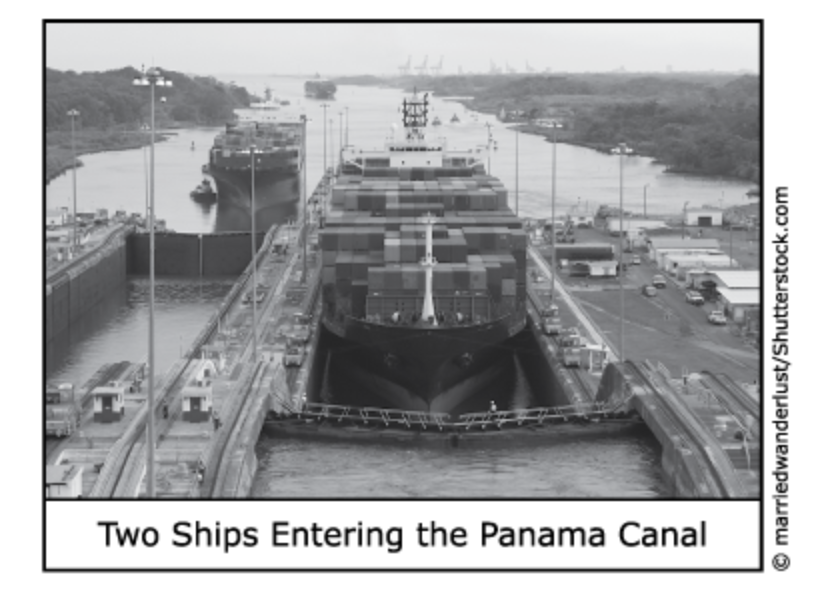
The Panama Canal
(1) Throughout most of history, a ship captain who wanted to travel from the Atlantic to the Pacific Ocean had to make a long journey around the southern tip of South America. (2) This meant that a 12,000-mile voyage from a port in New York City to one in San Francisco took more than two months. (3) As early as the 1500s, visionaries looked for a shortcut to link the two oceans. (4) However, it wasn't until 1904 that the vision began to become a reality. (5) Ten years later the Panama Canal was finished, it changed shipping and travel for the entire world.
(6) Panama is the southernmost country in Central America. (7) It includes a thin strip of land known as an isthmus. (8) At their narrowest point, this piece of land separates the Atlantic and the Pacific Oceans by less than 50 miles and links North and South America.
(9) Many people agreed that this narrow waterway was the ideal location for a canal that would connect the two oceans, but building such a structure wasn't as simple as digging an enormous trench across the land. (10) It was an arduous process, and developers faced many challenges disease-carrying mosquitoes, rugged terrain, and heavy rainfall. (11) There was also a problem with the sea level on each coast. (12) The Pacific Ocean is about 85 feet higher than the Atlantic Ocean. (13) To enable ships that were traveling from the Atlantic to get to the height of the Pacific, the Panama Canal had to include a system of locks and gates known as the Panama Water Lock System.
(14) A lock is a water-filled chamber that opens and closes, permitting ships to come in and out. (15) Once a ship is inside a locked area, the water can be slowly raised or lowered. (16) A ship travels through several lock gates to complete the journey through the canal. (17) This process can take from 8 to 10 hours, which may seem like a very long time to move less than 50 miles. (18) But when compared to the time it had taken for ships to go all the way around the tip of South America, this was of minimal concern. (19) In fact, the completion of the Panama Canal dramatically reduced travel times for ships all around the world. (20) For example, trips between New York and San Francisco were shortened by 8,000 miles. (21) And the United States wasn't the only country that benefited from using the canal. (22) The canal allowed for faster travel between Europe and East Asia as well.
(23) This made it a major factor in expanding global trade.
(24) In 2016, after another rigirous construction program, an expansion to the Panama Canal opened. (25) The expansion doubled the capacity of the canal and allowed much larger ships to pass through. (26) Today, about 14,000 ships use the canal every year. (27) Interested tourists can even book a cruise through this engineering marvel.
(28) The Panama Canal has been referred to as "one of historys' most incredible examples of large-scale engineering." (29) As a result, the American Society of Civil Engineers has recognized the Panama Canal as one of the seven wonders of the modern world. (30) To date, more than a million ships have passed through this marvel, and it's likely that these numbers will continue to grow in the future.
1
Sentence 5 is written incorrectly. Select the response that corrects this sentence.
Ten years later the Panama Canal was __________ and travel for the entire world.
1
What change is needed in sentence 8?
1
What change is needed in sentence 10?
1
What change needs to be made in sentence 24?
1
What change needs to be made in sentence 28?
Read the selection and choose the best answer to each question.
Jonah is writing a letter to request a refund from a company. Read these paragraphs from the beginning of Jonah's letter and look for corrections he needs to make. Then answer the questions that follow.
Refund for Unsatisfactory Fruit Basket
Dear Sir or Madam:
(1) I am writing to inform you about one of your products that did not meet my expectations. (2) Consequently, I am requesting a full refund.
(3) On August 29, 2021, I perused your website and finally ordered the Peachy Perfection basket. (4) I paid $39.99 and indicated that the basket was a birthday gift that needed to be shipped to my sister at the University of Massachusetts at Amherst. (5) I provided her correct mailing address and received confirmation that the fruit basket would arrive on September 13. (6) Throughout the process due to the promises of quality and the glowing testimonials on the website, I felt assured that my gift would arrive on time and be ready to enjoy.
(7) Unfortunately, neither of these assumptions were correct. (8) My sister did not receive her fruit basket until September 15, which was two days after her birthday. (9) Even worse, when we spoke, she reported that most of the peaches are bruised or had soft spots. (10) Needless to say, this rendered it far too unappetizing to eat. (11) I was disappointed, surprised, and embarrassed by my sister's experience.
1
What change, if any, needs to be made in sentence 5?
1
What change needs to be made in sentence 6?
1
What change needs to be made in sentence 7?
1
What change needs to be made in sentence 9?
1
What change, if any, needs to be made in sentence 10?