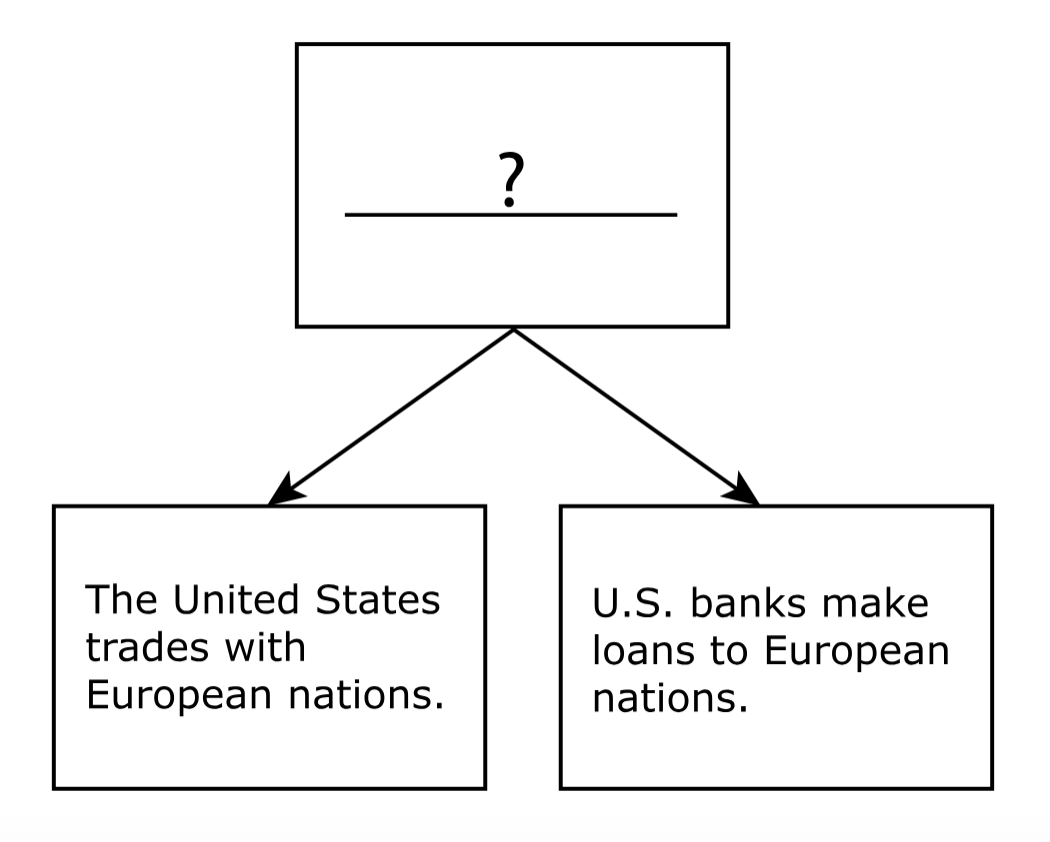
This chart shows events related to World War I.
Nødvendig
1
Which title correctly replaces the question mark in this chart?
Which title correctly replaces the question mark in this chart?
DOK 2
USH.4.F
This excerpt is from the Medal of Honor ceremony for Master Sergeant Raul “Roy” Perez Benavidez.
His fearless personal leadership, . . . devotion to duty, and extremely valorous actions in the face of overwhelming odds were in keeping with the highest traditions of the military service, and reflect the utmost credit on him and the United States Army.
—President Ronald Reagan, February 24, 1981
Why did Master Sergeant Benavidez earn the Medal of Honor?
This excerpt is from a pamphlet written in 1906.
A city is in many respects a great business corporation, but in other respects it is enlarged housekeeping. . . . May we not say that city housekeeping has failed partly because women, the traditional housekeepers, have not been consulted as to its [various] activities?
—Jane Addams
Which statement about the effect of Jane Addams’s work is BEST supported by the excerpt?
This excerpt is about an issue affecting the United States in the 2000s.
Structures such as buildings [and] roads . . . absorb and [release] the sun’s heat more than natural landscapes such as forests and water bodies. . . . These pockets of heat are referred to as “heat islands.” . . .
A review of research studies and data found that in the United States, the heat island effect results in daytime temperatures in urban areas about 1–7°F higher than temperatures in outlying areas. . . .
Heat islands are usually measured by the temperature difference between cities relative to the surrounding areas. . . .
In general, temperatures are different at the surface of the earth and in the atmospheric air, higher above the city.
—“Learn about Heat Islands,” Environmental Protection Agency
Which statements explain the impact of urban development on the physical environment?
Select TWO choices that correctly answer the question.
This excerpt describes a New Deal policy from the 1930s.
The constitutional basis of the Social Security Act was uncertain. The basic problem is that under the “reserve clause” of the Constitution (the 10th Amendment) powers not specifically granted to the federal government are reserved for the States or the people. When the federal government seeks to expand its influence in new areas it must find some basis in the Constitution to justify its action.
—Larry DeWitt, “The 1937 Supreme Court Rulings on the Social Security Act,” Social Security Administration, 1999
Based on the excerpt and your knowledge of U.S. history, which constitutional issue was raised by this legislation?
This excerpt highlights a debate in the U.S. Senate in the 1960s.
As the Senate debate continued, . . . opponents expressed their objections in far-ranging statements that summed up decades of anti-civil rights [positions]. . . . Senator Strom Thurmond of South Carolina echoed that sentiment, stating that “there are already ample laws on the [state law] books . . . if any qualified citizen does not vote today, the explanation must be either that he does not desire to vote or that he has not complained about voting.” Senator Russell Long of Louisiana argued that the bill would deny individuals the right to make “decisions such as whom a person will have as his neighbor and with whom he will associate in other respects.”
—“Civil Rights Act of 1964,” U.S. Senate
Based on the excerpt and your knowledge of U.S. history, how did southern Democrats in Congress work to maintain the status quo in the South?
Why did people such as President William McKinley and Sanford B. Dole argue that the annexation of Hawai`i would benefit the United States?
Select TWO correct answers.
One reason the Korean War ended in a stalemate was because North Korea was aided by thousands of troops from which country?
This excerpt describes circumstances that led to the 1967 Supreme Court case Loving v. Virginia.
In June, 1958, two residents of Virginia, Mildred Jeter, a Negro woman, and Richard Loving, a white man, were married in the District of Columbia pursuant to its laws. Shortly after their marriage, the Lovings returned to Virginia and established their marital abode in Caroline County. At the October Term, 1958, of the Circuit Court of Caroline County, a grand jury issued an indictment charging the Lovings with violating Virginia’s ban on interracial marriages. On January 6, 1959, the Lovings pleaded guilty to the charge, and were sentenced to one year in jail; however, the trial judge suspended the sentence for a period of 25 years on the condition that the Lovings leave the State and not return to Virginia together for 25 years.
—Legal Information Institute, www.law.cornell.edu (accessed May 9, 2019)
Why did the U.S. Supreme Court unanimously rule that Virginia’s interracial marriage law was unconstitutional?
This excerpt is from an organization with one view on climate change.
Global warming is indeed real, and human activity has been a contributor since 1975.
But global warming is also a very complicated and difficult issue that can provoke very unwise policy in response to political pressure. . . .
Although there are many different legislative proposals for substantial reductions in carbon dioxide emissions, there is no operational or tested suite of technologies that can accomplish the goals of such legislation. Fortunately . . . there is ample time to develop such technologies.
—“Global Warming and Climate Change,” Cato Handbook for Policymakers, Cato Institute
How did Charles Lindbergh affect the development of aviation in the United States?
This excerpt is from remarks given during a congressional debate over the Social Security Act of 1935.
[Social Security] launches the Federal Government into an immense undertaking which in [total] will reach dimensions none of us can really visualize. . . . Remember, once we pay pensions and supervise annuities, we cannot withdraw from the undertaking no matter how demoralizing and [disruptive] it may become. Pensions and annuities are never abandoned; nor are they ever reduced. The recipients ever [shout] for more.
—New York Rep. James Wadsworth Jr., April 19, 1935
Based on the excerpt, which statement reflects Representative Wadsworth’s fear about the passage of the Social Security Act?
This chart shows events related to World War I.
Which title correctly replaces the question mark in this chart?
Which effect did tariffs have on the U.S. economy during the early 1930s?
This photograph was taken at an automotive plant in Michigan.
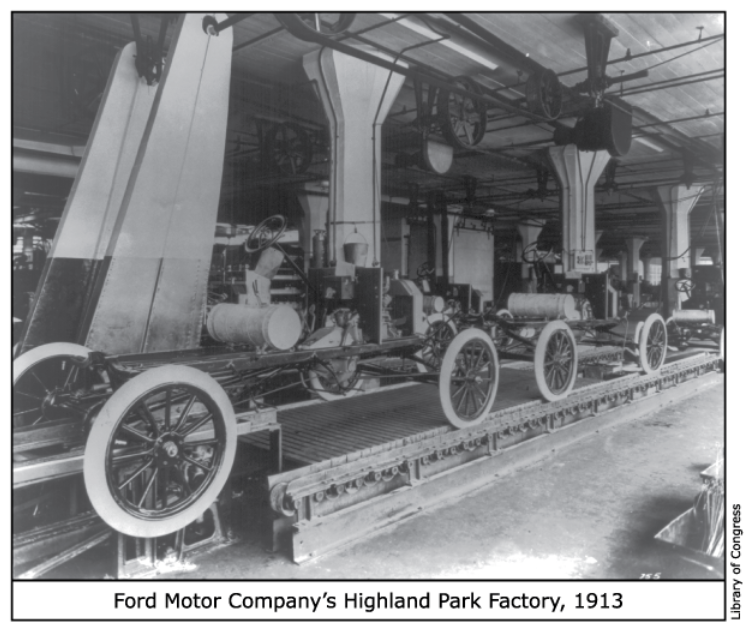
Based on the photograph and your knowledge of U.S. history, how did the use of the manufacturing process shown affect the production AND sale of goods in the United States?
Think about the question carefully. Then enter your answer in the box provided.
This excerpt about the Chinese Exclusion Act is from an Arizona newspaper article published in the early 1900s.
One of the big questions which is agitating this country at the present time is the Chinese exclusion act and the effect its rigid enforcement has . . . on American commerce. . . . The cry for more liberal immigration laws for the Chinese comes wholly from the manufacturers.
—“The Chinese Exclusion Act,” The Bisbee Daily Review, June 30, 1905
Based on the excerpt and your knowledge of U.S. history, how did the Chinese Exclusion Act affect the U.S. economy?
Why did the Framers of the Constitution decide to give impeachment power to the House of Representatives?
These excerpts are from two amendments to the U.S. Constitution.
The right of citizens of the United States to vote shall not be denied or abridged by the United States or by any State on account of race, color, or previous condition of servitude.
—Fifteenth Amendment
The right of citizens of the United States to vote shall not be denied or abridged by the United States or by any State on account of sex.
—Nineteenth Amendment
These excerpts are from two amendments to the U.S. Constitution.
The right of citizens of the United States to vote shall not be denied or abridged by the United States or by any State on account of race, color, or previous condition of servitude.
—Fifteenth Amendment
The right of citizens of the United States to vote shall not be denied or abridged by the United States or by any State on account of sex.
—Nineteenth Amendment
How did each of these amendments contribute to the development of civil rights in the United States? Select the correct answer in each row.
Fifteenth Amendment | Nineteenth Amendment | |
|---|---|---|
Increased political power for women | ||
Increased political participation for men | ||
Met goals of the suffragist movement | ||
Met goals of the abolitionist movement |
This diagram shows the results of federal legislation.
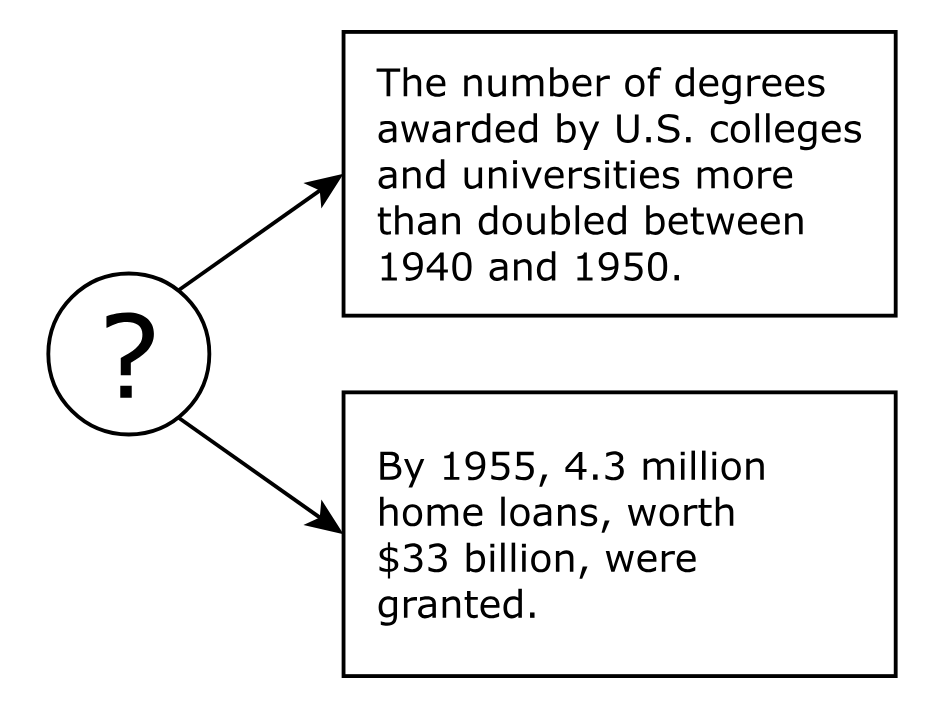
Which statement correctly replaces the question mark on this cause-and-effect diagram?
Which statements describe effects of industrialization during the late nineteenth century?
Select TWO correct answers.
This list provides information about a U.S. Supreme Court case from the 1960s. |
|---|
Summary of Wesberry v. Sanders
James Wesberry lived in a Georgia congressional district with more residents than other Georgia districts.
Wesberry challenged Georgia’s congressional district map in court.
In 1964, the Supreme Court ruled that congressional districts must have roughly equal populations.
Which statement describes the significance of Wesberry v. Sanders?
Which images show issues directly affecting civilians on the home front during World War II?
Select THREE correct answers.
In what way has the concept of laissez-faire contributed to U.S. economic success?
This excerpt describes U.S. migration in the mid-to-late 1800s.
White settlers from the East poured across the Mississippi to mine, farm, and ranch. African-American settlers also came West from the Deep South, convinced by promoters of all-black Western towns that prosperity could be found there. Chinese . . . workers further added to the diversity of the region’s population.
—“The American West, 1865-1900,” Library of Congress, www.loc.gov (accessed November 19, 2018)
Which factor contributed to the population shift described in this excerpt?
This excerpt is from a presidential speech about changes to the U.S. Supreme Court.
The Court in addition to the proper use of its judicial functions has improperly set itself up as a third house of the Congress—a super-legislature, as one of the justices has called it—reading into the Constitution words and implications which are not there, and which were never intended to be there. ...
That plan has two chief purposes. By bringing into the judicial system a steady and continuing stream of new and younger blood, I hope, first, to make the administration of all Federal justice speedier and, therefore, less costly; secondly, to bring to the decision of social and economic problems younger men who have had personal experience and contact with modern facts and circumstances under which average men have to live and work.
—President Franklin Roosevelt, Fireside Chat, March 9, 1937
Based on the excerpt, which justification did President Roosevelt use to support his proposal?
What was the PRIMARY motive for the U.S. government’s policy of supporting the government of South Vietnam?
This excerpt is from the U.S. Constitution.
After one year from the ratification of this article the manufacture, sale, or transportation of intoxicating liquors within . . . the United States . . . for beverage purposes is hereby prohibited.
—Eighteenth Amendment to the U.S. Constitution
Based on the excerpt and your knowledge of U.S. history, which long-term change in American society is reflected by the ratification of the Eighteenth Amendment?
Which results occurred on the home front because of U.S. involvement in World War I?
Select TWO correct answers.
This excerpt is from a U.S. government website discussing the 50th anniversary of the book Silent Spring by Rachel Carson.
As expected, her book provoked a firestorm of controversy. . . . The pesticide industry mounted a massive campaign to discredit Carson even though she did not urge the complete banning of pesticides but rather that research be conducted to ensure pesticides were used safely and alternatives to dangerous chemicals such as DDT be found. The federal government, however, ordered a complete review of its pesticide policy and Carson was asked to testify before a Congressional committee along with other witnesses. As a direct result of the study, DDT was banned.
—“Rachel Carson Biography,” U.S. Fish & Wildlife Service, Rachel Carson National Wildlife Refuge in Maine, 2012
Based on the excerpt and your knowledge of U.S. history, which major effect did Carson’s book have?
Which situation was one result of Jim Crow transportation laws?
Choose the correct answer from each drop-down menu to complete the sentences.
Following World War II, some African American soldiers were motivated to settle overseas because of the racism they experienced living in the United States and the they found in European countries. A few chose to open restaurants that served the regional cuisine they were accustomed to back home, leading to .
How did the beliefs of Martin Luther King Jr. differ from those of the Black Panthers?
This newspaper headline describes an attack during the Vietnam War.
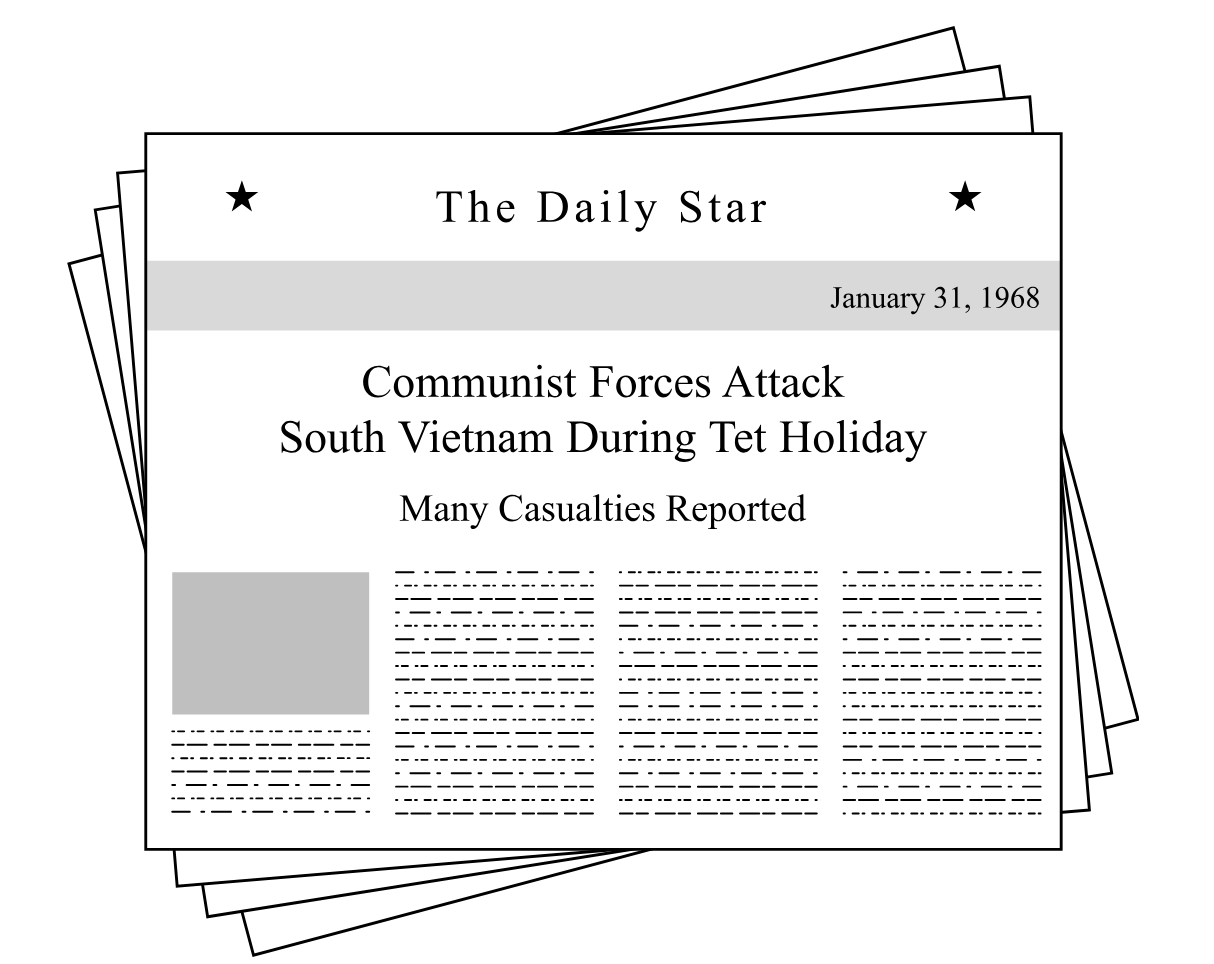
How did media coverage of the attack described in this headline influence the Vietnam War?
This diagram describes events in civil rights history.

Which 1948 action correctly replaces the question mark in this cause-and-effect diagram?
This excerpt discusses a proposed amendment.
The purpose of the ERA [Equal Rights Amendment] was to establish legal gender equality. . . .
[It] was drafted in 1923. . . .
In 1970, after decades of receiving little attention . . . the amendment was given serious consideration. By March 1972 the ERA . . . was sent to the states for ratification. Twenty-two states quickly ratified the amendment in 1972. But when the final deadline for ratification arrived . . . it was three states short.
—Christine Blackerby, “The Equal Rights Amendment: The Most Popular Never-Ratified Amendment,” National Archives
Which trend contributed to the attempt to pass the Equal Rights Amendment in the 1970s?
This excerpt is from a letter to the U.S. Army Chief of Staff during World War II.
But the most interesting—although horrible—sight that I encountered during the trip was a visit to a German internment camp near Gotha. The things I saw [are beyond] description. While I was touring the camp I encountered three men who had been inmates. . . . I interviewed them through an interpreter. The visual evidence and the verbal testimony of starvation, cruelty . . . were so overpowering as to leave me a bit sick. . . . I made the visit deliberately, in order to be in a position to give first-hand evidence of these things if ever, in the future, there develops a tendency to charge these allegations merely to propaganda.
—General Dwight D. Eisenhower, letter to General George C. Marshall, April 15, 1945
What major event of World War II does General Eisenhower’s letter refer to?
The following choices are all protest methods that have been used by U.S. citizens in the past. Which forms of protest were used in response to the Vietnam War?
Select TWO correct answers.
This map shows part of the Great Plains during the 1930s.
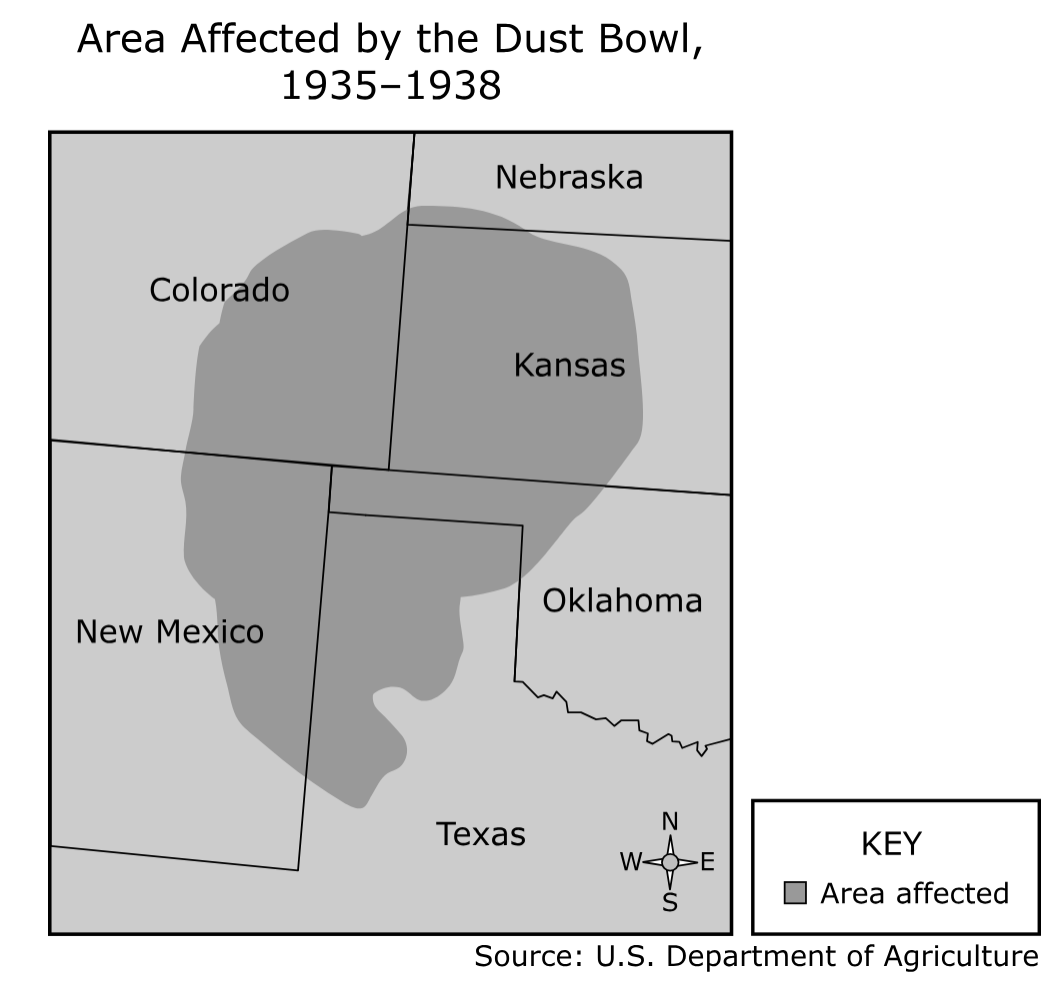
How did the government respond to the situation shown on this map?
Which period in U.S. history was characterized by organized protests and bus boycotts?
This excerpt is about the development of the atomic bomb during the 1940s.
Not all the scientists of the Manhattan Project were satisfied that their voices had been heard in decision-making about the bomb. . . . The Scientific Panel of the Interim Committee was supposed to be the connection between the scientists and the policymakers, but after the scientists of the Met Lab were briefed . . . [the Met Lab scientists] decided to create a “second opinion.” . . . [The Franck] report argued that postwar international control of atomic power was the only way to stop the arms race that would be inevitable if the United States bombed Japan without first demonstrating the weapon in an uninhabited area. . . . [Policymakers] disagreed with the Franck Report.
—“Debate Over How to Use the Bomb,” U.S. Department of Energy
Which information about the development of the atomic bomb is revealed by this excerpt?
What is one similarity between the Harlem Renaissance of the 1920s and the Chicano Mural Movement of the 1960s and 1970s?
This photograph shows a work environment during World War II.
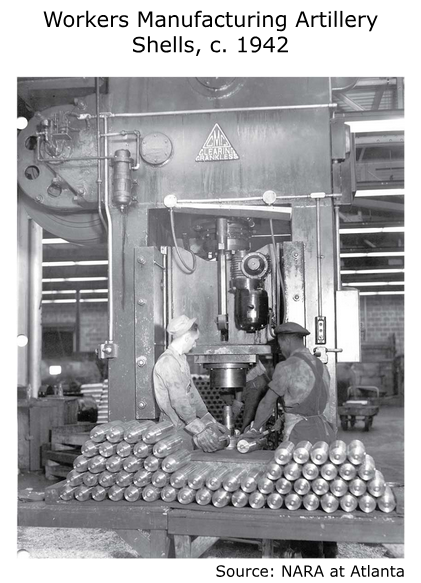
The photograph represents a result of which wartime policy?
This time line shows select accomplishments of Sandra Day O’Connor.
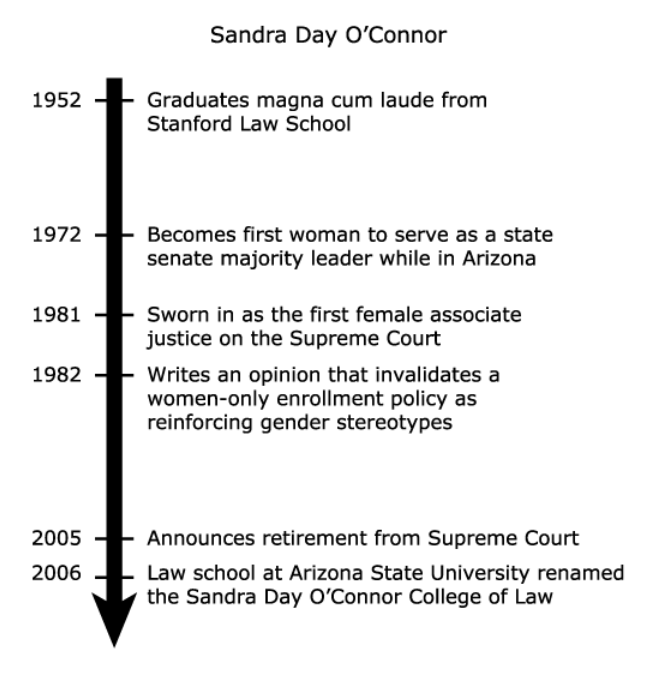
How did Sandra Day O’Connor contribute to the national identity of the United States?
Why was the development of electric lighting important to the economic development of the United States?
The Twenty-Fifth Amendment was ratified to clarify the process of presidential succession. Which TWO scenarios does the Twenty-Fifth Amendment address?
This excerpt is about a presidential order issued during the 1960s.
The Executive Order prohibits federal contractors . . . from discriminating in employment decisions on the basis of race, color, religion, sex, sexual orientation, gender identity or national origin. The Executive Order also requires Government contractors to take affirmative action to ensure that equal opportunity is provided in all aspects of their employment.
—“Executive Order 11246—Equal Employment Opportunity,” U.S. Department of Labor
Which statement describes an effect of this executive order?
Which action describes a part of the Great Society program during the 1960s?
This excerpt is from the transcript of an important U.S. Supreme Court ruling.
Because of the obvious importance of the question presented, the Court took jurisdiction. . . .
. . . Does segregation of children in public schools solely on the basis of race . . . deprive the children of the minority group of equal educational opportunities? . . .
Segregation of white and colored children in public schools has a detrimental effect upon the colored children. . . .
We conclude that, in the field of public education, the doctrine of “separate but equal” has no place. . . . This disposition makes unnecessary any discussion whether such segregation also violates the Due Process Clause.
—Brown v. Board of Education, May 17, 1954
This list highlights some acts of aggression by a European dictator in the 1930s. |
|---|
invaded and annexed Austria
demanded Czechoslovakia hand over the Sudetenland
invaded Poland in 1939
Which European leader is associated with these acts that led to World War II?
This excerpt is from a law passed in the 1860s.
That any person who is the head of a family, or who has arrived at the age of twenty-one years, and is a citizen of the United States, or who shall have filed his declaration of intention to become such, . . . and who has never borne arms against the United States Government or given aid and comfort to its enemies, shall . . . be entitled to enter one quarter section or a less quantity of unappropriated public lands.
—Homestead Act, May 20, 1862
Which phrase describes the purpose of this law?

Which event correctly completes this graphic organizer?
This table shows the results of the 2000 presidential election.
2000 Presidential Election Results
Candidate | Total Popular Vote | Popular Vote | Electoral Vote |
|---|---|---|---|
George W. Bush (Republican) | 50,456,002 | 47.87% | 271 |
Al Gore (Democrat) | 50,999,897 | 48.38% | 266 |
Ralph Nader (Green) | 2,882,955 | 2.74% | 0 |
Source: Federal Election Commission
This table shows the results of the 2000 presidential election.
2000 Presidential Election Results
Candidate | Total Popular Vote | Popular Vote | Electoral Vote |
|---|---|---|---|
George W. Bush (Republican) | 50,456,002 | 47.87% | 271 |
Al Gore (Democrat) | 50,999,897 | 48.38% | 266 |
Ralph Nader (Green) | 2,882,955 | 2.74% | 0 |
Based on the table and your knowledge of U.S. history, identify how Ralph Nader’s third-party candidacy affected the outcome of this election.
Move the correct answer to the box in the table. Not all answers will be used.
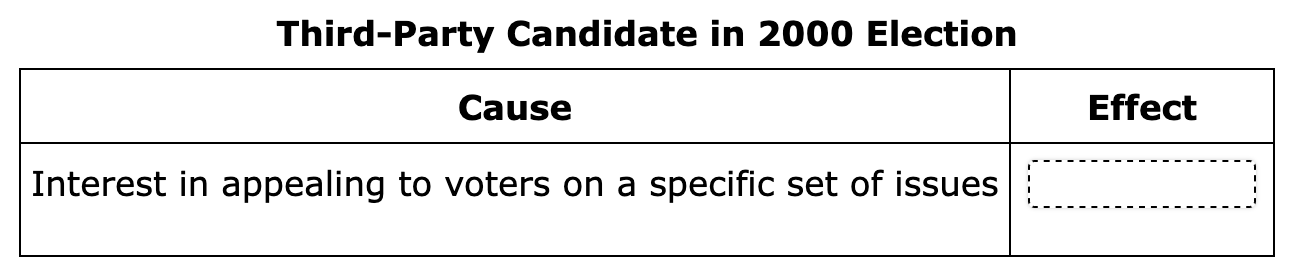
Guaranteed vote recounts in swing states
Loss of votes for major party nominees
Greater voter oversight of campaign spending
This excerpt provides background information on legislation passed during the 1880s.
Small businesses and farmers were protesting that the railroads charged them higher rates than larger corporations, and that the railroads were also setting higher rates for short hauls than for long-distance hauls. . . .
. . . When Congress failed to act, some states adopted their own railroad regulations. . . . Continued public anger over unfair railroad rates prompted Illinois senator Shelby M. Cullom to hold [congressional] hearings.
—United States Senate, Senate Historical Office
Which statement describes a direct result of these actions?
How did the United States respond to the Soviet blockade of Berlin in 1948?
This photograph shows a bumper sticker in 1970.
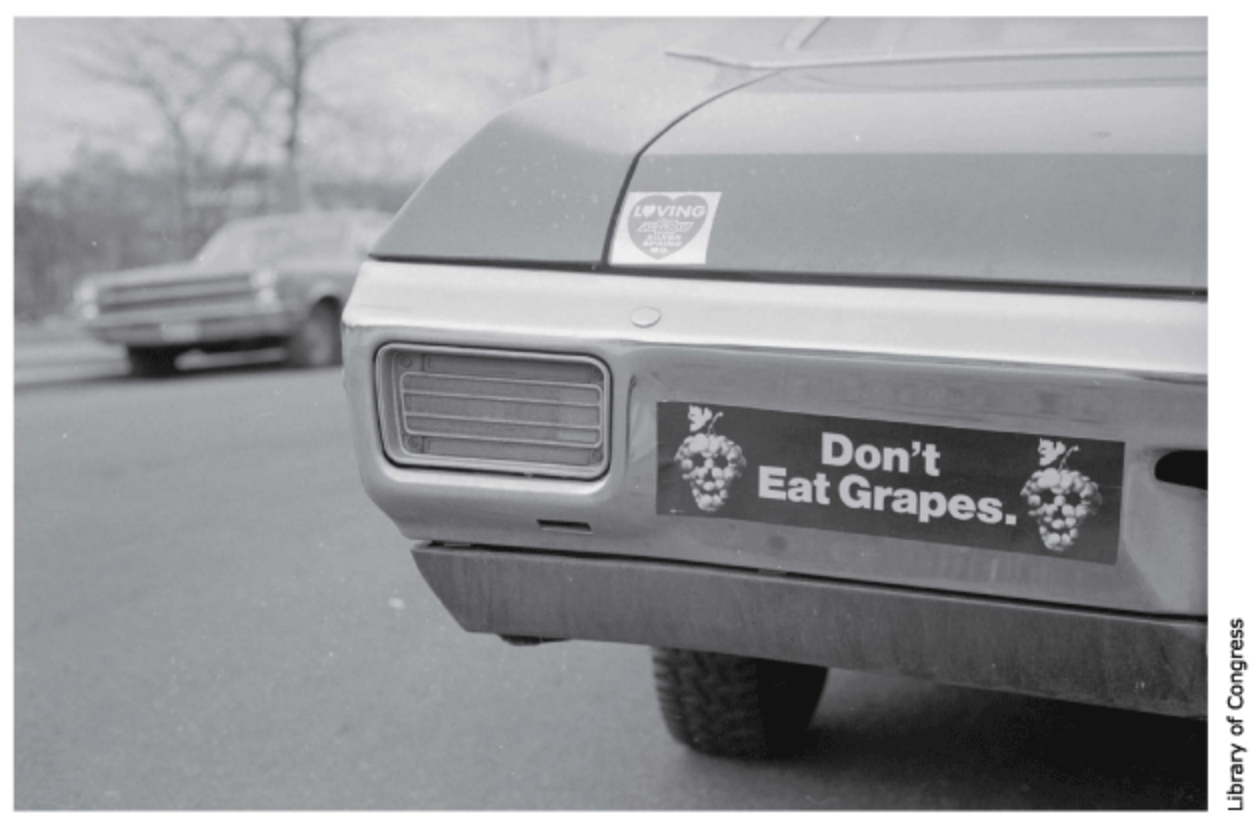
Based on the photograph and your knowledge of U.S. history, which impact did the United Farm Workers have on U.S. society?
How has space exploration improved the standard of living in the United States?
What were TWO geographic obstacles that were encountered during the construction of the Panama Canal?
Think about the question carefully. Then enter your answers in the box provided.
This excerpt is from a summary of a silent movie created in 1920.
An Italian immigrant arrives in America unable to speak English. Following disappointments and misfortunes, he takes language classes and ascends the ladder of success. Created as an education tool directed at industrial workers, this short drama was intended to help . . . immigrants.
—“The Making of an American,” Library of Congress
Based on the excerpt and your knowledge of U.S. history, what was the MAIN purpose of this film?
Which factor promoted the U.S. cattle industry’s rapid growth in the 1870s and early 1880s?
This photograph was taken at a public exhibition in the Soviet Union in 1958.
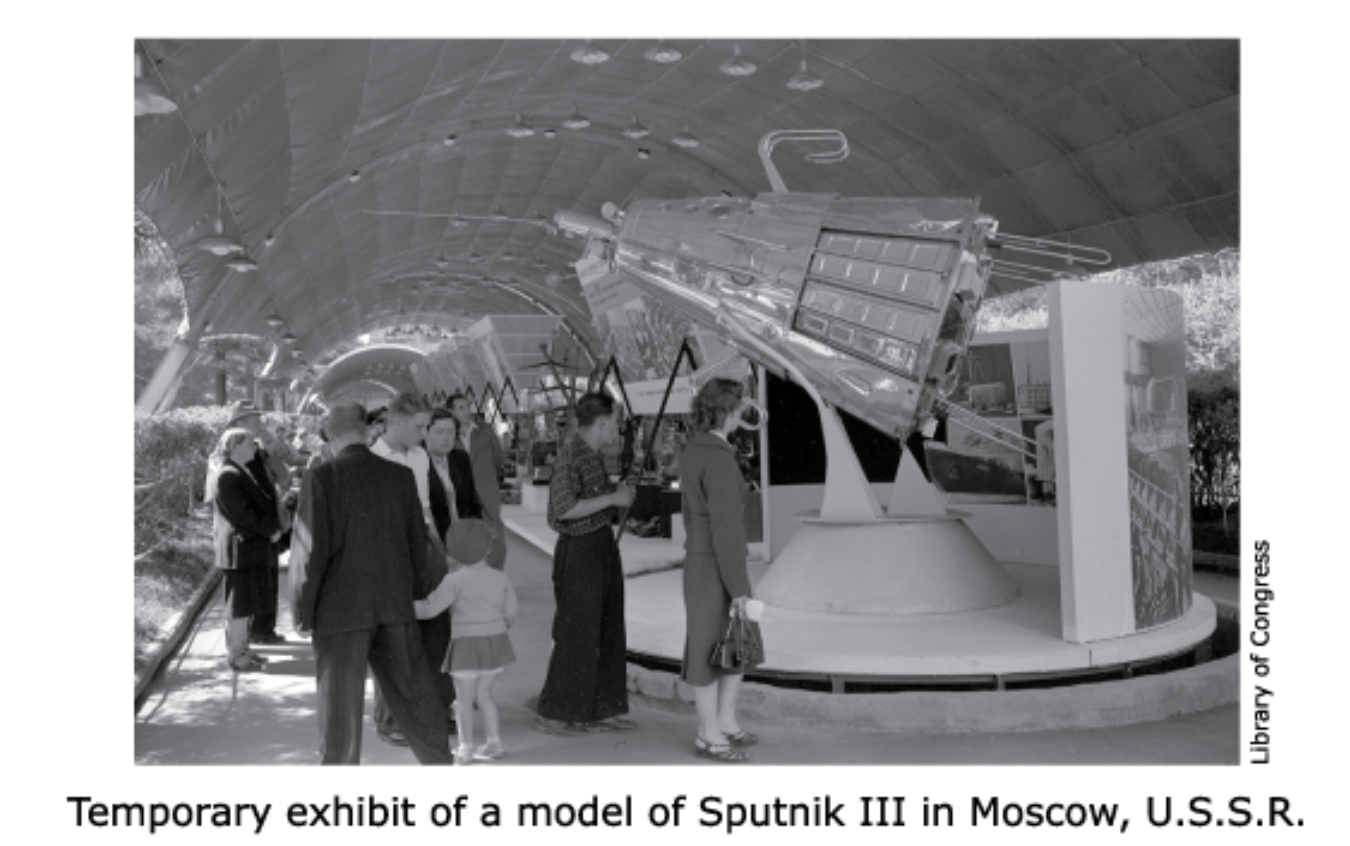
Based on the photograph and your knowledge of U.S. history, how did scientific developments such as the one shown affect the United States?
Which statement describes a criticism associated with the 1994 North American Free Trade Agreement (NAFTA)?
This excerpt is from a presidential address from the 1920s.
America is ready to encourage, eager to initiate, anxious to participate in any seemly program likely to lessen the probability of war. . . .
I speak for administrative efficiency, for lightened tax burdens . . . for the omission of unnecessary interference of Government with business. . . .
I wish for an America no less alert in guarding against dangers from within than it is watchful against enemies from without. . . .
. . . Opportunity is calling not alone for the restoration, but for a new era in production, transportation and trade. . . .
. . . Believing in our higher standards, reared through constitutional liberty and maintained opportunity, we invite the world to the same heights.
—President Warren Harding’s inaugural address, March 4, 1921
Which statements highlight President Warren G. Harding’s domestic economic policies after World War I?
Select TWO choices that correctly answer the question.
This excerpt is about Muhammad Ali, who refused to comply with the military draft in 1967.
The [draftee] drawing such intense interest was Muhammad Ali, the undefeated heavyweight champion of the world. Over the past three years, Ali had become a national [outcast] for his views on race, religion, and especially the Vietnam War. . . .
. . . He was tried and convicted of draft evasion in federal district court and sentenced to the maximum penalty. He was stripped of his [boxing] titles and suspended from boxing during the peak of his career, losing millions of dollars in the process. . . . In response, Ali and his legal team launched a lengthy challenge against his conviction that ended with victory in the Supreme Court of the United States in 1971.
—Winston Bowman, “United States v. Clay: Muhammad Ali’s Fight against the Vietnam Draft,” 2018
Based on the excerpt, why were Muhammad Ali’s actions significant?
How did the U.S. government respond to the global financial crisis in 2008?
Which action did the Ku Klux Klan MOST commonly use?
Which statement explains the Cato Institute’s position on climate change?
Which phrase from the excerpt provides evidence to support the answer to Part A?
Part A
How did the Brown v. Board of Education ruling affect the Civil Rights Movement?
Part B
Which statement from the excerpt provides evidence to support your answer to Part A?