Analyze the image on the worksheet to answer the questions on this Data Crunch.
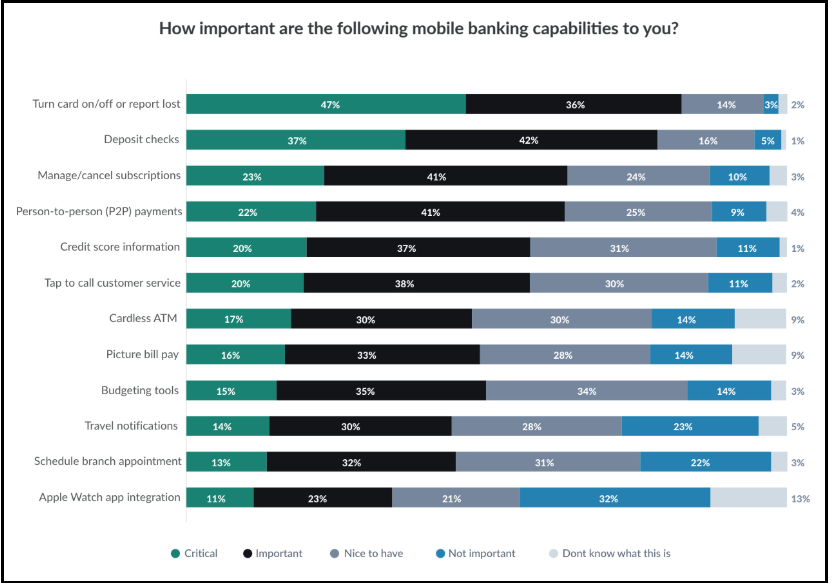
Maha looks at this graph and says: “This survey shows that Americans really care about the security of their bank account” Do you agree or disagree with Maha’s conclusion? Explain your reasoning.
How do you think this data would look if it only looked at how Gen Z uses mobile banking? Why?
The article listed 7 major advantages of online banking. Choose 2 and, in your own words, explain how they can make banking easier or more convenient.
Do you already conduct your banking online or through your phone? If yes, which of these advantages do you find helpful? If no, which of these do you think you would find to be the most helpful? Why?
ARTICLE: Online Bill Pay: What It Is and Why to Use It 📷5 min In the Data Crunch, you saw that many people are utilizing online and mobile banking with their checking accounts. They love the convenience and time-saving features of online banking, including the ability to pay their bills online. Skim this article to learn more. Then, answer the questions.
What might be the benefit of setting up a recurring payment through online bill pay?
Picture yourself moving out on your own or maybe with a roommate, working your first full-time job. List at least four people or companies you might want to pay regularly by using online bill pay.
VIDEO: What is Direct Deposit? 📷5 min Another feature online banking offers is Direct Deposit, which is now the most common form of payment for work. Watch this video to learn what some of the benefits of direct deposit are. Then, answer the following questions.
In your own words, explain what direct deposit is.
ACTIVITY: INTERACTIVE: Online Bank Simulator 📷30 min Now that we’ve explored the most important aspects of banking, let’s try using an online bank. Follow the directions on the worksheet to complete this activity.
Click here for the simulation: https://www.ngpf.org/bank-sim/
This activity is on Paper, please scren shot your final amount for full credit.
With many transactions like payments and direct deposits happening online, you might be concerned about the safety of your money. Read the article to learn about ways that you can improve your online banking security and protect your money. Then, answer the questions.
Why is it recommended that you avoid doing online banking on public Wi-Fi?
How can turning on text and email alerts help keep your account safe?
ARTICLE: The Pros and Cons of Moving to a Cashless Society 📷10 min
Another major change is a move towards a cashless society. Being cashless offers many conveniences, but it’s not without its downsides. Read the article up to “What Does a Cashless Society Look Like?” Then, answer the questions.
In your own words, what is a cashless society?
How does a cashless society affect your privacy?
How does a cashless society affect the economically disadvantaged (poor)?
How might a cashless society negatively impact someone who is unbanked or underbanked?
Which of the following is an example of online bill pay?
Using a person-to-person app to repay your friend for dinner
Using a mobile payment service to purchase your groceries at a store
Having your bank send your rent to the landlord each month
Having your check direct deposited into your bank account
Which of the following statements is an advantage of online banking?
Once you set up online banking, your bank will waive overdraft, ATM, and monthly fees
Using online banking, you can request transfers, pay bills, and automate your savings without visiting the bank branch
Online banking is the only way you can make online purchases
If you set up online banking, your bank will also file your taxes for you automatically
All of the following are ways that you can keep your online bank account safe EXCEPT…
Only using private wifi to access your account
Turning on text alerts to monitor your account for large or potentially fraudulent transactions
Changing your password regularly using reasonably complex passwords
Banking with small banks and credit unions because they are less frequently the target of fraud