Log in
Sign up for FREE
arrow_back
Library

Unit 9 - Structures & Behaviors - Test Corrections

star
star
star
star
star
Last updated about 1 year ago
17 questions
1
3.10B
1
5.7.A
1
4.13.B
1
5.8.A
1
5.13.B
1
3.13.B
1
5.8.C
1
5.13.A
1
5.13.A
1
5.8.C
1
5.13.A
1
5.13.A
1
5.9
1
5.13.A
1
3.13.B
1
5.9
1
5.10.A
Question 1
1.

Question 2
2.

Question 3
3.

Question 4
4.

Question 5
5.

Question 6
6.

Question 7
7.

Question 8
8.
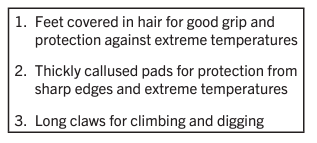
This question has two parts. First, answer Part A. Then answer Part B.

A student reads the following information.


Part A
Which animal most likely has the characteristics described? __________

Part B
Which statement best provides evidence for the answer to Part A? __________
Question 9
9.
This question has two parts. First, answer Part A. Then answer Part B.

Three students observe and record information about bird feet.


Part A
Which student's explanation is the best reason why geese have webbed feet? __________

Part B
Which best explains the answer to Part A? __________
Question 10
10.

Question 11
11.

Question 12
12.
This question has two parts. First, answer Part A. Then answer Part B.

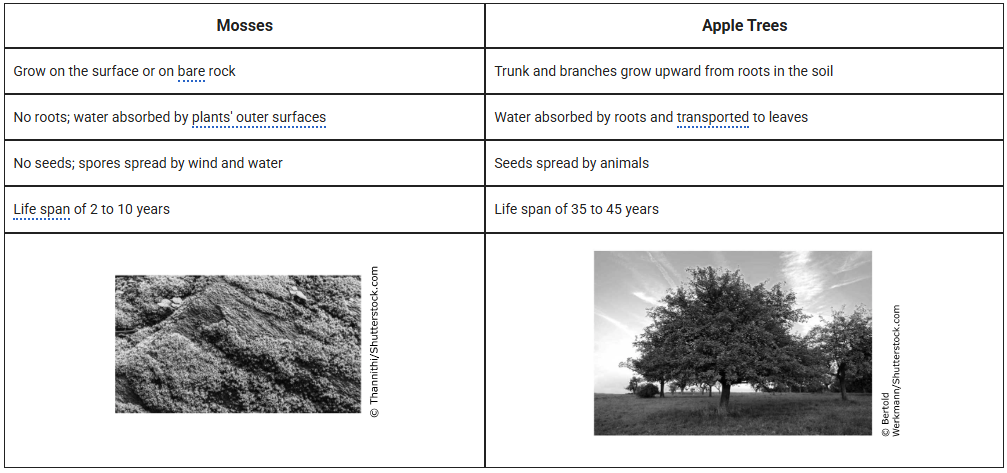
Characteristics of mosses and apple trees are shown in the table.


Part A

Which statement BEST describes a survival advantage apple trees could have compared to mosses in certain environments? __________

Part B
Which statement BEST supports the answer to Part A? __________
Question 13
13.

Question 14
14.

Question 15
15.

Question 16
16.

Question 17
17.

A gardener plants seeds in the garden. After the flower stage, the fruits and vegetables grow. A table of how many days are needed for some plants to be ready for harvest is shown.
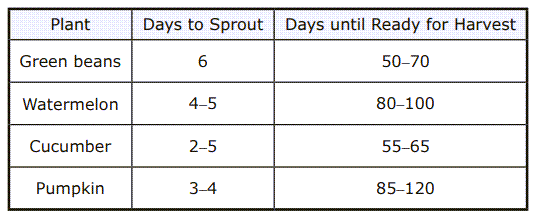


Which statement is supported by the data shown in the table?
Pumpkins take the most time to sprout and to be ready for harvesting.
Green bean seeds sprout faster because they are smaller than other seeds.
Cucumbers are ready for harvest in less time than watermelons.
Watermelon seeds take longer to sprout because watermelon plants produce large fruits.
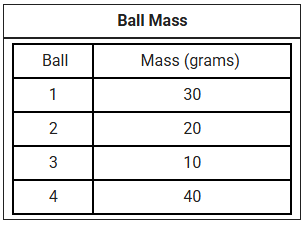
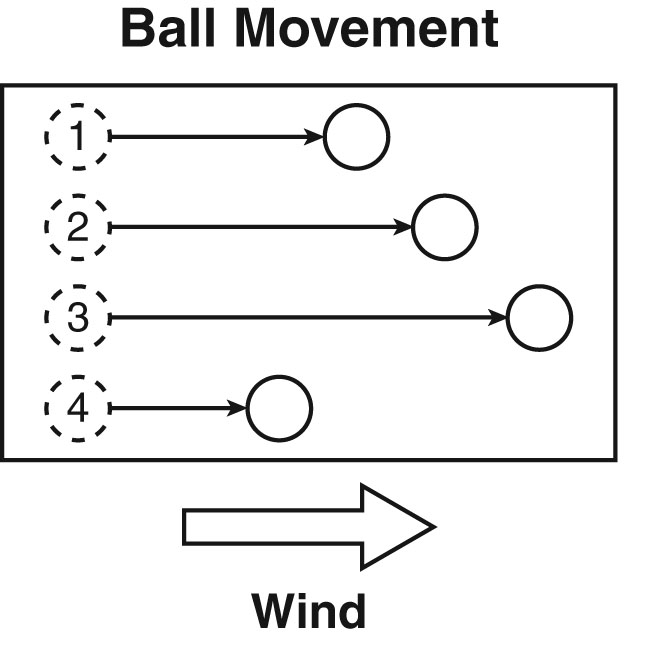
Students investigate how the force of the wind affects the movement of equal-sized balls that have different masses.


As students watch, a wind blows equally on all of the balls. When the wind stops, students draw a picture of their results.


Based on the results, what should the students conclude?
Balls move easily when their mass is higher.
Balls move farther when the wind speed is lower.
Balls move farther when their mass is lower.
Balls move quickly when their size is larger.
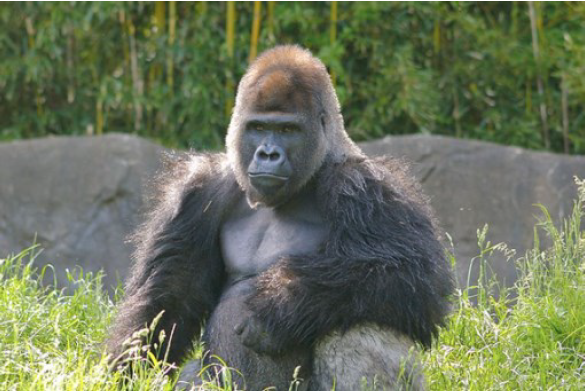
A class visits the zoo and observes the gorilla habitat for several minutes.


Which of the following observations are learned behaviors? Choose TWO correct answers.
The gorilla ate a piece of bamboo that was growing in the habitat.
The gorilla used a stick to dig an ant out of a hole.
The gorilla had thick, black fur on most of its body.
The gorilla ran to the zookeeper and became excited at feeding time.
The gorilla laid in the grass and slept.
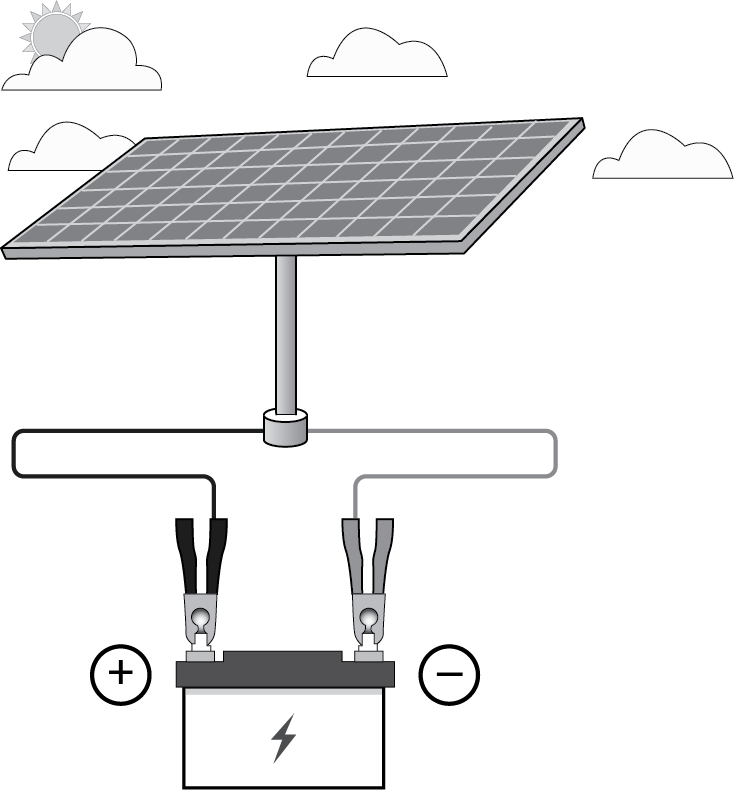
The image shows a solar cell connected to a battery, which can then be used to charge electronic devices.


Into what type of energy does the solar cell transform the solar energy?
mechanical energy
electrical energy
thermal energy
light energy
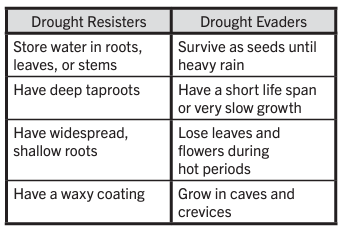
What can be concluded about drought resisters and drought evaders?

Both types of plants have learned behaviors that allow them to survive.
Drought resisters have inherited traits, while drought evaders have learned behaviors that allow them to survive.
Both types of plants have inherited traits that allow them to survive.
Drought resisters have learned behaviors, while drought evaders have inherited traits.
Students research how long it takes different animal eggs to develop. The information the students collected is in the table shown.


Which statement is best supported by the data shown in the table?
The turtles have a longer life span than the birds.
The egg stage for most animals is the shortest life cycle stage.
Frogs have short egg stages because they lay large numbers of eggs.
Frog and toad eggs hatch more quickly than turtle or bird eggs.

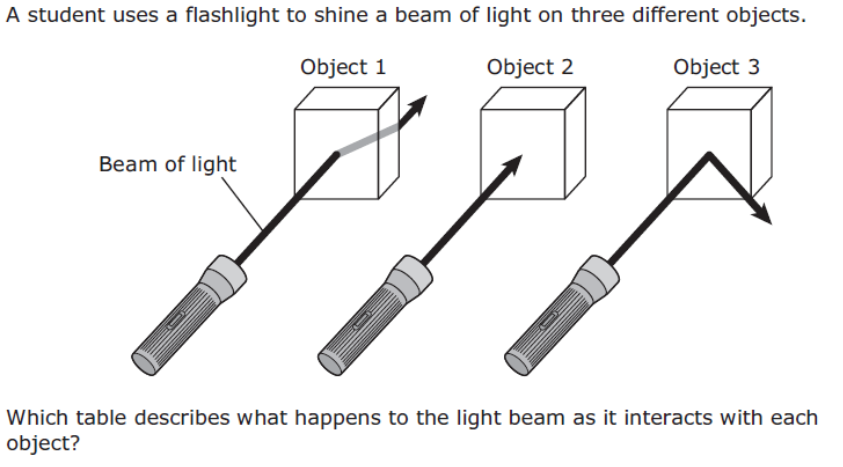
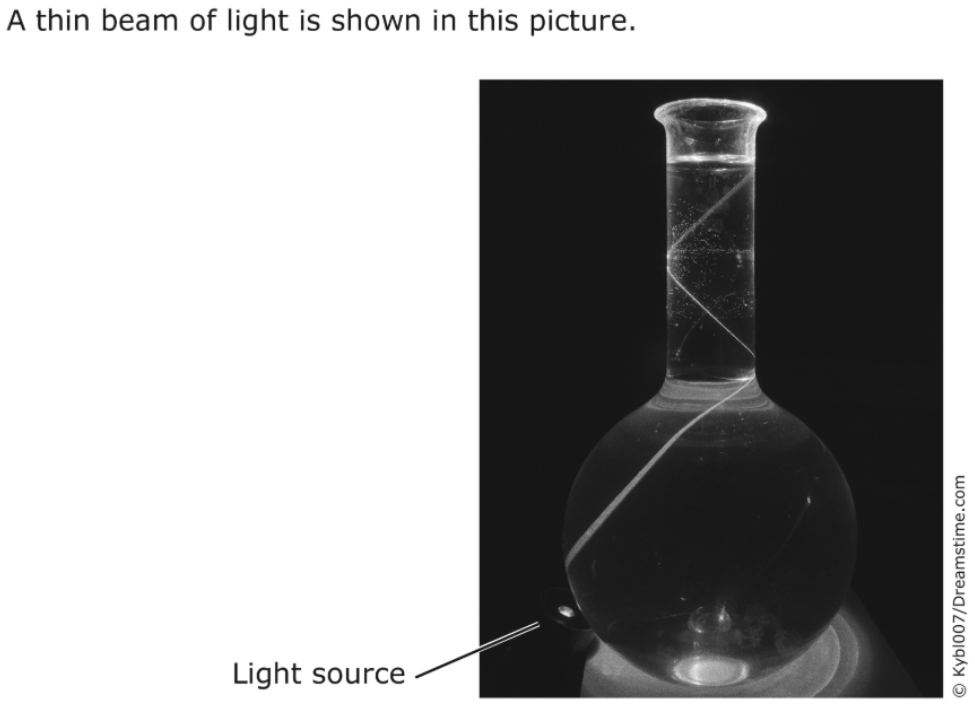
What does the picture demonstrate about light?
Light and its reflections travel in straight lines.
Light cannot reflect from more than one surface.
Light that goes through water cannot travel in straight lines.
Light can travel in a circular path.
Unlike humans, otters have special flaps that close off their nostrils and ears. These flaps help otters survive in an environment that is --
terrestrial
snowy
windy
aquatic

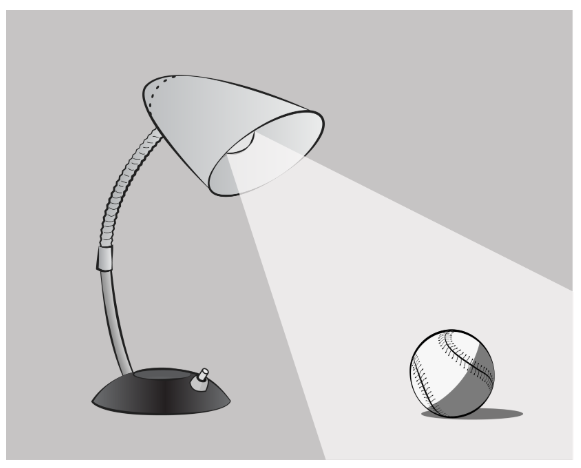
Which action would best model the cause of day and night?
move the ball around the lamp
rotate the ball one time
turn the lamp off and on
rotate the lamp one time
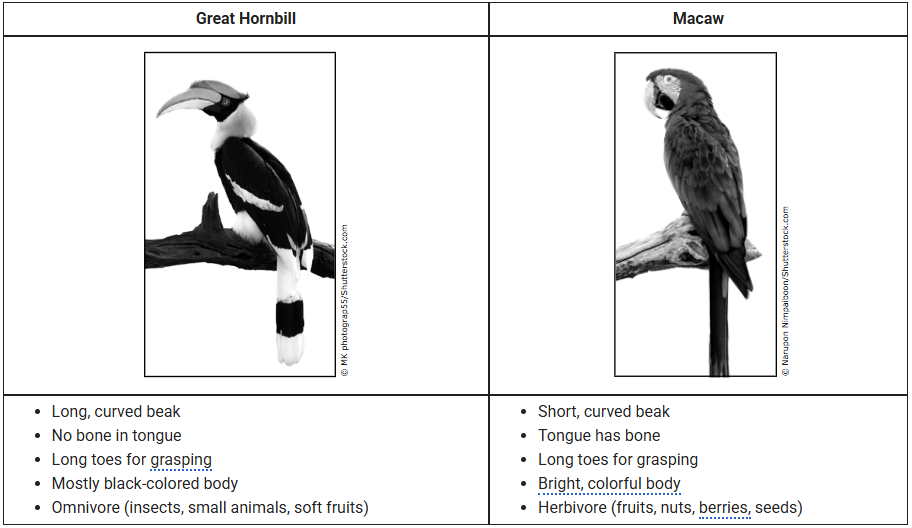
The table shows characteristics of two different types of birds that lives in similar forest environments.


Which statement explains an advantage of a bone in the macaw's tongue that the hornbill does NOT need?
It helps macaws catch and chew small mammals and crustaceans.
It helps macaws break open and eat tropical fruits and nuts.
It helps macaws make large holes in trees to reach insects to eat.
It helps macaws swallow whole prey.
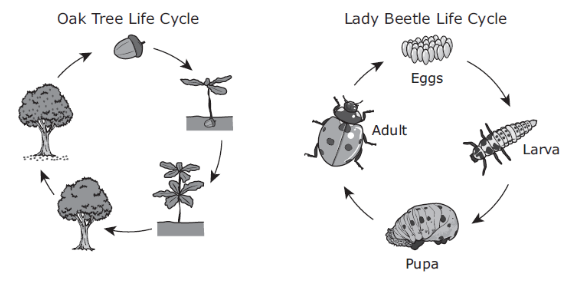
Students observe these diagrams showing the life cycle of an oak tree and a lady beetle.


Which inference can be made by comparing these diagrams?
Plants require less energy than insects to undergo changes from a young organism to a mature organism.
Insects and plants follow a series of changes that allows them to survive and reproduce.
Insects are more likely than plants to adapt to changes in the environment to survive.
Insects and plants are dependent on one another for survival.

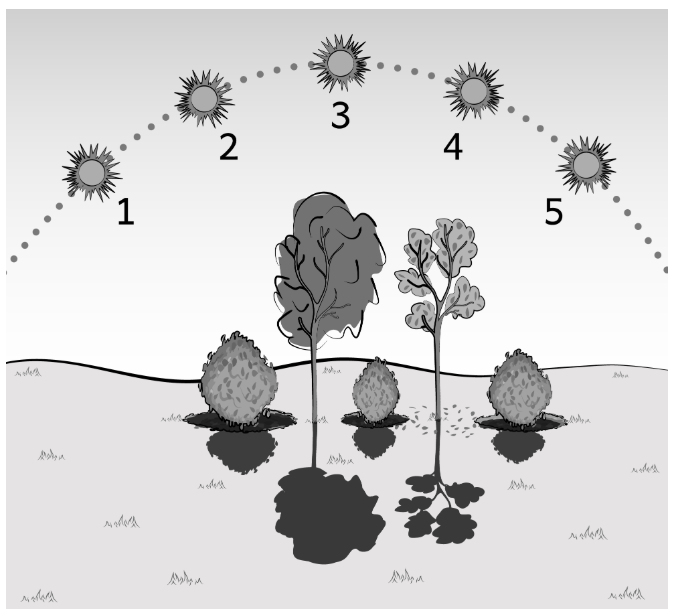
The image provided shows the Sun's path across the sky.  Which of the numbered locations shows the position of the sun at noon?
Number 1
Number 2
Number 3
Number 4
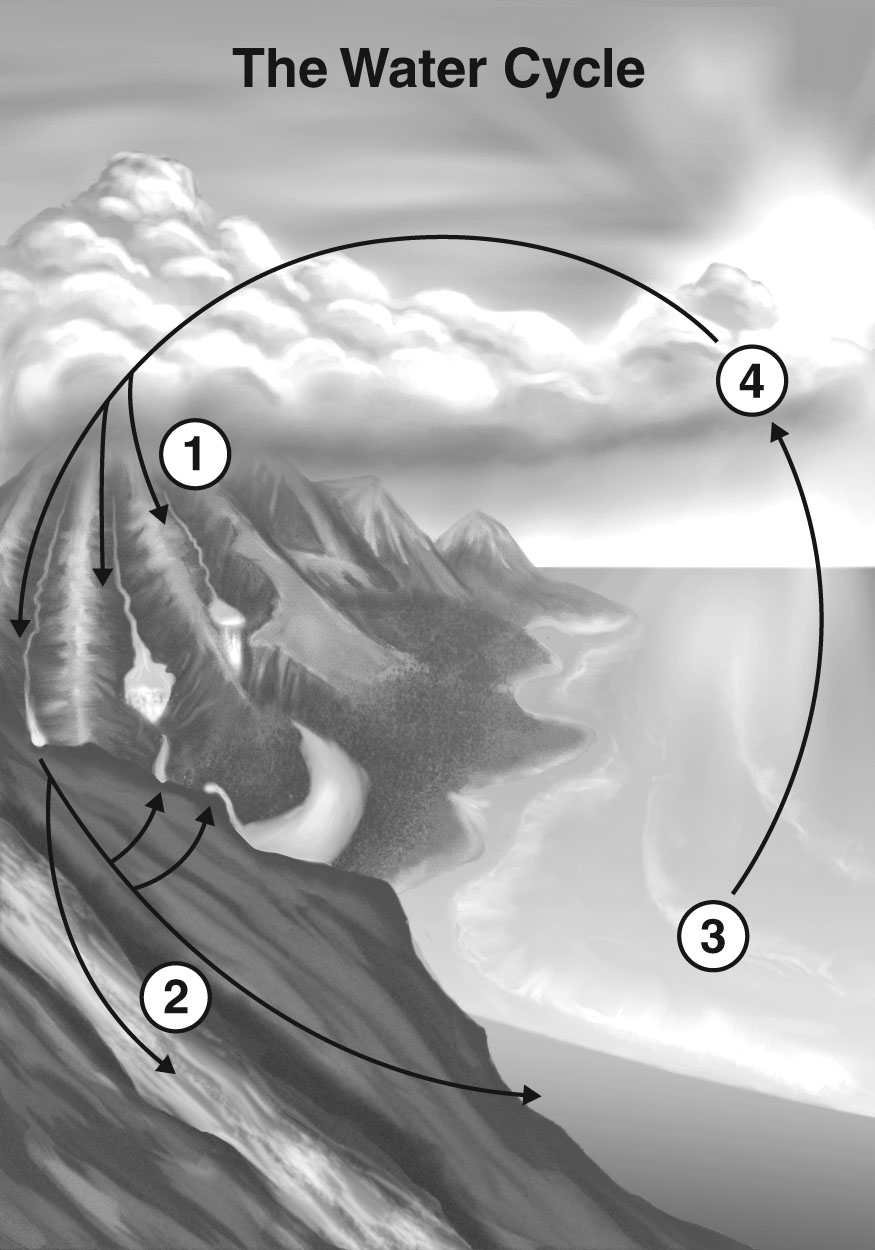
This diagram shows the water cycle.


What event happens at Point 3?
Tides move the ocean water.
Waves move ocean water onto the shore.
Organisms in the ocean breathe oxygen in the water.
The Sun heats ocean water causing some to evaporate.