2.10BM Strategies to Save
star
star
star
star
star
Last updated 2 months ago
25 questions
Note from the author:
Intro/Warm-UP
ACTIVITY: CREATE: Your Savings Goals đź“·10 min
CREATE: Your Savings Goals
We all know that saving money is good for us, but it can be difficult to save regularly. One of the most effective ways to help you save is to set savings goals for yourself and identify ways to keep yourself accountable. In this activity, you’ll identify what your savings goals are, calculate how much you need to save, and write a letter to your future self to help you reach your goals.
Part I: Identify Your Savings Goals
- Using post-it notes, small pieces of paper, or a piece of scrap paper, brainstorm specific savings goals you would like to meet. These goals can vary from small (saving for a new pair of sunglasses) to big (saving for college). Aim to come up with at least 15-20 ideas.
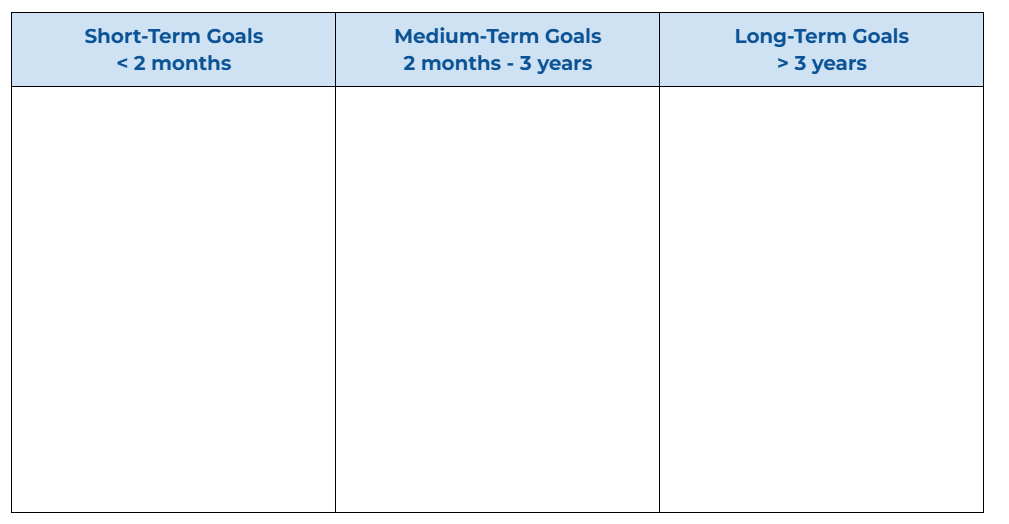
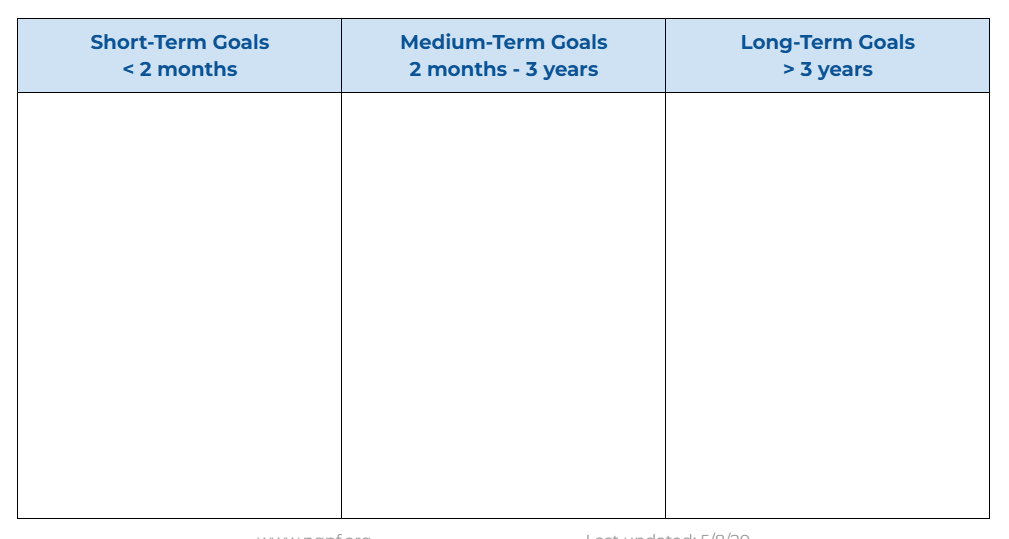
- Now sort your ideas into three piles:
Short-term goals: goals you would like to achieve within two months
Medium-term goals: goals you would like to achieve from within two months to three years
Long-term goals: goals you would like to achieve three or more years out
Fill out the table In your Notebook using the piles you created.
1
If absent, make up the list here and type in your answers.
3
Which goal, in each category, would motivate you most to save? Why?
- Short-term:_______
- Medium-term:_______
- Long-term:_______
1
Let’s say you have a part-time job and you’re able to save $100 per month from your paychecks. How would you distribute the money between your 3 savings goals above? Explain your reasoning.
Learn It
VIDEO: How Much Should I Save? đź“·7 min
After you establish your savings goals, it’s time to start saving!  What’s a reasonable amount to save from your paycheck? Watch this video on general guidelines for how much to save. Then,  answer the questions.
1
How much does the video recommend you save?_______ % of your income
3
What categories encompass the portion of your paycheck that is designated for saving?_______ _______ _______
1
Why does it make sense to start saving or investing right now?_______
INFOGRAPHIC: 50/30/20 Infographic
ARTICLE: Your Guide To The 50/30/20 Budgeting Rule đź“·11 min
The 50/30/20 budgeting rule is a well known rule of thumb and considered easy to follow. Use the infographic and article to answer the questions.
1
True or False: When calculating the percentages for each budget category, you should use your pre-tax income
6
Fill in some examples of items that would fit into each budget category
Wants:_______ _______
Needs:_______ _______
Savings: _______ _______
1
When might the 50/30/20 rule not be the best saving strategy to use?
EDPUZZLE: Pay Yourself First đź“·7 min
Automating your saving can make it even easier for you to save! Watch this video and follow your teacher's directions to answer the questions either in your student activity packet or within the EdPuzzle itself.
NOTE: EdPuzzle videos shuffle answer choices and do not always match the order provided in the lesson here.
1
Which strategy will help you save the most money?- Wait until the end of the month and add any money that you have not spent to your savings account.
- On the last day of each month, deposit a fixed $10 to your savings account.
- As soon as you receive your paycheck, put a fixed amount or percentage of your money directly into your savings.
- Wait to deposit into your savings account only when you have a large lump sum of money.
Which strategy will help you save the most money?
- Wait until the end of the month and add any money that you have not spent to your savings account.
- On the last day of each month, deposit a fixed $10 to your savings account.
- As soon as you receive your paycheck, put a fixed amount or percentage of your money directly into your savings.
- Wait to deposit into your savings account only when you have a large lump sum of money.
1
What is the benefit of automating your savings account contributions?- You can change the amount you deposit each month.
- The fees are relatively small to enroll in this service.
- Your money will be transferred automatically and guarantees you will be contributing to your savings.
- Your employer will contribute additional money to your savings account if you enroll in this service.
What is the benefit of automating your savings account contributions?
- You can change the amount you deposit each month.
- The fees are relatively small to enroll in this service.
- Your money will be transferred automatically and guarantees you will be contributing to your savings.
- Your employer will contribute additional money to your savings account if you enroll in this service.
1
What does it mean to "pay yourself first"?- Deposit money into your savings account before spending on anything else.
- Purchase an item you want before something you need.
- Pay all of your mandatory expenses before paying for optional expenses.
- Obtain an additional job to supplement your income.
What does it mean to "pay yourself first"?
- Deposit money into your savings account before spending on anything else.
- Purchase an item you want before something you need.
- Pay all of your mandatory expenses before paying for optional expenses.
- Obtain an additional job to supplement your income.
1
Why might some people still prefer manually saving their money (e.g. manually transfer or deposit money into their savings account)?
VIDEO: 3 Things You Need to Know about an Emergency Fund đź“·6 min
Another core saving strategy is to build an emergency fund for yourself. Watch this video to learn how much you should save for your emergency fund and when to use it. Then answer the questions.
1
Why do you think it is recommended that you save 3-6 months of expenses in your emergency fund?
1
Why might it be better to keep your emergency fund money in a separate account?
1
Which of these is the best reason to tap into your emergency fund?:
1
Explain why you made your choice in #16:
1
You want to start building an emergency fund. What is one challenge you anticipate that could get in the way? What is a possible solution?
CTIVITY: CREATE: Your Savings Goals đź“·30 min
Now that you’ve learned about different strategies to save, we can look back at your Savings goals from the Intro.  Follow the directions on the worksheet to complete Part II of this activity.
Part II: Calculate How Much You Need to Save
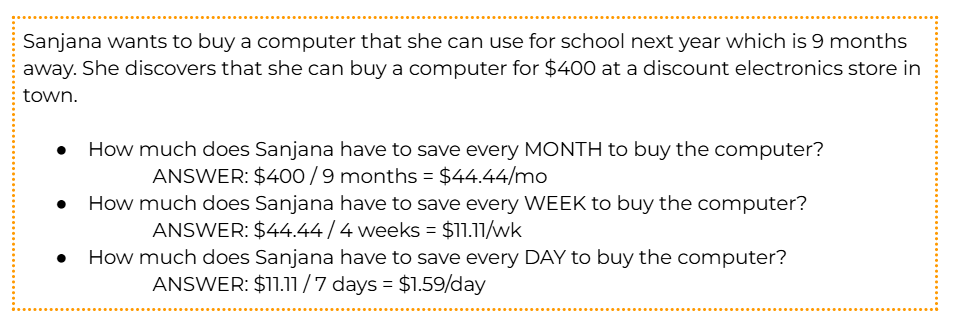
Now that you’ve identified what your savings goals are, it’s important to think about how much you would need to save on a regular basis so that you can reach those goals! Read through the following example on how Sanjana calculates how much she would need to save to buy a new computer. Then, answer the questions that follow.
1
Now it’s your turn. Pick either your medium- or long-term savings goal from Question 1 (or in your book)._______
5
Conduct research online to figure out a rough estimate of how much you would need to save to reach your goal. Write the figure below._______
How many months or years away would you like to achieve your goal? Choose a reasonable time frame._______
Now, do the math! Calculate how much per month, _______ week, _______ and day _______ you'll need to save to reach your goal.
0
Brainstorm at least 3-5 strategies you can use to save towards your goal.
1
Why is it helpful to break down the total amount you would need to save on a monthly, weekly, or daily basis?
Exit Ticket:
1
Keon receives a $1,000 paycheck. Â According to the 50/30/20 rule, how much should he put aside for saving?- $100
- $200
- $500
- $1,000
Keon receives a $1,000 paycheck. Â According to the 50/30/20 rule, how much should he put aside for saving?
- $100
- $200
- $500
- $1,000
1
What is a major benefit of the Pay Yourself First strategy?- It helps you budget all of your income for the month
- It encourages you to prioritize saving money
- It is a good way to build credit
- It generates additional income to cover essential expenses
What is a major benefit of the Pay Yourself First strategy?
- It helps you budget all of your income for the month
- It encourages you to prioritize saving money
- It is a good way to build credit
- It generates additional income to cover essential expenses
1
How much money should you try to save in your emergency fund?- 3-6 days worth of expenses
- 3-6 weeks worth of expenses
- 3-6 months worth of expenses
- 3-6 years worth of expenses
How much money should you try to save in your emergency fund?
- 3-6 days worth of expenses
- 3-6 weeks worth of expenses
- 3-6 months worth of expenses
- 3-6 years worth of expenses