Ɛhia
2
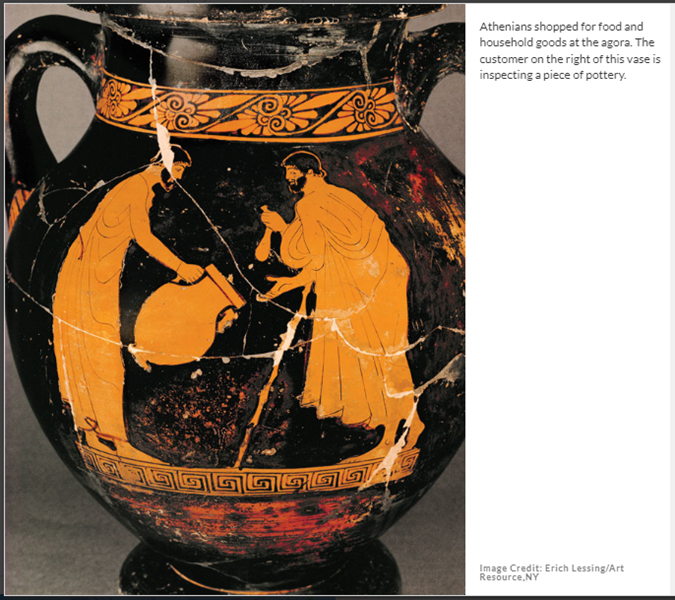
After studying this picture and caption, what two things did Athenians do at their Agora?
After studying this picture and caption, what two things did Athenians do at their Agora?
Read and re-read each question and the paragraphs to find the best answers.
Section 3: Athenian Economy (Part 1)
An important part of life in any community is its economy. An economy is the way in which a community or region organizes the production and exchange of money, food, products, and services to meet people’s requirements. Because the land around Athens did not provide enough food for all of the city’s people, Athens’s economy was based on trade. Athens was near the sea, and it had a good harbor. This location enabled Athenians to trade with other city-states and with several foreign lands to obtain the goods and natural resources they required. Athenians acquired wood from Italy and grain from Egypt. In return, Athenians traded honey, olive oil, silver, and beautifully painted pottery. Read the paragraphs above to answer the questions below. Don't be afraid to re-read!
Which two words below are synonyms of "get?"
Because the land
Section 3: Athenian Economy (Part 2)
Athenians exchanged goods at a huge marketplace called the agora, where merchants sold their goods from small stands. Athenians purchased lettuce, onions, olive oil, and other foods. Shoppers could also buy household items such as pottery, furniture, and clay oil lamps. Most Athenians made their clothes at home, but leather sandals and jewelry were popular items at the market. The agora was also the place where the Athenians bought and sold people. Similar to most other city-states, Athens developed its own coins—crafted from metals such as gold, silver, and bronze—to make trade easier. Athenians decorated the flat sides of their coins. One such coin had an image of the goddess Athena, while its other side pictured Athena’s favorite bird, the owl.
Click on the phrase that would not be seen at the agora.
Athenians
Click on the word below that is a synonym for "created." Then click on the word below that is a synonym for "comparable."
After studying this picture and caption, what two things did Athenians do at their Agora?
Section 7: Spartan Economy (Part 1)
While Athens's economy depended on trade, Sparta's economy relied on farming and on conquests of other people. Although Sparta had fertile soil, there was not enough land to provide food for everyone. When food ran low, Spartans took the lands they needed from their neighbors, who were then forced to work for Sparta. Because Spartan men were expected to serve in the army until the age of 60, Sparta had to rely on people who were enslaved and noncitizens to produce the goods it lacked. Conquered villagers became slaves, called helots. The helots were permitted to live in their own villages, but they had to give much of the food they grew to Sparta..
What did Sparta's economy depend on?
Click on the reason below that explain why Spartans used slaves to get the goods it needed.
When food ran low,
Section 7: Spartan Economy (Part 2)
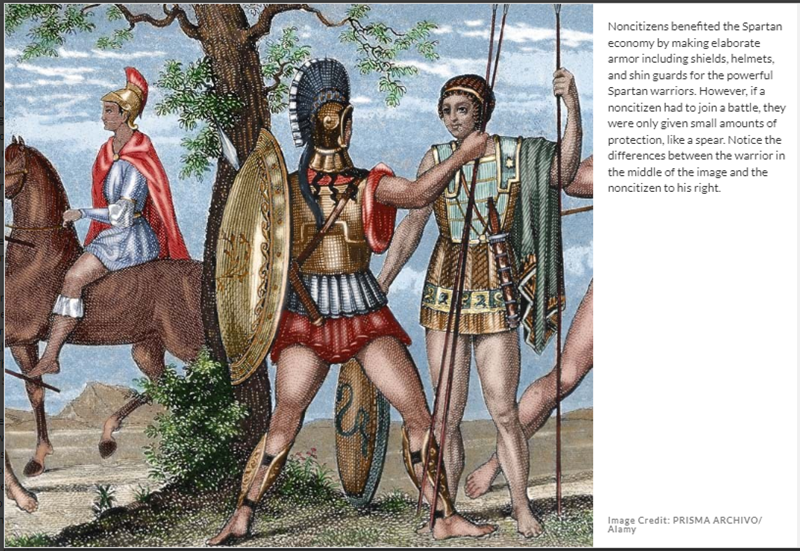
The Spartans also utilized a second group of people—noncitizens who were free. Noncitizens might serve in the army when needed, but they could not participate in Sparta's government. They were responsible for making such necessary items as shoes, red cloaks for the soldiers, iron tools like knives and spears, and pottery. They also conducted some trade with other city-states for goods that Sparta could not provide for itself. Generally, though, Sparta discouraged trade because the Spartans feared that contact with other city-states would lead to new ideas that might weaken the government. Trading with Sparta was already difficult because of its system of money. Rather than using coins, Spartans used heavy iron bars as currency. According to legend, an ancient Spartan leader decided to use this form of money to discourage stealing. Because an iron bar had little value, a thief would have needed to steal a wagonload of bars to make the theft worthwhile. As you might assume, other city-states were not anxious to receive iron as payment for goods.
Click on highlighted phrase that tells what noncitizens not allowed to do in Sparta?
The Spartans also utilized a second group of people—noncitizens who
Why did Sparta make it so difficult to trade?
Read both Passage One and Two above to sort the details below to the correct city's economy.
Traded away honey and olive oil
Created and decorated coins
Based on Trade
Stole the food they needed
Used noncitizens
Had non-citizens trade for them
Traded with Egypt
Based on Farming
Athens' Economy
Sparta's Economy
Click on the word that is a synonym for "aided." Then click on the word that is a synonym for "decorative."
Select the six statements that are true about Athen's economy.
What word best describes how a place gets the services, money, and products its people need?
What word best describes Athen's economy?
Select the five facts below that are true about Athen's money.
What could be bought at the agora?
Where did most Athenians get their clothes?
What three things were true of the people Sparta enslaved?
What reason below best summarizes why Spartans did not learn to farm?
Select the three statements that are true about why and how Sparta discouraged trade.
Who Made the Spartan's shoes and red cloaks?
After closely studying the picture and the caption, which person is a non-citizen?
What would happen if a noncitizen joined the Spartans in battle?
After studying this picture and caption, what three things could noncitizens do to help the Spartan economy?