Log in
Sign up for FREE
arrow_back
Library

Day 2 SURVIVOR Warm Up

star
star
star
star
star
Last updated about 2 months ago
5 questions
Required
5
Required
1
B.C.4B
Required
2
Required
1
Question 1
1.

Match each description with the appropriate term.

Draggable itemarrow_right_altCorresponding Item
The ability to allow some substances through, but not others
arrow_right_alt
prokaryotes
Complex cells with membrane bound organelles
arrow_right_alt
arrow_right_alt
arrow_right_alt
arrow_right_alt
Question 2
2.
The sodium-potassium pump is a type of active transport that uses an embedded ______________________ in the cell membrane to move ions Na+ and K+ across the cell membrane, ______________________ their concentration gradients. Because this is a form of active transport, energy is ______________________ to push the ions across the cell membrane where they are used for cellular processes.
Other Answer Choices:
against
with
not required
required
lipid
protein
Required
1
Question 3
3.

Some students used information they gathered from lab investigations to prepare a table. They entered the table in their lab notebooks. Which of these correctly identifies the two cells described in the table?

Question 4
4.

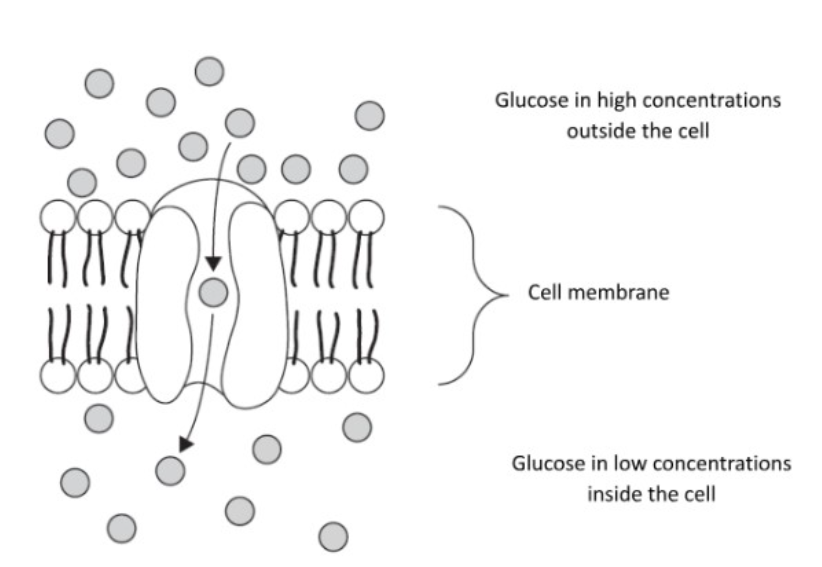
The diagram above shows cellular activity across a cell membrane. Which two processes does this diagram most directly model?

Question 5
5.

What type of transport can use proteins but does not require energy?

semi-permeable
Transport across a membrane from high concentration to low concentration
active transport
Cells which have genetic material, but lack a nuclear envelope
passive transport
Transport across a membrane from low concentration to high concentration
eukaryotes
Cell 1 is eukaryotic, and Cell 2 is prokaryotic.
Both Cell 1 and Cell 2 are prokaryotic.
Both Cell 1 and Cell 2 are eukaryotic.
synthesis of new molecules
homeostasis
transport of molecules
active transport