By the end of this activity, you will be able to:
Calculate the time it takes for a bullet to reach a target, given the velocity of the projectile and the distance to the target.
Calculate the distance that a projectile drops over time due to gravity.
Determine the adjustment required for the projectile to hit a target’s bull’s-eye to compensate for the force of gravity.
By the end of this activity, you will be able to:
Calculate the time it takes for a bullet to reach a target, given the velocity of the projectile and the distance to the target.
Calculate the distance that a projectile drops over time due to gravity.
Determine the adjustment required for the projectile to hit a target’s bull’s-eye to compensate for the force of gravity.
A projectile fired horizontally will hit the ground at exactly the same time a bullet dropped from your hand will hit the ground. By calculating the amount of horizontal drop of a fired projectile, you can determine the amount of compensation needed to hit the target’s bull’s-eye.
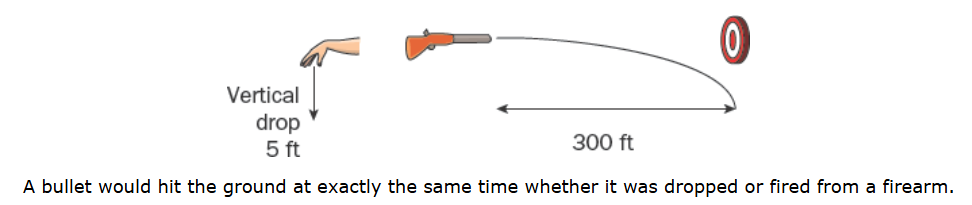
To calculate the amount of time required for a bullet fired downrange to hit the target, use the following relationship:
travel time to the target: t = d/v
t = time (seconds)
d = distance to target (feet)
v = velocity, which is specific to each firearm (ft/s)
To calculate the vertical drop of a fired projectile over time, use the following relationship:
Vertical distance dropped: d = 1/2 gt2
d = distance
t = time (s)
g = gravitational acceleration 32 ft/s2
s = seconds
Prepare a graph using the data in Data Table 1 that shows the relationship between time and distance traveled. Title your graph, and include units and labels on both axes.
How does a person discharging a firearm compensate for the gravitational drop of the projectile if they want to hit the bull’s-eye on a target 300 ft away?
Refer to your graph. What claim can you make about the effect of time on the distance the projectile drops due to gravity? Support your claim with data from your graph.
Complete the data table the same way as you did in part A!
Complete the data table the same way as you did in parts A and B!
Which projectile traveled the farthest horizontal distance: the BB, the pellet, or the .22 bullet? Use your data to support your claim.
Which projectile dropped a greater vertical distance distance over time? Support your claim with your data.
Based on your data, is there any relationship between the horizontal velocity of the projectile and the distance dropped (all traveled 300 ft)? Support your claim with your data.
What is the relationship between accuracy and the projectile’s velocity? Use evidence to support your claim.