The first step in saving money is to figure out your saving goals. What would you like to save for?
Complete the chart in the show your work box with potential savings goals you would like to meet. These goals can vary from small (saving for a new pair of sunglasses) to big (saving for college). Write at least three goals in each category.
After you finish your guesses, check the Meet chat for the link to the answers
What costs surprised you the most? Why?
Does this change any of your personal savings goals or plans? Why or why not?
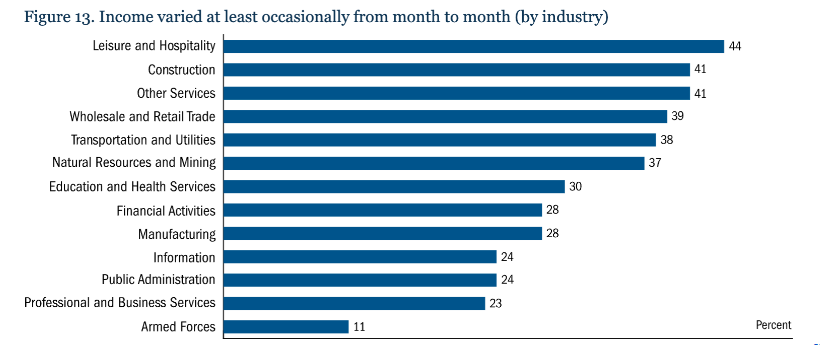
In which type of work are workers most likely to have varying income month-to-month, salary or wage?
Why might it be beneficial to save for some of these purchases in advance, even if you could pay for them right now?
According to the video, how much should you aim to have saved in an emergency fund?
What is one tip for growing your emergency fund?
What do you think are obstacles that might stop people from building an emergency fund?
Maryam’s average monthly expenses are $3,750. She wants to have an emergency fund that covers 3 months of expenses saved up within the next 24 months. If she’s starting with $300 in her account, how much does she need to save each month to reach that goal?
Retail salesperson is the largest occupation in the US, with over 3.5 million workers. What percentage of workers in the wholesale and retail trade industry report their income varies month to month?
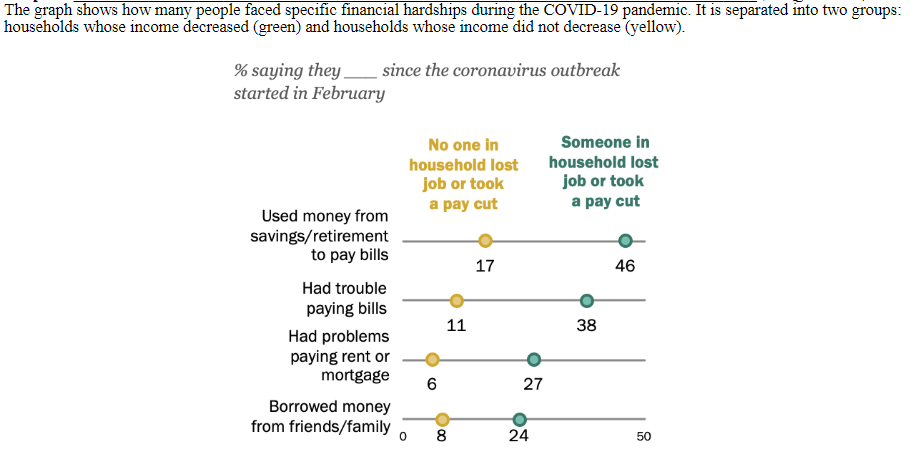
How does this graph illustrate the importance of saving?
What percentage of households where someone lost a job or took a pay cut used money from savings or retirement to pay bills?
Based on this graph, how would you summarize the impact of COVID-19 on households who lost a job or took a pay cut, compared to households who did not?
You’re including this graph in your presentation on the importance of saving. Write an appropriate title for this graph.
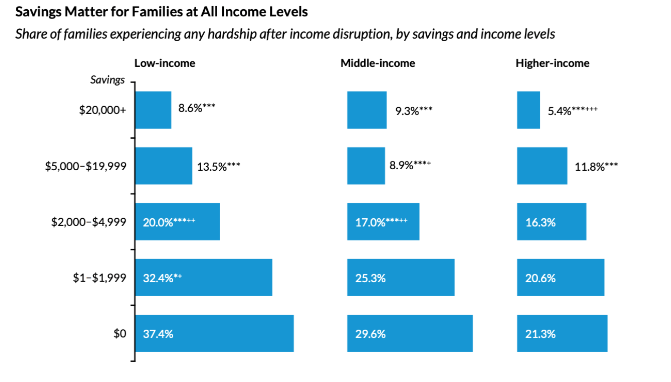
Look at the column for middle-income families.
After an income disruption, what percentage of middle-income families with $0 in savings experience financial hardship?
Look at the column for middle-income families.
What percentage with $20,000+ in savings experienced financial hardship?
Analyze the outcomes for families with savings between $2,000 and $4,999 after an income disruption.
What percentage of low-income families with $2,000 - $4,999 in savings experience financial hardship?
Analyze the outcomes for families with savings between $2,000 and $4,999 after an income disruption.
How does that compare to the percentage of middle- and higher-income families who experience financial hardship at the same savings level?
Based on the graph, what is the relationship between savings and experiencing financial hardship after an income disruption?
The original title of this graph is “Savings Matter for Families at All Income Levels”. Do you think this is a good title for this graph? Why or why not?
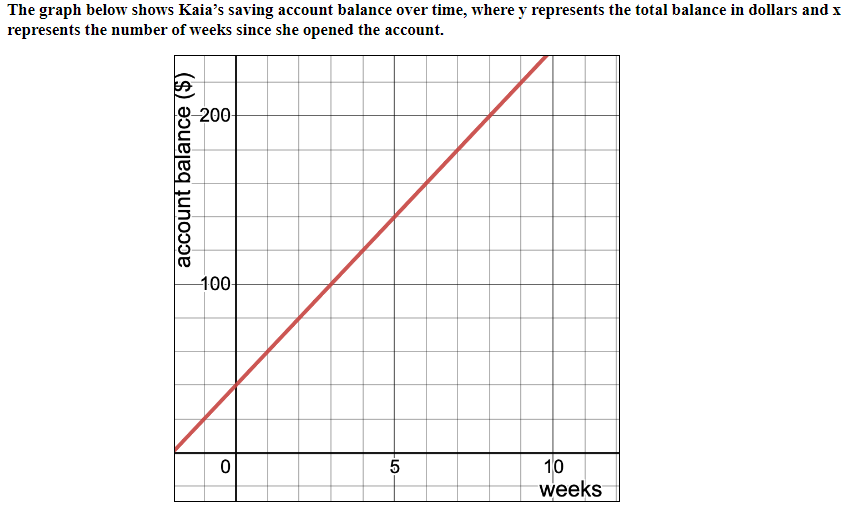
What is the slope of the line? (how much does y go up for every x)
What does the slope represent in this context? (What does it have to do with her money and weeks)
Based on the graph, how much did Kaia put in the savings account when she initially opened it?
Write the equation of the line representing Kaia’s balance.
Sara wants to save $5,000 to put towards college. She has a savings account with $320. Each month, she deposits $180 from her part-time job in the savings account.
Write an equation that represents her savings account balance, y, after x months.
How much does Sara have after 3 months?
Graph Sara’s savings account balance and goal using Desmos. Use this graph to answer the following questions.
If she continues saving $180 per month, how long will it take her to reach her goal? How can you find that point on the graph?
(Don't erase the graph yet, there are more questions!)
Approximately how many months earlier will Sara meet her saving goal if she saves $240 per month, instead of $180 per month?
If Sara wants to reach her $5000 goal in one year, approximately how much would she need to save each month?
Click HERE to complete the introduction slides on desmos
Did you complete the activity?

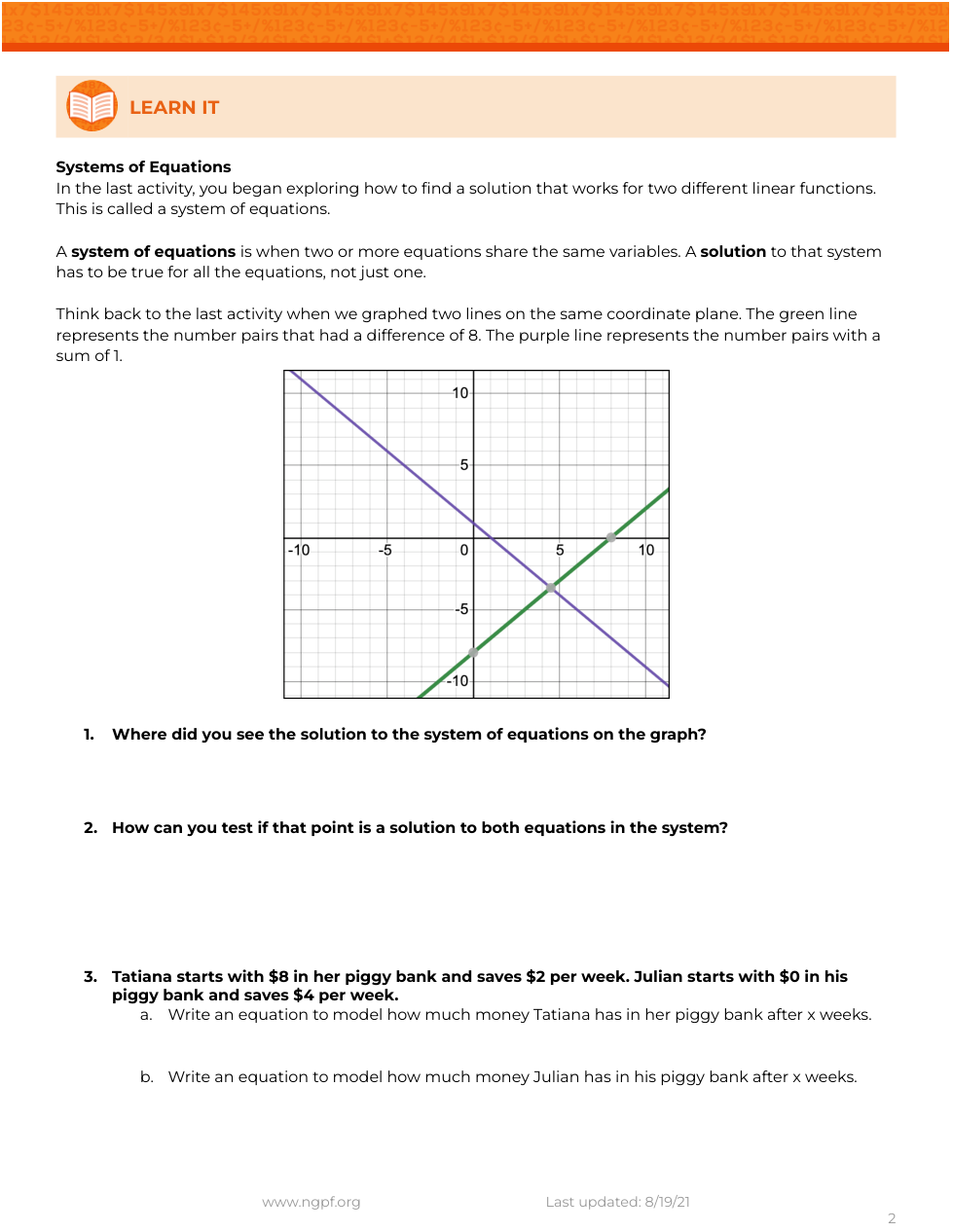
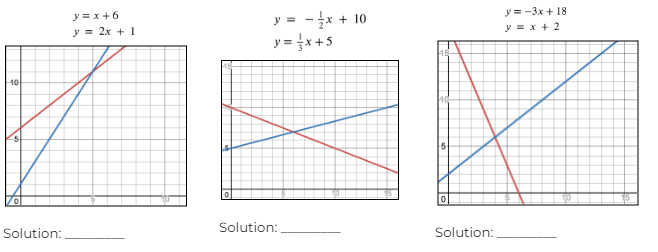
When you are given a system of equations and no word problem, the solution is a POINT that includes (x,y)
Graph the two equations on desmos, put a screenshot in the Show Your Work Box. Then list the solution in the answer box.
Include a screenshot of your desmos graph in the Show Your Work Box
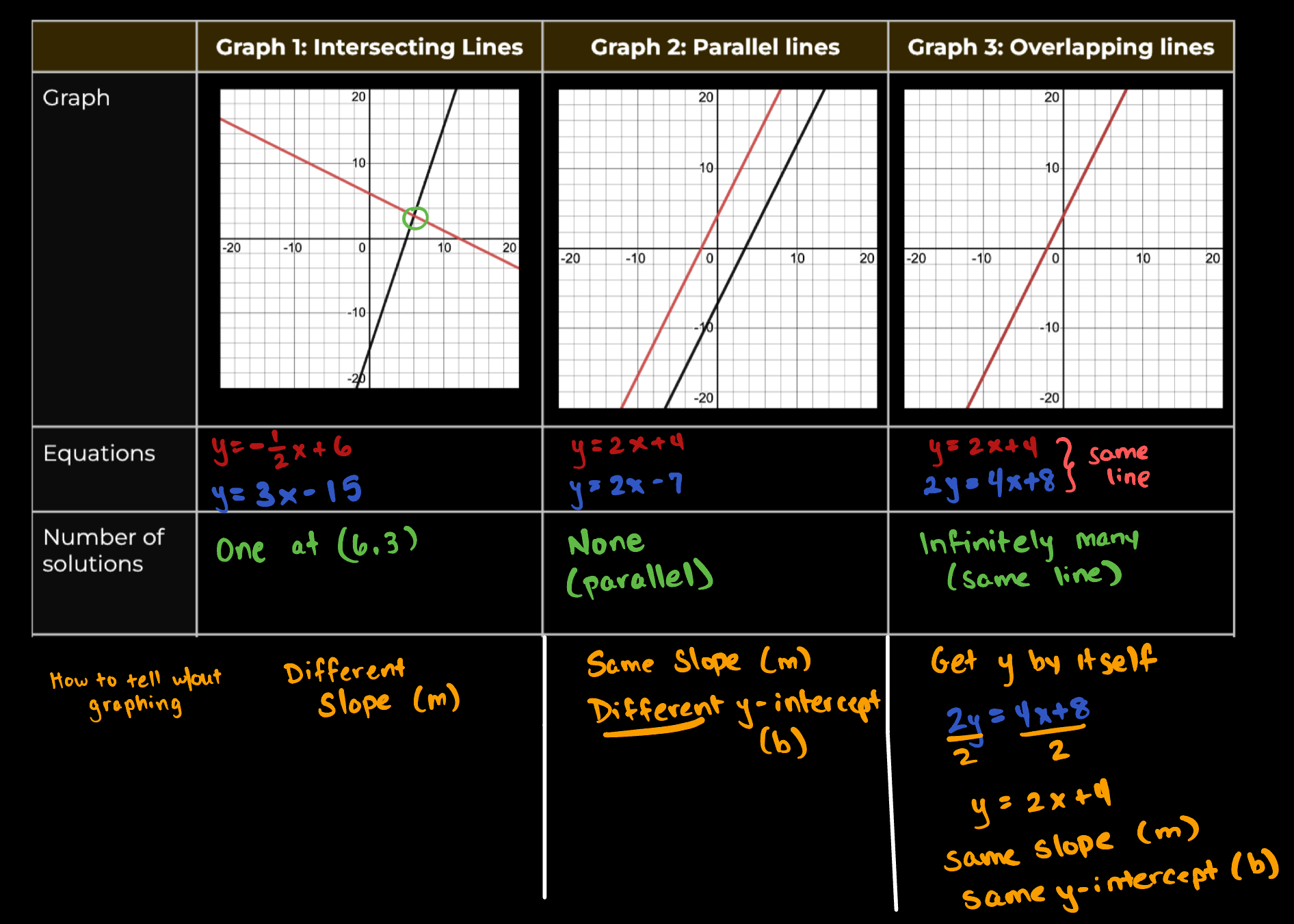
How could you identify that a system has no solutions, based on the equations in that system?
How could you identify that a system has infinite solutions, based on the equations in that system?
Could there be a system of linear equations with exactly two solutions? Why or why not?

Graph both equations on desmos. Put a screenshot of your graph in the Show Your Work Box.
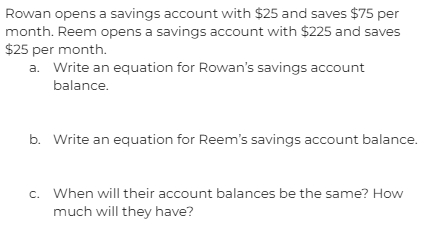
Who will have more money after 2 weeks? How much do they have?
When will they have the same amount of money? Justify your answer.
You can graph on desmos and put a screenshot in the Show Your Work Box
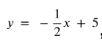
CHALLENGE: Graph the equation below on desmos. Thensee if you can write and graph another equation has a solution with the original equation (intersects it) at (4,3)