8Cd Comparing gas exchange

Last updated 3 months ago
16 questions
Gas Exchange in Different Organisms
All living organisms need a way to exchange gases with their environment. This process is essential for respiration, which provides energy for life processes. Different organisms have evolved different gas exchange systems, but they all share common features to allow efficient diffusion of gases such as oxygen and carbon dioxide.
Common Features of Gas Exchange Systems
Although these gas exchange systems are found in different organisms, they share important similarities:
  • Large Surface Area – This increases the amount of gas that can diffuse at one time.
  • Thin Surfaces – A short diffusion distance allows gases to move quickly.
  • Steep Concentration Gradient – Maintained by blood flow in animals or air circulation in plants, ensuring efficient diffusion.
Gas Exchange in Humans
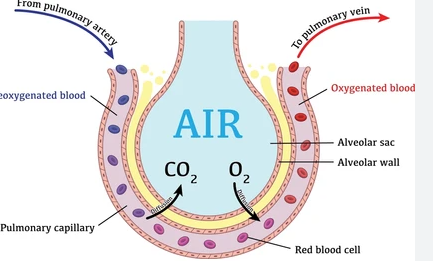
Humans and other mammals have lungs, which contain millions of tiny air sacs called alveoli. These alveoli provide a large surface area for gas exchange. Oxygen from the air we breathe in diffuses across the thin walls of the alveoli into the blood, while carbon dioxide diffuses out of the blood into the alveoli to be exhaled. The alveoli have very thin walls, only one cell thick, ensuring a short diffusion path for gases to move quickly between the lungs and the blood. Additionally, they are surrounded by a dense network of capillaries, which maintain a steep concentration gradient by constantly bringing in blood with low oxygen levels and removing oxygenated blood.
Gas Exchange in Fish
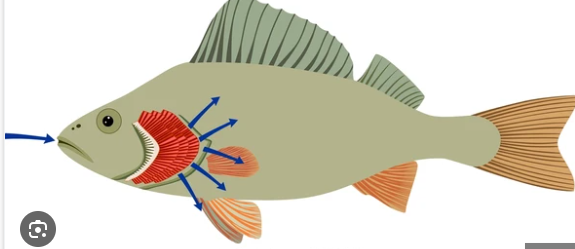
Fish live in water and rely on gills for gas exchange. Gills are made up of many thin filaments covered in tiny structures called lamellae, which increase the surface area for diffusion. Water containing oxygen flows over the gills, and oxygen diffuses into the blood in the gill capillaries. At the same time, carbon dioxide diffuses out of the blood and into the water. Fish use a counter-current flow system, where water and blood flow in opposite directions, maintaining a high concentration gradient for efficient gas exchange. Like alveoli, gills have very thin surfaces to allow gases to diffuse quickly.
Gas Exchange in Plants
Plants also need to exchange gases, particularly for photosynthesis and respiration. They do this through tiny openings on the underside of leaves called stomata. During the day, carbon dioxide from the air diffuses into the leaf through the stomata and is used in photosynthesis to produce oxygen and glucose. Oxygen then diffuses out of the leaf into the air. Inside the leaf, spongy mesophyll cells have air spaces that increase the surface area for gas exchange. Like other gas exchange surfaces, these cells have thin walls to ensure a short diffusion distance.
1

Why do living organisms need gas exchange?

1

What are the two main gases involved in gas exchange?

1

What is the main organ used for gas exchange in humans?

1

What are the tiny air sacs in the lungs called?

1

What is the function of alveoli?

1

Why are alveoli walls thin?

1

How does blood help in gas exchange in alveoli?

1

Where does gas exchange occur in fish?

1

What are the thin structures in fish gills called?

1

How does oxygen enter the fish’s blood?

1

What structures in leaves allow gas exchange?

1

Which gas enters a leaf for photosynthesis?

1

Where are stomata mostly found?

1

Why do gas exchange surfaces have a large surface area?

1

Why do gas exchange surfaces need to be thin?

1

What helps maintain a steep concentration gradient in gas exchange?