Log in
Sign up for FREE
arrow_back
Library

9.1 - Environments & Ecosystems [Mastery Check]

star
star
star
star
star
Last updated about 1 year ago
8 questions
Required
0.3
Required
0.7
Required
0.8
Required
0.6
Required
0.6
Required
0.3
Required
0.3
Required
0.4

Due 8 AM on Wed/Thur (3/12 - 3/13)

Important: This is the mastery check part of this assignment. Make sure you have fully completed the tutorial formative first, before this one!


This assignment will NOT let you check your answers before submitting.
Question 1
1.

Question 2
2.

Question 3
3.
Fill in the missing terms with the most accurate word or phrase.

Insolation refers to the __________, which mainly differs based on __________. As a result of the increased temperatures near the equator, the air tends to __________ at the equator, falling back down around __________. There tends to be __________ rainfall in the areas where the air currents are falling back down. The Gulf Stream pushes __________ water __________ the side of North America towards __________.
Question 4
4.

Draggable itemarrow_right_altCorresponding Item
arrow_right_alt
arrow_right_alt
arrow_right_alt
arrow_right_alt
arrow_right_alt
arrow_right_alt
Question 5
5.

Question 6
6.

Question 7
7.

A simple food web is shown below. Each arrow represents the flow of energy.

Click to select the organism(s) in this food web that would be correctly classified as primary consumers.

Question 8
8.

In January 2019, parts of North America experienced very cold temperatures, similar to Artic conditions, as a result of the polar vortex moving down to cover these portions of North America for part of that January. Would it be more accurate to describe this phenomenon as weather or climate, and why?
Climate - the atmospheric conditions the area experienced occurred over a relatively short period of time
Climate - the atmospheric conditions the area experienced occurred over a relatively long period of time
Climate - the conditions included changes in both temperature and precipitation, both of which are important factors in determining an area's climate, but not in determining an area's weather
Weather - the atmospheric conditions the area experienced occurred over a relatively short period of time
Weather - the atmospheric conditions the area experienced occurred over a relatively long period of time
Weather - the conditions included changes in both temperature and precipitation, both of which are important factors in determining an area's weather, but not in determining an area's climate
Reading through each statement and determine whether that statement is describing weather or climate.

All statements must be used, and each statement can only be used once.
The summers here are warm and sometimes humid.
The average temperature for the month of January in Chicago is 29 ºF.
Snow is falling at the rate of 5 cm per hour.
Our lowest temperature last winter was -29ºC.
It is supposed to rain tomorrow.
The air temperature outside is 22ºC.
That region typically has rain from August through June.
Climate
Weather
Below are just a few of the important biomes found throughout the world, along with some statements that describe certain aspects of a biome.

Match each statement to a particular biome.

While some statements may seem like they could apply to more than one biome, when all statements are paired correctly each biome should have one accurate statement matched to it.
Tropical Rainforest
The ground here is permanently frozen.
Chaparral
Contains coniferous evergreen trees.
Temperate Deciduous Forest
Has the highest biodiversity of any biome.
Taiga
Have high levels of precipitation and can often be found in coastal mountains.
Tundra
Contains short trees and shrubs.
Temperate Rainforest
Tends to go through four distinct seasons, with the trees visibly changing depending on the current season.
Mark all statements below that are TRUE.
Tropical rainforests tend to have some of the most nutrient-rich soil out of the different biomes.
In a deciduous forest, you would expect to see the leaves falling from trees during the autumn season.
While deserts typically receive very low levels of precipitation, when they do receive rain it tends to be in short bursts.
The floor level of tropical rainforests tend to receive very high levels of sunlight.
In the tundra, there is a thin layer of active soil that melts during the summer, allowing things to live. Below this layer is permafrost, which is soil that never thaws.
In the chaparral biome, you would expect to have significantly higher precipitation levels during the summer than during the winter.
A simplified energy pyramid is shown below:
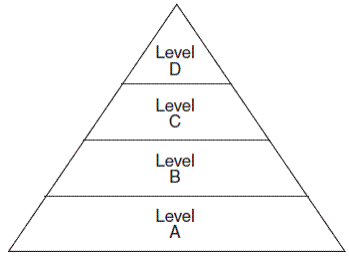
The energy used by organisms in level A of this pyramid originally comes from....
the Sun
level D
chemoautotrophs
producers
level B
[MARK ALL THAT APPLY!]

Mark all TRUE statement(s) below.
Abiotic factors in an environment could include things like wind, sunlight, and rocks.
If the producer level of an ecosystem has a total of 42,500 kcal of energy, you would expect about 38,250 kcal of energy to be lost as heat when you move up to the primary consumer trophic level.
The term "ecosystem" is more inclusive than the term "community".
A population includes multiple species within it.