Base your answers to questions 6 and 7 on the cartoon below and on your knowledge of social studies.

Source: 1789 (adapted)
1
This cartoon could be used to explain the
This cartoon could be used to explain the
10.2.c.i
1
10.2.c.ii
Answer all questions in this part.
Base your answers to questions 1 and 2 on the passage below and on your knowledge of social studies.
Source: Philip Ziegler, “Decline and Fall of the Mughal Empire,” The Telegraph, May 25, 2003
The Mughals failed because they made little, if any, effort to drag India out of the Middle Ages. The Mughal empire, writes Abraham Eraly, “lagged way behind Europe, behind even China, Japan and Persia. There was hardly any vigour in the economy, scant spirit of enterprise among the people. In agriculture, industry and trade, Indian practices were archaic [outdated]. There was no ferment of ideas. . . .” The Mughals were formidable conquerors but inept [ineffectual] governors. They did nothing to cure the endemic [native] weaknesses of Indian society and added fresh economic burdens through the profligacy [extravagance] of their courts and the cost of their military campaigns. . . .
Based on this passage, what was one cause of the collapse of the Mughal Empire?
Base your answer to question 3 on the passage below and on your knowledge of social studies.
Source: Robert C. Allen, Enclosure and the Yeoman, Oxford, Clarendon Press, 1992
. . . English agriculture differed from the European continent's in other, suggestive ways. The technical revolution in farming had been accompanied by an institutional revolution. The open fields were enclosed, and the small peasant holdings were amalgamated [combined] into large farms let to tenants who cultivated them with wage labor. By the nineteenth century, a unique rural society had emerged in England. This new society was characterized by exceptional inequality. English property ownership was usually concentrated. Rents had risen, while wages stagnated. By the nineteenth century, the landlord's mansion was lavish, the farmer's house modest, the labourer's cottage a hovel.The revolution in rural life was occurring in an increasingly commercial society. From the sixteenth century, London was one of the most rapidly growing cities in Europe. In the eighteenth century this dynamism extended to the provincial towns. From a rustic backwater at the end of the middle ages, England became Europe's greatest commercial power in the eighteenth century, and the leading industrial nation in the nineteenth. . . .
According to this passage, what was one impact of the agricultural changes in England?
Base your answers to questions 4 and 5 on the statements below and on your knowledge of social studies.
Speaker A: The great and chief end, therefore, of men uniting into commonwealths, and putting themselves under government, is the preservation of their property; to which in the state of Nature there are many things wanting.
Speaker B: When the legislative and executive powers are united in the same person, or in the same body of magistrates, there can be no liberty; because apprehensions may arise, lest the same monarch or senate should enact tyrannical laws, to execute them in a tyrannical manner.
Speaker C: Strengthen the female mind by enlarging it, and there will be an end to blind obedience to men.
Speaker D: A trade founded in iniquity [evil], and carried on as this was, must be abolished, let the policy be what it might, —let the consequences be what they would, I from this time determined that I would never rest till I had effected its abolition.
What impact did Speakers C and D have on world history?
Base your answers to questions 6 and 7 on the cartoon below and on your knowledge of social studies.
Source: 1789 (adapted)
This cartoon could be used to explain the
Base your answer to question 8 on the passage below and on your knowledge of social studies.
Source: Olympe de Gouges, Declaration of the Rights of Woman and of the Female Citizen, 1791
MOTHERS, daughters, sisters, representatives of the nation all, are demanding to be incorporated into the national assembly. Being of the opinion that ignorance, oblivion or mistrust of the rights of women are the sole causes of public misery and of the corruption of governments, they have resolved to expound [set forth] the natural, inalienable and sacred rights of women in a solemn declaration so that this declaration, constantly before the body of society, will always remind them of their rights and duties. The actions of women and men will be comparable at all times with the aims of political institutions, thereby becoming more respected, and women’s demands, founded henceforth on simple and incontestable principles, shall revolve around upholding the constitution, morality and happiness of all. . . .
What problem did Olympe de Gouges hope to directly address with this passage?
Base your answer to question 9 on the passage below and on your knowledge of social studies.
Source: Woodbridge Bingham, et al., A History of Asia, Vol. II, Allyn and Bacon, 1974
. . .It was the new Western idea, nationalism, which seemed to spell the doom of the disintegrating [Ottoman] empire. After maturing for a long period among the subject peoples of the Turks, it broke out in a series of revolutions which shook the Turkish state to its core. It seemed as if this disintegrating state would fall easy prey to one of the great new powers of Europe, Russia. The tsar, it appeared, would be heir to the defenseless Turkish state and would gain access to Constantinople [Istanbul] and the Straits. But precisely this possibility was to ensure the continued though feeble existence of the Ottoman empire. England, the rival of Russia, would not tolerate Russian control in this area. As early as 1792 the younger [British Prime Minister William] Pitt had declared that “the true doctrine of the balance of power requires that the Russian empire should not, if possible, be allowed to increase, nor that of Turkey to diminish.”. . .
Which claim about the Ottoman Empire is best supported by this passage?
Base your answers to questions 10 and 11 on the cartoon below and on your knowledge of social studies.

Source: David H.T. Wong, Escape to Gold Mountain, Arsenal Pulp Press, 2012 (adapted)
*indemnity – reimbursement for loss
What was one reason the British wanted to increase the supply of opium to China?
Base your answers to questions 12 and 13 on the passage below and on your knowledge of social studies.
...The importation of Western civilization opened a gaping chasm between town and country, between educated and uneducated, between connected and unconnected, and above all between the rich and poor. Nowhere were Japan's growing pains felt more sorely than in the countryside, where the weight of Meiji reforms crushed many farmers, who enjoyed few of the fruits of Japan's nineteenth-century enlightenment. In large part, the situation persisted until the abolishment of the tenancy system and the dramatic reforms initiated during the US occupation.
Source: Brett L. Walker, A Concise History of Japan, Cambridge University Press, 2015
The Japanese social and economic changes of the late 19th century described in the passage were a result of
Base your answers to questions 14 and 15 on the illustration below and on your knowledge of social studies.
Source: Philip Dorf, Europe in Our Day, Oxford Book Company, 1939

Which claim is best supported by this illustration?
Base your answers to questions 16 and 17 on the passage below and on your knowledge of social studies.
... In 1919, Woodrow Wilson arrived in France to sign the treaty ending World War I, and Ho [Chi Minh], supposing that the President's doctrine of self-determination applied to Asia, donned a cutaway coat [wore a western suit] and tried to present Wilson with a lengthy list of French abuses in Vietnam. Rebuffed, Ho joined the newly created French Communist Party. “It was patriotism, not communism, that inspired me,” he later explained. ...
In 1940, Japan’s legions swept into Indochina and French officials in Vietnam, loyal to the pro-German Vichy administration in France, collaborated with them. Nationalists in the region greeted the Japanese as liberators, but to Ho they were no better than the French. Slipping across the Chinese frontier into Vietnam—his first return home in three decades—he urged his disciples to fight both the Japanese and the French. There, in a remote camp, he founded the Viet Minh, an acronym for the Vietnam Independence League, from which he derived his nom de guerre [alias], Ho Chi Minh—roughly “Bringer of Light.”...
Source: Stanley Karnow, “Ho Chi Minh,” Time, April 13, 1998
Which evidence best supports the claim made by Ho Chi Minh in this passage when he said “It was patriotism, not communism, that inspired” him?
Base your answers to questions 18 and 19 on the illustration below and on your knowledge of social studies.

Source: Philip Dorf, Visualized World History, Oxford Book Company, 1958
Which event led to the situation depicted in the illustration?
Base your answers to questions 20 and 21 on the article below and on your knowledge of social studies.
On Feb. 18, 1943, two students at the University of Munich were arrested and taken into police custody. Hans Scholl, 25, and his sister Sophie, 22, were members of the White Rose, an underground anti-Nazi resistance group founded in 1942 by a handful of students at the University of Munich. The Nazis were committing genocide against the Jews and other “undesirables” in Germany and the parts of Europe it occupied. By discreetly placing anti-Nazi leaflets in public places across Germany, the group hoped to rouse people to action against Adolf Hitler's totalitarian Nazi regime.
Source: Robert K. Elder, “The White Rose,” New York Times Upfront Magazine, December 9, 2013
What was the purpose of this article?
Base your answer to question 22 on the passage below and on your knowledge of social studies.
NATO was the first peacetime military alliance the United States entered into outside of the Western Hemisphere. After the destruction of the Second World War, the nations of Europe struggled to rebuild their economies and ensure their security. The former required a massive influx of aid to help the war-torn landscapes re-establish industries and produce food, and the latter required assurances against a resurgent Germany or incursions from the Soviet Union.
The United States viewed an economically strong, rearmed, and integrated Europe as vital to the prevention of communist expansion across the continent. As a result, Secretary of State George Marshall proposed a program of large-scale economic aid to Europe. The resulting European Recovery Program, or Marshall Plan, not only facilitated European economic integration but promoted the idea of shared interests and cooperation between the United States and Europe. Soviet refusal either to participate in the Marshall Plan or to allow its satellite states in Eastern Europe to accept the economic assistance helped to reinforce the growing division between east and west in Europe.
Source: Office of the Historian of the United States Department of State, North Atlantic Treaty Organization, 1949
Based on this passage, what was the main purpose for the establishment of the North Atlantic Treaty Organization (NATO)?
Base your answers to questions 23 and 24 on the cartoon below and on your knowledge of social studies.

Source: Art Wood, 1950 (adapted)
Which statement best represents the position of the world in this cartoon?
Base your answers to questions 25 and 26 on the passage below and on your knowledge of social studies.
...To extend government control and promote Westernization, the shah overhauled the administrative machinery and vastly expanded the bureaucracy. He created an extensive system of secular primary and secondary schools and, in 1935, established the country’s first European-style university in Tehran. These schools and institutions of higher education became training grounds for the new bureaucracy and, along with economic expansion, helped create a new middle class. The shah also expanded the road network, successfully completed the trans-Iranian railroad, and established a string of state-owned factories to produce such basic consumer goods as textiles, matches, canned goods, sugar, and cigarettes.
Many of the Shah’s measures were consciously designed to break the power of the religious hierarchy. His educational reforms ended the clerics’ near monopoly on education. To limit further the power of the clerics, he undertook a codification of the laws that created a body of secular law, applied and interpreted by a secular judiciary outside the control of the religious establishment. He excluded the clerics from judgeships, created a system of secular courts, and transferred the important and lucrative task of notarizing documents from the clerics to state-licensed notaries. The state even encroached [intruded] on the administration of waqfs (religious endowments) and on licensing of graduates of religious seminaries....
Source: Helen Chapin Metz, ed., Iran: A Country Study, Library of Congress, 1987
Which group in Iran most likely opposed the policies of Shah Pahlavi described in this passage?
Base your answers to questions 27 and 28 on the article below and on your knowledge of social studies.
...The Maritime Silk Road [MSR] was initially proposed by President Xi Jinping during a speech to the Indonesian Parliament. The MSR aims to reach Europe, originating from cities on China’s southeastern coast and using a system of linked ports and infrastructure projects. The planned sea route begins in Fuzhou, China and goes via Vietnam, Indonesia, Bangladesh, India, Sri Lanka, the Maldives, and East Africa. Along the African coast, China plans to develop ports in Kenya, Djibouti, Tanzania, and Mozambique. The MSR would then continue from the African coast into the Red Sea and through the Suez Canal to the Mediterranean. After passing Athens, the road terminates in Venice, where it joins the land-based ‘belt’ route. (The land-based route will start from the Chinese city of Xi’an, traveling through Central Asia, West Asia, and the Middle East, before reaching Europe and ending in Venice.)...
A number of factors pose a threat to the project, including wars, territorial disputes, and concerns over China’s growing geopolitical power. Regional concerns include the crisis in Ukraine, territorial disputes in the South China Sea, and a border contention [dispute] between India and China.
The Maritime Silk Road and the Silk Road Economic Belt present a fresh opportunity for China to increase demand for its industrial output and revitalize its economy amid slowing economic growth. Moreover, if geopolitical obstacles can be overcome, China will deepen its economic, political, and cultural ties with the numerous countries participating in the venture.
Source: Dan Blystone, “China and the Maritime Silk Road,” Investopedia, 2015
Part II
These questions are based on the accompanying documents and are designed to test your ability to work with historical documents. Each Constructed Response Question (CRQ) Set is made up of 2 documents. Some of these documents have been edited for the purposes of this question. Keep in mind that the language and images used in a document may reflect the historical context of the time in which it was created.
In developing your answers to Part II, be sure to keep these explanations in mind:
Identify—means to put a name to or to name.
Explain—means to make plain or understandable; to give reasons for or causes of; to show the logical development or relationship of something.
Short-Answer CRQ Set 1 Structure
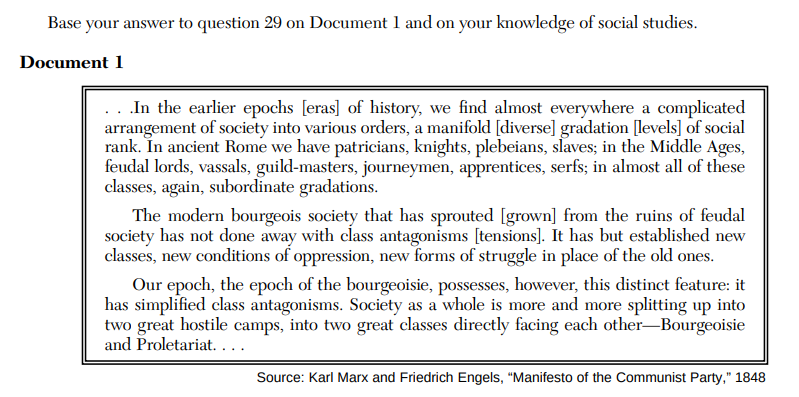
Question 29 uses Document 1 (Context)
Question 30 uses Document 2 (Source)
Question 31 uses Documents 1 and 2 (Relationship between documents)
Short-Answer CRQ Set 2 Structure
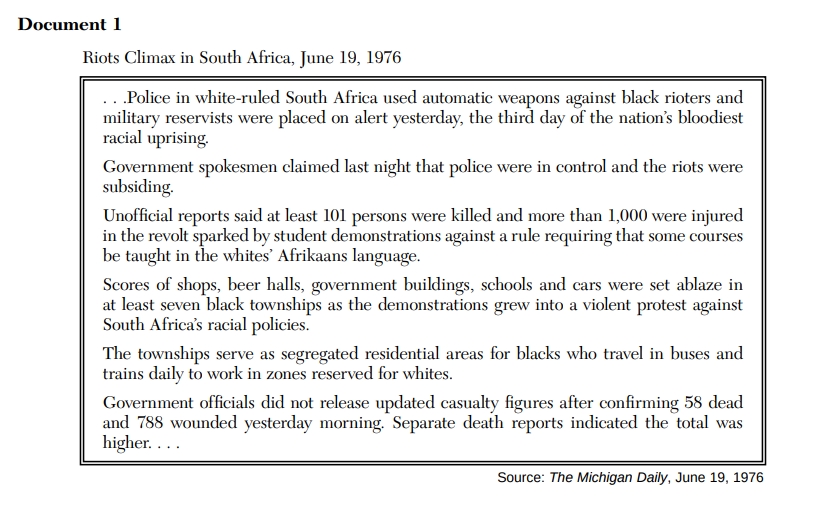
Question 32 uses Document 1 (Context)
Question 33 uses Document 2 (Source)
Questions 34a and 34b use Documents 1 and 2 (Relationship between documents)

Explain the historical circumstances that led to the events described in this passage. [1]

Explain Lenin’s point of view regarding the impact of the Russian Revolution, based on this passage. [1]
Identify and explain a cause-and-effect relationship between the events and/or ideas found in these documents. Be sure to use evidence from both Documents 1 and 2 in your response. [1]

Explain the historical circumstances that led to the demonstrations discussed in this 1976 newspaper excerpt. [1]

Based on this excerpt, identify Shelly Ng’s [SN] point of view regarding the Chinese government. [1]
34a–34b Using evidence from both Documents 1 and 2 and your knowledge of social studies:
Identify a similarity or a difference between the use of protest in South Africa in 1976 and in China in 1989. [1]
Explain the similarity or a difference you identified using evidence from both documents. [1]
This question is based on the accompanying documents. The question is designed to test your ability to work with historical documents. Some of these documents have been edited for the purposes of this question. As you analyze the documents, take into account the source of each document and any point of view that may be presented in the document. Keep in mind that the language and images used in a document may reflect the historical context of the time in which it was created.
Directions: Read and analyze each of the five documents and write a well-organized essay that includes an introduction, several paragraphs, and a conclusion. Support your response with relevant facts, examples, and details based on your knowledge of social studies and evidence from the documents.
An enduring issue is a challenge or problem that has been debated or discussed across time. An enduring issue is one that many societies have attempted to address with varying degrees of success.
Task:
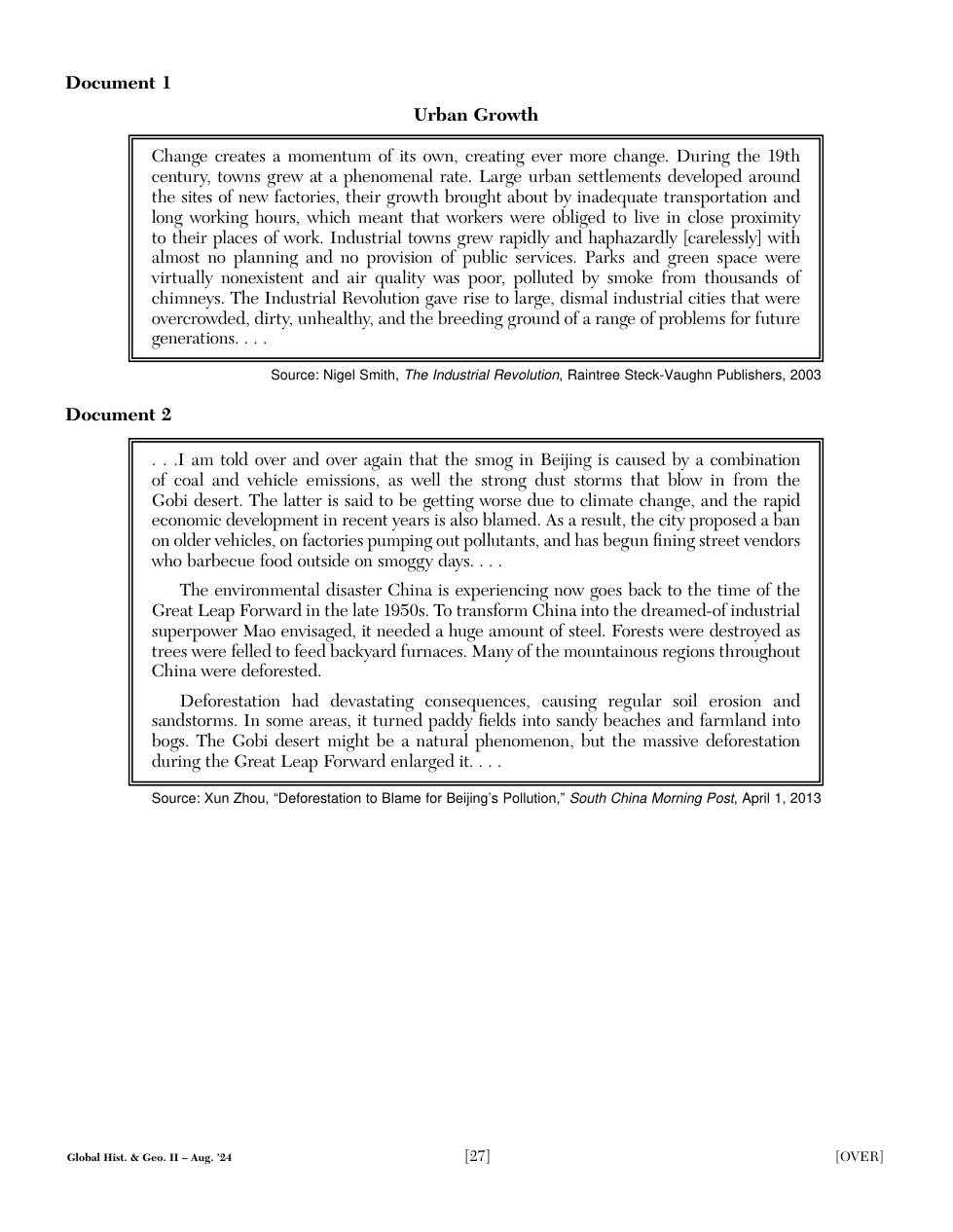
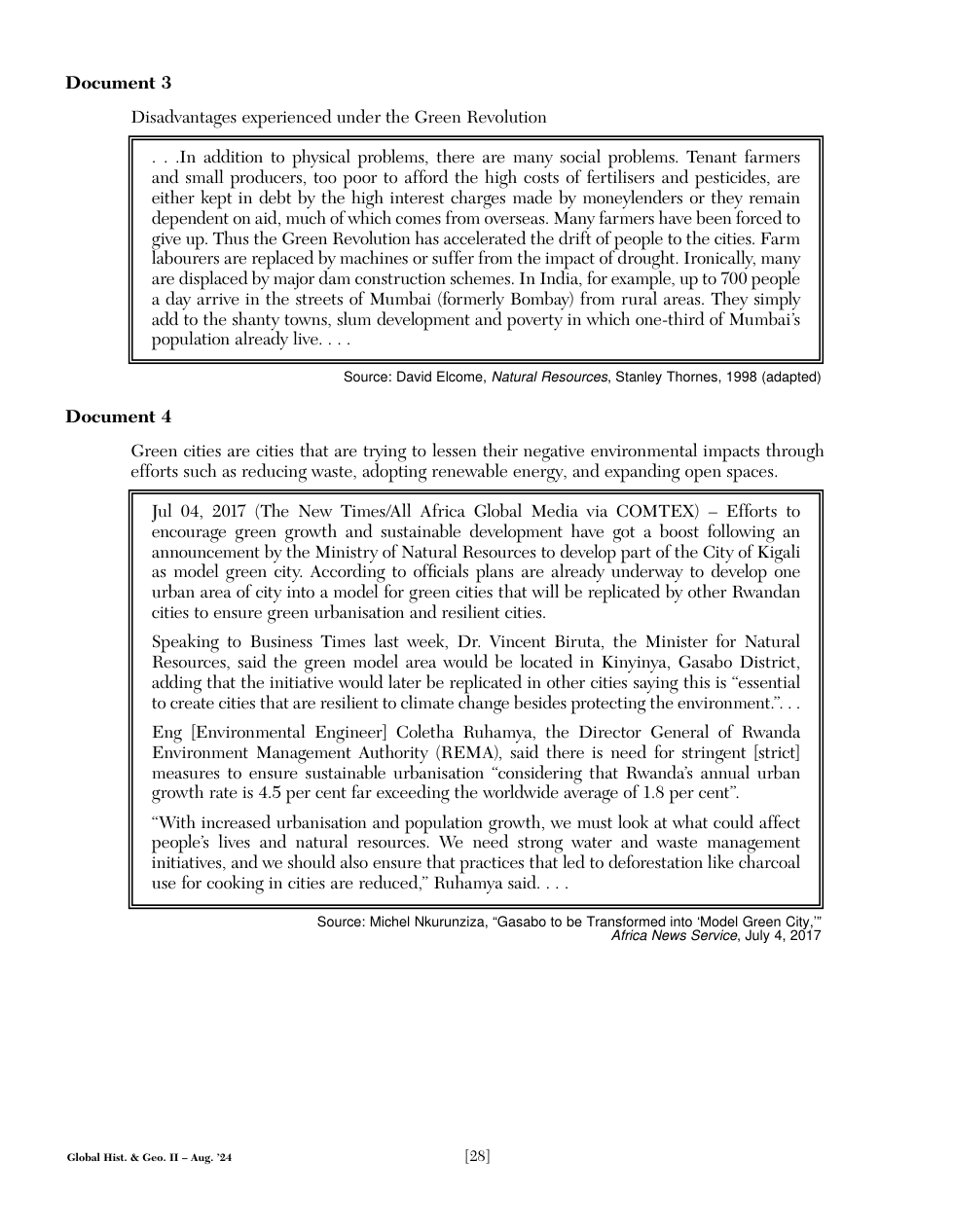
• Identify and explain an enduring issue raised by this set of documents
• Argue why the issue you selected is significant and how it has endured across time using your knowledge of social studies and evidence from the documents
In your essay, be sure to
• Identify the enduring issue based on a historically accurate interpretation of at least three documents
• Explain the issue using relevant evidence from at least three documents
• Argue that this is a significant issue that has endured by showing:
– How the issue has affected people or has been affected by people
– How the issue has continued to be an issue or has changed over time
• Include relevant outside information from your knowledge of social studies
In developing your answer to Part III, be sure to keep these explanations in mind:
Identify—means to put a name to or to name.
Explain—means to make plain or understandable; to give reasons for or causes of; to show logical development or relationship of something.
Argue—means to provide a series of statements that provide evidence and reasons to support a conclusion.
Documents 1 and 2 (Scroll further down for Documents 3-5)
Documents 3 & 4
Document 5
Write your essay here following the detailed instructions above.
Directions: Read and analyze each of the five documents and write a well-organized essay that includes an introduction, several paragraphs, and a conclusion. Support your response with relevant facts, examples, and details based on your knowledge of social studies and evidence from the documents.
Optional Planning Page
Which course of action did the British take in response to the situation described in this passage?
These speakers’ ideas and arguments were influenced by
Which statement best represents a response taken by the Third Estate to the situation shown in the cartoon?
In what way did the situations shown in this cartoon significantly affect China?
Which claim about the impacts of foreign influence in Japan is best supported by this passage?
What was a direct outcome of the event in this illustration?
Based on this passage, which action was being recommended by Ho Chi Minh?
Based on this illustration, which course of action is being recommended by Mustafa Kemal Atatürk?
Based on this article, the type of action taken by Hans and Sophie Scholl can best be described as
Which later development was a result of the political situation shown in this cartoon?
Which event would later reverse many of the changes described in this passage?
Based on this article, what major problem is China attempting to overcome?
Which claim about the Maritime Silk Road is best supported by this article?