Which title would be best to replace Title B?
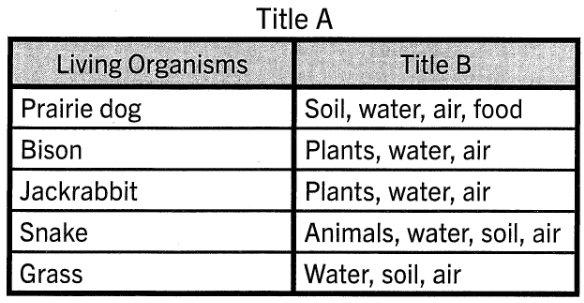
Which title would be best to replace Title B?
Which title would be best to replace Title B?
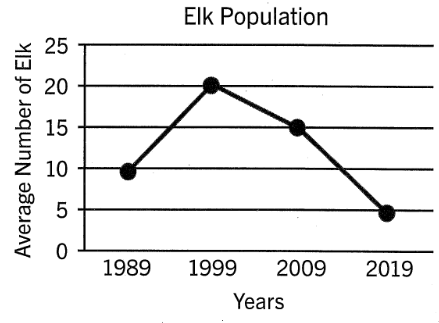
What can be concluded using the data shown below?
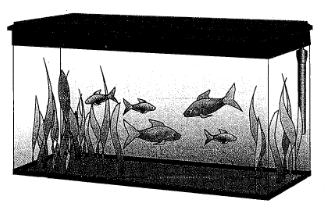
Specific environments meet the needs of organisms. The school aquarium below shows what is needed for these organisms to survive in their environment.
The aquarium pictured is a good model of –
Which of the following are examples of how animals interact with living components of their environment?
Select TWO correct answers.
A student wants to display the way organisms live and survive in their ecosystem. The student decides to construct a diorama as a representation of the relationships organisms have within an environment. The diorama is a/ an –
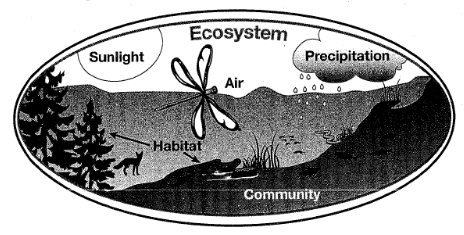
How are the living and the nonliving components connected to one another in this diagram?
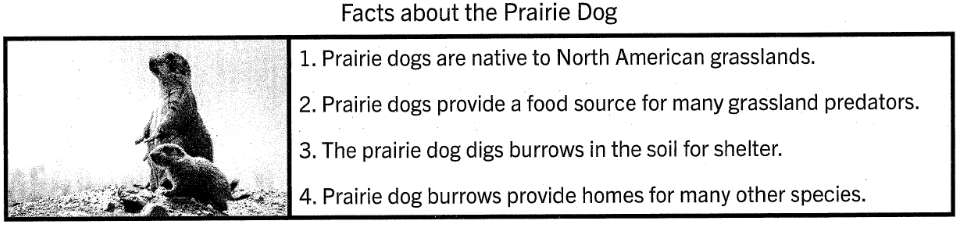
Some facts about an animal called the prairie dog are listed in the box shown below.
Which fact describes one way the prairie dog changes the environment to meet its needs?
What is an ecosystem made up of?
How do plants get their energy in an ecosystem?
What role do decomposers play in an ecosystem?
Categorize these organisms based on how they obtain energy.
Trees
Grass
Deer
Fox
Bacteria
Fungus
Consumers
Decomposers
Producers
Sort these items into living and nonliving components of an ecosystem.
Water
Birds
Bees
Sunlight
Living components
Nonliving components
Group these entities based on the roles they play in a forest ecosystem.
Rivers
Caves
Trees
Berries
Shelter providers
Food providers
Air purifiers
Water providers
What might a rabbit need from its ecosystem to survive?
Why is sunlight important in an ecosystem?
What roles do plants play in an ecosystem?
Why do some animals in an ecosystem hibernate?
Which of these makes up an ecosystem's nonliving components?
How do decomposers like mushrooms contribute to ecosystem interactions?
Match the organisms to the way they survive in their ecosystem
| Draggable item | arrow_right_alt | Corresponding Item |
|---|---|---|
Penguins | arrow_right_alt | Storing water in stems to survive in arid conditions |
Cactus | arrow_right_alt | Building dams to create a sheltered habitat |
Beavers | arrow_right_alt | Having a layer of blubber to keep warm in freezing environments |
Match the non-living component to the ecosystem it characterizes
| Draggable item | arrow_right_alt | Corresponding Item |
|---|---|---|
High levels of sunlight | arrow_right_alt | Arctic Tundra |
Precipitation | arrow_right_alt | Desert |
Low temperature | arrow_right_alt | Rainforest |
Match the organism to its food source in the ecosystem
| Draggable item | arrow_right_alt | Corresponding Item |
|---|---|---|
Elephants | arrow_right_alt | Fish and berries |
Sharks | arrow_right_alt | Plants and fruits |
Bears | arrow_right_alt | Other fish and marine mammals |
Match the organism to its method of obtaining food
| Draggable item | arrow_right_alt | Corresponding Item |
|---|---|---|
Spider | arrow_right_alt | Using echolocation to hunt |
Humpback Whale | arrow_right_alt | Using its long tongue to eat ants and termites |
Anteater | arrow_right_alt | Building a web to trap insects |
Classify the following organisms based on how they obtain their food.
Deer
Grass
Lion
Mushrooms
Primary Consumers
Decomposers
Producers
Secondary Consumers
Sort these items into their proper categories based on their role in the ecosystem.
Sunlight
Bacteria
Trees
Air
Living components
Non-living components
Classify these species by their impact on the ecosystem.
Zebra mussels
Snow leopards
Bees
Pandas
Invasive species
Beneficial species
Endangered species
Identify the abiotic factors (elements that are not biological or living) in an ecosystem.
In a food chain, which organisms convert sunlight into usable energy?
Which elements are necessary for organisms to survive in a desert ecosystem?
What interactions might a frog have in its pond ecosystem?