Log in
Sign up for FREE
arrow_back
Library

Digital Inquiry: Bees

star
star
star
star
star
Last updated 9 months ago
19 questions
3
3
3
Trim End | 03:24
Question 1 | 01:37
Question 2 | 01:54
Question 3 | 02:08
Question 4 | 02:50
00:00/00:00
Question 1
01:37
keyboard_arrow_down
1
Question 2
01:54
keyboard_arrow_down
1
Question 3
02:08
keyboard_arrow_down
1
Question 4
02:50
keyboard_arrow_down
1

Honey Bees: Nature's Tiny Heroes


Honey bees are fascinating insects that play a crucial role in our ecosystem. They are known for their ability to produce honey, but their importance goes far beyond that. Honey bees are essential pollinators, helping plants reproduce by transferring pollen from one flower to another. This process is vital for the growth of fruits, vegetables, and many other crops that we rely on for food.

Honey bees live in well-organized colonies, each with a specific role to ensure the hive's survival. The queen bee is the leader of the colony and is responsible for laying eggs. Worker bees, which are all female, take care of the hive, gather nectar and pollen, and produce honey. Male bees, called drones, have the sole purpose of mating with the queen.

Here are some interesting facts about honey bees:

1) Honey bees have five eyes: They have two large compound eyes and three smaller simple eyes on top of their heads.

2) A single bee can visit up to 5,000 flowers in one day: This makes them incredibly efficient pollinators.

3) Honey bees communicate through dance: They perform a "waggle dance" to inform other bees about the location of food sources.

4) A queen bee can lay up to 2,000 eggs per day: This ensures the colony remains strong and productive.

5) Honey bees have a special stomach for nectar: They store nectar in this stomach and convert it into honey.

6) Bees can recognize human faces: They use their complex vision to remember and recognize different faces.

7) Honey never spoils: Archaeologists have found pots of honey in ancient Egyptian tombs that are still edible.

8) Bees are the only insects that produce food eaten by humans: Honey is a unique product of their hard work.

9) A bee's wings beat 200 times per second: This rapid movement allows them to fly and hover efficiently.

10) Honey bees can travel up to 6 miles in search of food: They are determined and tireless workers.
1
1
1
1
1

TEXT: BEEKEEPING


People love honey, but it is hard to find a natural bee hive. So, beekeepers set up places for bees to live and make honey. Here’s how it is done.

Bees need carbohydrates from flower nectar and protein from pollen to grow and reproduce. They need a place to store their food and grow new bees. This is done in wooden brood boxes with trays where the bees can build honey combs.
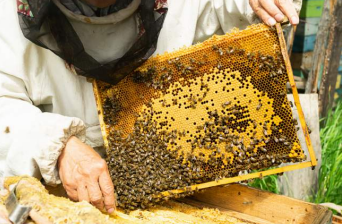

Boxes are set up on stands to keep them dry and keep pests away. Bees need two boxes to provide enough space for their own honey and pollen stores and for the queen to lay eggs for the next generation.

After the bees have nearly filled their own brood boxes, keepers add smaller boxes on top. These are called honey supers. Because bees really are busy, they can produce much more honey than they can eat. This extra honey can be harvested by keepers. Bees get a safe, clean place to grow and we get honey.
1
1
1

VIDEO: WHAT'S HAPPENING TO ALL THE BEES?


Click the link to watch a video about the decline in bee population.
1
1
1
1
Question 17
17.
Honeybees are flying ____________that help to ______________ flowers and crops. Flowers and bees are two ___________ things that work together during pollination.
Other Answer Choices:
insects
living
pollinate
Question 18
18.
Bees gather ___________and ___________ from plants. Honeybees use nectar and other liquids in their bodies to make __________.
Other Answer Choices:
honey
nectar
pollen
Question 19
19.
People are another group of living _____________ that bees work with. Beekeepers provide wooden ________________ for honeybees. They can produce honey for themselves and provide extra honey to the _______________ .
Other Answer Choices:
orgnisms
brood boxes
beekeepers
Question 1
1.

Where does Beeswax come from?

Question 2
2.

Do bees eat honey?

Question 3
3.

About how many eggs a day does the queen lay?

Question 4
4.

Bees are the only insect that create a food that human eat directly.

Question 5
5.

What is the primary role of worker bees in a honey bee colony?

Question 6
6.

How do honey bees communicate the location of food sources to other bees?

Question 7
7.

How many eggs can a queen bee lay in one day?

Question 8
8.

What unique ability do honey bees have regarding human faces?

Question 9
9.

How far can honey bees travel in search of food?

Question 10
10.

Why do beekeepers set up places for bees to live and make honey?

Question 11
11.

What do bees need from flower nectar and pollen?

Question 12
12.

What are honey supers used for?

Question 13
13.

What is the primary role of bees in our ecosystem?

Question 14
14.

What is one of the main reasons for the decline in bee populations?

Question 15
15.

How does the decline in bee populations affect human food supply?

Question 16
16.

What can people do to help protect bee populations?