NYSTP Grade 5 ELA
star
star
star
star
star
Last updated 7 months ago
25 questions
Directions: Read this story. Then answer questions 1 through 7.
Tom works at Sandy Lane Stables with his friends Rosie, Jess, and Nick. Chancy, the horse he will be taking care of this summer, has just arrived in a horse truck.
Excerpt from Sandy Lane Stables: A Horse for the Summer
by Michelle Bates
1 Everyone was quiet as a disgruntled-looking man stepped down from the cab, alone. . . .
disgruntled-looking = appearing unhappy or upset
2 “I don’t know what you’ve got in there,” said the man, hunching his shoulders. “Supposed to be a horse . . . well, he was when I loaded him anyway. A real handful. Only just managed to get him in the van and that was nothing compared to the ride here. Thought he was going to kick the van down. Better you than me, son,” he said, climbing into the van before Tom had a chance to reply.
3 There was a frantic whinny and the sound of drumming hooves reverberated around the stables as Chancy pranced down the ramp. He was certainly on his toes, but he didn’t look like the sleek, well turned-out horse that Tom remembered seeing last season. He was still unclipped and his shabby winter coat was flecked with foam, as feverishly he pawed the ground. No one knew what to say.
reverberated = echoed
4 Eventually, Rosie managed to pipe up with: “Are you sure it’s the same horse?”
5 “Of course it is,” Tom snapped, unable to keep the disappointment out of his voice. “He only needs to be clipped and he’ll look fine.”
6 “I wouldn’t be so sure,” Jess muttered under her breath.
7 “Shouldn’t he have been clipped already?” said Rosie. She was always looking things up in her Pony Club manual and was sure that she had read that horses should be clipped before January, or their summer coat would be spoiled.
8 “He probably should have been, still that won’t be too much of a problem,” said Nick kindly. “Now come on everyone, stop crowding him and get back to what you were doing. Take him to his new home, Tom.”
9 Tom approached the horse and took the halter that the man offered him. Chancey jumped skittishly from side to side, rolling his eyes and flicking his tail as Tom led him off.
skittishly = in a nervous way
10 “Poor Tom,” said Rosie. “He was so excited about that horse. Still, even though Chancey isn’t very good-looking, I’m sure he’ll be an absolute dream to ride.”
11 Tom didn’t know what to think. When he had seen Chancey last season, he had been one hundred percent fit, his muscles rippling under his glossy chestnut coat. Tom was sure that he hadn’t been mistaken, he was definitely the same horse.
12 Tom picked up the things that the van driver had left in the middle of the stables. There was a saddle and bridle, a dark blue New Zealand blanket and a box full of glossy grooming brushes that looked as though they had never been used. Putting them in the tack room, he grabbed an old body brush and curry comb, and hurried back to Chancey’s stall. He would have to be quick if he was going to be able to give Chancey a quick grooming and get home in time for lunch. Tom opened the door slowly, careful not to startle him.
13 “Come on, boy. Let’s get you cleaned up and give you your lunch. I bet you’re hungry after that awful trip,” he crooned.
14 Chancey seemed to have settled down a little and nuzzled Tom’s pockets inquisitively. Tom fumbled around for a mint. The horse’s lips were as soft as crushed velvet as he gratefully accepted the offering.
inquisitively = curiously
15 “That’s better,” said Tom. “I thought you’d taken an instant dislike to me, and it’s very important that we’re friends if we’re going to spend the whole summer together.”
16 “Hey, now hang on a minute,” said Tom, as the nuzzling turned into frantic chewing. “I’m sure my jacket doesn’t taste that great and I won’t be getting a new one if you eat it either.” Gently, Tom pushed Chancey’s nose away.
17 “I've got to go home for lunch in a minute,” Tom went on, giving him a quick rubdown. “I'll be back at two. Nick has said that we can join the 3 o'clock class. Are you listening?”
18 Chancey wasn't paying any notice. Already bored of all the attention, his head was buried deep in a bucket of pony pellets as Tom bolted the door of the stall and set off for home.
pellets = small chunks of food
19 Lunch was something that Tom’s mother insisted upon. If he was going to be at the stables all day, she said that he must at least come back at one to eat. He was careful to obey her, if only to keep her from going on about the amount of time he spent at Sandy Lane.
Required
1
Which detail from paragraph 3 best helps the reader understand the meaning of the phrase “well turned-out”?
Required
1
How do paragraphs 3 and 11 develop an idea in the story?
Required
1
Paragraphs 14 and 18 are important to understanding Chancey because they show that he
Required
1
Tom and Nick are similar in the story because they both
Required
1
How does paragraph 19 help the reader understand the story?
Required
1
Which sentence best expresses a theme of the story?
Required
1
Scientists who have studied horses believe that they are able to understand the moods of the people around them. How does this idea best connect to the details in the story?
Directions: Read this article. Then answer questions 8 through 14.
Excerpt from Wild in the City
by Megan Hansen
1 At first glance, a vacant lot in a city might seem lifeless. But look closer. A dragonfly dances around a puddle. A frog darts from a drainpipe to snatch the dragonfly. From the rooftops, a hawk swoops down to grab the frog. Cities might have been built for humans, but wildlife is everywhere! When you think of wildlife, you might picture bears lumbering through the forest. But many animals have adapted to the sewers, parks, and alleys of the “concrete jungle.” These areas provide a natural habitat for many species. Wild animals need food, water, space to hunt or hide, and a place to raise young. A city offers all of these.
2 The rooftops abound with winged wildlife. More than 200 bird species are found in the city, including blue jays, robins, doves, finches, crows, gulls, and woodpeckers. Peregrine falcons and ospreys nest on skyscrapers and bridges. New Yorkers also love to watch butterflies. Each year, thousands of monarch butterflies pass through the streets during their fall migration to Mexico. And let’s not forget nature’s insect control: bats. These winged mammals can eat eight mosquitoes, flies, or moths a minute. With up to 500 bats living in a single church belfry, that’s 240,000 bugs an hour—gobbled up!
3 What about the city’s tiniest wildlife? Although you might not like to think about them, cockroaches are amazingly well-adapted to city life. These insects can live for two months without food, and haven’t changed much since scurrying around with dinosaurs millions of years ago. No wonder they seem unstoppable! Earthworms are another urban crawler. These marvelous little wrigglers gobble up dead leaves, food scraps, and garbage, and turn them into rich soil. Without worms, the trees, grass, and flowers of Central Park would not grow.
4 Sometimes New York gets unexpected visitors. As the forests surrounding New York fill with more and more people, wild animals are forced to find new homes. New Yorkers have spotted coyotes, white-tailed deer, and gray foxes in the city. A black bear was spotted wandering past a high school just 20 miles away from the city. And in 2009, a 30-foot long humpback whale swam into New York Harbor. Biologists, engineers, and politicians work hard to make sure city wildlife stays healthy and interacts safely with humans. A special nest for four eaglets was constructed in New York’s Inwood Park. Bald eagles, which were once endangered, can now be spotted flying over Central Park. So the next time you’re in New York (or any other big city), take a moment to look up, look under, and look closer. You’ll find a world of wildlife!
1
How do the details in paragraph 2 support a central idea of the article?
1
Which detail from the article best explains why wildlife can survive in urban areas?
1
What is the meaning of the word “interacts” as it is used in paragraph 4 of the article?
Required
1
Scientists have found that ants eat a great deal of the food thrown away by people. How does this idea mainly connect to the details in the article?
Required
1
What is the main claim the author makes about people and wildlife?
Required
2
This question is worth 2 credits.
How does the author describe the relationship between animals and people in cities? Use two details from the article to support your response.
This question is worth 2 credits.
How does the author describe the relationship between animals and people in cities? Use two details from the article to support your response.
Required
2
This question is worth 2 credits.
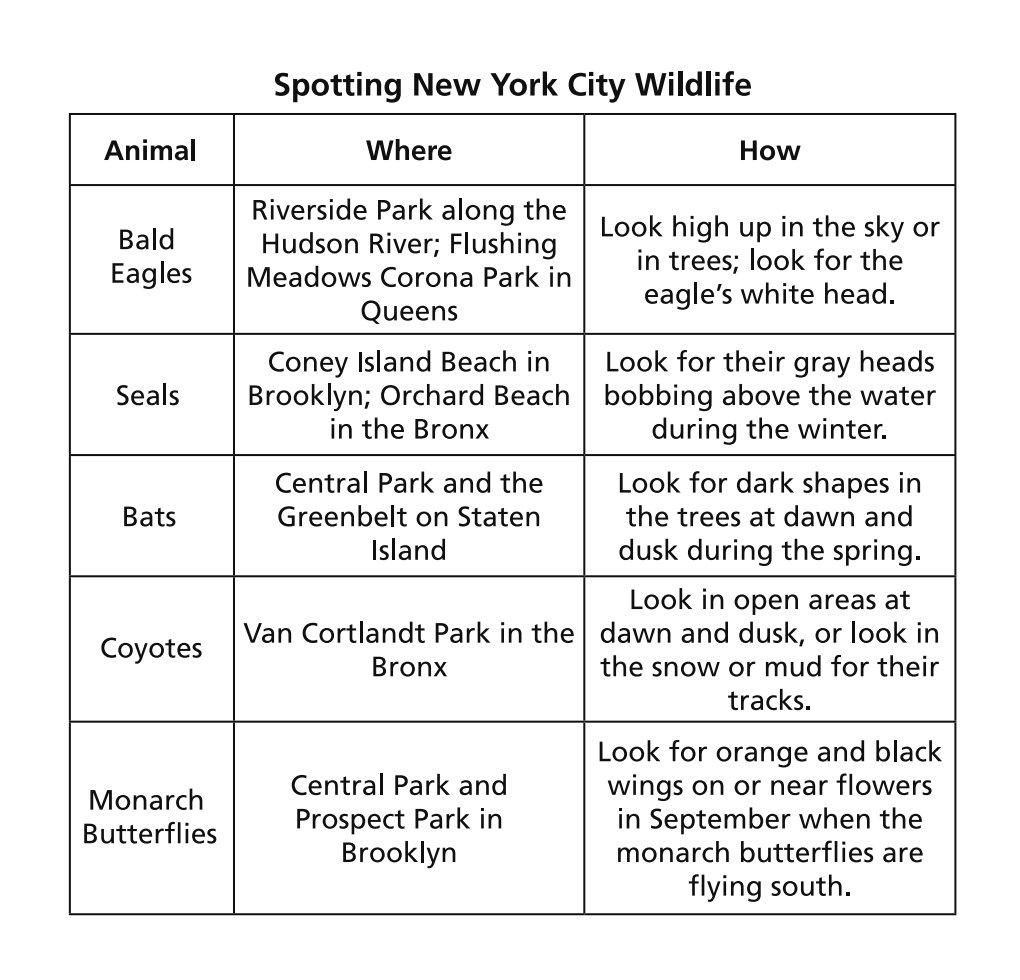
How do the details in the “Spotting New York City Wildlife” chart support the ideas in the article? Use two details from the article to support your response.
This question is worth 2 credits.
How do the details in the “Spotting New York City Wildlife” chart support the ideas in the article? Use two details from the article to support your response.
Directions: Read this story. Then answer questions 15 through 21.
Excerpt from Lobsterman
by Dahlov Ipcar
1 Larry lives in a fishing village on the coast of Maine. White gulls soar above his house and perch on the roof top. From his window he can see the harbor full of fishing boats. . . .
2 Larry’s father is a lobster fisherman and owns one of the lobster boats. He fishes for lobsters all year round, even in the winter, if weather permits. But winter storms are hard on boats and traps, so at least once a year a lobsterman has to overhaul his gear. Every spring Larry’s father has his big boat hauled out of the water, and then he and Larry work on her. . . .
3 They paint their lobster trap buoys too in the spring. Larry’s father paints his buoys red and yellow and black. Every lobsterman uses different colors so that he can tell his buoys from the others. . . .
buoys = floating objects used to mark places at sea
4 Soon everything is ready. One morning early in May they make their first trip out to set their traps. It is still dark when they eat breakfast and put on their yellow waterproof pants and jackets and their black hip boots. Larry helps his father carry the gear down to the dock. There they load the big boat with as many traps as she can carry. Then Larry’s father starts the engine, and they chug out of the harbor. . . .
5 They pass beaches where clamdiggers are digging for clams. They pass rocky islands where seals bask in the sun with their babies. Some of them dive into the water and swim after the boat with only their heads showing above the water. Larry throws a herring to one of them and she catches it.
6 Then Larry takes the wheel while his father pushes the traps overboard. The lobsters hide deep in the cool, green water among the seaweeds and rocks. They hide there with their long feelers waving and their big claws ready to catch any fishes that swim by. . . .
7 Larry and his father come to a little cove where long streamers of brown kelp grow so thick that they can look down and see them waving in a great, dark tangle, like a jungle under the water.
kelp = type of large seaweed
8 “There must be lobsters down there, for sure,” Larry says. “This is where I want to set my trap.”
9 They push the trap over . . . and down it goes, down, down, down, until it disappears among the kelp . . . and only the yellow buoy with black and white stripes floats on top to mark where the trap is.
10 They set each trap in a different place. They make many trips back to shore for more traps. All day long they drop the traps over the side of the boat, one by one. Some they drop far out to sea and some along the rocky shores. Then as darkness falls over the water they head back home.
11 Next morning Larry and his father go out in the boat again, this time to haul their traps. Larry reaches over with the gaff and hooks each buoy out of the water. . . .
gaff = iron hook
12 When they pull up Larry’s trap out of the tangled kelp, they find three big lobsters in it. They weigh Larry’s lobsters and one is a whopping four-pounder, the biggest they have caught so far.
13 “We’ll keep track of all the lobsters you catch,” his father says. “Then when we sell them, I’ll put aside the money for you, and by the end of the summer you ought to have enough to buy something you want. Maybe you can save up for a skiff or an outboard motor.”
skiff = small boat
14 “But let’s not sell these three lobsters,” Larry says. “I want to have one for supper tonight, and you and Momma can eat the other two, because they’re the first lobsters I ever caught in a trap of my own.” . . .
15 And when Larry climbs into bed that night he lies awake a while. He thinks about all the many different kinds of fishing, and he says to himself, “I could fish with nets for herring or mackerel, I could work on a big dragger catching redfish or flounder or haddock, I could be a tuna fisherman, or even a clamdigger; but of all the kinds of fishing there are, I think lobstering is the most fun . . . and besides I like lobsters, so I’m going to be a lobsterman when I grow up!”
Required
1
Which sentence best describes the narrator’s point of view?
Required
1
How do paragraphs 1 and 5 mainly contribute to the structure of the story?
Required
1
Read this sentence from paragraph 8.“There must be lobsters down there, for sure,” Larry says.
Which detail from the story best supports the reason Larry feels certain about the lobsters?
Read this sentence from paragraph 8.
“There must be lobsters down there, for sure,” Larry says.
Which detail from the story best supports the reason Larry feels certain about the lobsters?
Required
1
Read this excerpt from paragraph 9.... the yellow buoy with black and white stripes floats on top to mark where the trap is.
According to this excerpt, buoys are used to
Read this excerpt from paragraph 9.
... the yellow buoy with black and white stripes floats on top to mark where the trap is.
According to this excerpt, buoys are used to
Required
1
Which detail best supports a theme of the story?
Required
1
Paragraphs 13 and 14 suggest that Larry
Required
1
Which detail would be most important to include in a summary of the story?
Directions: Read this story. Then answer question 22 and 23.
The Lion’s Share
retold by Victoria Parker
1 A lion once went hunting with a fox, a jackal, and a wolf. The four hunters prowled and lurked and tracked until at last they came upon a huge stag in the depths of the forest. Working together, they took the stag totally unaware and claimed its life.
jackal = a wild member of the dog family
stag = a male deer
2 The hunters stood triumphant as the stag lay before them. But then they all began to wonder how they should share out their catch.
3 Just as an argument was about to break out, the lion threw back his head and gave a mighty roar. “Divide this stag up into quarters right NOW!” he bellowed, and the other animals leapt to it.
4 When it was done, the lion snarled at the fox, the jackal and the wolf, who stood sulkily before him. “The first quarter is for me,” he declared, “because I am King of the Beasts.”
5 The fox, the jackal, and the wolf looked at each other and shrugged—that was fair enough, they thought. But then the lion went on . . . “The second quarter is mine too, as I am the one sorting out the shares.”
6 “But—”
7 “Hang on a minute—”
8 “Rubbish!” The fox, the jackal, and the wolf began to grumble, but the lion took no notice and carried on.
9 “The third share should be mine because of the part I played in hunting the stag. As for the fourth quarter, well, I should like to see which of you will dare to lay a paw upon it.” And the lion bared his teeth and flexed his sharp claws.
10 The three other hunters slunk away into the shadows with their tails between their legs.
Required
2
This question is worth 2 credits.
In “The Lion’s Share,” how does paragraph 10 contribute to the structure of the story? Use two details from the story to support your response.
This question is worth 2 credits.
In “The Lion’s Share,” how does paragraph 10 contribute to the structure of the story? Use two details from the story to support your response.
Required
2
This question is worth 2 credits.
What is a theme of “The Lion’s Share”? Use two details from the story to support your response.
This question is worth 2 credits.
What is a theme of “The Lion’s Share”? Use two details from the story to support your response.
Directions: Read this story. Then answer questions 24 and 25.
The Bees and Wasps, and the Hornet
by Aesop
1 A store of honey had been found in a hollow tree, and the Wasps declared positively that it belonged to them. The Bees were just as sure that the treasure was theirs. The argument grew very pointed, and it looked as if the affair could not be settled without a battle, when at last, with much good sense, they agreed to let a judge decide the matter. So they brought the case before the Hornet, justice of the peace in that part of the woods.
2 When the Judge called the case, witnesses declared that they had seen certain winged creatures in the neighborhood of the hollow tree who hummed loudly and whose bodies were striped, yellow and black, like bees.
3 Counsel for the Wasps immediately insisted that this description fitted his clients exactly.
counsel = person who argues someone’s case in a court of law
4 Such evidence did not help Judge Hornet to any decision, so he adjourned court for six weeks to give him time to think it over. When the case came up again, both sides had a large number of witnesses. An Ant was the first to take the stand, and was about to be cross-examined, when a wise old Bee addressed the Court.
5 “Your honor,” he said, “the case has now been pending for six weeks. If it is not decided soon, the honey will not be fit for anything. I move that the Bees and the Wasps both be instructed to build a honey comb. Then we shall soon see to whom the honey really belongs.”
6 The Wasps protested loudly. Wise Judge Hornet quickly understood why they did so: They knew they could not build a honey comb and fill it with honey.
7 “It is clear,” said the Judge, “who made the comb and who could not have made it. The honey belongs to the Bees.”
Required
2
This question is worth 2 credits.
In “The Bees and Wasps, and the Hornet,” how is the Hornet’s interest in the case different from the Wasps’? Use two details from the story to support your response.
This question is worth 2 credits.
In “The Bees and Wasps, and the Hornet,” how is the Hornet’s interest in the case different from the Wasps’? Use two details from the story to support your response.
Required
4
This question is worth 4 credits.
In "The Lion’s Share" and "The Bees and Wasps, and the Hornet," the main characters develop solutions to their problems. What similar problem do the main characters share? How do the main characters solve this problem? Use details from both stories to support your response.
In your response, be sure to- identify the similar problem the main characters share in both stories
- explain how the main characters solve this problem
- use details from both stories to support your response
This question is worth 4 credits.
In "The Lion’s Share" and "The Bees and Wasps, and the Hornet," the main characters develop solutions to their problems. What similar problem do the main characters share? How do the main characters solve this problem? Use details from both stories to support your response.
In your response, be sure to
- identify the similar problem the main characters share in both stories
- explain how the main characters solve this problem
- use details from both stories to support your response