NYSTP Grade 6 ELA

Last updated 7 months ago
25 questions
Read this article. Then answer questions 1 through 7.

Excerpt from Great Migrations

by Elizabeth Carney

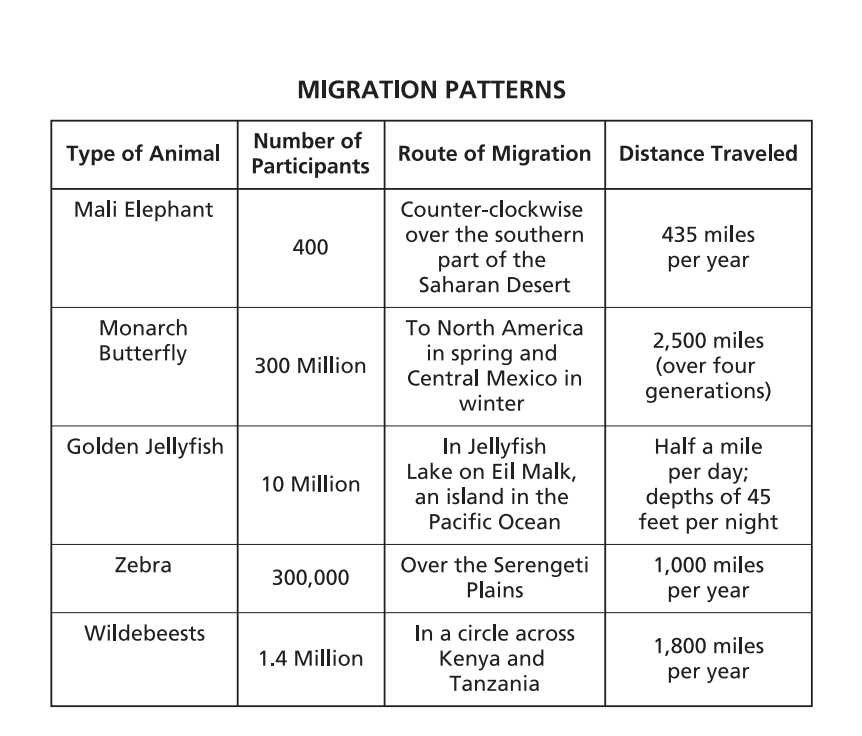
1 Animals migrate for a variety of reasons, some we know and some we don't. They may need fresh sources of food or a place to mate. They might have to flee from predators or find shelter from extreme temperatures.

2 The sun —its rise and fall over a day and the whirling of the Earth around it for a year
—powers these events. They are some of natures most thrilling dramas. Come have a closer look at some of the world's great migrations.

Mali Elephants

Driven by Thirst

3 There's a saying that an elephant never forgets. For the Mali desert elephants, that saying must be true. For them, forgetting the location of a lifesaving water hole would be a deadly mistake.

4 Mali elephants live along the southern edge of the Sahara desert. In order to survive in their parched environment, the animals are on a nearly constant search for water. A wise, older female, called a matriarch, leads each family group. The herd's survival depends on her decisions.

5 Under typical conditions, Mali elephants can thrive. But sometimes even the wisest matriarch is no match for nature. When a recent drought dried up nearly every water source in the region, the Malian government trucked in water for the elephants.

6 Mali elephants have the longest migration of any elephant. Their life-or-death challenge is to find enough water in a desert. After a rare rain, Mali elephants must get to newly-formed water holes before they dry up.

Dangers

7 Oven-like 120°F heat and fierce sand storms can be a threat for tired, thirsty elephants. Youngsters are the most vulnerable.1

Monarch Butterflies

Color A-Flutter

8 It's spring in Mexicos Oyamel Forests. After blanketing nearly every inch of the trees, millions of monarch butterflies take flight. Their orange-and-black wings color the sky like an explosion of confetti.

9 With the sun as their compass, they head north. No one butterfly will live long enough to complete the entire journey. Instead, they rely on a map imprinted in their genes. Each new generation of butterfly picks up where its parents left off. Together, they travel farther than any known insect.

Motive to Move

10 The delicate butterflies cannot survive cold winter temperatures. In the fall, they head south to spend the winter in Mexico. When spring arrives, the butterflies take flight to the United States and Canada where their favorite food, milkweed, is plentiful.

Dangers

11 Monarchs face many predators, but the butterflies' toxic2 skin discourages second helpings.

Golden Jellyfish

Gold Rush

12 With the rise of the sun, swarms of golden jellyfish start a migration. While many migrating animals make their move once a year, these jellyfish undertake a major journey every single day. Following the movement of the sun, millions of jellyfish circle the saltwater lake they call home— the appropriately named Jellyfish Lake.

13 Why does a small, pulsating3 jellyfish go through all the trouble? Golden jellyfish must follow the sun to support the plant-like algae that grow in their bodies. The algae convert sunlight into sugars for energy. In exchange for protection and a place to live, the algal hitchhikers make extra food for the jellyfish. The algae also give jellyfish their beautiful golden glow.

Motive to Move

14 Golden jellyfish must maximize their time in the sun so the algae living on their bodies can survive.

Dangers

15 Golden jellyfish have to avoid the shade to keep their algae in the sunshine. Staying on the move also helps the jellies avoid the stinging clutches of a predatory sea anemone.

Zebras

Striped Stallions

16 Just as the American West has its mustangs, the Serengeti4 has a horse-like animal to call its own: the unmistakable zebra. But zebras don't have time to horse around. Like the region's other hoofed animals-wildebeests and gazelles- zebras must stay on the move for fresh grass and water.

17 Zebras live in small groups with a dominant male, called a stallion, leading them.
Sometimes, herds will come together by the thousands to find better feeding grounds.

18 Of all Serengeti's grazers, zebras are the least picky. They'll feed on the toughest grasses, paving the way for soft, leafy regrowth that wildebeests and gazelles prefer.

Motive to Move

19 Zebras are forever searching for fresh grass and water. They follow roughly the same movements as wildebeests. The timing of their travels is driven by rainfall, which fuels the growth of new grass and refills water holes.

Dangers

20 Zebras must always be on the lookout for lions, crocodiles, and hyenas. The animals are favorite prey for these big carnivores.

Wildebeests

Wild Risks

21 On a Tanzanian plain, a wildebeest is born. Its mother urges it to stand. Human babies can take a year or more to take their first steps. But this young antelope has to be mobile in minutes. In central Africa, it's get up or get eaten!

22 For a wildebeest, being in a rush is a way of life. That's because they are a favorite snack on the savanna. Lions, leopards, crocodiles, and hyenas all feed on the moving herds. Outrunning enemies means living to see tomorrow. Despite the danger, wildebeests have to follow the seasonal rains to greener grasslands. Water and food are worth braving exhaustion and hungry predators.

Motive to Move

23 The region's alternating dry and rainy seasons mean that plant eaters have to stay on the move to find a steady supply of greens. During the dry seasons, the plains dry up into barren dust fields. Wildebeests would starve if they didn't migrate.

Dangers

24 Wildebeests who escape predators and survive thirst may still be trampled if their herd is startled into a frenzied stampede.

____________________________________
1vulnerable: likely to be affected by something bad
2toxic: poisonous to others
3pulsating: pulsing, pumping, or beating with blood or breath
4Serengeti: a plain in northern Tanzania
Required
1

What is the meaning of the word “parched” as it is used in paragraph 4?

Required
1

Read this sentence from paragraph 8.

Their orange-and-black wings color the sky like an explosion of confetti.

What is the author’s main purpose for using this sentence?

Required
1

Which sentence from the article best supports the author’s central claim?

Required
1

Which detail from the article represents the author’s belief?

Required
1

According to the article, zebras and wildebeests are similar because both animals

Required
1

The main way the different Motive to Move sections help the reader understand migration is by

Required
1

Which phrase from the article best helps the reader understand the claim in paragraph 22 that “being in a rush is a way of life” for wildebeests?

Directions: Read this article. Then answer questions 8 through 14.

Excerpt from The Story Behind Electricity

by Sean Stewart Price

1 Electricity often seems like a kind of magic. With the touch of a button, we can turn on lights or play music. Electricity lets us watch television. It also allows us to make phone calls from anywhere in the world.

2 But electricity does not just run machines. It also lights up the sky during a thunderstorm. It puts the “static cling” in our clothes. Try bending your finger. Electricity sends the signals that make that possible. Some animals, such as sharks, can sense electric signals in animals. That helps them hunt down their prey (the animals they eat).

A Powerful First

3 A Greek scientist named Thales was the first person to study electricity. That was about 2,600 years ago. Thales saw that something strange happened to amber (a yellow gem) when he rubbed it. Small, light objects such as feathers magically moved toward the amber. Thales did not know it, but he was creating electricity.

4 Electricity was not studied well until about 400 years ago. Since then, electricity has become more and more a part of our lives. . . .

5 A series of scientists helped discover all we know about electrical energy today.

Studying Static

6 In 1660, a German inventor named Otto von Guericke invented a machine that produced static electricity.1 Later scientists used this to study electricity.

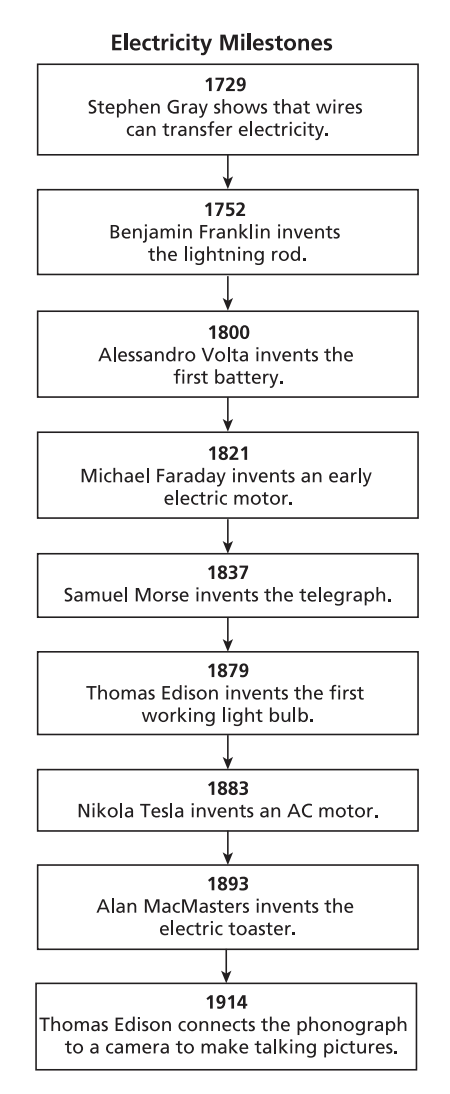
7 In the mid-1700s the U.S. inventor and politician Benjamin Franklin set out to learn more about electricity. Franklin did many experiments. They showed him that static electricity looked a lot like lightning. But it was smaller. Franklin realized that lightning was a type of electrical energy.

8 This was a huge discovery. At the time, lightning was a big problem. Lightning often hit tall buildings, such as church steeples. This caused deadly fires. People rang church bells to warn others of bad weather. Lightning sometimes struck and killed the bell ringers.

The Lightning Rod

9 Franklin invented the lightning rod. A lightning rod is a metal pole with a wire attached. Franklin put his lightning rod on tall buildings. Then he ran the wire down to the ground. Lightning tends to hit the rod. This is because it is the highest object on the roof. The electricity followed the wire. It went harmlessly to the ground. Franklin’s invention is still used on tall buildings today.

The Battery

10 In 1800 an Italian scientist named Alessandro Volta created the first battery. A battery is something that uses metal and chemicals to create electrical energy. Batteries would one day become essential power sources for modern electricity.

Michael Faraday

11 In 1821 the English scientist Michael Faraday invented an early form of the electric motor. This was the first time a magnet and electric current were used to create mechanical motion (motion involving machines). Faraday later discovered a dynamo. It did just the opposite. It converted mechanical motion into electrical energy. This new power source would lead to the electrical generators we rely on today.

Thomas Edison and the Next Step

12 In 1879 the U.S. inventor Thomas Edison created the first working lightbulb. At the time, many people used candles for light. Others used kerosene (a kind of oil) and gas lamps. All of these were smelly and caused fires. Edison’s lightbulb had the potential to change all this.

13 People had no way to get electricity into their homes. So, Edison began building an electric power station. On September 4, 1882, Edison flipped a switch at the Pearl Street Power Station in New York City. This lit up the homes and businesses of 85 customers. They were the first people to enjoy electric lighting.

Power to Thousands

14 In 1883 the U.S. scientist Nikola Tesla found a way to make electrical energy travel longer distances. He did so by using alternating current (AC) power. Power stations could now supply power for hundreds of miles and to thousands of people. The demand for electricity caught on. Today, most people cannot imagine life without electricity.


____________________________________
1static electricity: an electrical charge that does not move, usually produced by friction that causes sparks or crackling
Required
1

According to the article, what was the main effect of Franklin’s study of static electricity?

Required
1

Working with electricity can sometimes be dangerous. Which detail in the article best supports this idea?

Required
1

In paragraph 14, how does the author demonstrate how the demand for electricity “caught on”?

Required
1

What is most likely the author’s opinion about electricity?

Required
1

How does the author organize information to develop a central idea in the article?

Required
2

This question is worth 2 credits.

In "Excerpt from The Story Behind Electricity," how does the author support the claim that electricity has become “more and more a part of our lives” (paragraph 4)? Use two details from the article to support your response.

Required
2

This question is worth 2 credits.

In "Excerpt from The Story Behind Electricity," how are the ideas in paragraphs 8 and 9 related? Use two details from the article to support your response.

Directions: Read this story. Then answer questions 15 through 21.

A sea captain named Charlie Noble has retired to Bald Head Island, near Singing Beach.

Excerpt from “Charlie Noble and Mate”

by Louis Arthur Norton


1 Charlie’s companion was a black Labrador Retriever named Mate. Dogs learn obedience commands from the language of their owners. Instead of ordinary English, Mate responded to instructions that the captain used aboard ship like on board, meaning “come to your master,” and many other commands such as luff for “slow down,” avast for “stay,” heave to for “stop,” capsize for “roll over,” hail for “speak,” pipe down for “stop barking,” backwater for “move away,” shipshape for “good dog,” and most welcome, hardtack for “biscuit reward.”

2 When Charlie and Mate walked the streets of Bald Head or strolled along the sands of Singing Beach, they swayed from side to side as if they were on a pitching deck in a choppy sea. Townsfolk would pat the dog’s head and say nice things, but Mate just looked at them with his head cocked to one side and one ear raised. It seemed as if they were speaking to him in a foreign tongue, using words that were indeed strange to him.

3 Charlie Noble owned a sailboat named the Fast and Able. Sailing in each other’s company provided a perfect afternoon for Charlie and Mate, but they did not go too far from shore in the small boat. Mate either slept on the sun-warmed deck or joined Charlie in the cockpit, usually snuggling up to his master. If a fogbank rolled in, Mate would bark loudly, acting as the Fast and Able’s foghorn.

4 One sunny day as they sailed along the shoreline, a strong wind gust caused the sailboat to jibe1 suddenly. The heavy wooden boom holding the sail swung wildly and hit the old captain on the side of his head. Charlie fell to the bottom of the boat unconscious.

5 Mate whimpered and frantically licked his master’s face, but the old seaman did not move. The boat was now adrift,2 but not too far from land. Somehow the dog realized he should swim to shore and get help. Being a retriever he was a good swimmer, so Mate leaped into the cold water and dog-paddled to the beach.

6 Once ashore, Mate raced over the sand dunes and down the road toward the village. When he reached the town green, he tried to attract attention, running in circles and barking frantically.

7 The people of Bald Head shouted questions at the sopping wet dog. “What’s the matter, pup? Where’s your master?” But the dog seemed confused and barked even louder.

8 A young sailor in the crowd named Jake, a former shipmate of Charlie, recognized Mate and remembered that the old man’s dog responded to “sailor talk.” Jake bellowed in a deep voice, “Heave to!” followed by “Pipe down!” Mate stopped running in circles, then rapidly wagged his tail. The dog seemed to understand. Realizing that the captain might be in trouble, Jake then shouted, “On board!” and the eager dog led the sailor and concerned townsfolk down the road to the beach.

9 There the would-be rescuers saw the sailboat adrift offshore, but there were no rescue boats on the strand.3 Jake turned toward Mate and yelled, “On board!” once again. Mate wagged his tail even more rapidly as if to say, “Good idea!” He jumped into the surf and swam for the Fast and Able.

10 Mate reached the boat and scrabbled over the side. Once on board, he barked loudly while violently shaking himself. The cold seawater flew off Mate’s furry coat and splashed over Charlie, who now began to stir. Mate whimpered once again and licked Charlie’s face. The dazed old man sat up slowly, rubbing the side of his sore head. Charlie looked in Mate’s direction and grinned, then took a firm grip on the tiller.4 A fresh sea breeze filled the sail of the boat, and the vessel came to life.

11 Jake and the other folks onshore gave a cheer and turned back toward Bald Head. Charlie softly whispered, “Shipshape!” to Mate, then a little louder, “Hardtack!” and gave Mate a dog biscuit. The sea dog had helped to save the day—and perhaps his master’s life.

12 When Charlie and Mate finally docked the Fast and Able at the town landing, the old mariner had a broad smile on his face. Charlie straightened his captain’s cap and assumed his tall, dignified posture. Once again the retired ship’s master and his beloved dog took their customary walk along the cobblestone lanes of Bald Head and the cool sands of Singing Beach, swaying sailor-like together.
____________________________________
1jibe: change from leaning in one direction to leaning in the opposite direction
2adrift: floating without control
3strand: beach
4tiller: lever used for steering a boat
Required
1

In paragraph 2, the author uses the phrase “in a foreign tongue” to indicate that Mate

Required
1

Which detail signals a change in the direction of the story?

Required
1

Read this sentence from paragraph 5.

Mate whimpered and frantically licked his master’s face, but the old seaman did not move.

The words “whimpered” and “frantically” affect the tone of the story by

Required
1

How does paragraph 8 best help advance the plot of the story?

Required
1

What do the details in paragraphs 9 through 11 mainly reveal about Mate?

Required
1

Which detail best shows how the author indicates the close friendship of Charlie and Mate to the reader?

Required
1

A common saying is that “Dogs are man’s best friend.” Which detail from the story best supports this idea?

Directions: Read this story. Then answer question 22.

In 1938, when many people are out of work, teenager Cece Maloney dreams of getting a job as a radio star at Columbia Radio in Manhattan.

Excerpt from Radio Girl

by Carol Brendler

1 The minute Ma and Nory left for Mass on Saturday morning, I emptied out my skate bag, shoving my skates under the bed as far as I could reach. The bag was my cover. If anyone asked, I was just going to the roller rink, like every weekend. I threw my pocketbook into the bag, along with my working paper and a dollar I had borrowed from Ma’s rainy-day jar. I would need money for trolley fares and the ferry. Next, I dragged out the least shabby of my blouses and my new school skirt, the only one that fit. I cuffed my bobby socks neatly and laced up my saddle shoes.

2 All week long, I had practiced tongue twisters and read up on Columbia’s programs in Radio Guide. All I had to do next was get out of the apartment before Ma and Nory came back from church, drop my skate bag off at Bev’s place, then head for 485 Madison Avenue in Manhattan and the offices of CBS. . . .

3 Thirty minutes later, I had left behind the brewery smells of Newark. I leaned against a damp railing on the Hoboken ferry, bound for the Thirty-ninth Street dock. The mist on the river cooled my face and arms. Waves on the Hudson caught the sun and glimmered like the sequins on a radio star’s evening gown. I’d never been across the Hudson by myself before, and the freedom of it made me feel like one snappy piece of work.

4 When the ferry sidled up next to the dock, the crew threw ropes around the pilings. “Unique New York,”1 I whispered. “Unique New York.” The city lay before me, with seven million future fans, and I couldn’t wait to get started.

5 The streets were packed with people, shouting, running, hailing cabs. I hurried up to Forty-second Street, then headed east, passing shopkeepers propping open tavern doors and sweeping stoops. Wisecracking men unloaded trucks. Horns honked. Bellhops stood outside of hotels, and there were already lines at the banks.

6 Flattened chewing gum and old stogies2 dotted the sidewalks. I passed a Chinese restaurant smelling of boiled cabbage, then crossed another alley that smelled of rotten vegetables and exhaust fumes. On Fifth Avenue, I squeezed past fancy-dressed ladies in wide brimmed hats walking their toy dogs. I passed a Sabrett’s hot-dog cart on the street. There were businessmen in smart suits and fedoras rushing by shabby folks sitting against streetlamps selling pencils or asking for spare change. More horns honked. Motor oil on the street shimmered in the sun. At the corner of Madison and Forty-sixth, a Buick nearly ran over the toes of my saddle shoes.

7 Finally, there it was, twenty-four stories high. Four hundred eighty-five Madison Avenue, the Columbia building. Its windows were like mirrors, reflecting the even taller skyscrapers all around. I stood in front for a minute, taking it all in. This was a moment I would always remember, the beginning of my rise to radio stardom.

8 I licked my thumb and rubbed the scuff marks off my shoes, nodded at the doorman, and pushed through the revolving door.
____________________________________
1Unique New York: a tongue twister that the narrator practices, as well as a feeling that New York City, especially Manhattan, is like no other place in the world
2old stogies: cigars
Required
2

This question is worth 2 credits.

In “Excerpt from Radio Girl,” how do paragraphs 3 and 4 contribute to the story’s structure? Use two details from the story to support your response.

Directions: Read this story. Then answer questions 23 through 24.

In the early 1900s, a man from the country named Bud travels to the big city, hoping to find work. At the beginning of the excerpt, Bud is on a ferry boat, talking to a younger man as a violinist asks people for money.

Excerpt from Manhattan Transfer: A Novel

by John Dos Passos

1 The breeze made the hair stir round the tight line of his cap and dried the sweat on his temples. His feet were blistered, he was leaden tired, but when the ferry moved out of the slip, bucking the little slapping scalloped waves of the river he felt something warm and tingling shoot suddenly through all his veins. “Say, friend, how far is it into the city from where this ferry lands?” he asked a young man in a straw hat wearing a blue and white striped necktie who stood beside him.

2 The young man’s glance moved up from Bud’s road-swelled shoes to the red wrist that stuck out from the frayed sleeves of his coat, past the skinny turkey’s throat and slid up cockily into the intent eyes under the broken-visored cap.

3 “That depends where you want to get to.”

4 “How do I get to Broadway? . . . I want to get to the center of things.”

5 “Walk east a block and turn down Broadway and you’ll find the center of things if you walk far enough.” . . .

6 The violinist was going through the crowd with his hat held out, the wind ruffling the wisps of gray hair on his shabby bald head. Bud found the face tilted up at him, the crushed eyes like two black pins looking into his. “Nothin,” he said gruffly and turned away to look at the expanse of river bright as knife blades. The plank walls of the slip closed in, cracked as the ferry lurched against them; there was rattling of chains, and Bud was pushed forward among the crowd through the ferryhouse. He walked between two coal wagons and out over a dusty expanse of street towards yellow streetcars. A trembling took hold of his knees. He thrust his hands deep in his pockets.

7 [The word] “EAT” [could be seen] on a lunchwagon halfway down the block. He slid stiffly onto a revolving stool and looked for a long while at the pricelist.

8 “Fried eggs and a cup o’ coffee.”

9 "You look all in, feller," the man said as he broke the eggs into the sizzling grease of the frying pan.

10 "Came down from upstate. I walked fifteen miles this morning."

11 The man made a whistling sound through his eyeteeth. "Comin' to the big city to look for a job, eh?"

12 Bud nodded. The man flopped the eggs sizzling and netted with brown out onto the plate and pushed it towards Bud with some bread and butter on the edge of it. "I'm goin' to slip you a bit of advice, feller, and it won't cost you nutten. You go an' git a shave and a haircut and brush the hayseeds out o' yer suit a bit before you start lookin'. You'll be more likely to git something. It's looks that count in this city."
Required
2

This question is worth 2 credits.

Read this sentence from paragraph 6 of “Excerpt from Manhattan Transfer: A Novel.”
A trembling took hold of his knees.
What effect does this sentence have on the tone of the story? Use two details from the story to support your response.

Required
2

This question is worth 2 credits.

In “Excerpt from Manhattan Transfer: A Novel,” why does Bud continue on his journey to New York City even though he is exhausted? Use two details from the story to support your response.

4

This question is worth 4 credits.

The stories “Excerpt from Radio Girl” and “Excerpt from Manhattan Transfer: A Novel” both share a similar theme. What is the similar theme in both stories? How does each author develop this theme differently? Use details from both stories to support your response.

In your response, be sure to
  • identify a similar theme shared by both stories
  • explain how each author develops this theme differently
  • use details from both stories to support your response