NYSED High School Regents U.S. History & Government
star
star
star
star
star
Last updated 8 months ago
37 questions
Required
5
Required
5
Required
5
... It is Ordered, sentenced, and decreed, that there shall be yearly two General Assemblies or Courts, the one the second Thursday in April, the other the second Thursday in September following; the first shall be called the Court of Election, wherein shall be yearly chosen from time to time, so many Magistrates and other public Officers as shall be found requisite [needed]: Whereof one to be chosen Governor for the year ensuing and another be chosen, and no other Magistrate to be chosen for more than one year: provided always there be six chosen besides the Governor, which being chosen and sworn according to an Oath recorded for that purpose, shall have the power to administer justice according to the Laws here established, and for want thereof, according to the Rule of the Word of God; which choice shall be made by all that are admitted freemen and have taken the Oath of Fidelity, and do cohabit within this Jurisdiction having been admitted inhabitants by the major part of the Town wherein they live or the major part of such as shall be then present. ...
Whereas it appears that a state of war exists between Austria, Prussia, Sardinia, Great Britain, and the United Netherlands, of the one part, and France on the other; and the duty and interest of the United States require, that they should with sincerity and good faith adopt and pursue a conduct friendly and impartial toward the belligerent Powers; . . .
. . . The result is a conviction that the States have no power, by taxation or otherwise, to retard [slow down], impede, burden, or in any manner control, the operations of the constitutional laws enacted by Congress to carry into execution the powers vested in the general government. This is, we think, the unavoidable consequence of that supremacy which the constitution has declared. We are unanimously of opinion, that the law passed by the legislature of Maryland, imposing a tax on the Bank of the United States, is unconstitutional and void. . . .
...This treaty [Louisiana Purchase] must of course be laid before both houses, because both have important functions to exercise respecting it. They I presume will see their duty to their country in ratifying & paying for it, so as to secure a good which would otherwise probably be never again in their power. But I suppose they must then appeal to the nation for an additional article to the constitution, approving & confirming an act which the nation had not previously authorised. The constitution has made no provision for our holding foreign territory, still less for incorporating foreign nations into our union. ...
... As to the policy I “seem to be pursuing” as you say, I have not meant to leave any one in doubt.I would save the Union. I would save it the shortest way under the Constitution. The sooner the national authority can be restored; the nearer the Union will be “the Union as it was.” If there be those who would not save the Union, unless they could at the same time save slavery, I do not agree with them. If there be those who would not save the Union unless they could at the same time destroy slavery, I do not agree with them. My paramount object in this struggle is to save the Union, and is not either to save or to destroy slavery. If I could save the Union without freeing any slave I would do it, and if I could save it by freeing all the slaves I would do it; and if I could save it by freeing some and leaving others alone I would also do that. What I do about slavery, and the colored [African American] race, I do because I believe it helps to save the Union, and what I forbear, I forbear because I do not believe it would help to save the Union. . . .
. . As a people we have played a large part in the world, and we are bent upon making our future even larger than the past. In particular, the events of the last four years have definitely decided that, for woe or weal [poverty or prosperity], our place must be great among the nations. We may either fall greatly or succeed greatly; but we can not avoid the endeavor from which either great failure or great success must come. Even if we would, we can not play a small part. If we should try, all that would follow would be that we should play a large part ignobly [dishonorably] and shamefully. . . .
. . . This social security measure gives at least some protection to thirty millions of our citizens who will reap direct benefits through unemployment compensation, through old-age pensions and through increased services for the protection of children and the prevention of ill health. . . .This law, too, represents a cornerstone in a structure which is being built but is by no means complete. It is a structure intended to lessen the force of possible future depressions. It will act as a protection to future Administrations against the necessity of going deeply into debt to furnish relief to the needy. The law will flatten out the peaks and valleys of deflation and of inflation. It is, in short, a law that will take care of human needs and at the same time provide the United States an economic structure of vastly greater soundness. . . .
In [South] Korea the Government forces, which were armed to prevent border raids and to preserve internal security, were attacked by invading forces from North Korea. The Security Council of the United Nations called upon the invading troops to cease hostilities and to withdraw to the 38th parallel. This they have not done, but on the contrary have pressed the attack. The Security Council called upon all members of the United Nations to render every assistance to the United Nations in the execution of this resolution. In these circumstances I have ordered United States air and sea forces to give the Korean Government troops cover and support.
The attack upon Korea makes it plain beyond all doubt that Communism has passed beyond the use of subversion to conquer independent nations and will now use armed invasion and war. It has defied the orders of the Security Council of the United Nations issued to preserve international peace and security. In these circumstances, the occupation of Formosa [Taiwan] by Communist forces would be a direct threat to the security of the Pacific area and to United States forces performing their lawful and necessary functions in that area. . . .
I know that all members of the United Nations will consider carefully the consequences of this latest aggression in Korea in defiance of the Charter of the United Nations. A return to the rule of force in international affairs would have far-reaching effects. The United States will continue to uphold the rule of law. . . .
Three years ago the Supreme Court of this nation rendered in simple, eloquent and unequivocal language a decision which will long be stenciled on the mental sheets of succeeding generations. For all men of good will, this May 17 decision came as a joyous daybreak to end the long night of segregation. It came as a great beacon light of hope to millions of distinguished people throughout the world who had dared only to dream of freedom. It came as a legal and sociological deathblow to the old Plessy doctrine of “separate-but-equal.” It came as a reaffirmation of the good old American doctrine of freedom and equality for all people.
Unfortunately, this noble and sublime decision has not gone without opposition. This opposition has often risen to ominous proportions. Many states have risen up in open defiance. The legislative halls of the South ring loud with such words as “interposition” and “nullification.” Methods of defiance range from crippling economic reprisals to the tragic reign of violence and terror. All of these forces have conjoined to make for massive resistance.
But, even more, all types of conniving methods are still being used to prevent Negroes [African Americans] from becoming registered voters. The denial of this sacred right is a tragic betrayal of the highest mandates of our democratic traditions and it is democracy turned upside down. . . .
... Every device of which human ingenuity is capable has been used to deny this right. The Negro [African American] citizen may go to register only to be told that the day is wrong, or the hour is late, or the official in charge is absent. And if he persists, and if he manages to present himself to the registrar, he may be disqualified because he did not spell out his middle name or because he abbreviated a word on the application.And if he manages to fill out an application he is given a test. The registrar is the sole judge of whether he passes this test. He may be asked to recite the entire Constitution, or explain the most complex provisions of State law. And even a college degree cannot be used to prove that he can read and write.
. . . Miss Anthony—When I was brought before your honor for trial, I hoped for a broad and liberal interpretation of the Constitution and its recent amendments, that should declare all United States citizens under its protecting aegis [shield] that should declare equality of rights the national guarantee to all persons born or naturalized in the United States. But failing to get this justice—failing, even, to get a trial by a jury not of my peers—I ask not leniency at your hands—but rather the full rigors of the law. . . .Judge Hunt—The sentence of the Court is that you pay a fine of one hundred dollars and the costs of the prosecution.Miss Anthony—May it please your honor, I shall never pay a dollar of your unjust penalty. All the stock in trade I possess is a $10,000 debt, incurred by publishing my paper—The Revolution—four years ago, the sole object of which was to educate all women to do precisely as I have done, rebel against your man-made, unjust, unconstitutional forms of law, that tax, fine, imprison and hang women, while they deny them the right of representation in the government; and I shall work on with might and main to pay every dollar of that honest debt, but not a penny shall go to this unjust claim. And I shall earnestly and persistently continue to urge all women to the practical recognition of the old revolutionary maxim, that “Resistance to tyranny is obedience to God.”
. . . The Revenue that may be raised by the Duties which have been already, or by these if they should be hereafter imposed, are all equally applied by Parliament, towards defraying [paying] the necessary Expenses of defending, protecting, and securing, the British Colonies and Plantations in America. . . . They have indeed their own civil Governments besides to support; but Great Britain has her civil Government too; she has also a large Peace Establishment to maintain; and the national Debt, tho’ so great a Part, and that the heaviest Part of it has been incurred [assumed] by a War undertaken for the Protection of the Colonies, lies solely still upon her. . . .
. . . I. That his Majesty’s Subjects in these Colonies, owe the same Allegiance to the Crown of Great-Britain, that is owing from his Subjects born within the Realm, and all due Subordination to that August [noble] Body the Parliament of Great-Britain.II. That his Majesty’s Liege [obligated] Subjects in these Colonies, are entitled to all the inherent Rights and Liberties of his Natural born Subjects, within the Kingdom of Great-Britain.III. That it is inseparably essential to the Freedom of a People, and the undoubted Right of Englishmen, that no Taxes be imposed on them, but with their own Consent, given personally, or by their Representatives.IV. That the People of these Colonies are not, and from their local Circumstances cannot be, Represented in the House of Commons in Great-Britain.V. That the only Representatives of the People of these Colonies, are Persons chosen therein by themselves, and that no Taxes ever have been, or can be Constitutionally imposed on them, but by their respective Legislature. . . .XIII. That it is the Right of the British Subjects in these Colonies, to Petition the King, or either House of Parliament. . . .
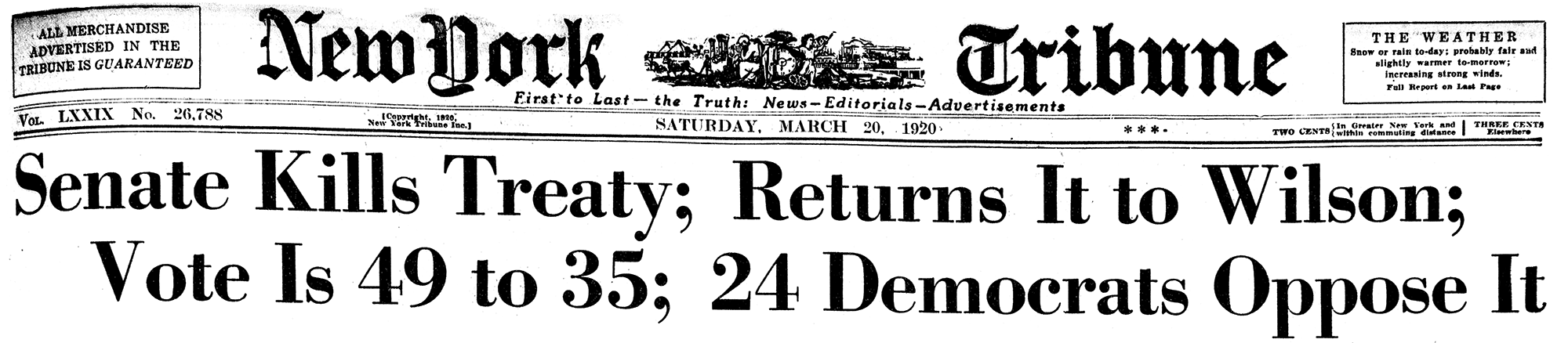
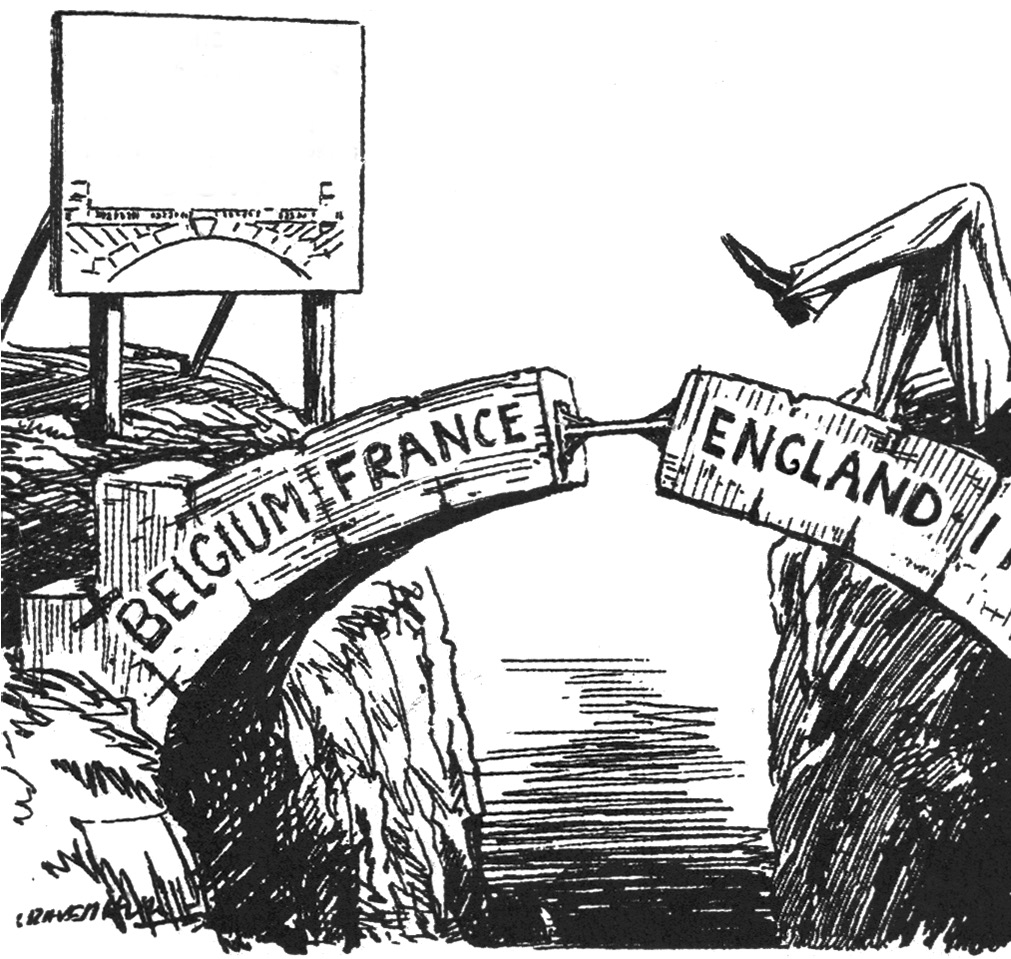
. . . Animated by the conviction that he would “follow no man and vote for no measures which, however well intended, seem in my best judgement to lead to dissensions [disagreements] rather than to harmony among the nations or to injury, peril, or injustice to my country,” and his insistence that the Senate, “which is charged with responsibility. . . should investigate every proposal with the utmost thoroughness,” Lodge’s address was a painstaking critique of the League’s constitution. He began with the impassioned argument that the document repudiated [contradicted] George Washington’s September 17, 1796, Farewell Address and the Monroe Doctrine, two sacred canons [principles] of American foreign policy. “I ask the press and the public and, of course, the Senate to consider well the gravity of this proposition,” Lodge pleaded, “before it takes the heavy responsibility of finally casting aside these policies which we have adhered to for a century and more and under which we have greatly served the cause of peace both at home and abroad.”
Turning to the specific provisions of the proposed draft, Lodge argued that the provision guaranteeing the independence and territorial integrity of all members was particularly troubling. He warned that, to insure that guarantee, the United States “must be in possession of fleets and armies capable of enforcing them at a moment’s notice.” . . .
. . . In the end Wilson failed largely because the country had never really abandoned its isolationist predilections [preferences], particularly the assumption that the United States unaided could maintain its national security. During the war, these convictions were driven underground. It is astonishing that despite the tradition of isolation, despite Wilson’s collapse, despite partisan bitterness and the animosity of ethnic groups, 85 per cent of the senators voting on November 19 were willing to accept the League in some form. Yet even if the country had entered the League, it is doubtful that Americans would have been willing to assume their full obligations. The United States had not been prepared by a threat to its own security for the kind of enterprise [action] it was later to undertake in Korea. It had insufficient incentive for abandoning either isolation or absolute national sovereignty. It would take the chastening experience of World War II, Hiroshima, and the Cold War to provide that incentive. . . .