NYSED High School Regents Global History & Geography II
star
star
star
star
star
Last updated 8 months ago
35 questions
Required
1
Required
2
Required
5
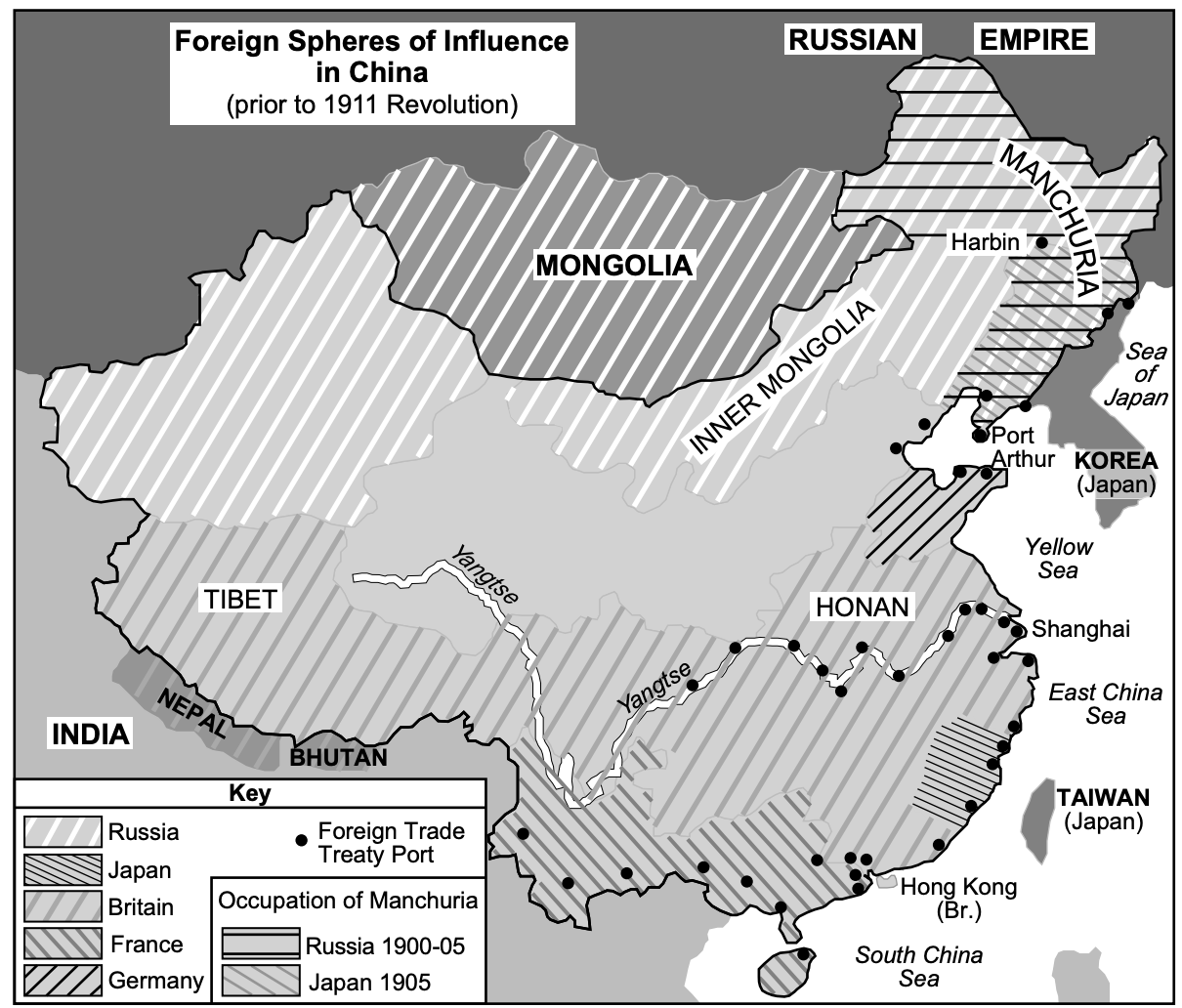
. . . India, in the eighteenth century, was an empire ready to be conquered. This vast continent, so rich in resources of every kind, was divided into many states, colonized on the edges, and constantly rent [torn] by war. By the 1730s, the Mogul [Mughal] Empire, which had once ruled two-thirds of its land area, had collapsed; new states had arisen in great numbers; older states, once subordinated to the empire, had recovered their full independence. And then there were the foreigners.
Some, like the Portuguese in Goa, really did not matter: they controlled a port and its immediate hinterland [back country] in order to trade — in spices, rice, ivory, precious stones, rare tropical woods, and silk — and that was the limit of their ambition. Others, like the French, had once hoped to have an empire in India, but Great Britain had defeated them during the Seven Years’ War (1756-1763), and they had been left with a mere five ports. There remained the British, or rather that oddest of entities, the East India Company. . . .
In comparing the advantages of England for manufactures with those of other countries, we can by no means overlook the excellent commercial position of the country — intermediate between the north and south of Europe; and its insular situation [island location], which, combined with the command of the seas, secures our territory from invasion or annoyance. The German ocean, the Baltic, and the Mediterranean are the regular highways for our ships; and our western ports command an unobstructed [clear] passage to the Atlantic, and to every quarter [part] of the world.
“Does the white man understand our custom about land?”
“How can he when he does not even speak our tongue?”
But he says that our customs are bad; and our own brothers who have taken up his religion also say that our customs are bad. How do you think we can fight when our own brothers have turned against us? The white man is very clever. He came quietly and peaceably with his religion. We were amused at his foolishness and allowed him to stay. Now he has won our brothers, and our clan can no longer act like one. He has put a knife on the things that held us together and we have fallen apart.”
... I reminded the people that our land was our own and that we did not want to continue to live in slavery and under exploitation and oppression; that it was only under full self-government that we would be in a position to develop the country so that our people could enjoy the comforts and amenities of modern civilization. I explained to them the necessity for backing our demand for self-government with a programme of positive action employing legitimate agitation, newspaper and political educational campaigns and the application of strikes, boycotts and non-cooperation based on the principle of non-violence. I advised against diplomacy and deception as I pointed out to them that the British, as past masters themselves of diplomatic tactics, would far prefer to have from us frankness and firmness. A policy of collaboration and appeasement would get us nowhere in our struggle for immediate self-government...
India's partition and the conflict over Kashmir, a Muslim-majority princely state ruled by a Hindu dynasty, were driven by local interests and philosophy, including the two-nation theory, which held that the Muslims of British India should be granted their own country, Pakistan. According to Muhammad Ali Jinnah, the founder of Pakistan:
"Hindus and Muslims belong to two different religious philosophies, social customs and literary traditions. They neither intermarry nor eat together, and indeed they belong to two different civilizations which are based mainly on conflicting ideas and conceptions.
"This view of Hindus and Muslims belonging to two different civilizations is problematic for many modern thinkers, who seek in the British Raj an explanation for the subcontinent’s divides. Was the divide — the different social customs and philosophies that Jinnah referred to — the result of a colonial plot? Or is there a deeper civilizational divide?
. . .The new Turkish Constitution, based on the principle of national sovereignty adopted in April 1924; the “new order” now had its legal frame. In November 1925 Western headgear was officially adopted. The religious orders and their premises were banned during the same month. In December 1925 a new law established the Western calendar and time system which were to be effective as of January 1926. A new civil code, inspired by the Swiss code was enacted in February, transforming the legal basis of marriage, family and property. . . .
In April 1928, Article 2 of the Constitution of 1924, which stipulated that Islam was the official religion of the Turkish State, was annulled. Latin numbers were adopted in May 1928, and the Latin alphabet, replacing the Arabic alphabet, in November of the same year. . . .
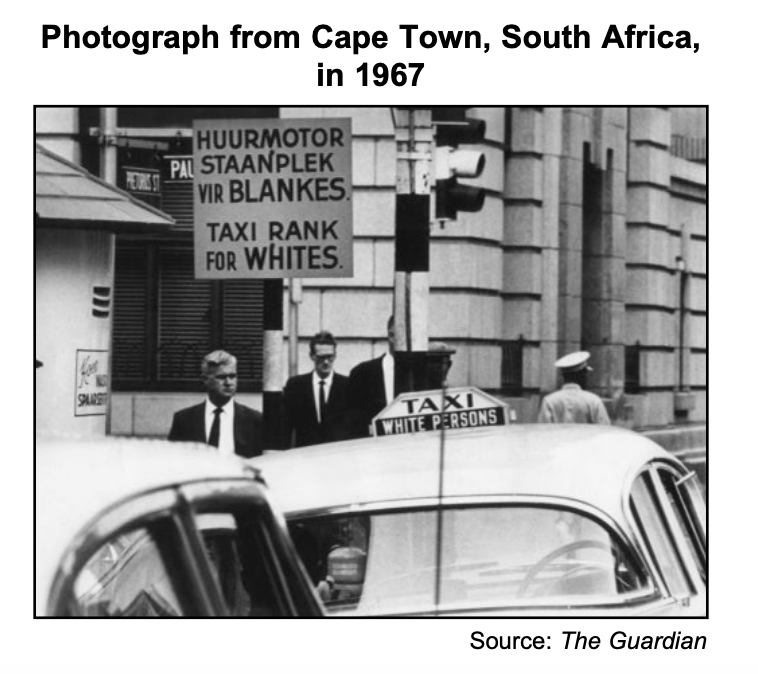
. . .Our country and all its people have been embroiled in conflict, tension and violent struggle for decades. It is time for us to break out of the cycle of violence and break through to peace and reconciliation. The silent majority is yearning for this. The youth deserve it.
With the steps the Government has taken it has proven its good faith and the table is laid for sensible leaders to begin talking about a new dispensation [system], to reach an understanding by way of dialogue discussion.
The agenda is open and the overall aims to which we are aspiring should be acceptable to all reasonable South Africans.
Among other things, those aims include a new, democratic constitution; universal franchise [voting]; no domination; equality before an independent judiciary; the protection of minorities as well as of individual rights; freedom of religion; a sound economy based on proven economic principles and private enterprise; dynamic programmes directed at better education, health services, housing and social conditions for all.
In this connection Mr. Nelson Mandela could play an important part. The Government has noted that he has declared himself to be willing to make a constructive contribution to the peaceful political process in South Africa. . . .
...Christened the Congo Free State in 1885, Leopold’s playground was an astonishing 76 times the size of Belgium. Comprised largely of unmapped jungle, it was initially a huge financial burden. But when worldwide demand for rubber boomed, Leopold cashed in. Congolese workers were sent out into the jungle to slash down vines and layer their bodies with rubber latex. Later they would scrape it off their skin – often taking flesh and hair with it. The work was labour-intensive and injurious to health; the only economical way to collect it was via the forced mobilisation of Congolese society. The Congo Free State evolved from a vanity possession into a slave plantation.
Saddam Hussein is the first world leader in modern times to have brutally used chemical weapons against his own people. His goals were to systematically terrorize and exterminate the Kurdish population in northern Iraq, to silence his critics, and to test the effectiveness of his chemical and biological weapons. Hussein launched chemical attacks against 40 Kurdish villages and thousands of innocent civilians in 1987-88, using them as testing grounds. The worst of these attacks devastated the city of Halabja on March 16, 1988.