Given the bright-line spectrum of element X and the spectra of four mixtures:
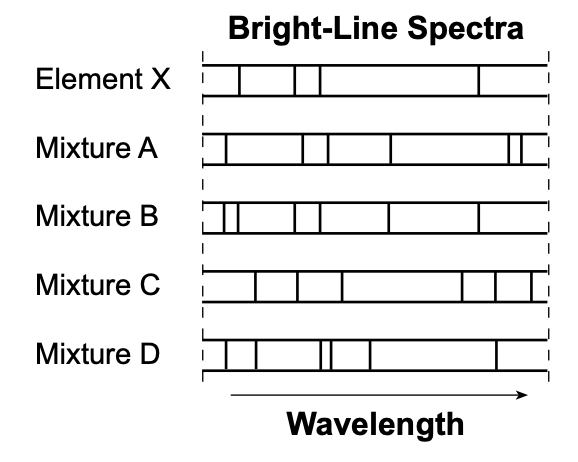
Which mixture contains element X?
Given the bright-line spectrum of element X and the spectra of four mixtures:
Which mixture contains element X?
The subatomic particles in the nucleus of an oxygen atom include
Which phrase describes the charges and numbers of protons and electrons in an atom?
In the wave-mechanical model, which term identifies a region in an atom of lithium that is the most probable location of electrons in the ground state?
An atom of C-12 in the ground state and an atom of C-13 in the ground state are defined as isotopes of carbon because these atoms have the same number of protons and
At STP, which property can be used to differentiate between a 2.0-gram sample of oxygen, O2(g), and a 2.0-gram sample of helium, He(g)?
How do the molecular structures and properties of oxygen, O2, and ozone, O3, compare?
Which substance can be broken down by chemical means?
Which type of bonding is present in a sample of zinc at STP?
Which formula represents a nonpolar molecule?
Given the equation representing a reaction:
F + F → F2
What occurs during this reaction?
Based on Table S, an atom of which element in Group 16 has the greatest attraction for electrons in a chemical bond?
A solution is made by completely dissolving a sample of sodium hydrogen carbonate in water. This solution is classified as a
In which sample of matter can the proportion of its components be varied?
According to the kinetic molecular theory, the particles of an ideal gas have
A chemical reaction is most likely to occur when reactant particles collide with the proper orientation and proper
At STP, which sample contains the same number of molecules as 44 liters of NO2(
Based on Table I, which chemical change is exothermic?
Which term identifies a factor that affects the rate of a chemical reaction?
Which phrase represents the net amount of energy released or absorbed during a chemical reaction?
A catalyst increases the rate of a chemical reaction by providing an alternate reaction pathway that has a
Systems in nature tend to undergo changes toward
Atoms of which element bond with each other to form chains, rings, and networks?
A molecule of which compound contains an –OH functional group?
Which statement explains why butane and methylpropane are isomers of each other?
Molecules of which two substances each contain a multiple covalent bond?
Which term identifies a type of organic reaction?
Which statement identifies where oxidation and reduction occur in an electrochemical cell?
Which type of reaction yields a salt and water as the only products?
In which process are heavy nuclei split into lighter nuclei?
Which statement explains the large amount of heat produced during a fission reaction?
Directions (31–50): For each statement or question, select the word or expression that, of those given, best completes the statement or answers the question. Some questions may require the use of the 2011 Edition Reference Tables for Physical Setting/Chemistry.
What is the approximate mass of an ion that has 12 protons, 13 neutrons, and 10 electrons?
Given the bright-line spectrum of element X and the spectra of four mixtures:
Which mixture contains element X?
What is the number of valence electrons in an atom in the ground state with an electron configuration of 2-8-18-3?
Which statement describes the general trends in electronegativity and atomic radius as the first seven elements in Period 3 are considered in order of increasing atomic number?
What is a chemical name for KClO2?
What is the percent by mass of oxygen in CH3COOH (gram-formula mass = 60. g/mol)?
Given the formula for a compound:
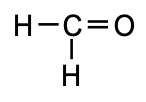
How many electrons are shared between the carbon atom and the oxygen atom in a molecule of this compound?
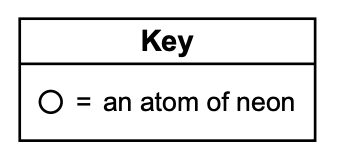
Which particle model diagram represents the arrangement of particles in a sample of neon at STP?
The volume of a 150.0-gram sample of copper at 298 K and 101.3 kPa is 16.7 cm3 . The mass of the copper sample is expressed to how many significant figures?
Which statement describes the energy transfer that occurs when a sample of copper at 100.°C is placed in a sample of water at 20.°C?
Which change will cause an open flask half-filled with water at 295 K and 1.0 atm to reach phase equilibrium?
What is the amount of heat released when 1.0 mole of NH3(g) is formed from its elements at 101.3 kPa and 298 K?
Given the equation representing a phase change for carbon dioxide, CO2(s):
CO2(s) + energy → CO2(g)
Which statement describes this phase change in terms of energy and entropy?
Which equation represents an oxidation half-reaction?
Which equation represents a redox reaction?
Based on Table J, which metal will react spontaneously with Fe2+(aq) ions?
Based on Table F, a saturated solution of which compound is the best conductor of electricity?
Given the equation representing a system at equilibrium:

According to one acid-base theory
What is the pH value of an aqueous solution with a hydronium ion concentration 1000 times greater than an aqueous solution with a pH value of 5.0?
Which energy source is paired with a risk associated with its usage?
State, in terms of electrons and energy states, how the light emitted by excited boron atoms is produced.
Base your answers to questions 52 and 53 on the information below and on your knowledge of chemistry.
The atomic mass and natural abundance for the two naturally occurring isotopes of copper are shown in the table below.
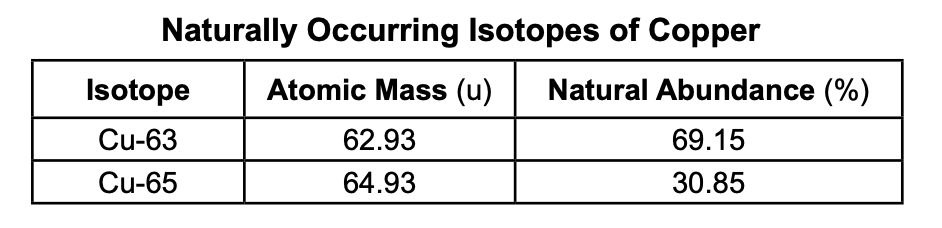
Show a numerical setup for calculating the atomic mass of the element copper.
A technician determined the percent natural abundance of Cu-65 in a sample to be 31.47%. Determine the percent error for this percent natural abundance of Cu-65 compared to the accepted value shown in the table.
Base your answers to questions 54 through 56 on the information below and on your knowledge of chemistry.
The elements beryllium, magnesium, calcium, strontium, and barium are located in Group 2 on the Periodic Table. These Group 2 elements have both similarities and differences in their physical and chemical properties.
Based on the location of Group 2 elements on the Periodic Table, state the element classification of these elements.
Explain, in terms of electron shells, why the atomic radius of a calcium atom in the ground state is greater than the atomic radius of a magnesium atom in the ground state.
State the general trend in first ionization energy for the Group 2 elements, beryllium through barium, as these elements are considered in order of increasing atomic number.
Base your answers to questions 57 through 59 on the information below and on your knowledge of chemistry.
Diagram 1 represents a sample of N2(g) and the conditions of pressure, volume, and temperature of the gas in a sealed, rigid cylinder with a movable piston. Diagram 2 represents a sample of O2(g) and the conditions of pressure, volume, and temperature of the gas in a sealed, rigid cylinder with a movable piston.
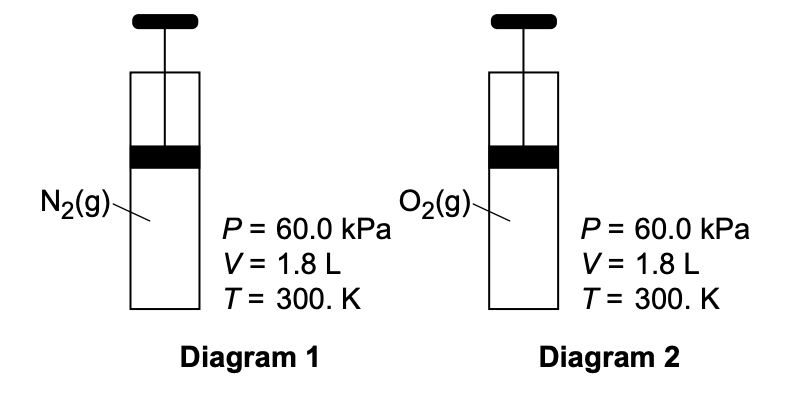
Compare the average kinetic energy of the gas molecules in diagram 1 to the average kinetic energy of the gas molecules in diagram 2.
Determine the volume of the O2(g) in diagram 2 when conditions are changed to STP.
Determine the pressure, in atmospheres, of the nitrogen gas in diagram 1.
Base your answers to questions 60 through 62 on the information below and on your knowledge of chemistry.
The boiling point for a sample of a molecular compound is 80.°C at standard pressure. The heat of fusion, Hf, of this compound is 127 joules per gram.
Compare the potential energy of the molecules in the sample before vaporization to the potential energy of the molecules after vaporization.
Determine the amount of heat required to completely melt a 50.0-gram sample of this molecular compound at its melting point.
Explain, in terms of intermolecular forces, why the boiling point of this molecular compound is lower than the boiling point of water at standard pressure.
Base your answers to questions 63 through 65 on the information below and on your knowledge of chemistry.
A NaOH(aq) solution and an acid-base indicator are used to determine the molarity of an HCl(aq) solution. A 15.0-milliliter sample of the HCl(aq) is exactly neutralized by 30.0 milliliters of 0.010 M NaOH(aq).
Identify the positive ion in the sample of HCl(aq) solution.
Based on Table M, state the color of litmus when placed in a sample of the original HCl(aq) solution.
Using the titration data, determine the concentration of the HCl(aq) solution.
Base your answers to questions 66 through 68 on the information below and on your knowledge of chemistry.
The table below shows three compounds that are used for medical purposes.
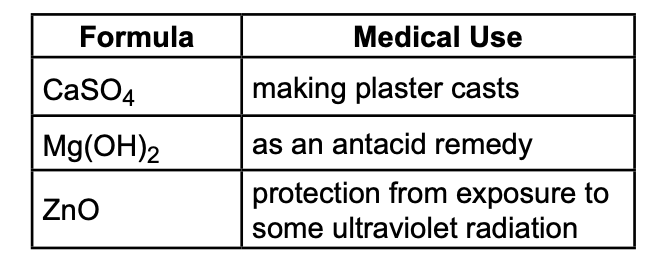
Identify the two types of bonding in the compound used to make plaster casts.
Identify the noble gas that has atoms in the ground state with the same electron configuration as the positive ion in Mg(OH)2 in the ground state.
Based on Table S, determine the electronegativity difference for the bond between zinc and oxygen in ZnO.
Base your answers to questions 69 through 71 on the information below and on your knowledge of chemistry.
During a laboratory activity, appropriate safety equipment is used and safety procedures are followed. In a beaker, a student dissolves 0.10 mole of potassium nitrate, KNO3, in 100. grams of water at 25°C. The gram-formula mass of KNO3 is 101 g/mol.
Compare the freezing point of water at standard pressure to the freezing point of the KNO3(aq) solution at standard pressure.
Based on Table G, classify, in terms of saturation, the type of KNO3 solution made by the student.
Describe a laboratory procedure the student can use to separate the original KNO3 from the KNO3(aq) solution.
Base your answers to questions 72 through 74 on the information below and on your knowledge of chemistry.
A major component of agricultural fertilizer is ammonium nitrate, NH4NO3. It is commercially produced by reacting ammonia gas with concentrated nitric acid, as shown in equation 1 below.

The ammonium nitrate can decompose to produce nitrogen dioxide gas, NO2(g), which is a brown gas. When NO2(g) is placed in a sealed, glass container, some NO2 molecules react to produce colorless N2O4 gas. An equilibrium system forms in the glass container, as shown in equation 2 below.

State, in terms of reactants and products, why the chemical reaction represented by equation 1 is a synthesis reaction.
On the labeled axes, draw a potential energy diagram for the reaction represented by equation 1.
Compare the rate of the forward reaction to the rate of the reverse reaction in the equilibrium system represented by equation 2.
Base your answers to questions 75 through 77 on the information below and on your knowledge of chemistry.
Pentane, hexane, heptane, and octane are components of gasoline. The structural formula below represents a straight-chain molecule of pentane.
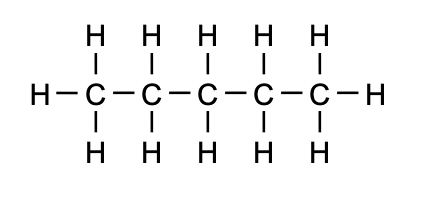
State the number of hydrogen atoms in a molecule of hexane.
State, in terms of carbon-carbon bonds, why octane is a saturated hydrocarbon.
Draw a structural formula for a straight-chain molecule of heptane.
Base your answers to questions 78 through 80 on the information below and on your knowledge of chemistry.
Chlorine gas and sodium metal are two valuable industrial elements that can be produced in an electrochemical cell by an electrolytic reaction. In the reaction, liquid sodium chloride is separated into the elements by an electric current. The simplified diagram and equation below represent this process.
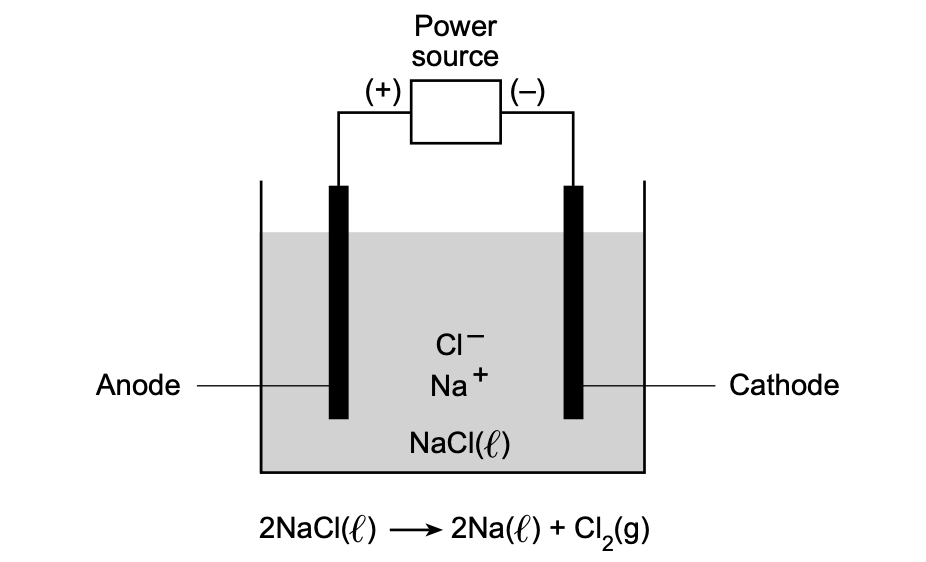
State, in terms of energy, why the power source is required for the cell to operate.
State the number of moles of electrons lost when 4.0 moles of electrons are gained in this reaction.
Determine the change in oxidation state that occurs for chlorine in this cell.
Base your answers to questions 81 through 85 on the information below and on your knowledge of chemistry.
The radioisotope U-238 changes to Pb-206 in a series of nuclear decays that can be used to determine the age of some rock layers. In one step of this nuclear decay series, U-234 produces Th-230 by alpha emission. The graph below represents the decay of a 40.-milligram sample of Th-230.
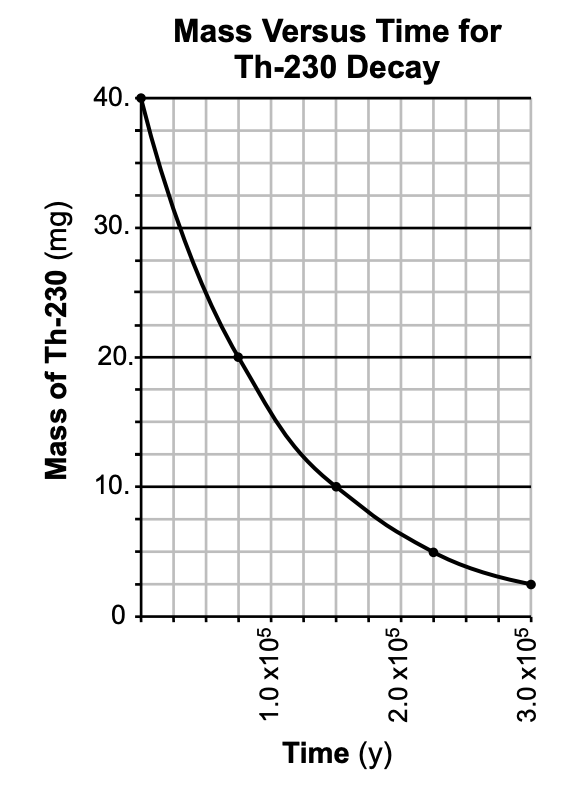
Using the graph, determine the half-life of Th-230.
Determine the fraction of the Th-230 sample that remains unchanged after two half-lives.
Compare the penetrating power of a beta particle to the penetrating power of the alpha decay particle from a Th-230 atom.
Complete the nuclear equation for the decay of U-238 by writing a notation for the missing product.
Explain, in terms of elements, why the nuclear decay of U-234 to Th-230 is considered a transmutation.