Log in
Sign up for FREE
arrow_back
Library

NYSED High School Regents Physics

star
star
star
star
star
Last updated 12 months ago
73 questions
Required
1
Required
1
Required
1
Required
1
Required
1
Required
1
Required
1
Required
1
Required
1
Required
1
Required
1
Required
1
Required
1
Required
1
Required
1
Required
1
Required
1
Required
1
Required
1
Required
1
Required
1
Required
1
Required
1
Required
1
Required
1
Required
1
Required
1
Required
1
Required
1
Required
1
Required
1
Required
1
Required
1
Required
1
Required
1
Required
1
Required
1
Required
1
Required
1
Required
1
Required
1
Required
1
Required
1
Required
1
Required
1
Required
1
Required
1
Required
1
Required
2
Required
2
Required
2
Required
1
Required
1
Required
2
Required
2

Part A

Answer all questions in this part.

Directions (1–35): For each statement or question, choose the word or expression that, of those given, best completes the statement or answers the question. Some questions may require the use of the 2006 Edition Reference Tables for Physical Setting/Physics.
Question 1
1.

Question 2
2.

Question 3
3.

Question 4
4.

Question 5
5.

Question 6
6.

Question 7
7.

Question 8
8.

Question 9
9.

Question 10
10.

Question 11
11.

Question 12
12.

Question 13
13.

Question 14
14.

Question 15
15.

Question 16
16.

Question 17
17.

Question 18
18.

Question 19
19.

Question 20
20.

Question 21
21.

Question 22
22.

Question 23
23.

Question 24
24.

Question 25
25.

Question 26
26.

Question 27
27.

Question 28
28.

Question 29
29.

Question 30
30.

Question 31
31.

Question 32
32.

Question 33
33.

Question 34
34.

Question 35
35.

Part B–1

Answer all questions in this part.

Directions (36–50): For each statement or question, choose the word or expression that, of those given, best completes the statement or answers the question. Some questions may require the use of the 2006 Edition Reference Tables for Physical Setting/Physics.
Question 36
36.

Question 37
37.

Question 38
38.

Question 39
39.

Question 40
40.

Question 41
41.

Question 42
42.

Question 43
43.

Question 44
44.

Base your answers to questions 45 and 46 on the information below and on your knowledge of physics.

Two students did an experiment to measure the acceleration of a freely falling object. One student dropped an object from rest. The other student measured the distance fallen by the object and the corresponding time of fall. The data for the dropped object are shown below.

distance fallen by object = 2.4 meters time of fall = 0.71 second
Required
1
Required
1
Question 47
47.

Question 48
48.

Question 49
49.

Question 50
50.

Part B–2

Answer all questions in this part.

Directions (51–59): Some questions may require the use of the 2006 Edition Reference Tables for Physical Setting/Physics.
Question 51
51.

Planet Nede has a mass of 6.50 \times 10^{23} kilograms and a radius of 2.96 \times 10^{6} meters. The magnitude of the gravitational force of attraction exerted on a 5.00-kilogram object by planet Nede is 7.15 newtons when the object is located at a position 5.50 \times 10^{6} meters from the center of Nede. Calculate the gravitational field strength of planet Nede at the position of the object. [Show all work, including the equation and substitution with units.]

Question 52
52.

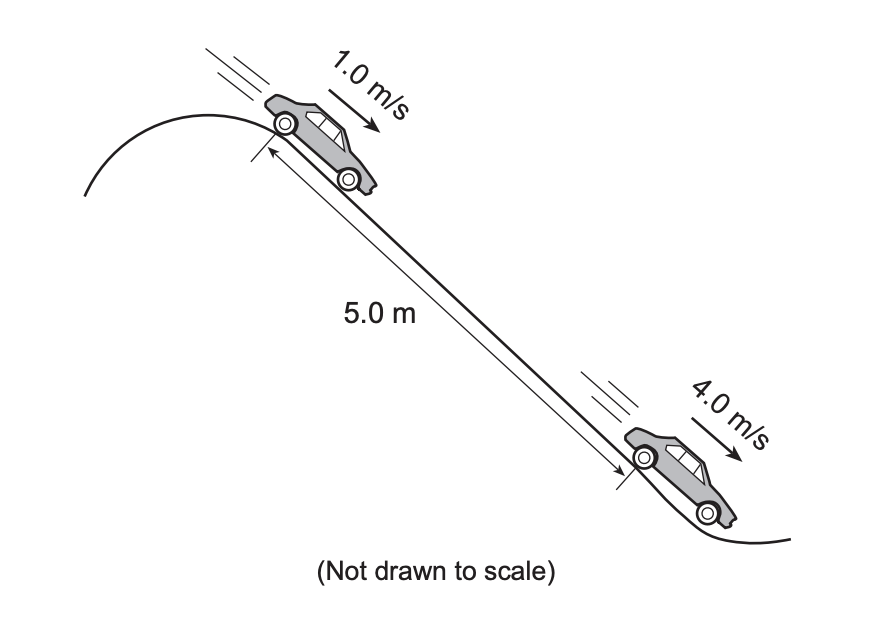
As shown in the diagram below, a toy car, initially traveling at 1.0 meter per second, uniformly accelerates to a speed of 4.0 meters per second as it travels down a 5.0-meter-long slope.


Calculate the time required for the toy car to travel the 5.0 meters from the top of the slope to the bottom. [Show all work, including the equation and substitution with units.]

Question 53
53.

Calculate the resistance of an incandescent lightbulb that operates at 20. watts of power when connected to a 12-volt battery. [Show all work, including the equation and substitution with units.]

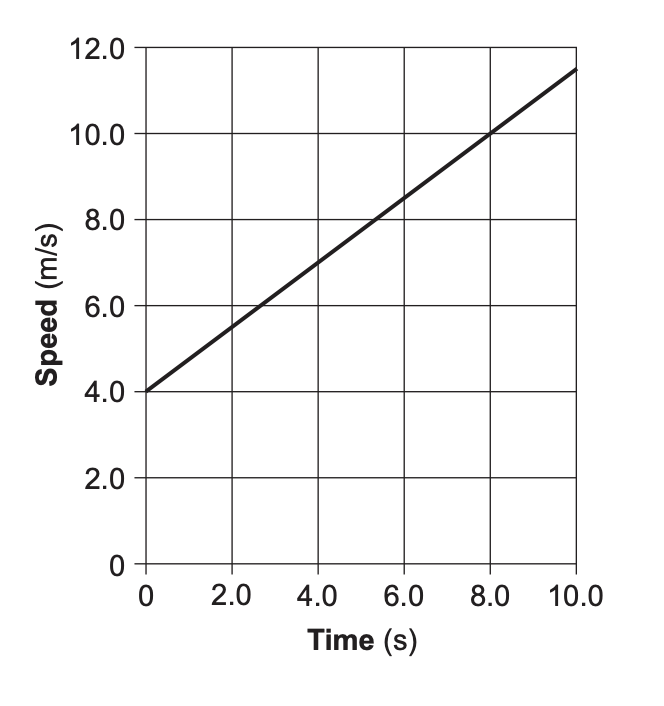
Base your answers to questions 54 through 55 on the information and graph below and on your knowledge of physics.

The motion of a car traveling along a straight road is represented in the graph below.

Required
1
Required
2
Question 56
56.

A light ray is traveling through a transparent medium at a speed of 1.75 \times 10^8 meters per second. Determine the absolute index of refraction of this medium for this light ray.

Question 57
57.

As shown in the diagram below, a ray of light traveling through medium X is incident upon the surface of medium Y. The absolute index of refraction of medium Y is greater than the absolute index of refraction of medium X.

On the diagram, use a ray that could represent the path of the light in medium Y.

Question 58
58.

A tungsten wire has a cross-sectional area of 5.03 \times 10^{-7} meter squared and has a resistance of 1.21 \times 10^{-2} ohm when operated at 20°C. Calculate the length of this wire. [Show all work, including the equation and substitution with units.]

Question 59
59.

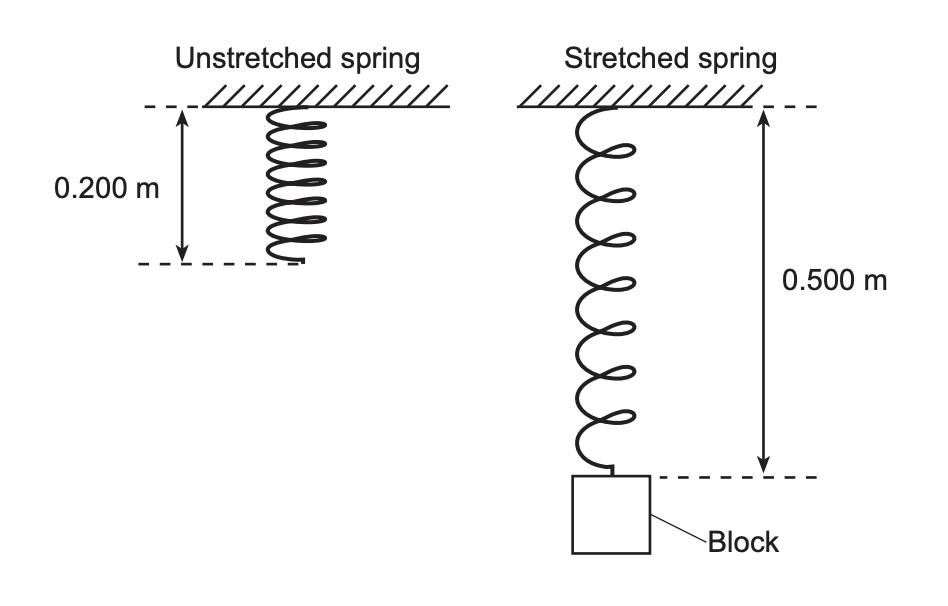
As shown in the diagram below, a block is hanging motionless from a vertical spring, having caused the spring to elongate from its unstretched length of 0.200 meter to a length of 0.500 meter. The spring has a spring constant of 250. newtons per meter.


Calculate the magnitude of the force exerted by the block on the spring. [Show all work, including the equation and substitution with units.]

Part C


Answer all questions in this part.

Directions (66–85): Some questions may require the use of the 2006 Edition Reference Tables for Physical Setting/Physics.
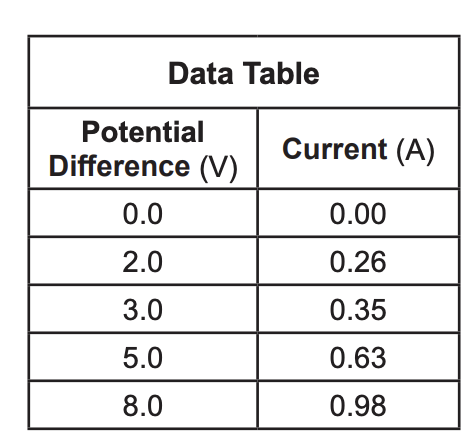
Base your answers to questions 60 through 62 on the information and data table below and on your knowledge of physics.

In an experiment, a resistor is connected to a source of varying potential difference. A voltmeter and an ammeter are included in the circuit so that the current can be measured at different potential difference settings. The data table below shows the potential differences and currents measured.

Required
2
Required
2
Required
1
Required
1
Required
1
Required
1
Required
2
Base your answers to questions 67 through 69 on the information below and on your knowledge of physics.

Two students investigate transverse waves using a long, stretched spring. One student holds one end of the spring stationary, while the other student produces 12 waves every 4.0 seconds. The waves have a uniform amplitude of 0.20 meter and the distance between two adjacent crests is 0.40 meter.
Required
2
Required
1
Required
2
Required
1
Required
2
Required
1
Required
1
Which quantity is a vector?
electric field
electric potential difference
electric charge
electric power
What is the magnitude of the eastward component of the velocity of an airplane flying at 612 per hour in a direction 40.0^\circ?
393 km/h
469 km/h
799 km/h
952 km/h
A car, initially traveling at 25 meters per second, is uniformly brought to rest as the brakes are applied over a distance of 40. meters. The magnitude of the average acceleration of the car while braking is
0.31 m/s2
0.63 m/s2
7.8 m/s2
16 m/s2
A brick starts from rest and falls freely from the top of a building to the ground. As the brick falls, its acceleration
increases and its speed increases
increases and its speed is constant
is constant and its speed increases
is constant and its speed is constant
Which object has the greatest inertia?
a 0.10\text{-kg} baseball traveling at 30. \text{ m/s}
a 70\text{-kg} sprinter traveling at 10. \text{ m/s}
a 1000\text{-kg} car traveling at 50. \text{ m/s}
a 2000\text{-kg} truck traveling at 20. \text{ m/s}
An unbalanced force is always necessary to
keep a body at rest
keep a body moving with constant velocity
change the speed of a body
change the position of a body
Space probes launched from Earth send information back to Earth from space in the form of
mechanical waves
sound waves
longitudinal waves
electromagnetic waves
A ball is thrown from level ground at an angle of 55^\circ above the horizontal and lands on level ground. Neglecting friction, if the ball is thrown again at the same angle but with a larger initial speed, the ball will travel
higher and the same distance horizontally
to the same maximum height and farther horizontally
both higher and farther horizontally
to the same maximum height and the same distance horizontally
A photon collides with an electron, as represented in the diagram below.
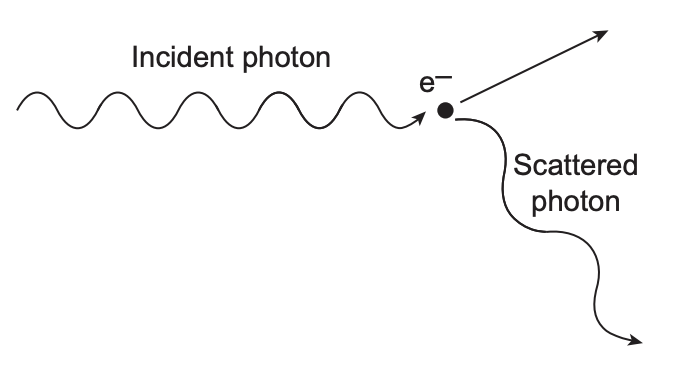

After the collision, the electron recoils and the photon is scattered in another direction with a longer wavelength than the incident photon. The increase in photon wavelength results because, during the collision, the photon
loses energy to the electron
gains momentum from the electron
loses some speed
generates a magnetic field
What is the weight of a 60.0-kilogram student on the surface of Earth?
0.164 \, \text{N}
6.12 \, \text{N}
60.0 \, \text{N}
589 \, \text{N}
A 120-newton box is pulled by a 48-newton horizontal force across a horizontal surface at constant velocity. The coefficient of kinetic friction between the box and the horizontal surface is
0.041
0.40
0.67
2.5
Box A has a mass of 10. kilograms and is at rest on a shelf that is 1.5 meters above the floor. Box B has a mass of 20. kilograms and is at rest on a shelf that is 3.0 meters above the floor. Compared to box A, box B has a gravitational potential energy relative to the floor that is
one fourth as great
the same
twice as great
four times as great
A 0.10-kilogram yo-yo is whirled at the end of a length of string in a horizontal circular path of radius 0.80 meter at a speed of 6.0 meters per second. The magnitude of the centripetal acceleration of the yo-yo is
4.5 \, \text{m/s}^2
7.5 \, \text{m/s}^2
23 \, \text{m/s}^2
45 \, \text{m/s}^2
A 4.0-kilogram mass is initially at rest on a horizontal, frictionless surface. A constant 2.0-newton force to the east is applied to the mass for a 5.0-second interval. As a result of this action, the mass acquires a
velocity of 10. m/s, east
velocity of 10. m/s, west
momentum of 10. kg•m/s, east
momentum of 10. kg•m/s, west
A motor lifts a 1.2 x 10⁴-newton elevator 9.0 meters in 15 seconds. The minimum power output of the motor is
8.0 \times 10^2 \, \text{W}
7.2 \times 10^3 \, \text{W}
1.0 \times 10^5 \, \text{W}
1.6 \times 10^6 \, \text{W}
A train blows its horn, which emits a uniform sound as the train approaches a stationary observer. The observer hears a sound that has a
lower frequency than the emitted sound and is decreasing in amplitude
lower frequency than the emitted sound and is increasing in amplitude
higher frequency than the emitted sound and is decreasing in amplitude
higher frequency than the emitted sound and is increasing in amplitude
A wood block is pulled at constant velocity across a horizontal wood floor. Which type of energy increases in this block-floor system as the block moves?
gravitational potential
kinetic
mechanical
thermal
A total energy of 5.0 joules is used to move an electron from position A to position B in a uniform electric field. What is the potential difference between positions A and B?
3.1 \times 10^{19} \, \text{V}
8.0 \times 10^{-19} \, \text{V}
3.2 \times 10^{-20} \, \text{V}
4.3 \times 10^{18} \, \text{V}
A 0.14-kilogram lacrosse ball, traveling west at 17 meters per second, is brought to rest with a 0.21-kilogram lacrosse stick. If the force applied by the lacrosse stick on the ball is 220 newtons east, the force applied by the ball on the stick is
150 \, \text{N east}
150 \, \text{N west}
220 \, \text{N east}
220 \, \text{N west}
Four wires are tested for electrical conductivity. All the wires have the same length and the same cross-sectional area, but are made of different metals. Which wire has the highest conductivity at 20^\circC?
aluminum
copper
gold
silver
The angle of incidence for a ray of light striking a plane mirror is 20^\circ. What is the angle between the incident ray and the reflected ray?
20^\circ
40^\circ
70^\circ
90^\circ
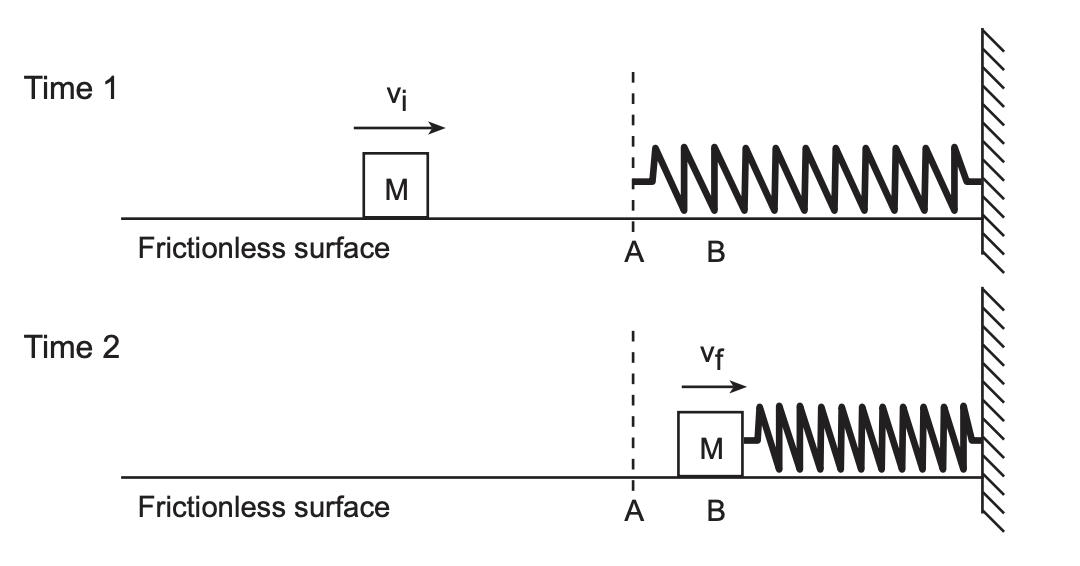
As shown in the diagram below, mass M slides across a level, frictionless surface with speed vi​. The mass strikes a spring at position A, causing the spring to compress. When the mass is at position B, it is moving at a slower speed, ​vf.


Which statement best describes the energy conversion as the mass moves from position A to position B?
Some of mass M's kinetic energy is converted to elastic potential energy.
All of mass M's kinetic energy is converted to elastic potential energy.
Some of mass M's kinetic energy is converted to gravitational potential energy.
All of mass M's kinetic energy is converted to internal energy.
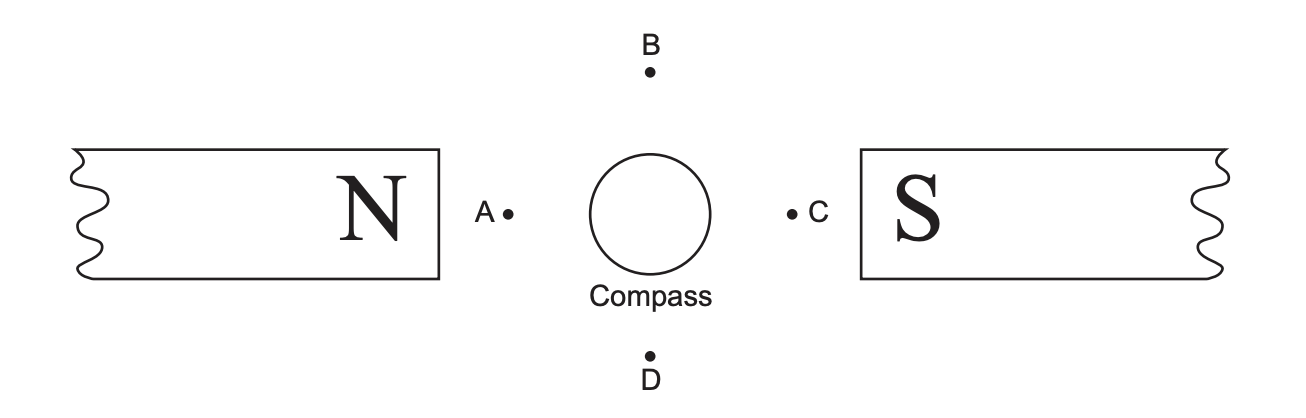
The diagram below shows a magnetic compass placed between unlike magnetic poles.


The north pole of the compass needle will point toward
A
B
C
D
Which circuit diagram contains a lamp that will not have current passing through it until switch S is closed?
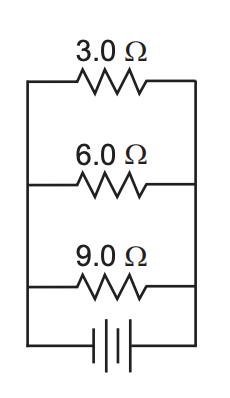
The diagram below represents an electric circuit.


The equivalent resistance of the circuit is
1.6 \, \Omega
2.0 \, \Omega
6.0 \, \Omega
18 \, \Omega
An object is thrown vertically upward with an initial velocity of 9.81 \, \text{meters per second}. What is the maximum height reached by the object? [Neglect friction.]
1.00 \, \text{m}
4.91 \, \text{m}
9.81 \, \text{m}
19.6 \, \text{m}
Which type of photon has the least amount of energy?
ultraviolet
visible light
infrared
radio
A 7.5\text{-kilogram} object moving at 20. \text{ meters per second} strikes a 60.\text{ -kilogram} object initially at rest on a horizontal, frictionless surface. The two objects stick together and move off at a speed of
0.33 \, \text{m/s}
2.2 \, \text{m/s}
2.5 \, \text{m/s}
18 \, \text{m/s}
How is the electrostatic force between two positive charges affected as the charges are brought closer together?
The force of attraction between them increases.
The force of repulsion between them increases.
The force of attraction between them decreases.
The force of repulsion between them decreases.
What is one difference between magnetic forces and gravitational forces?
Magnetic forces are always attractive, whereas gravitational forces are always repulsive.
Magnetic forces are always repulsive, whereas gravitational forces are always attractive.
Magnetic forces may be attractive or repulsive, whereas gravitational forces are always attractive.
Magnetic forces may be attractive or repulsive, whereas gravitational forces are always repulsive.
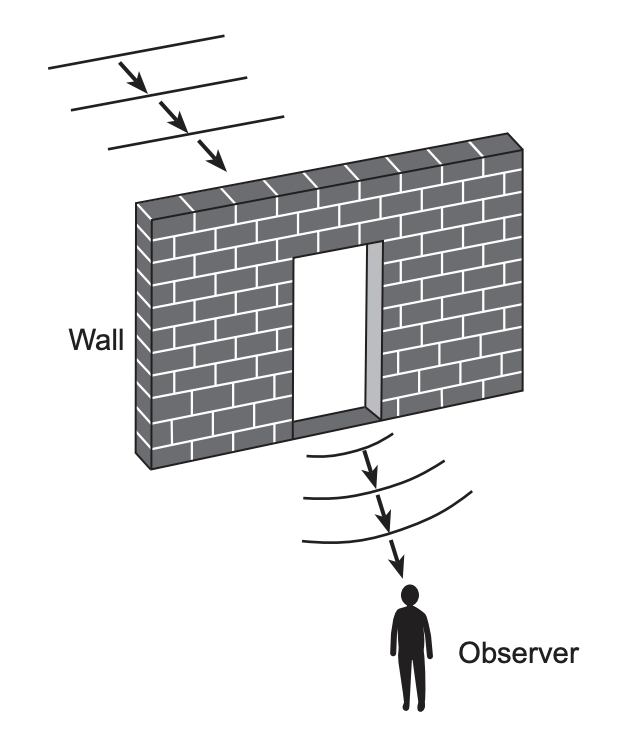
A sound wave passes through an opening in a brick wall as represented in the diagram below.


An observer standing behind the wall is able to hear the sound. This spreading out of the sound wave as it passes through the opening is an example of
interference
reflection
refraction
diffraction
A sound wave is emitted by a vibrating tuning fork. What is transferred as the sound wave travels to a student’s ear?
mass, only
energy, only
both mass and energy
neither mass nor energy
An electric current passing through a copper wire at constant temperature would result in
an increase in the resistivity of the wire
a decrease in the resistivity of the wire
the emission of protons from the wire
the production of a magnetic field around the wire
The velocity of an object in uniform circular motion has a
constant magnitude and changing direction
constant magnitude and constant direction
changing magnitude and constant direction
changing magnitude and changing direction
Tuning fork A starts to vibrate at 320 hertz when it is held near tuning fork B, already vibrating at 320 hertz. Which phenomenon is exemplified by the action of tuning fork A?
the Doppler effect
resonance
diffraction
refraction
A light ray with a frequency of 5.09 \times 10^{14} hertz has a wavelength of 2.44 \times 10^{-7} meter in diamond. The wavelength of this light ray in sodium chloride is:
1.55 \times 10^{-7} m
2.44 \times 10^{-7} m
3.83 \times 10^{-7} m
5.89 \times 10^{-7} m
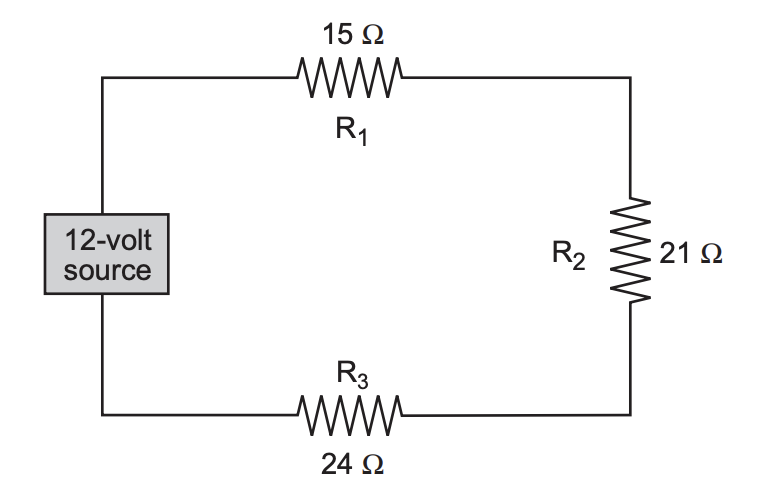
The diagram below shows resistors R_1, R_2, and R_3 connected to a 12-volt source.


The current flowing through resistor R_3 is:
5.0 A
2.0 A
0.50 A
0.20 A
A charge of 25 coulombs moves past a point in a circuit in 2.5 seconds. What is the current at that point in the circuit?
0.10 A
10. A
50. A
63 A
Which statement describes an object with constant kinetic energy?
A car accelerates along a straight road.
A runner decreases her speed along a curved path.
A bicycle travels around a curve at constant speed.
A sled travels down a frictionless, steep, straight hill.
Which phrase describes a box in equilibrium?
box in an elevator slowing down as it rises vertically
box at rest on a stationary table
box sliding down a frictionless ramp
box in free fall
Quarks may combine to produce a meson of charge
- \frac{1}{3} e
+2 e
+ \frac{1}{3} e
0 e
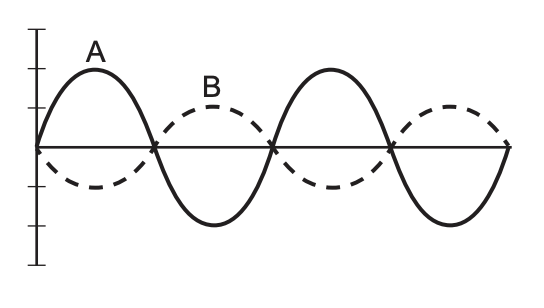
The diagram below shows waves A and B as they travel through a region in the same medium.


Which wave best represents the superposition of waves A and B?
The diagrams below show the direction of wave travel and the direction of medium particle vibration for different waves. Which diagram best represents the characteristics of a sound wave?
In a sample of gas, many excited hydrogen atoms are in the n = 4 energy level. What is the maximum number of different photon energies that can be emitted by these atoms as they return to the ground state?
6
5
3
4
Question 45
45.

Question 46
46.

Which graph represents the motion of an object falling freely from rest near the surface of the Moon?
The diagrams below represent the initial velocities, v_i, of four identical projectiles launched from level ground at various angles above the horizontal. Which projectile will have the longest time of flight? [Neglect friction.]
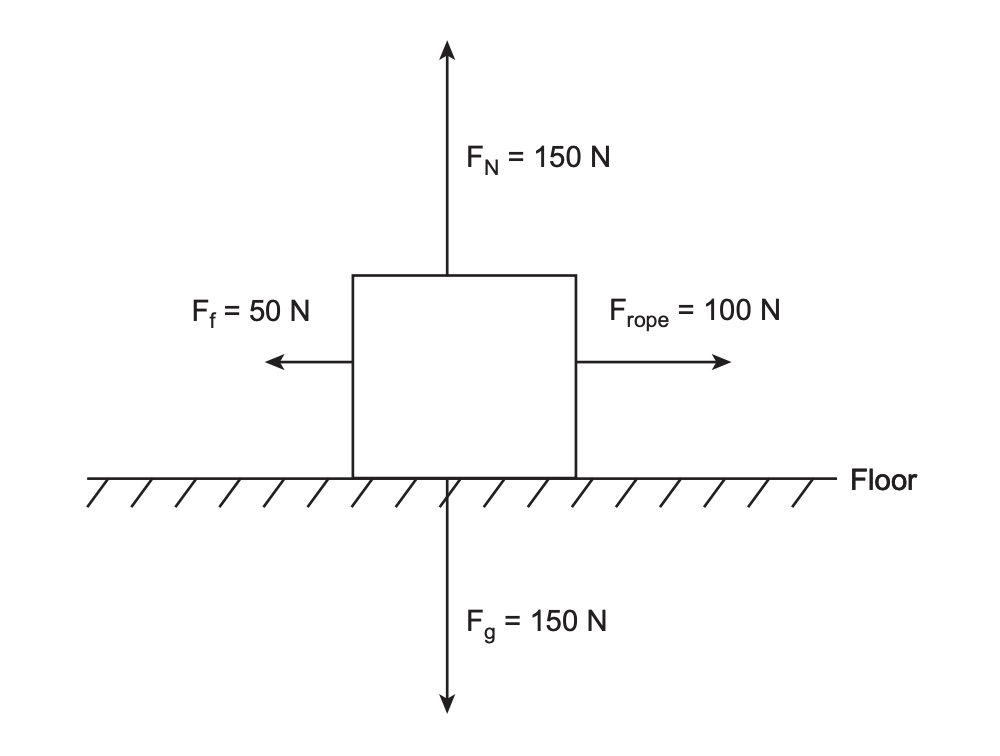
Four forces act on a crate on a level floor, as shown in the diagram below.


At the instant shown, the crate is:
accelerating to the right
accelerating to the left
moving at constant velocity to the right
remaining at rest
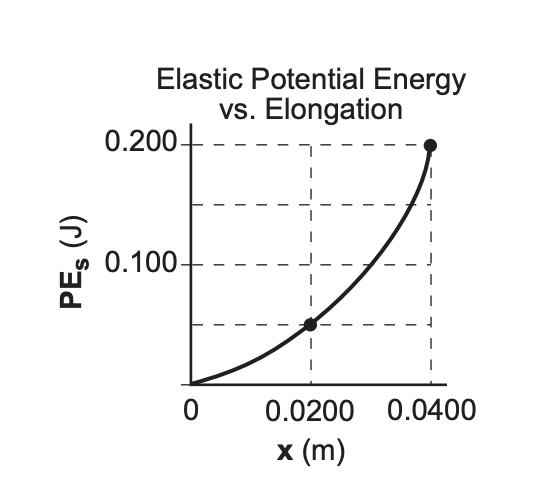
The graph below represents the relationship between the potential energy stored in a spring, PE_s, and the elongation of the spring, x.


The value of the spring constant is:
5.00 N/m
10.0 N/m
125 N/m
250. N/m
Question 54
54.

Determine the average speed of the car from t = 0 to t = 8.0 seconds.

Question 55
55.

Calculate the magnitude of the acceleration of the car from t = 0 to t = 8.0 seconds. [Show all work, including the equation and substitution with units.]

Question 60
60.

Directions: Using the information in the data table, construct a graph on the grid following the directions below.

a. Plot the data points for current versus potential difference.
b. Draw the line of best fit.

Question 61
61.

Calculate the slope of the line. [Show all work, including the equation and substitution with units.]

Question 62
62.

Determine the resistance of the resistor.

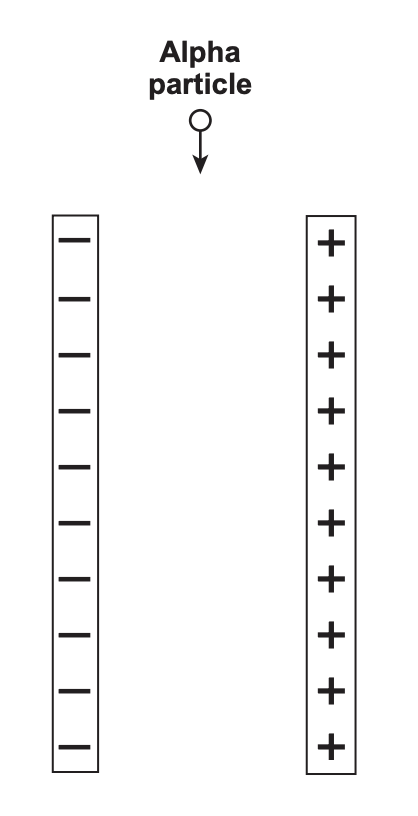
Base your answers to questions 63 through 66 on the information and diagram below and on your knowledge of physics.

An alpha particle with a charge of +2 elementary charges is moving toward two oppositely charged parallel plates, as shown in the diagram below. The magnitude of the electric field strength between the plates is 5.0 \times 10^4 newtons per coulomb.

Question 63
63.

Determine the magnitude of the charge of an alpha particle in coulombs.

Question 64
64.

On the diagram, draw at least three field lines to show the direction of the electric field in the space between the charged plates.

Question 65
65.

What is the direction of the electrostatic force exerted on the alpha particle as it passes between the plates?

Question 66
66.

Calculate the magnitude of the electrostatic force exerted on the alpha particle by the electric field as the alpha particle passes through the electric field.
[Show all work, including the equation and substitution with units.]

Question 67
67.

On the diagram, draw at least one complete wave produced in the spring.

Question 68
68.

Determine the frequency of the waves.

Question 69
69.

Calculate the speed of the waves. [Show all work, including the equation and substitution with units.]

Base your answers to questions 70 through 73 on the information below and on your knowledge of physics.

Alpha particles are stable decay products of many nuclear disintegrations. An alpha particle consists of two protons and two neutrons and has a mass of 6.644 \times 10^{-27} kilogram. When the individual masses of two protons and two neutrons are added, the sum is 6.695 \times 10^{-27} kilogram. The difference between the mass of an alpha particle and the total mass of its four individual component particles is called the mass defect.
Question 70
70.

Determine the mass defect in kilograms when two protons and two neutrons combine to form an alpha particle.

Question 71
71.

Calculate the total amount of energy in joules that would result from the complete conversion of this mass defect to energy. [Show all work, including the equation and substitution with units.]

Question 72
72.

Determine the total amount of energy that would result from the complete conversion of this mass defect to energy in megaelectronvolts (MeV).

Question 73
73.

What fundamental interaction is primarily responsible for holding protons and neutrons together in an alpha particle?

Based on the data for the dropped object, the experimental value calculated for the object's acceleration is
11 \, \text{m/s}^2
9.5 \, \text{m/s}^2
6.8 \, \text{m/s}^2
4.8 \, \text{m/s}^2
The ideal value for the acceleration differs from the one obtained experimentally by the students. What is one possible cause of this discrepancy?
The object was given some initial horizontal velocity.
The force of gravity was much stronger outside the building than inside.
Motion formulas should not be used in an experimental setting.
There may have been errors in the measurement of distance and/or time.