Log in
Sign up for FREE
arrow_back
Library
Keystone Species
By NICHOLAS GLAESER
star
star
star
star
star
Share
share
Last updated 9 months ago
9 questions
Add this activity
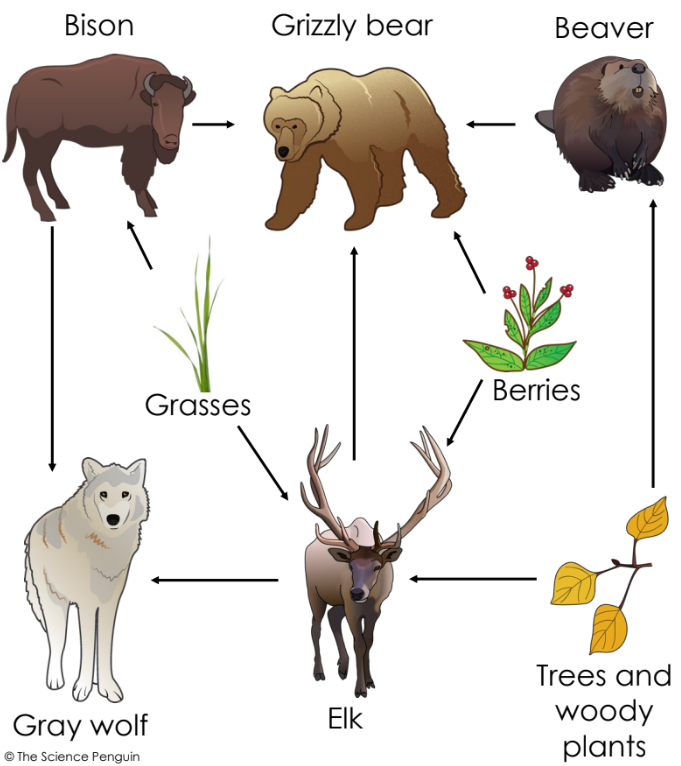
Yellowstone Food Web
4
5.12.B
1
5.12.B
play_arrow
Trim End | 02:56
Question 1 | 02:55
00:00/00:00
closed_caption_disabled
slow_motion_video
fullscreen
Question 1
02:55
keyboard_arrow_down
1
5.12.B
play_arrow
Trim End | 01:57
Question 2 | 01:31
Question 3 | 01:56
00:00/00:00
closed_caption_disabled
slow_motion_video
fullscreen
Question 2
01:31
keyboard_arrow_down
1
5.12.B
Question 3
01:56
keyboard_arrow_down
1
5.12.B
play_arrow
Trim End | 05:19
Questions 4-7 | 05:18
00:00/00:00
closed_caption_disabled
slow_motion_video
fullscreen
Questions 4-7
05:18
keyboard_arrow_down
1
5.12.B
1
5.12.B
2
1
5.12.B
Question 8
8.
Use the image on the left to determine if each organism is a
producer
or
consumer
.
Producer
Consumer
Bison
Grizzly Bear
Beaver
Grasses
Berries
Gray Wolf
Elk
Trees & Wooded Plants
Question 9
9.
The source of energy for this food web is not shown, but we know it is the __________.
Energy moves from berries to the __________ to the gray wolf.
Energy moves directly from the beaver to the __________.
The __________ is an omnivore, or an animal that eats both plants and animals.
Energy from the sun is used by __________ to produce food that is eaten by herbivores and omnivores.
Question 1
1.
What do you think will happen after all the starfish are removed from the tide pool ecosystem?
The tide pools will remain the same, with no noticeable changes.
The number of other species in the tide pools will increase, leading to greater biodiversity.
The tide pools will experience a decline in biodiversity, with some species becoming more dominant.
The tide pools will become uninhabitable for most species, leading to a collapse of the ecosystem.
Question 2
2.
What is a keystone species?
A species that is the largest in its ecosystem.
A species that has a disproportionately large impact on its ecosystem relative to its abundance.
A species that migrates frequently between different ecosystems.
A species that is at the top of the food chain.
Question 3
3.
Why don't all species have the same impact on an ecosystem?
Some species are more abundant than others.
Some species have unique roles that are crucial for the ecosystem's balance.
Some species are larger and more powerful than others.
Some species are more adaptable to changes in the environment.
Question 4
4.
Which animal in this food web do you think is the keystone species? Why?
The elk because they keep the grasses, berries, and trees from over populating.
The grey wolf because they keep the bison and elk from overgrazing.
The grizzly bear because they help beavers remove trees from the forest.
The bison because they help overgraze.
Question 5
5.
After watching the video, which animal in the food web is the keystone species?
Elk
Grizzly Bear
Grey Wolf
Bison
Question 6
6.
How did the removal of the keystone species affect 2 other organisms? Select two.
Grizzly bears had fewer berries.
Grizzly bears had less Elk to feed on.
Elk overgrazed the producers.
Bison had more grasses to eat.
Question 7
7.
How did the removal of the keystone species affect the river?
Fish had cleaner water to live in.
Elk hooves eroded the soil on the riverbanks.
More trees developed roots near the riverbanks.
Elk had cleaner water to drink.