Log in
Sign up for FREE
arrow_back
Library
LA GRAVEDAD
By Aurora Aurora
star
star
star
star
star
Share
share
Last updated 11 months ago
43 questions
Add this activity
42
43
zoom_in
1
1
zoom_in
1
1
1
1
1
zoom_in
1
1
1
1
1
1
zoom_in
1
1
1
1
1
1
zoom_in
1
1
1
1
1
1
zoom_in
1
1
1
1
1
1
zoom_in
1
1
1
1
1
1
zoom_in
1
1
1
1
1
1
Question 43
43.
True
False
Question 1
1.
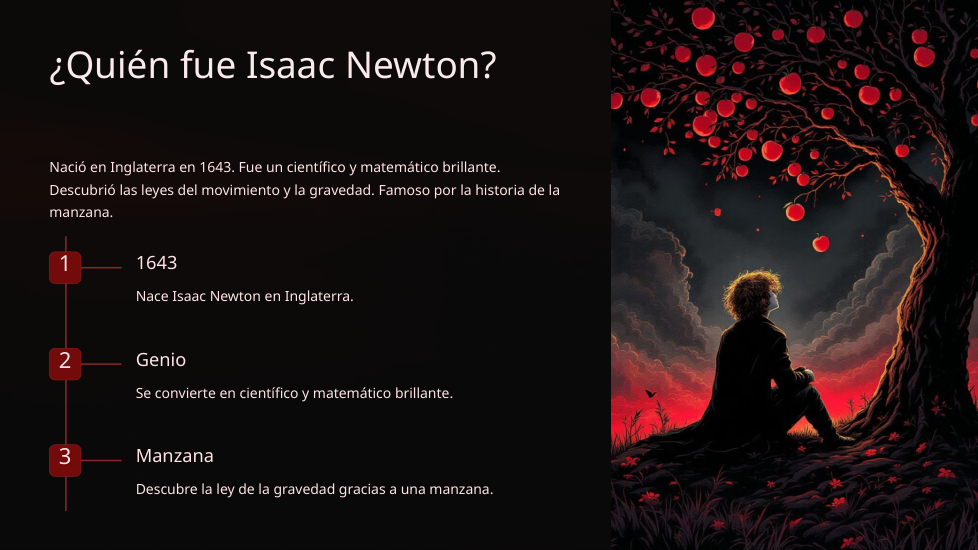
What causes an apple to fall from a tree?
Gravity pulling it towards the ground.
Apples are heavy and drop.
Wind blusters it away.
Trees release them magically.
Question 2
2.
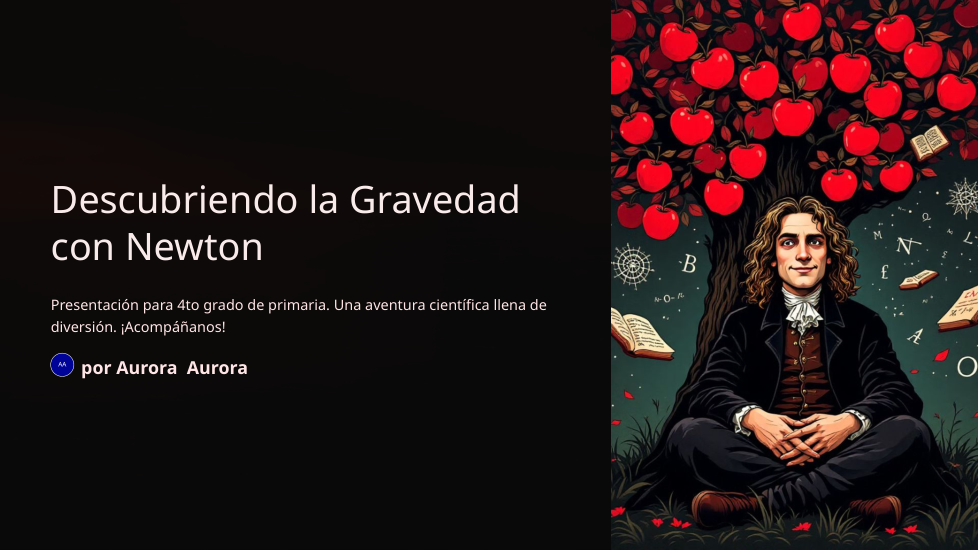
Who is known for discovering gravity?
Sir Isaac Newton is the correct answer.
Galileo Galilei's observations.
Nikola Tesla's inventions.
Albert Einstein in 1905.
Question 3
3.
What did Newton use to explain his ideas?
Pictures drawn on paper.
Only common sense solutions.
Magic and fiction stories.
Mathematics and scientific principles.
Question 4
4.
Which fruit is often associated with Newton's story?
Oranges for their color.
Cherries, for being small.
An apple, representing gravity's discovery.
Bananas, for their curves.
Question 5
5.
What did Newton sit under when he discovered gravity?
A cherry tree, for shade.
An apple tree, where inspiration struck.
A fig tree, for ideas.
A pine tree, for relaxation.
Question 6
6.
What would happen to objects without gravity?
They would float instead of falling down.
They would fall faster towards space.
They would disappear into thin air.
They would stay on the ground.
Question 7
7.
How would humans move in a no-gravity world?
Humans would walk normally without issues.
Humans would not be able to move.
Humans would float like astronauts in space.
Humans would swim in mid-air easily.
Question 8
8.
What happens to water without gravity?
Water would not flow downwards as usual.
Water would stay in one place.
Water would float into space.
Water would form large lakes.
Question 9
9.
What would objects do in a no-gravity environment?
They would remain suspended in mid-air.
They would fall to the ground quickly.
They would bounce around randomly.
They would stick to surfaces easily.
Question 10
10.
How would daily life change without gravity?
Movement would be easier and faster.
Food would still stay on tables.
People would need to learn to float safely.
Life would remain the same as now.
Question 11
11.
What would you need to do to stay on the ground?
You would need a special suit.
You wouldn't need to do anything; you'd float.
You would need heavy shoes.
You would have to hold onto things.
Question 12
12.
In which year was Isaac Newton born?
1665
1643
1650
1640
Question 13
13.
What profession is Isaac Newton known for?
Astronomer
Philosopher
Artist
Scientist and mathematician
Question 14
14.
What laws did Isaac Newton discover?
Thermodynamics
Laws of motion and gravity
Energy conservation
Optics
Question 15
15.
What famous event is Newton known for?
The lightning bolt
The falling star
Story of the apple
An earthquake
Question 16
16.
Where was Isaac Newton born?
In America
In England
In France
In Italy
Question 17
17.
Newton is famous for his studies of which force?
Magnetism
Gravity
Electricity
Friction
Question 18
18.
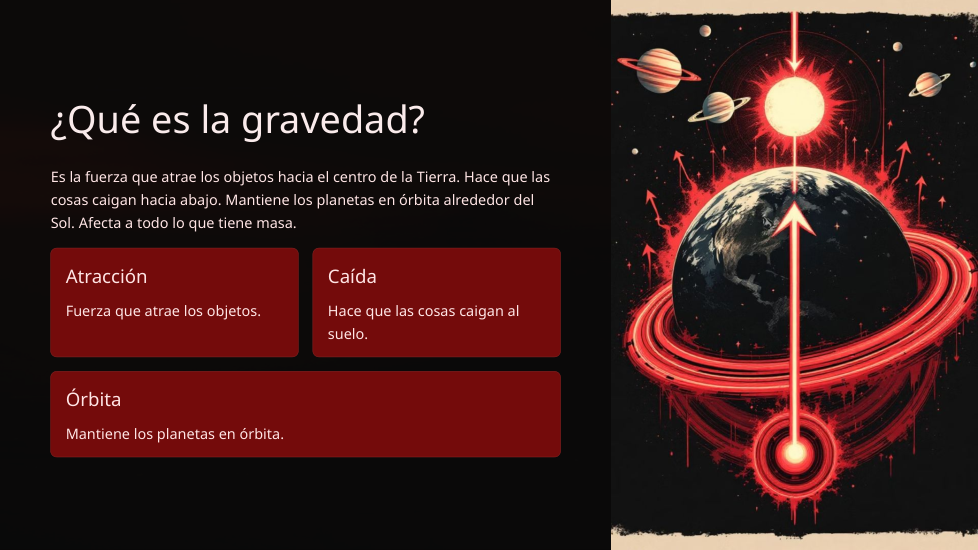
What keeps planets in orbit around the sun?
Magnetism pulls planets towards the sun.
Wind pushes planets in a circle.
Gravity keeps planets in orbit around the sun.
Friction keeps planets still in space.
Question 19
19.
What does gravity affect in the universe?
Gravity affects everything that has mass in the universe.
Gravity only affects big objects like planets.
Gravity affects only the Earth, not space.
Gravity only affects objects on the ground.
Question 20
20.
How does gravity help objects on Earth?
Gravity has no effect on objects on Earth.
Gravity makes objects float away from Earth.
Gravity pushes objects away from Earth.
Gravity pulls objects towards the center of the Earth.
Question 21
21.
What happens when there is no gravity?
Objects would float away and not stay grounded.
All objects would be attracted to the sun.
Objects would fall faster than usual.
Nothing changes; everything stays the same.
Question 22
22.
Why do astronauts float in space?
They are pushed by strong winds in space.
They float due to microgravity, not zero gravity.
Space is a vacuum that attracts nothing.
There is no gravity in space at all.
Question 23
23.
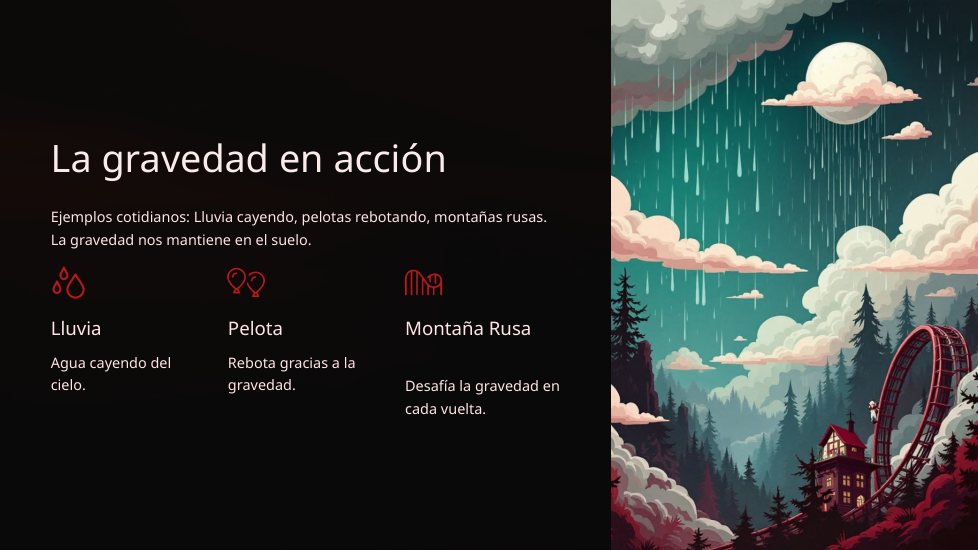
What is an example of gravity in action?
A cloud moving across the sky.
An apple falling from a tree due to gravity.
A car parked on a hill.
A butterfly flying away from the tree.
Question 24
24.
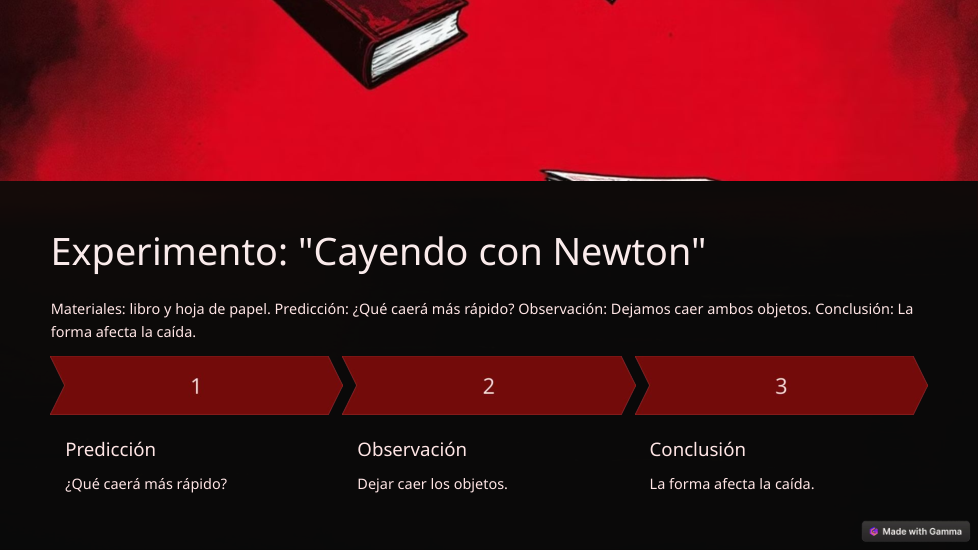
What is being tested in the experiment?
The weight of the objects.
The speed of falling objects.
The color of the objects.
The material of the book.
Question 25
25.
What materials are used in the experiment?
Only paper and glue.
A book and a piece of paper.
A ball and a rock.
Only a book and a pencil.
Question 26
26.
What is the conclusion of the experiment?
Shape affects how fast objects fall.
Color affects falling speed.
Size does not matter in falling.
Weight affects falling speed.
Question 27
27.
What does the term prediction mean?
A guess about what will happen.
A question to ask in science.
A fact that is proven true.
An observation of past events.
Question 28
28.
What is one way to observe the experiment?
Weigh the objects before dropping.
Let both objects fall simultaneously.
Color the objects with paint first.
Measure the height of the drop.
Question 29
29.
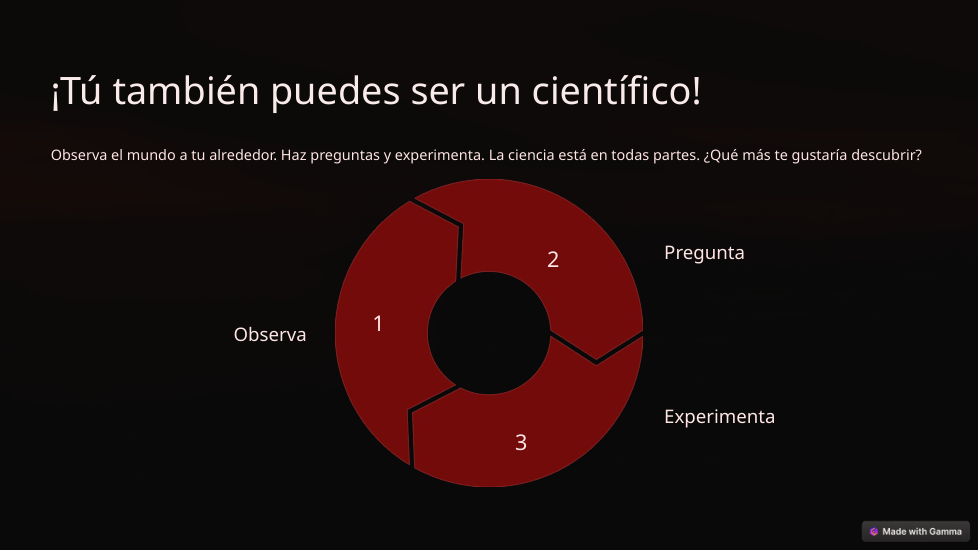
Why is it important to conduct experiments?
To test questions and learn from results.
To create a messy lab.
To show how smart you are.
To take notes in a science book.
Question 30
30.
What keeps rain falling to the ground?
Wind pushes it upwards.
Gravity pulls it down towards the Earth.
Only air pressure affects it.
Clouds hold it until full.
Question 31
31.
What is a common example of gravity in action?
Leaves floating gently down.
A car rolling uphill.
A bird flying in the sky.
A ball bouncing back after hitting the ground.
Question 32
32.
How does a roller coaster work with gravity?
It floats through the air.
It runs on electricity alone.
It uses gravity to pull cars down tracks.
It is pushed by wind force.
Question 33
33.
What happens to objects when gravity is removed?
They become invisible instantly.
They slow down and stop.
They explode into smaller pieces.
They float away into space without falling.
Question 34
34.
Why do we say gravity keeps us on the ground?
We have special shoes to help.
The atmosphere traps us here.
Earth's surface is flat always.
It pulls objects towards the Earth’s center.
Question 35
35.
What effect does gravity have on a bouncy ball?
It stops the ball mid-air.
It prevents the ball from bouncing.
It makes the ball roll sideways.
It makes the ball fall back down after bouncing.
Question 36
36.
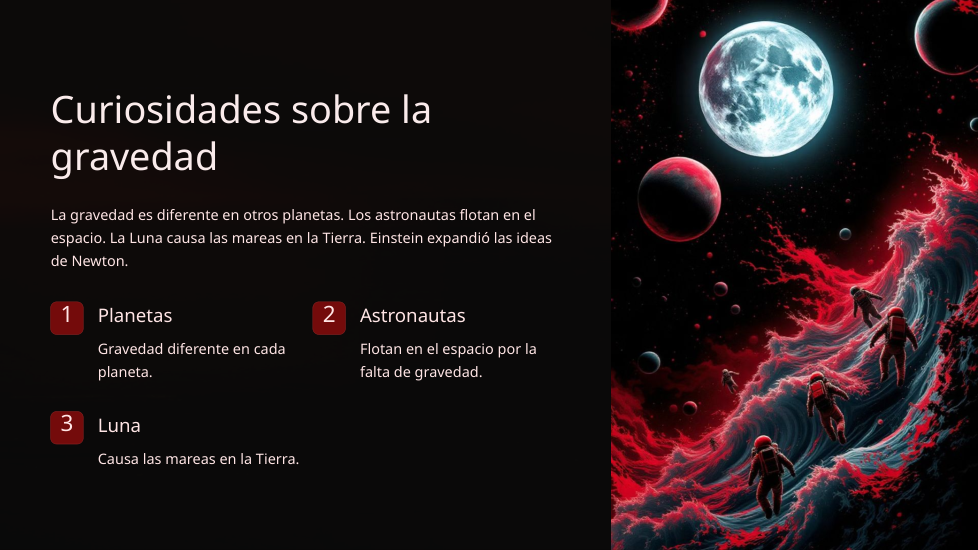
What causes the tides on Earth?
The sun's heat.
Rainfall on water surfaces.
Strong ocean currents.
The moon's gravitational pull.
Question 37
37.
Why do astronauts float in space?
Lack of gravity.
Heavy space suits.
Increased altitude effects.
Low oxygen levels.
Question 38
38.
Which planet has the strongest gravity?
All planets have equal gravity.
The smallest planet.
The hottest planet.
The planet with the largest mass.
Question 39
39.
Gravity varies on different planets. True or False?
True.
False, it's the same everywhere.
Only on gas giants.
Only on Earth.
Question 40
40.
Who expanded Newton's ideas on gravity?
Einstein.
Galileo.
Hawking.
Kepler.
Question 41
41.
What do planets have that affects gravity?
Heat.
Size only.
Water.
Mass.