Log in
Sign up for FREE
arrow_back
Library

Unit 5 Heredity Onlevel Exam

star
star
star
star
star
Last updated about 1 month ago
31 questions
Required
1
Required
1
Required
1
Required
1
Required
1
Required
1
Required
1
Required
1
Required
1
0
Required
1
Required
1
Required
1
Required
1
Required
1
Required
1
Required
1
Required
1
Required
1
Required
1
Required
1
Required
1
Question 1
1.

Assume a white cabbage butterfly mates with a yellow cabbage butterfly, and ALL of the offspring (F1) are heterozygous and white. Which cross represents the genotypes of the parent generation?

Question 2
2.

Who is considered the Father of Genetics?

Question 3
3.

Match the terms with the correct example.

Draggable itemarrow_right_altCorresponding Item
Homozygous dominant genotype
arrow_right_alt
FF
phenotype
arrow_right_alt
Bb
Heterozygous genotype
arrow_right_alt
aa
Homozygous recessive genotype
arrow_right_alt
green scales
Question 4
4.

Which cellular change in an organism could be inherited by the next generation?

Question 5
5.

Researchers cross two types of mice together, Type A and Type B. In the resulting offspring, half of the DNA comes from Type A and half comes from Type B. Why?

Question 6
6.

Two pea plants were both grown from green peas. When these plants are crossed, their offspring produce green, yellow, and white peas. What accounts for the difference between parents and offspring?

Question 7
7.

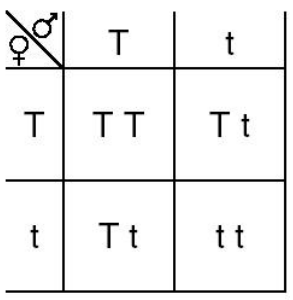
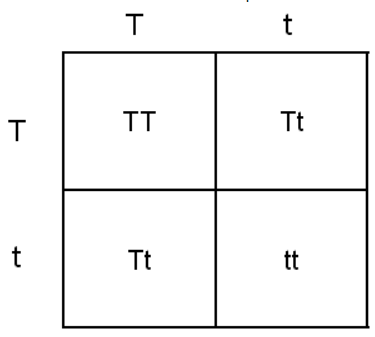
In plants, tall plants are dominant to short plants. If two heterozygous tall plants are crossed, what percent of the offspring will probably be short?
Question 8
8.

When an organism has more than 10 fingers or toes, the condition is known as polydactylism. Although polydactylism is rare, it is a dominant trait. If two cats that are heterozygous for polydactylism mate and have a litter with a total of 12 kittens, how many of them would you expect to have polydactylism?

Question 9
9.

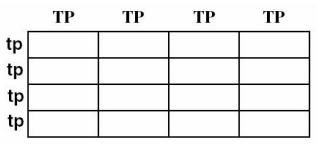
Two plants are crossed, and the traits of height and color are assessed in the offspring. The following cross was conducted: TTPP x ttpp      T = dominate allele for height; tall plant      t = recessive allele for height; short plant      P = dominate allele for color; purple      p = recessive allele for color; white 
Which of the following choices correctly describes the offspring?

Question 10
10.

Hemophilia is a sex-linked, recessive trait (XhXh). Which of the following describes the probability of hemophilia in the offspring of a man who does not have hemophilia (XHY) and a woman who is a carrier (XHXh)?

Question 11
11.

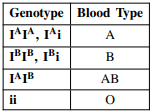
The table below shows the genotypes that result in four different blood types in humans. 
Based on the information in the table, which of the following describes alleles IA and IB?

Question 12
12.

Why do siblings with the same biological parents sometimes inherit different combinations, or a variation of traits, such as eye color, hair type, or height?

Question 13
13.

A male and female child have three copies of chromosome 18. Although both parents are unaffected, their doctor claims that the disorder associated with having an extra chromosome 18 is the result of a chromosomal mutation in cells that carry inherited material. Which argument supports this claim?

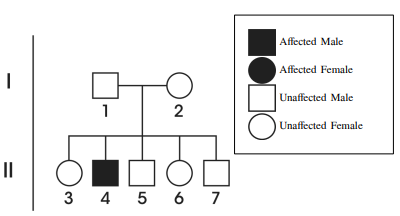
The pedigree below shows the inheritance patten of a recessive allele (z) that results in a genetic disease. 
*click image to enlarge
Required
1
Question 15
15.


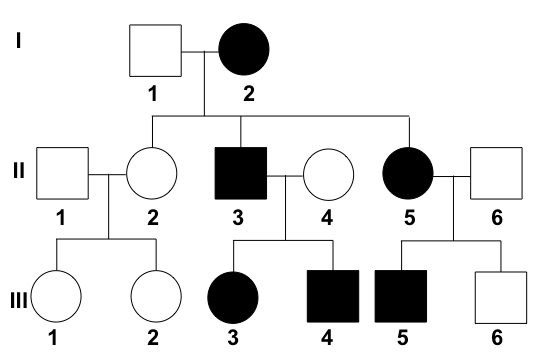
Albino individuals lack all pigmentation so that their hair and skin are white. This family tree shows that albinism

Question 16
16.

A heterozygous tall pea plant is crossed with a heterozygous tall pea plant. These two tall offspring are crossed. The Punnett square for this cross is shown below. 
What can be concluded from this cross?

Question 17
17.

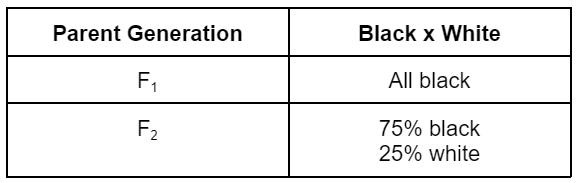
The table provided below shows the heredity of fur color for rabbits. The black fur color is dominant to white fur. The parent generation, first generation of offspring (F1), and second generation of offspring (F2) is shown below.
What conclusion can be drawn from the genetic information above?

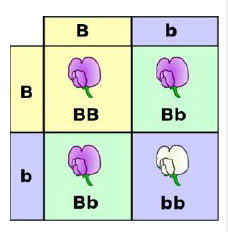
The Punnett square below depicts a type of cross known as a monohybrid cross, and it is similar to crosses performed by Gregor Mendel. 

Required
1
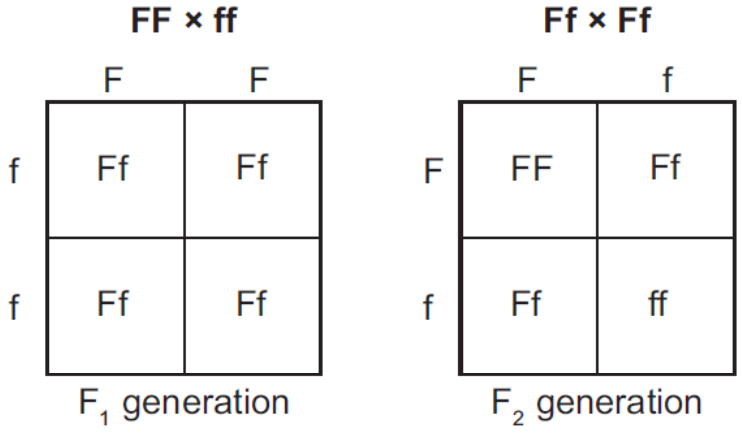
Students studied Mendel's laws of segregation and independent assortment. They created a Punnett square to show a cross between a homozygous furred mouse (FF) and a homozygous furless mouse (ff). The students then created a Punnett square for a cross between two heterozygous F1 mice. 

Required
1
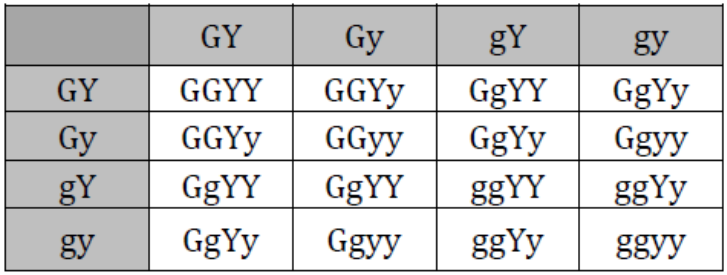
Use the cross below to answer the following questions:

Required
1
Required
1
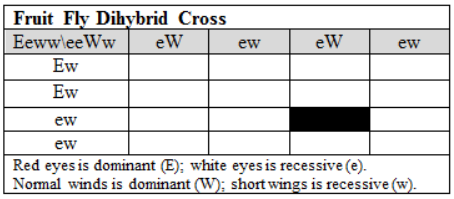
A fruit fly with red eyes and short wings is crossed with a fruit fly with white eyes and normal wings.

*click table to enlarge
Required
1
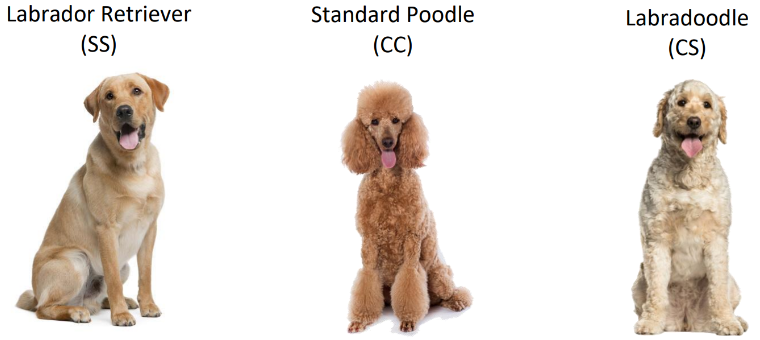
A labradoodle is a mix between a Labrador Retriever and a Standard Poodle. Labradoodles have wavy coats (CS) while Labrador retrievers have straight coats (SS) and standard poodles have curly coats (CC). The image below depicts the types of coats.

*click image to enlarge
Required
1
Required
1
Question 25
25.
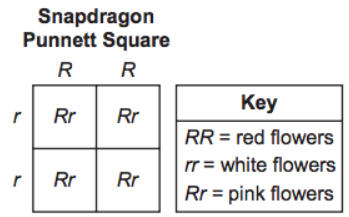
The Punnett square shows the inheritance of flower color in snapdragon flowers.

The alleles for flower color show __________because both alleles are __________ in __________ individuals.
Question 26
26.

Placing a cell in a hypertonic solution can turn off certain genes, inhibiting their expression and therefore protein synthesis. When a cell is placed in a hypertonic solution

Question 27
27.
Protein
Nucleic acids
Carbohydrates
Amino acids make up
DNA and RNA are examples of
DNA codes for making
Monosaccharides are an example of
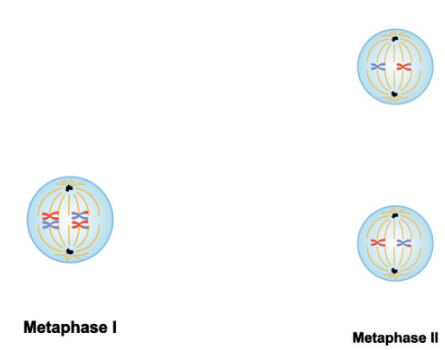
A student group is discussing a model of meiosis and determining what causes reproductive variability. The group decides that the following sets of steps in meiosis are the most important for creating reproductive variability.

Required
1
Question 29
29.

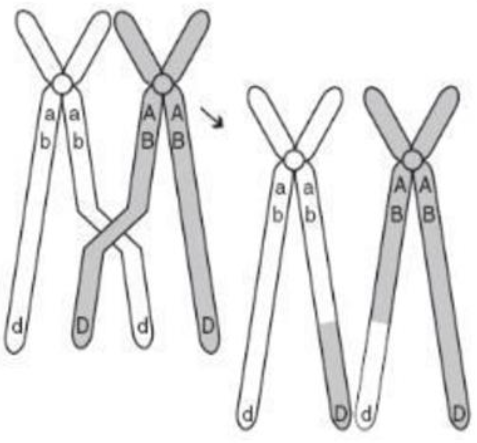
The diagram above shows homologous chromosomes during prophase I of meiosis. Which of the following correctly describes the process being illustrated?

Question 30
30.
The diploid chromosome number in honeybees is 32.
The number of chromosomes in a male somatic cell is __________.
The number of chromosomes in a male gamete cell is __________.
Question 31
31.

Sort each characteristics based on if it matches to photosynthesis or cellular respiration

  • Location: Chloroplast
  • Product: Carbon dioxide
  • Who performs this: plants
  • Location: Mitochondria
  • Who performs this: animals and plants
  • Energy source: Sunlight
  • Product: Oxygen
  • Energy source: Glucose
  • Photosynthesis
  • Cellular Respiration
Question 14
14.

Based on the inheritance pattern, what are all the possible genotypes for individual 6?

Question 18
18.

Which of the following arguments can NOT be defended using the evidence in this Punnett square?

Question 19
19.

Which of the following questions could be answered using the information from the Punnett squares above?

Question 20
20.

Which of the following represents the genotypes of the parents in this dihybrid cross?

Question 21
21.

What will be the phenotypic ratio of offspring in this dihybrid cross?

Question 22
22.

According to the cross shown in the diagram, what is the expected phenotype of fruit flies in the shaded box.

Question 23
23.

What inheritance best describes the inheritance of coat texture in these dogs?

Question 24
24.

If a labradoodle has offspring with another labradoodle, what is the probability that their offspring will have curly coats?

Question 28
28.

The group constructs multiple explanations for their conclusion. Choose the best explanation that uses evidence from the model.