Log in
Sign up for FREE
arrow_back
Library
Acids, bases and volumetric analysis
By Sue Hardy
star
star
star
star
star
Share
share
Last updated 11 months ago
12 questions
Add this activity
1
1
1
1
1
zoom_in
1
Question 1
1.
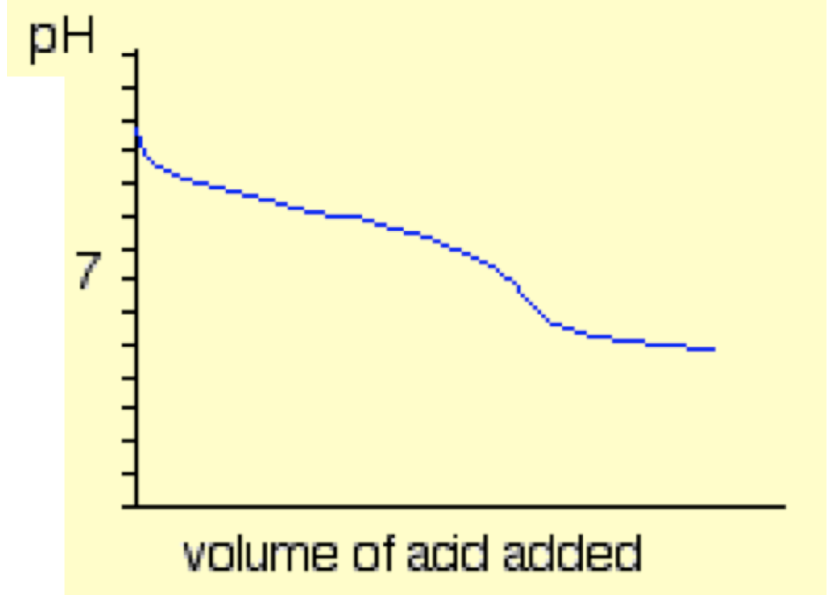
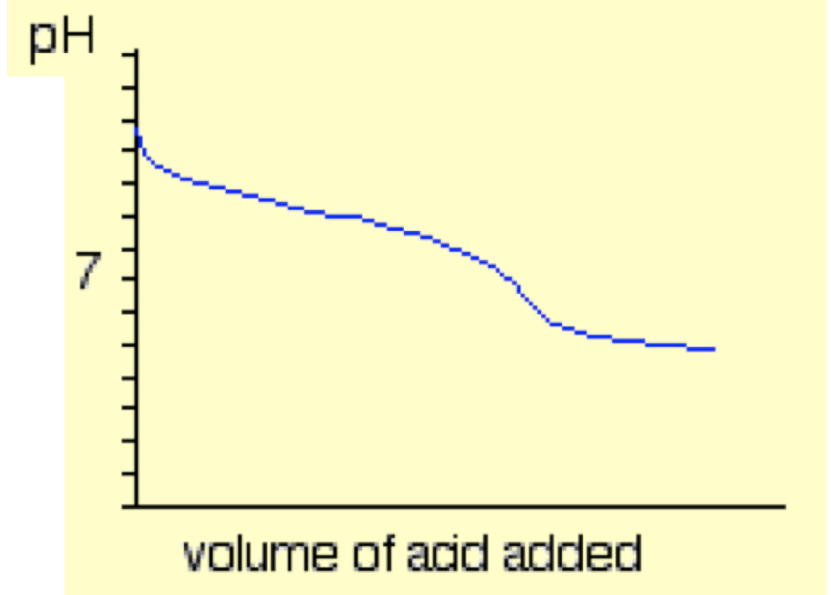
Which reaction is most likely to give the titration curve above?
aqueous sodium hydroxide and hydrochloric acid
sulfuric acid and aqueous ammonia
ethanoic acid and aqueous sodium hydroxide
ethanoic acid and aqueous ammonia
zoom_in
1
1
1
Question 5
5.
Sulfuric acid is known as an acid because it:
produces H
3
O
+
ions in aqueous solution
produces OH- ions in aqueous solution
reacts with potassium chloride to produce H
2
gas
neutralises hydrochloric acid
Question 6
6.
The conjugate base of the ion, HPO
4
2-
is:
H
2
PO
4
-
H
2
O
PO
4
3-
OH-
Question 7
7.
Which of the following contains bases in order from the
weakest
to the
strongest?
NaOH, CO
3
2-
, HCO
3
-, H
2
O
NaOH, HCO
3
- , CO
3
2-
, H
2
O
H
2
O, HCO
3
-, CO
3
2-
, NaOH
H
2
O, CO
3
2-
, HCO
3
-, NaOH
Question 8
8.
Of the following solutions, which one contains the largest concentration of OH- (aq) ions?
solution with pH = 7
solution with pH= 1
solution with pH = 14
solution with pH= 10
Question 9
9.
Consider the following unbalanced ionic equation:
Zn(s) + MnO
4
-
(aq) + H
+
(aq) --> Zn
2+
(aq) + Mn
2+
(aq) + H
2
O (l)
When this equation is completely balanced, the coefficient of Zn(s) will be:
1
2
3
5
zoom_in
1
Question 10
10.
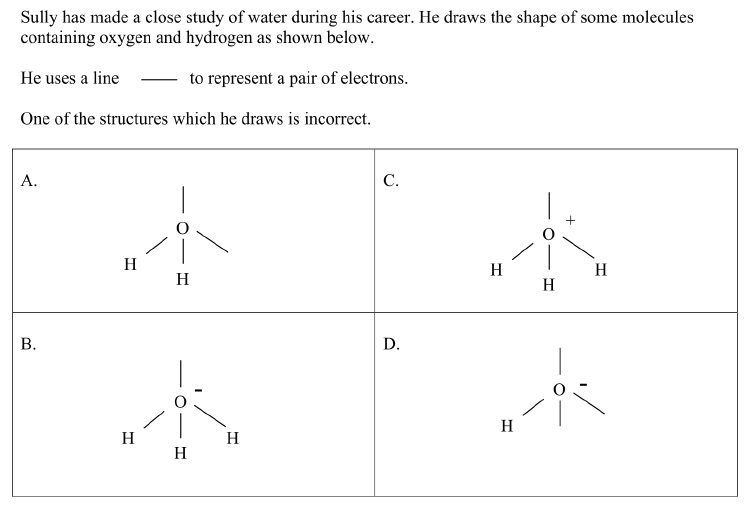
Which one of these best shows the structure of a water molecule?
A
B
C
D
zoom_in
1
Question 11
11.
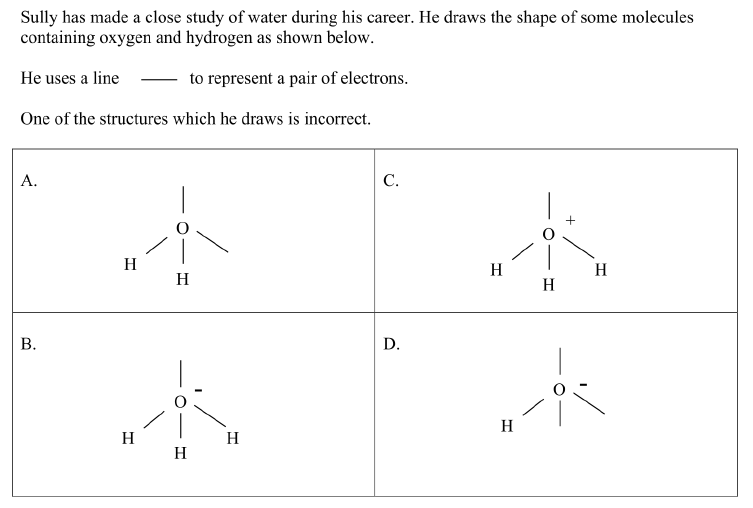
Which one of these is the incorrect structure?
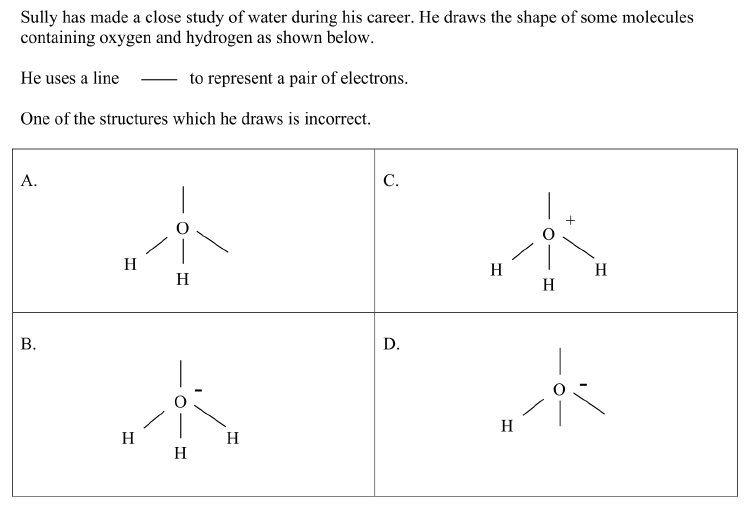
A
B
C
D
zoom_in
1
Question 12
12.
Which one of these best shows the structure of an hydronium ion?
A
B
C
D
Question 2
2.
This would not be a suitable titration curve for analysis purposes because
the pH at the start is too low
the pH at the end is too high
the equivalence point is not well defined
the equivalence point occurs at pH 7
Question 3
3.
Potassium metal reacts violently with hydrochloric acid to produce potassium chloride solution and hydrogen gas.
The balanced chemical equation showing the reaction is:
K (s) +2HCl (aq) --> 2KCl (aq) + H
2
(g)
2K (s) +2HCl (aq) --> 2KCl (aq) + H
2
(g)
2K (s) +2HCl (aq) --> 2KCl (aq) + 2H
2
(g)
K (s) +HCl (aq) --> KCl (aq) + H
2
(g)
Question 4
4.
Which of the following contains an a base and an acid in
that order
?
carbon dioxide (aq), vinegar
sodium bicarbonate, vinegar
carbon dioxide (aq), sodium carbonate
sodium carbonate, sodium bicarbonate