What do you think of when you hear the word investing? (Who does it? Why do they do it? Where does it happen? What does it involve?)
INFOGRAPHIC: A Simple Introduction to Investing
What is investing? How is it different from saving? Review this infographic to learn more and answer the questions.
5
Question 2
2.
Identify whether each of the following statements describes saving (S) or investing (I). Circle or highlight your answers.
1
Question 3
3.
What is the advantage of starting to invest at a young age?
1
Question 4
4.
Why is investing a more powerful tool to build long-term wealth than saving?
VIDEO: Trading vs Investing: What’s the Difference?
Many people think of the stereotypical Wall Street stock trader when they think of investing. However, this image does not reflect the everyday investor. Watch this video to learn about the difference between trading and investing. Then, answer the questions.
6
Question 5
5.
According to the video, traders and investors differ in terms of time frame, activity, and risk management. Complete the table below describing those differences.
Traders
Timeframe: _______
Activity: _______
Risk Management: _______
Investors
Timeframe: _______
Activity: _______
Risk Management:_______
1
Question 6
6.
The stock market fluctuates in the short-term but tends to increase in the long term, with an average projected growth of approximately 6% per year. Based on what you know about trading and investing, which approach is higher risk? Why?
REFERENCE: Reasons to Invest
You’ve learned how investing differs from saving and trading. But how might investing your money help you? Review this reference to learn about the main reasons why you should invest. Then, answer the questions.
2
Question 7
7.
What are two disadvantages of putting your money into savings accounts, compared to investing?_______ _______
2
Question 8
8.
Which reason to invest resonates the most with you? _______Why?_______
VIDEO: Understanding Compound Interest
In the previous resource you learned how you can build wealth through investing by using the power of compound interest. Let’s take a closer look at what compound interest is and how it works in this video. Then, answer the questions.
1
Question 9
9.
Which option resulted in having more money? Explain the role compound interest played in making this possible.
1
Question 10
10.
What recommendations would you give someone who wants to take advantage of compound interest but is not able to put away large sums of money on a regular basis?
Interactive: NGPF’s STAX
Cheat Sheet:
7 different investment types will unlock throughout the game. Read the pop-up information and click the question mark at the top right of the asset box to learn more.
Every 6 months (30 seconds in the game), you receive pocket cash to invest.
Your pocket cash represents 10% of your salary that you are saving.
Your pocket cash starts at $2,000 and increases over time
You can toggle the view between balance and profit for each investment.
At the end of the game, keep your results window open to answer the questions below.
10
0
1
1
1
1
1
1
1
Question 20
20.
All of the following are reasons to invest, EXCEPT…
To minimize the impact on inflation, which causes you to lose purchasing power
To earn a consistent rate of return with lower risk than typical savings accounts
To build wealth by reinvesting your returns and allowing them to compound
To earn higher average rates of return than you would in a typical savings account
Question 21
21.
Which of the following statements BEST describes investing?
Putting $100 per month into an FDIC-insured bank account for short-term goals
Buying and selling stocks within the same day to take advantage of short-term price variation
Reducing the purchasing power of your money over time
Buying assets, like stocks, with the intention to hold them and grow your wealth over the long term.
Question 22
22.
An investor can best harness the power of compounding by doing all of the following, EXCEPT…
Making frequent trades
Starting to invest early
Reinvesting earnings
Minimizing risk
Question 11
11.
Take a screenshot of your portfolio at the end of the game and paste it in the box below.
Question 12
12.
How did you divide money between asset classes? Use your Investment Portfolio pie chart to complete the table below.
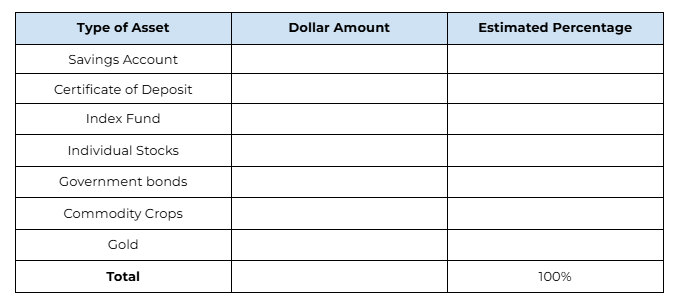
Type of Assett: Amount %
Savings Account: _______ _______
CD: _______ _______
Index Fund: _______ _______
Stocks: _______ _______
Govt. Bonds: _______ _______
Commodity Crops: _______ _______
Gold: _______ _______
Total: _______ _______
Question 13
13.
Do you think you finished the game with a diversified portfolio? Why or why not?
Question 14
14.
Describe your investment strategy as you played the game.
What was your plan when you first started playing? How did it change during the course of the game?
If you didn’t have a strategy, why not?
Question 15
15.
Describe the various emotions you felt as you played the game. How did your emotions impact your decision-making? Provide specific examples.
Question 16
16.
What strategy did the computer follow? Why do you think that strategy was so successful?
Question 17
17.
Your friend brags, “It was easy to beat the computer in STAX. I made $50,000 more by picking individual stocks to buy and sell. Why buy an index fund, when I can actively trade and beat the market?” Your friend got lucky, but why might their strategy be risky?
Question 18
18.
If you had the opportunity to play STAX a second time, what would be your strategy?
Question 19
19.
You had seven different investment options in the game. The most diversified portfolio would include all of them. Would this diversified portfolio have the highest return? Why or why not?