LR257.5.1: Evolution

Last updated 9 months ago
22 questions
Look at the picture of an Archaeopteryx. Does it look similar to any other organisms on Earth? It appears to look similar to some modern day birds. Archaeopteryx has even been referred to as the earliest bird.
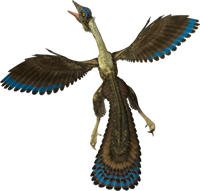
This creature is thought to have been a bridge between dinosaurs and modern birds.


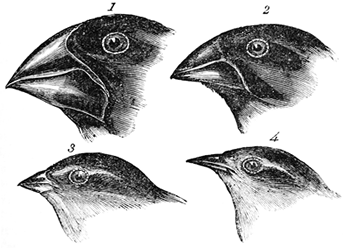
Organisms like Archaeopteryx help scientists determine how today's organisms have developed. Charles Darwin, a British naturalist, had a theory about how organisms may have changed over time. In the 1900s, Darwin studied many plants and animals, including finches, from the Gal'pagos Islands of South America. He collected and studied different finches, comparing them to each other as well as those that were closer to the mainland of South America. At the time, Darwin assumed they were just different birds, but he realized that they were all different types of finches. In England, he studied their different features, such as beak size. He found that finches from different islands had different beak sizes, which scientists later concluded were a result of their differing diets. Birds with different beaks ate different foods.
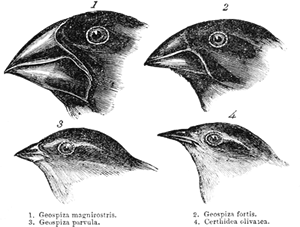

The vegetarian finch has a curved beak that helped it pick large berries from branches. The cactus finch had a narrower beak that helped it to dig into small areas, such as holes, to find insects.


Darwin's observations helped shape his theory of evolution. Evolution is the process by which modern organisms descended and developed from older organisms. Evolution helped explain how the finches Darwin collected showed different traits. The birds on different islands evolved differently.
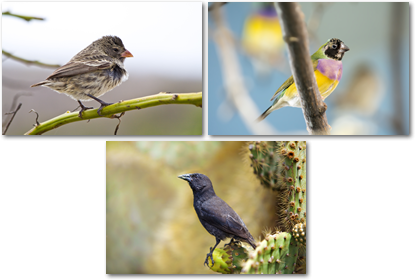


Each of these birds looks very different, but they are all types of finches that evolved differently from the same ancestor.
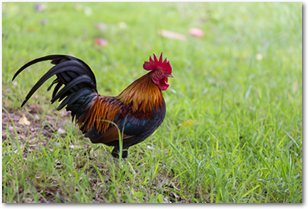
In addition to his own observations, others also influenced Darwin’s theory of evolution, which explained how populations of organisms could change over time. One influential idea that affected Darwin's thinking was artificial selection, or the practice of breeding animals or plants to have desired traits. In artificial selection, humans select for a desired trait by breeding two parents with that trait, for example chickens with small tail feathers. This produces offspring that are more likely to have small tail feathers, showing how traits change and spread in a population from generation to generation.

This chicken may have been bred to have large tail feathers.


Jean Baptiste Lamarck also influenced Darwin. He believed that organisms could acquire traits that they needed for survival and also pass those traits on to their offspring. For example, over time a dog could develop strong legs to run faster, and if running faster was beneficial for the dog’s survival, it could pass the trait on to its offspring. This idea was disproved because acquired traits are not part of an organism’s DNA and cannot be passed on to the offspring. However, the idea that organisms could change and acquire certain traits for survival greatly influenced Darwin’s thinking.


Lamarck believed that if someone developed a trait through the environment, such as stronger muscles, that person would automatically pass it on to their offspring. However, acquired traits are typically not passed on to offspring.


Charles Lyell believed that over hundreds of millions of years, small changes in rock collected on the Earth. Darwin believed that since the Earth was very old, very small changes had enough time to add up.

Another idea about the Earth and environment also influenced Darwin. He read an essay by Thomas Malthus about population growth and factors that could limit population growth. He believed that the organisms that survived some of these factors, such as disease and competition for food, must have had traits that helped them survive. He believed that organisms passed these traits on to their offspring.
Required
1
All of the birds in this picture are types of finches, though they do not look the same. The different finches changed over time. The study of these finches led __________
to his theory of__________.

Required
1

How did artificial selection influence Darwin's ideas about organisms?

Required
1

Match each person or name to the correct idea or principle.

Draggable itemCorresponding Item
Useful acquired characteristics can be passed on.
artificial selection
The geologic record shows evidence of change over long periods of time.
Jean Baptiste Lamarck
Selective breeding can influence traits seen in later generations.
Charles Lyell
Organisms that survived factors threatening population growth had traits that helped them survive.
Thomas Maithus
Darwin's theory of evolution did not just change the way scientists viewed organisms. It also changed the way scientists classified organisms. Today's system of classifying organisms takes into account an organism's evolutionary history. Different groups of organisms that have a similar evolutionary history are classified and grouped more closely together.

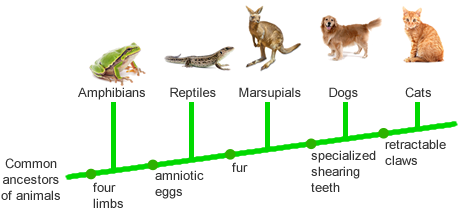
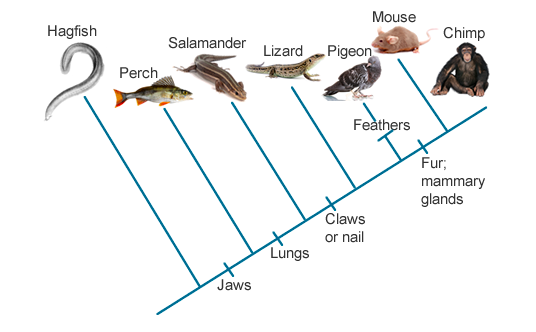
One way to show different organisms' evolutionary histories is with a branching tree diagram. A branching tree diagram is a diagram that shows the evolutionary relationship among organisms and the order in which specific characteristics may have evolved. A branching tree diagram shows evolution and common ancestors among organisms. A common ancestor is the most recent species from which two groups of organisms have evolved.

Dogs and cats both have the characteristic of specialized shearing teeth. However, only cats have the characteristic of retractable claws.


Common ancestors of all the organisms in the branching tree diagram appear at the base. Then, organisms are grouped together based on their shared derived characteristics, which are traits that the common ancestor had and passed on to its descendants. Organisms on the branches above the common ancestor usually have that characteristic, but the organisms on branches below the characteristic probably do not have that characteristic. For example, reptiles can have four limbs and produce eggs, so they are placed above those characteristics. However, they do not have fur, so they are placed below that characteristic.

The characteristics that are lower on the diagram developed before the characteristics that are farther up the diagram. In certain cases, some organisms placed above a characteristic may have evolved to lose that characteristic. For example, a snake is a legless reptile, but snakes have a common ancestor that had four legs.
Required
1
Required
1

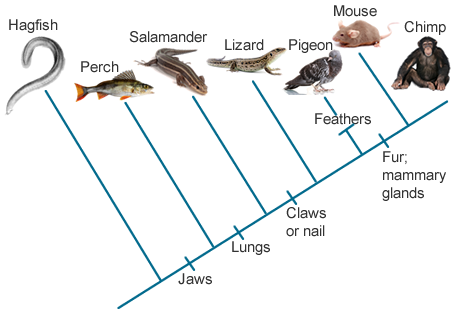
Study the branching tree diagram above. Which organism has lungs but does not have claws or nails?

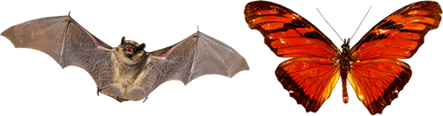
Organisms are grouped together with other organisms that have similar characteristics. However, organisms that are not related sometimes evolve similar characteristics, but they do not have a common ancestor. Convergent evolution is the process by which unrelated organisms evolve similar characteristics as a result of having to adapt to similar environments. For example, bats and butterflies both have wings, but their wing structures are very different. Bats and butterflies are unrelated organisms that both developed the ability to fly, but they do not have a common ancestor.

A bat and a butterfly evolved similar characteristics as a result of convergent evolution.
Required
1

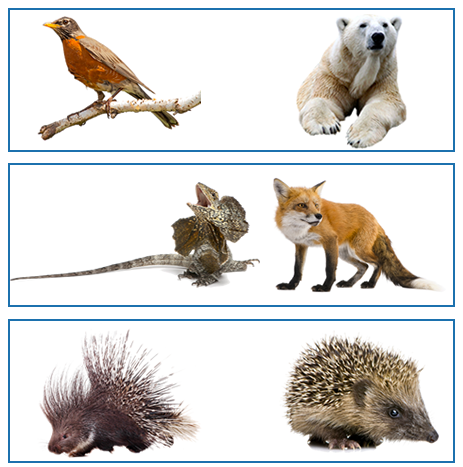
Which set of pictures shows an example of convergent evolution?

Required
1

Bats and mosquitoes both have wings, but their structures are different. What process explains how this happened?

Check for Understanding:

1. Charles Darwin's theory of evolution explains how modern organisms developed from ancient organisms.

2. Other people influenced Darwin's theory of evolution.

3. The theory of evolution changed the way scientists classified organisms. Scientists use branching tree diagrams to show the evolutionary relationship among organisms.

4. Convergent evolution allows organisms to evolve similar characteristics, even if they do not share a closely related common ancestor.
Charles Darwin believed that organisms changed over time through evolution, but how exactly do organisms evolve? Darwin hypothesized that most organisms evolved through natural selection. Natural selection is the process by which well-adapted organisms survive and reproduce more successfully in an environment than less well-adapted organisms. There are four important parts of natural selection: overproduction, genetic variation, selection, and adaptation:

• As a result of overproduction, not all plants or animals that are born will survive to adulthood.

Genetic variation can happen within a specific group of organisms when there are natural differences, or variations, that can be passed down from parent to offspring.

• During selection, these variations can be traits that are advantageous to survival of an organism. The helpful traits are "selected for" because organisms with the helpful traits are more likely to survive and pass the traits to their off spring. Over time, the traits become more likely to appear in the next generation.

• With adaptation, specific adaptations are inherited traits that help organisms survive. These can appear from one generation to the next.
Required
1

Animal A is very fast. It can catch and eat many organisms, as well as run away quickly from other animals that may try to harm it. Animal B is not very fast. It is not able to catch any animals to eat, and it is not fast enough to run away from animals that can harm it. Over time, Animal A produces many offspring that continue to reproduce, but Animal B dies out. This is an example of __________.

Plants and animals oftentimes reproduce more offspring than the environment can handle, which causes overproduction. Only some of the offspring make it to adulthood. Of the offspring that do survive and make it to adulthood, only a few of them are able to successfully reproduce.

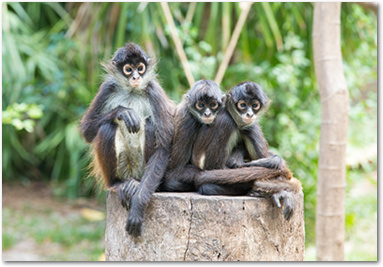
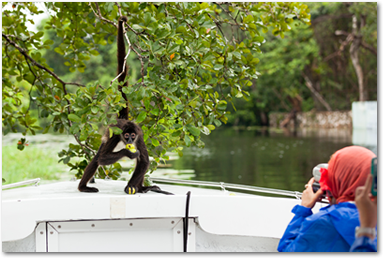
These spider monkeys all survived to adulthood, but it is possible they may not all be able to reproduce and create new offspring.


Within a population of organisms, there are variations, or natural differences, that can be passed down from parent to offspring. Variation is any difference among organisms of a particular species. For example, the tails of some spider monkeys may be longer than others. This difference could be due to change in genetic material, or a mutation. Genetic variations can change over time and as each new generation of offspring is produced, new genetic differences may be introduced into the population. More genetic variation means there is a higher chance of some individuals having traits that are more advantageous to survival.
Required
1

True or False: A plant or animal offspring is guaranteed to survive and reproduce.

Required
1

Some dolphins have longer snouts, which are useful for eating larger fish. In which environment would dolphins with long snouts have the greatest advantage over other dolphins?

Darwin’s theory of natural selection states that individuals with advantageous traits, such as a prehensile tail that allows them to grasp and hold objects, are more likely to survive and reproduce. This advantageous trait is “selected for” because organisms with this trait will become more common in the next generation. Because forests differ in certain areas of the world, animals in denser forests must be able to maneuver quickly through the thick plants and trees. Animals like spider monkeys have traits that allow them to maneuver through these areas. Spider monkeys have prehensile tails that act as a fifth limb.

Required
1

A predatory cat species that lives in cold, snowy tundra has a variety of coat colors and pouncing distances. Which of these traits would most likely be “selected for” and appear more frequently in the next generation? (choose all that are true)

Required
1

An African wild dog does not have any predators in its environment. Recently, a lion was introduced into the environment, and it preys on African wild dogs. Some of the African wild dog's offspring have a trait that allows them to camouflage in the grass. Is this trait more or less likely to be "selected for" and become more common in the next generation?

An adaptation is a trait that helps an organism survive and reproduce in its environment. The prehensile tail in spider monkeys helped it to survive and maneuver through dense forest areas. This adaptation became more and more common through natural selection. Over time, new adaptations can also arise in organisms as mutations occur. As a result, the population becomes better adapted to its environment and is better able to survive. When environments change, those species that do not adapt can become extinct. Extinction is the death of every member of a species.

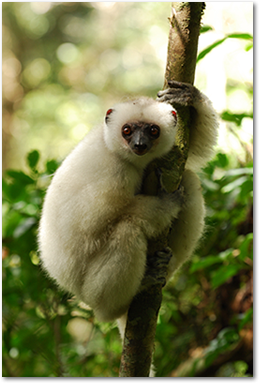
The silky sifaka is found only in Madagascar. It has been on The World's 25 Most Endangered Primates list since 2000. There are less than 1,000 individuals left in the wild.
Required
1
At one point, giraffes had shorter necks. Eventually, mutations caused some giraffes to have longer necks, and they were able to reach food higher up in the trees. As more organisms inhabited savannas, giraffes competed with them for the same food supply. Over time, long necks became more common in the next generation. A giraffe’s long neck is an example of an _______________ .
Other Answer Choices:
extinction
adaptation
artificial selection
Required
1

True or False: Adaptations CANNOT appear in more than one generation of species.

Required
1

One plant has a trait that requires less water for it to survive, while another plant still requires large amounts of water to survive. If the environment becomes drier, what could eventually happen to the plant that requires large amounts of water?

Check for Understanding:

1. According to Darwin, most evolution happens through natural selection.

2. Natural Selection is the process by which organisms with advantageous traits survive and reproduce more successfully than other organisms.

3. There are four parts to natural selection: overproduction, variation, selection, and adaptation.

4. Adaptations due to genetic variation can allow species to survive and reproduce.
There are four main areas of evidence that support Darwin’s theory of evolution: the fossil record, structural similarities, developmental similarities, and DNA similarities.

Fossils are the remains of traces of an organism found in earth or rock. Most fossils form when a dead organism is covered in a layer of sediment or mud, and more sediment eventually settles on top and hardens.

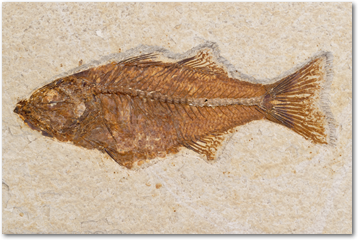
This fossil contains the remains of a prehistoric fish.


Many of the types of organisms found in fossils are not alive today, a clue that life changes over time. Fossils that are found in newer layers are usually more closely related to modern-day organisms than the fossils found in older layers, which are more likely related to organisms that no longer exist.

Fossils sometimes show the sequences of changes that have led to today’s life forms. This can be seen in the fossil record. The fossil record is the total number of fossils that have been discovered and the information gathered from them. There are many organisms that lived in the past that are not alive today. Therefore the fossil record shows change over time.
Required
1
__________are the remains of organisms found in earth or rock. The total number of these remains makes up the__________.
Required
1

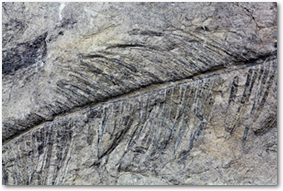
This fossil of a leaf impression shows a plant that no longer lives on Earth. What conclusions could be drawn from this fossil?

There is also other evidence to support evolution and the idea that modern and ancient groups of similar organisms share an ancestor. In addition to fossils, scientists also study structural data, DNA, and developmental patterns as evidence to support the theory of evolution. By studying this evidence, scientists have found that sometimes populations become new groups of similar organisms.

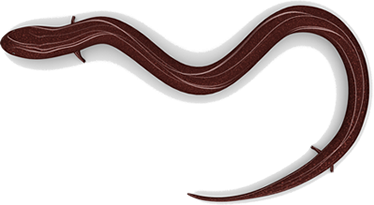
One source of evidence to support the theory of evolution is structural data of organisms. Structural traits are the physical features of an organism, such as legs on a frog. Scientists have observed that more closely related organisms share more similar structural traits and physical features. For example, a four-legged lizard, like an iguana, has a closer common ancestor to a dog than an organism without any limbs, like an eel. This suggests that animals with limbs developed from animals without limbs.

This Congo Eel may show how snakes looked long ago if they had legs.


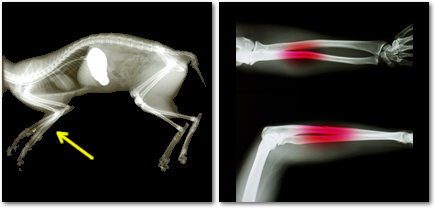
Sometimes scientists find organisms that appear to have similar structural traits, but the structures are not used for the same functions. For example, the arm of a human being and the front leg of a cat have a similar structure even though they do not look alike. The bone structures are similar, though these bones perform different functions in a human and a cat. However, these similarities suggest that humans and cats had a common ancestor hundreds of millions of years ago, during which many changes occurred in the common ancestor.

Notice some of the similarities between the structures of the front limb of a cat and the human arm. A cat’s forelimbs support its body weight whereas a human’s are used to interact with its surroundings more generally.


Scientists can also study organisms’ DNA to determine their closest common ancestors. DNA contains stored genetic information and molecules that scientists can compare among different organisms. Two groups of organisms that have a greater number of DNA similarities are more likely to have recently shared a common ancestor, which means they are more closely related.

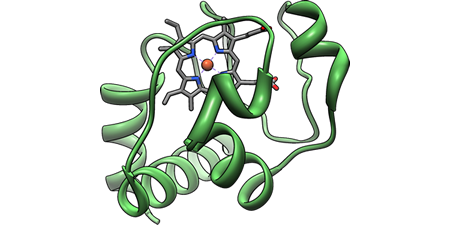
Scientists study and compare the amino acids that make up cytochrome c proteins in many groups of organisms. They have determined that groups of organisms with fewer amino acid differences, caused by DNA differences, are more closely related and share a more recent common ancestor.
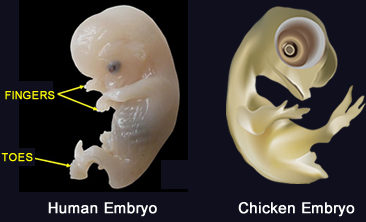
In addition to similarities in structure and DNA, scientists also study similarities in the way different groups of organisms develop. Organisms that have developmental similarities also likely share a close common ancestor. Scientists study and observe the patterns of development in different organisms. One such example is the way in which animals with backbones develop. At some point in their development, animals with backbones have a tail, which suggests that all animals shared a common ancestor.


These two embryos are at similar stages in development. Notice how they both have started to develop limbs and have eyes.
Required
1

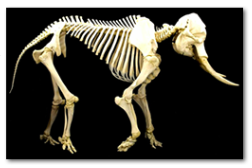
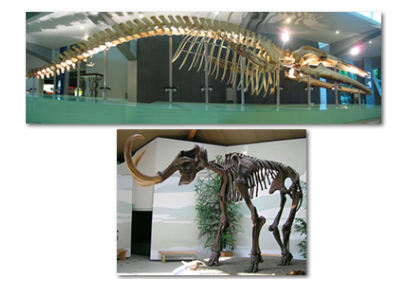
This is a modern day elephant. which skeleton below has a more recent common ancestor with the modern day elephant?

Required
1

James studied the DNA of two species and found that only 2% of the organisms’ genetic code was different. What can this tell James about how recently these two species shared a common ancestor?

Required
1

The pattern and structure of two embryos are extremely different. Is it likely that they recently shared a common ancestor?

Check for Understanding:

1. Scientists have found evidence that organisms have changed over time.

2. Layers of rock can preserve an organism's remains and form a fossil.

3. Fossil records show evidence of the order in which species existed.

4. Scientists also study structural data, DNA, and developmental smililarities as evidence to support the theory of evolution.
Required
1
Adaptations are ____________________________________________________________________________.
Selective breeding is ______________________________________________________________________
Evolution is _________________________________________________________________________________________
Natural selection is___________________________________________________________________________________________________________________________________________
A fossil is ________________________________________________________________
Other Answer Choices:
a trait that helps an organism survive and reproduce in its environment
the remains or traces of an organism found in earth or rock
the process by which modern organisms descended and developed from ancient organisms
the process by which well-adapted organisms survive and reproduce more successfully in an environment than less well-adapted organisms
the practice of breeding animals or plants to have desired traits
Required
1

Study the branching tree diagram below. Which organisms have claws, but do not have mammary glands?