P6.2 Circuits, Current, Potential Difference and Resistance Assignment
star
star
star
star
star
Last updated about 1 month ago
26 Nsɛmmisa
1
1
1
2
1
3
8
4
1
1
1
1
1
1
1
1
1
1
10
1
1
1
1
1
1
1
When a cell or battery is used, what chemical store is decreasing?
What type of energy store is coal? (This is from out Energy topic we did back in October/November)
How long does it take fossil fuels to form? (This is from out Energy topic we did back in October/November)
Which of the following do not require fuel to generate electricity? (This is from out Energy topic we did back in October/November)
What gas is produced when fossil fuels are burned? (This is from out Energy topic we did back in October/November)
Explain how a hydroelectric power station works. (This is from out Energy topic we did back in October/November)
Identify which items below made the light bulb light up (conductor) and which did not (insulator).
Hand
Dollar bill
Wire
Coin
Pencil
Eraser
Paper clip
Dog
Conductor
Insulator
Match the quantity to the unit
| Draggable item | arrow_right_alt | Corresponding Item |
|---|---|---|
Charge | arrow_right_alt | Joules |
Current of Electricity | arrow_right_alt | Watts |
Power | arrow_right_alt | Coulombs |
Energy | arrow_right_alt | Amps |
Match the item to its circuit drawing
| Draggable item | arrow_right_alt | Corresponding Item |
|---|---|---|
Switch (open and closed) | arrow_right_alt | |
Resistor | arrow_right_alt | |
Bulb / Lamp | arrow_right_alt | |
Cell | arrow_right_alt | |
Battery | arrow_right_alt | |
Motor | arrow_right_alt | |
Wire | arrow_right_alt |
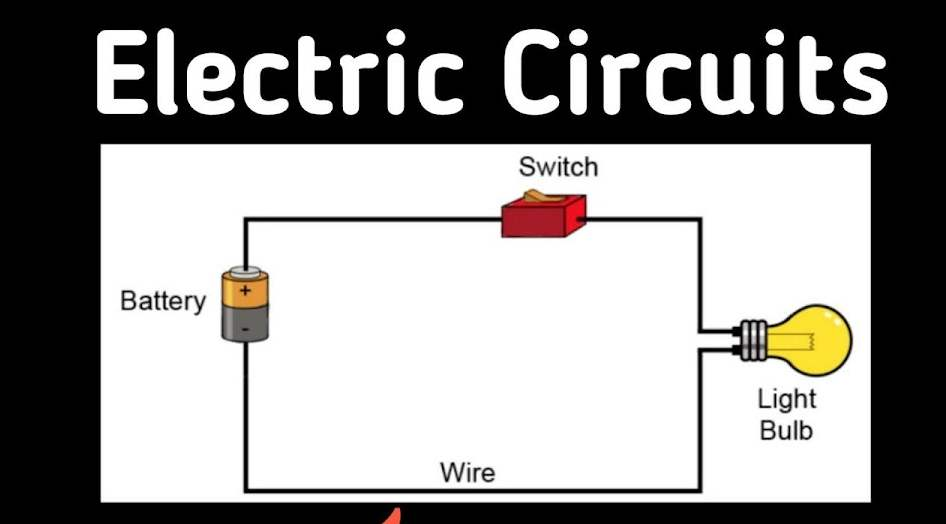
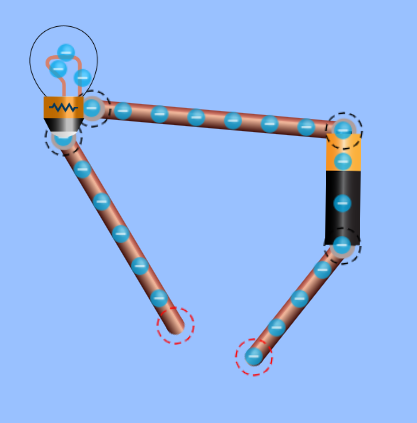
Use circuit symbols to redraw this circuit correctly:
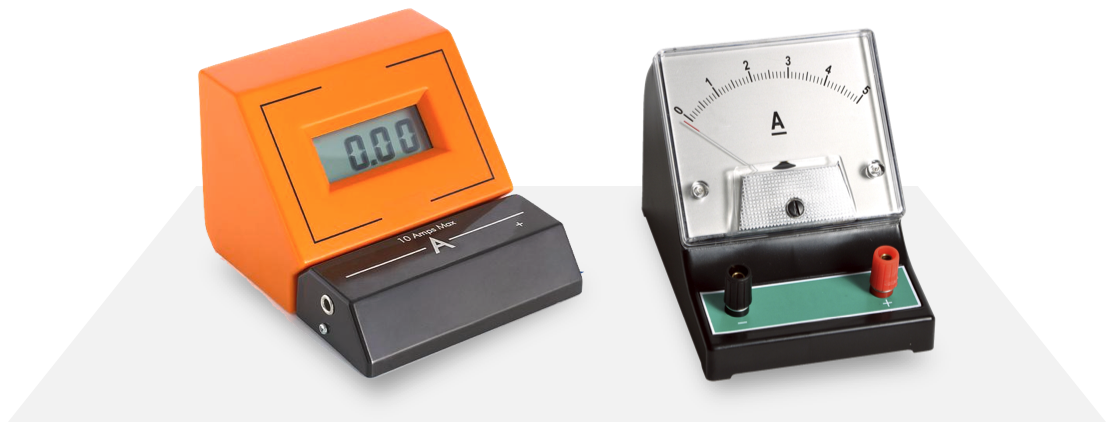
What piece of equipment measures current in a circuit?
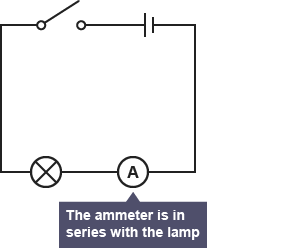
We can calculate the current in a circuit by finding out how much charge (from electrons) flows past every second. We place it in the circuit like this:
The equation to find current is this:
Example: 10 coulombs of charge flows past in 2 seconds. What is current?
10 / 2 = 5 Amps
If a charge of 12 coulombs flows in 3 seconds, what is the current?
Calculate current from 15 coulombs over 5 seconds. What is the result?
A total of 30 coulombs passes a point in 10 seconds. What is the current?
If you have 8 coulombs moving in 2 seconds, find the current in amperes.
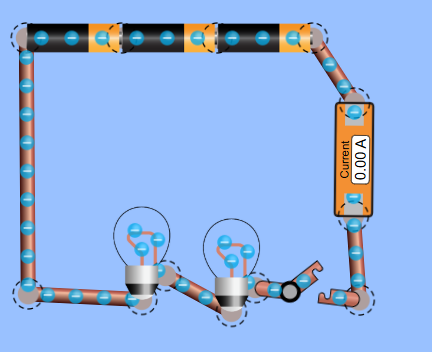
Use the circuit builder above to make the circuit and add an Ammeter. Please take a screenshot and post it here.
With the same circuit, put the ammeter elsewhere. Take a screenshot and post it here.
What do you notice about where the ammeter is in the circuit? Does it have the same or different values for current?
This is your chance to play with the circuit builder and I'd like you to tell me what you discover. For example
- I put in 3 batteries and the current is much higher
- I change from one lightbulb to 2 lightbulbs, and now they are both dimmer
Write AS MANY as you like - I'd like at least 10!
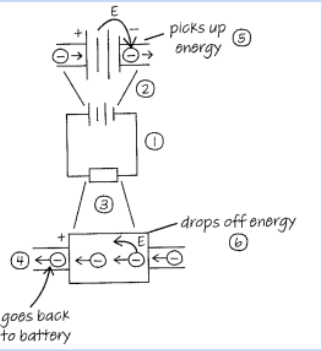
Energy changes around a circuit. Look at this picture:
Electrons pick up energy from the power source (A cell, a battery, or the mains) and they drop off that energy to the different components (bulbs, resistors, motors). If the battery provides 12 J of energy, it gives out those 12 J to the components.
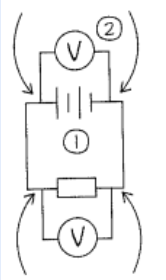
We measure this energy by measuring the all the energy in the charges that pass two different points. The piece of equipment to do this is called a Voltmeter and they are measuring the potential difference between the 2 points. Here is what they look like:
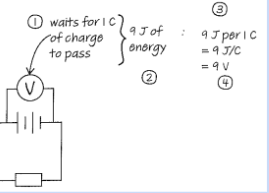
The Voltmeter waits for 1 Coulomb of charge to pass, and measure the energy
Here there are 9 Joules of energy in Coulomb of Charge, so we say this is 9 Volts (V).
If the battery provides 9V then the components will use all 9V.
If 50 joules of energy are used to move 5 coulombs of charge, what is the potential difference? (please include unit)
Calculate the potential difference when 30 joules is used to move 3 coulombs of charge. (please include unit)
What is the potential difference if 15 joules of energy moves 1.5 coulombs of charge? (please include unit)
Find the potential difference if 60 joules is used for 6 coulombs of charge. (please include unit)
What piece of equipment measure the potential difference?
Use the circuit builder and build this circuit:
What is the current reading?
Take away a bulb - what is it now?
Increase the bulbs to 3 - what is it now?
What is the pattern?
What if you use resistors instead of bulbs?
If you are finished, this is where you can tell me what other things you've discovered about the circuit builder here.