Ɛhia
1
Ɛhia
1
Ɛhia
1
Ɛhia
1
Ɛhia
1
Ɛhia
1
Ɛhia
1
Ɛhia
1
Ɛhia
1
Aqui podras encontrar la evaluacion final de nuestra seguda seccion.
In this section do you can put up in action all your speaking, writing and reading skills
✍️ Writing Task: My daily routine (present simple and adverbs of frequency)
📝 Instructions:
Write a short paragraph (8-10 sentences) about your daily routine. Use the present simple tense to describe your usual habits and activities.
📌 Your paragraph should include:
What time you get up and what you do in the morning.
Your activities in the afternoon.
What you usually do in the evening.
At least three adverbs of frequency (e.g., always, usually, often, sometimes, sometimes, never).
Correct use of the present simple tense throughout the paragraph.
Reading Test: Daily Routine (Present simple and frequency adverbs).
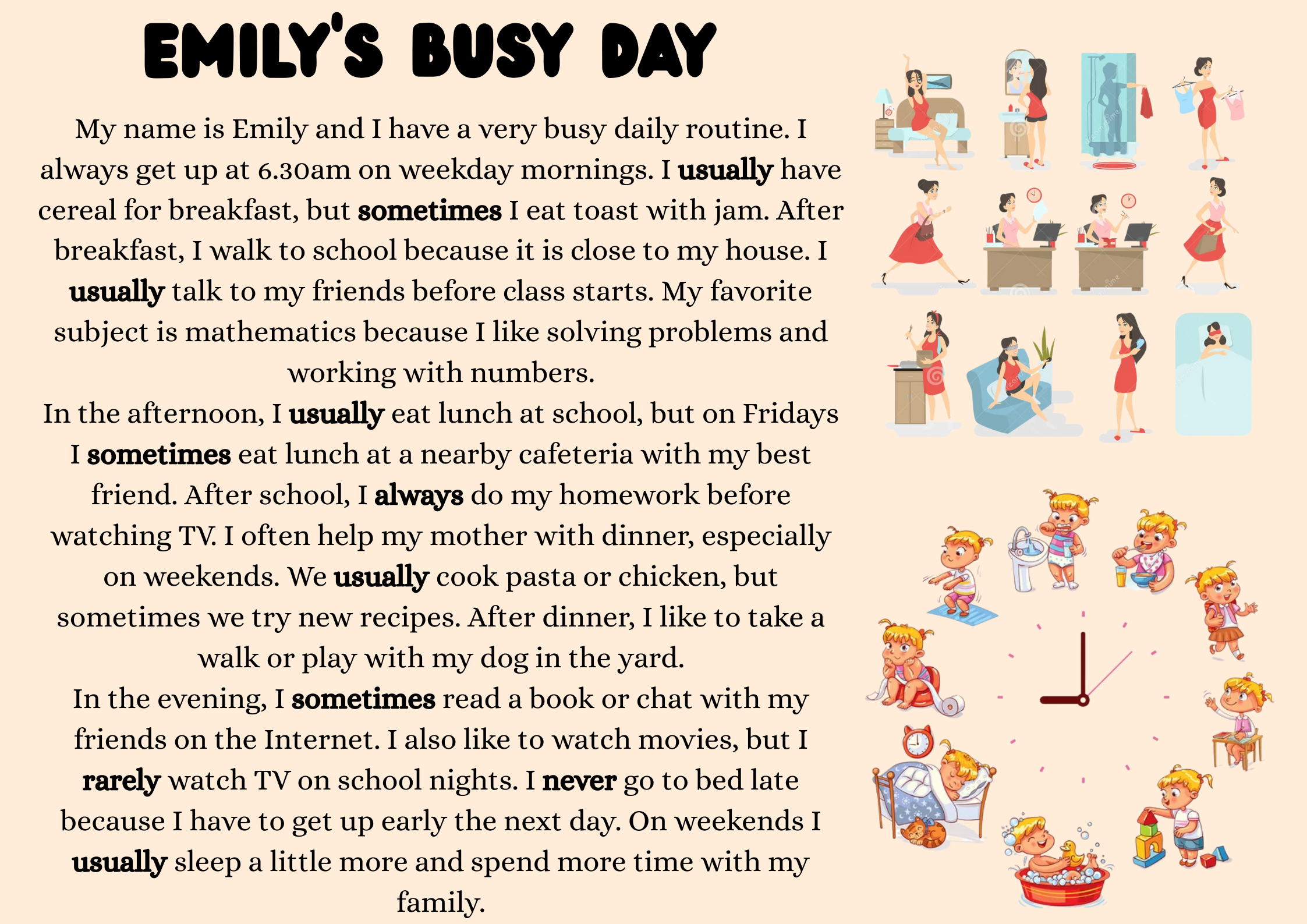
In the following questions you will find an image where Emily, describing her daily routine, answers according to the reading.
Matching activity: Match the time of day to what Emily does.
Instruction:Match each time of day with the complete action Emily performs.
| Draggable item | arrow_right_alt | Corresponding Item |
|---|---|---|
Evening | arrow_right_alt | Emily always wakes up at 6:30 a.m. on weekdays. |
Evening | arrow_right_alt | Emily usually has lunch at school, but on Fridays she eats at a nearby café. |
Morning | arrow_right_alt | Emily sometimes reads a book or chats with her friends online. |
Afternoon | arrow_right_alt | Emily never goes to bed late because she needs to wake up early. |
Sort out what Emily does in the afternoon and evening
Instruction:
Drag the sentences into the correct order according to what Emily does after school.
1
2
3
4
She helps her mom with dinner on weekends.
She goes for a short walk or plays with her dog.
She reads a book or chats with her friends online.
Emily eats lunch at school or at a café on Fridays.
What time does Emily usually wake up on weekdays?
What does Emily usually have for breakfast?
Emily sometimes eats lunch at a nearby café with her best friend on Fridays.
How does Emily go to school?
What does Emily always do before watching TV?
Emily often watches TV late at night on school days.
Why does Emily never go to bed late?