Log in
Sign up for FREE
arrow_back
Library

U4 Ch1: Budgeting and Linear Inequalities (2025)

star
star
star
star
star
Last updated 11 months ago
48 questions
Note from the author:
Objectives:

Write and graph linear equations and determine if a given point is a possible solution
Calculate percentages
Create a mathematical model in the form of a budget
Differentiate between income and expenses and explain how they’re used to create a budget
Consider needs versus wants when deciding how to spend money
Build a basic budget with constant or variable income
Objectives:

Write and graph linear equations and determine if a given point is a possible solution
Calculate percentages
Create a mathematical model in the form of a budget
Differentiate between income and expenses and explain how they’re used to create a budget
Consider needs versus wants when deciding how to spend money
Build a basic budget with constant or variable income
Section 1: Median Spending
0
0
0
0
0
0
0
0
0
0
Section 2: Graphing Budget Equations
0
0
0
0
0
Section 3: Budgeting without Steady Income
0
0
0
Section 4: Budget Practice
1
5
1
1
1
1
Section 5: Five Point Quiz
Section 6: Graphing Linear Inequalities Part 1
0
Section 7: Graphing Linear Inequatlities Part 2
0
Section 8: Apply It
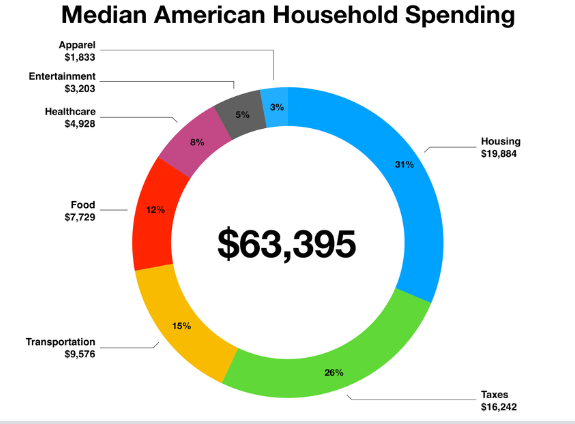
This graph shows how the average American household spends their money across a variety of common categories, with the central number representing median income. This is based on data for the whole country, including cities, suburbs, and rural areas. This also includes households with different numbers of adults/children living in them.
Question 1
1.

How do you think costs in cities would compare to the medians listed here?

Question 2
2.

How do you think costs in rural areas would compare to the medians listed here?

Question 3
3.

Are there some costs that vary more than usual based on where you live? (As in, there are extreme differences in price from one place to another) If so, what would those be?

Question 4
4.

Are there some things that will cost the same no matter where you live? If so, what might those be?

Question 5
5.

Are there some costs that might vary based on who you are or your personal behavior? If so, what would those be?

This cost of living chart shows the typical cost of living to meet basic needs in Essex County, Massachusetts (the area Peabody is in).

Open the link and use the data to answer the questions below.
Question 6
6.

How much does a single adult with no children need to make per hour to live on their own in Essex County?

Question 7
7.

How much does a single adult with one child need to make per hour to live on their own in Essex County?

Question 8
8.

If you have a job now, does your job pay enough for you to live on your own with no assistance (no SNAP, WIC, disability, rent assistance, family help, etc.)? If not, what could you do to increase your income? What could you do to reduce your costs?

Question 9
9.

Scroll down to the chart with expense categories. How does the cost of food for 2 adults, 0 children compare to the median cost in the graph at the beginning of the section? What does this tell you about the cost of living in Essex County, MA as compared to other parts of the country?

Question 10
10.

Scroll down to the job income data. Find the category of job you are interested in working in when you graduate. Does it typically earn enough for you to live on your own? If not, what could you do? Would you have to go to college to get the job? How will you pay for that?

Click here to open the class notes for this section

Section 2 additional practice notes
Question 11
11.
Sean has an annual shoe budget of $640. On average, a pair of Jordans cost $160, and a pair of Adidas cost $40.

Create an equation that represents the combinations of shoe purchases that allow Sean to stay in his budget. _______
(Hint: What does x stand for? What does y stand for?)

Graph the equation for his budget on desmos.com - put a screenshot of your graph in the Show Your Work Box

Based on the graph, list

2 combinations that use his entire budget
# Jordans _______ # Adidas _______
# Jordans _______ # Adidas_______

1 combination that would be under budget
# Jordans _______ # Adidas _______

1 combination that would be over his budget.
# Jordans _______ # Adidas _______
Question 12
12.
Aliyah either takes a bus or Uber to get to work and has a $240 monthly budget for her round trip weekday commute. A bus ride costs $3, and an average Uber costs $12.

Define your variables. What does x stand for (in words), what does y stand for (in words)?
x = _______
y = _______

Create an equation that represents the combinations of commute options that allow Aliyah to stay in her budget. _______

Graph the equation for her budget on desmos.com - put a screenshot of your graph in the Show Your Work Box

Based on the graph, list
2 combinations that use her entire budget
# bus rides _______ # uber rides_______
# bus rides _______ # uber rides _______

1 combination that would be under budget
# bus rides _______ # uber rides _______

1 combination that would be over her budget.
# bus rides _______ # uber rides _______
Question 13
13.

You probably wouldn't make an actual graph in real life, but why is it helpful to think about a variety of combinations for purchases when keeping a budget?

Question 14
14.

Every point on the line in your graph is a mathematically possible solution to the equation. Why do some of the solutions not make sense in real life?

Question 15
15.
Critical thinking (Not optional):

Sean just got a pay raise and wants to increase his shoe budget by 10%.

Write a new equation for his budget. _______

Graph it on desmos.com and include a screenshot in the Show Your Work Box

Based on your new line, what is the highest number of pairs of Adidas can Sean buy if he buys 3 pairs of Jordans? _______

Will he have money leftover? _______ How do you know?_______
VIDEO or ARTICLE: How to Build a Budget If You Don't Have a Steady Income

Many teens and adults do not have a steady income every week or month. Your boss may schedule you for an irregular number of hours; you may have periods of the year where you receive gifts, refunds, bonuses, or other infusions of cash; or you may work in the gig economy or on commission where income depends directly on output. Choose to watch this video or read the article to get some tips for budgeting with irregular income. (the video and article are at the same link)
Question 16
16.

Why is determining your “noodle budget” so important if you have an irregular income?

Question 17
17.

How are squirrels and people different?

Question 18
18.
Konstantine follows The Budgetnista’s advice to “pay the pot.” As a high school student, their noodle budget is $200 per month for a cell phone bill, gas for their car, and a few other must-pay expenses.

In month 1, Konstantine makes $500 babysitting.
  1. How much do they put into the pot? _______
  2. How much they have in usable budget? _______
  3. How much remains in the pot? _______
In month 2, Konstantine makes $100 babysitting.
  1. How much do they put into the pot? _______
  2. How much they have in usable budget? _______
  3. How much remains in the pot? _______
Question 19
19.

Your prom is 7 months away, and at your school, the average amount each student spends on prom is $850. You currently have $65 in savings.

How much, per month, do you need to save in order to have enough to pay for prom? Round up to the nearest whole dollar.

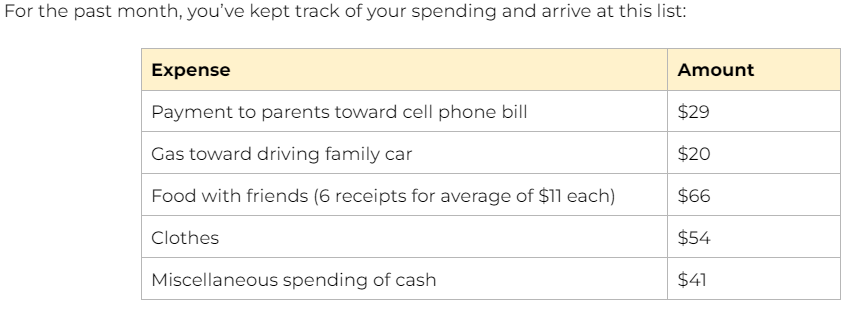
This is all your pretend info - in the table and below!


You make $10/hr and almost always work 8 hours per week, though occasionally you work 10 hours per week. Payroll (FICA) taxes of 7.65% are withheld from your paycheck. (yes, the min wage and these costs are very low for Massachusetts, it's just pretend!)
Question 20
20.

Use this template and the information above in the table/text to create a budget that allows you to attend prom in 7 months. A few tips:
  • If your income is variable, make sure you think about whether to plan for the lowest amount or highest
  • You may need to re-work your earnings or spending, after your first attempt, in order to make the budget work
  • Round each value to the nearest whole dollar

SUPER IMPORTANT: Assume that every month has 4.3 weeks and your cell phone bill CANNOT change

How to fill out the table notes

Question 21
21.

How much did you assume you make each month? How did you get this number?

Question 22
22.

Compared to the month you tracked, what spending changes did you have to make, if any, for your budget to work?

Question 23
23.

What was most challenging about creating this budget?

Question 24
24.

How does this process change, if at all, if you are trying to budget for college, a car, or something else more expensive than prom?

Link coming soon!
Click this link to play the game, then answer the reflection questions below.

Don't click off the results until you answer the questions below!!
0
Question 25
25.
0
Question 26
26.
0
0
0
Question 30
30.
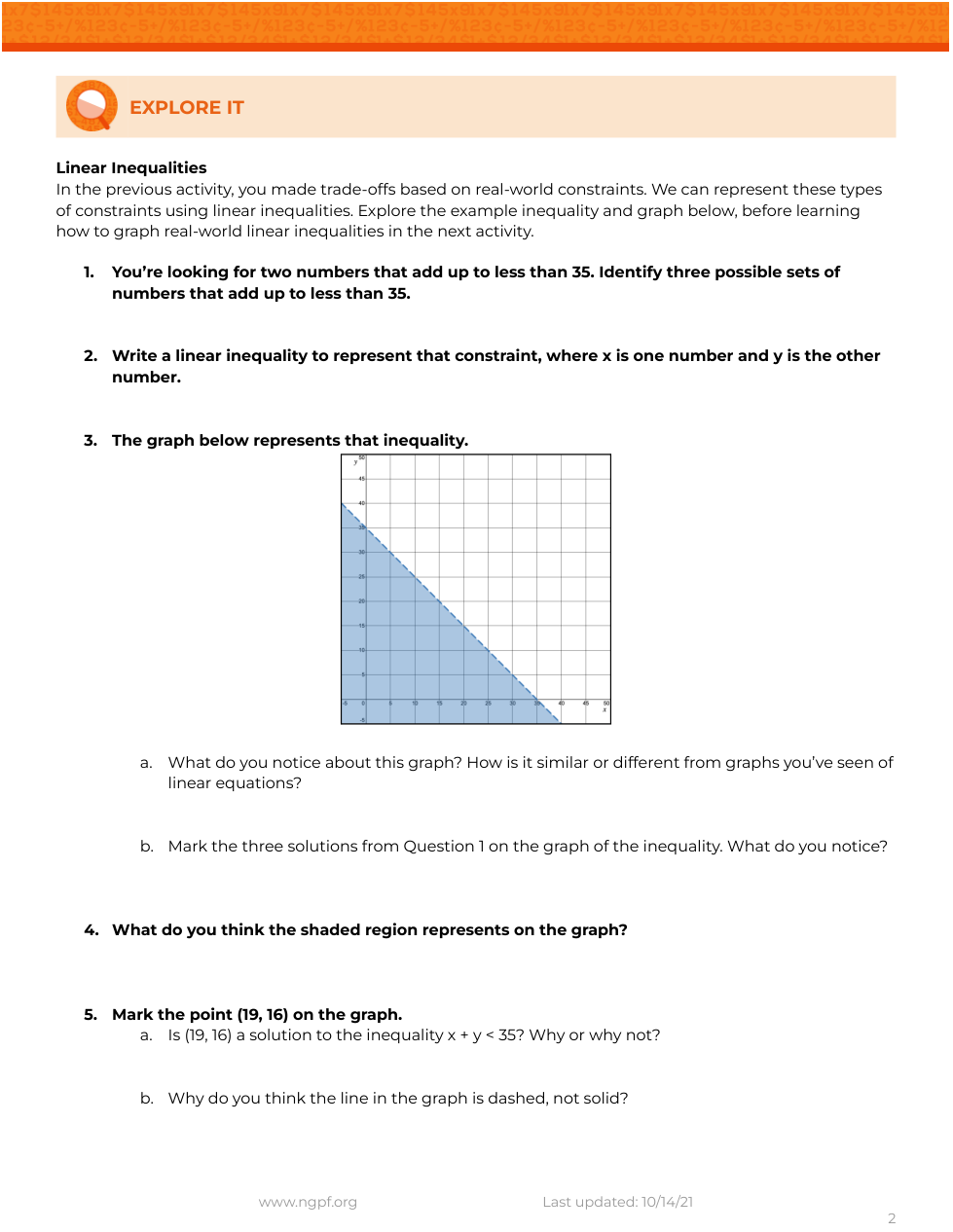
  • less than
  • greater than
  • less than or equal to
  • greater than or equal to
  • at least
  • at a minimum
  • no more than
  • at most
  • fewer than
  • a maximum of
  • up to
  • starting from
  • more than
  • >
  • <
Notes on Section 6
0
Question 31
31.
0
Question 32
32.
0
0
0
0
0
Question 38
38.

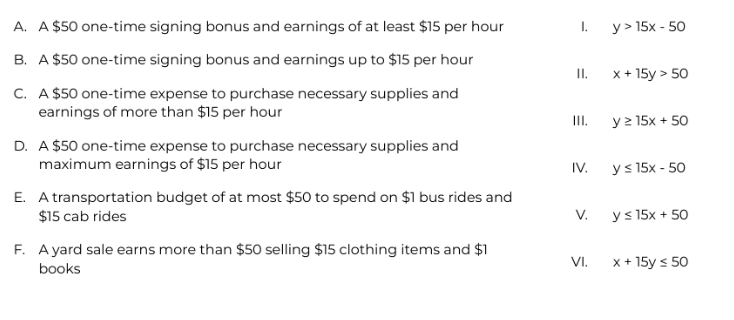
Match the words with the inequality

Draggable itemarrow_right_altCorresponding Item
A
arrow_right_alt
III
B
arrow_right_alt
V
D
arrow_right_alt
I
C
arrow_right_alt
IV
F
arrow_right_alt
VI
E
arrow_right_alt
II
0
Question 39
39.
0
Question 40
40.
0
Question 41
41.
0
Question 42
42.
0
Question 43
43.

OPTIONAL CHALLENGE

0
Question 44
44.
0
Question 45
45.
0
Question 46
46.
0
Question 47
47.
0
Question 48
48.
Click here to access the Apply It graded assignment. If you need it unlocked, ask Mrs. Butler
Question 27
27.
Question 28
28.
Question 29
29.

Hint: Think about changing the symbol, not the numbers!

Question 33
33.
Question 34
34.
Question 35
35.
Question 36
36.
Question 37
37.